Sanctions showdown: US-China legal crossfire throws global business into compliance chaos
The gist
A full-blown US-China legal crossfire is throwing global business into chaos, as dueling sanctions and anti-sanctions laws force companies to walk a costly, high-stakes compliance tightrope.
What to know
- In early 2026, the US ramped up sanctions on Chinese oil giants like Hengli Petrochemical and began naval interdictions to choke off Iran-China oil flows ahead of the Trump-Xi summit.
- China struck back by activating its Blocking Statute and Anti-Foreign Sanctions Law in May 2026, making it illegal for Chinese firms to comply with US sanctions—leaving multinationals trapped between conflicting legal regimes.
- Companies are scrambling to split operations, invest in advanced supply chain tracing, and navigate skyrocketing compliance costs as global supply chains fragment and economic decoupling accelerates.
Sanctions as Strategic Weapons
The US wielded sanctions and naval power in a coordinated campaign to choke off Iran-China oil flows, exposing the global dominance of American financial leverage and setting the stage for tit-for-tat escalation ahead of the Trump-Xi summit.
By early 2026, the US government escalated its sanctions campaign targeting Chinese firms involved in Iranian oil trade, most notably sanctioning Hengli Petrochemical, China's second-largest independent refiner and a major Iranian oil customer. This move, part of the broader Operation Economic Fury, aimed to sever Tehran's critical revenue streams ahead of the Trump-Xi summit, signaling Washington's intent to leverage economic pressure to influence diplomatic dynamics. Despite China's vocal opposition, its deep integration with the US-dominated financial system compelled compliance, underscoring the potent reach of American sanctions in global energy markets.
The US strategy extended beyond primary sanctions to include secondary sanctions and military interdictions designed to choke off Iran-China oil trade comprehensively. For instance, the US Treasury warned Chinese banks of secondary sanctions for facilitating Iran's economy, while the US military intercepted a stateless vessel in the Indian Ocean carrying millions of barrels of Iranian oil destined for China. This multifaceted approach reflects a calculated effort to 'starve China of the source of cheap oil,' exerting economic pressure without triggering direct military conflict.
Complementing economic measures, the Trump administration maintained a naval blockade targeting Iranian oil shipments to China, balancing containment of Iranian influence over the strategic Strait of Hormuz with the avoidance of full-scale military escalation. This naval interdiction, combined with unprecedented Chinese retaliatory measures such as blocking rules against US sanctions, illustrates the high-stakes chess game unfolding in US-China relations amid the Iran standoff, where sanctions and military maneuvers intertwine ahead of critical diplomatic engagements.



China’s Legal Counteroffensive
China’s unprecedented activation of its Blocking Statute and Anti-Foreign Sanctions Law not only rejects US sanctions jurisdiction but also empowers Chinese firms to sue and penalize entities that comply with foreign restrictions, intensifying the legal minefield for multinationals.
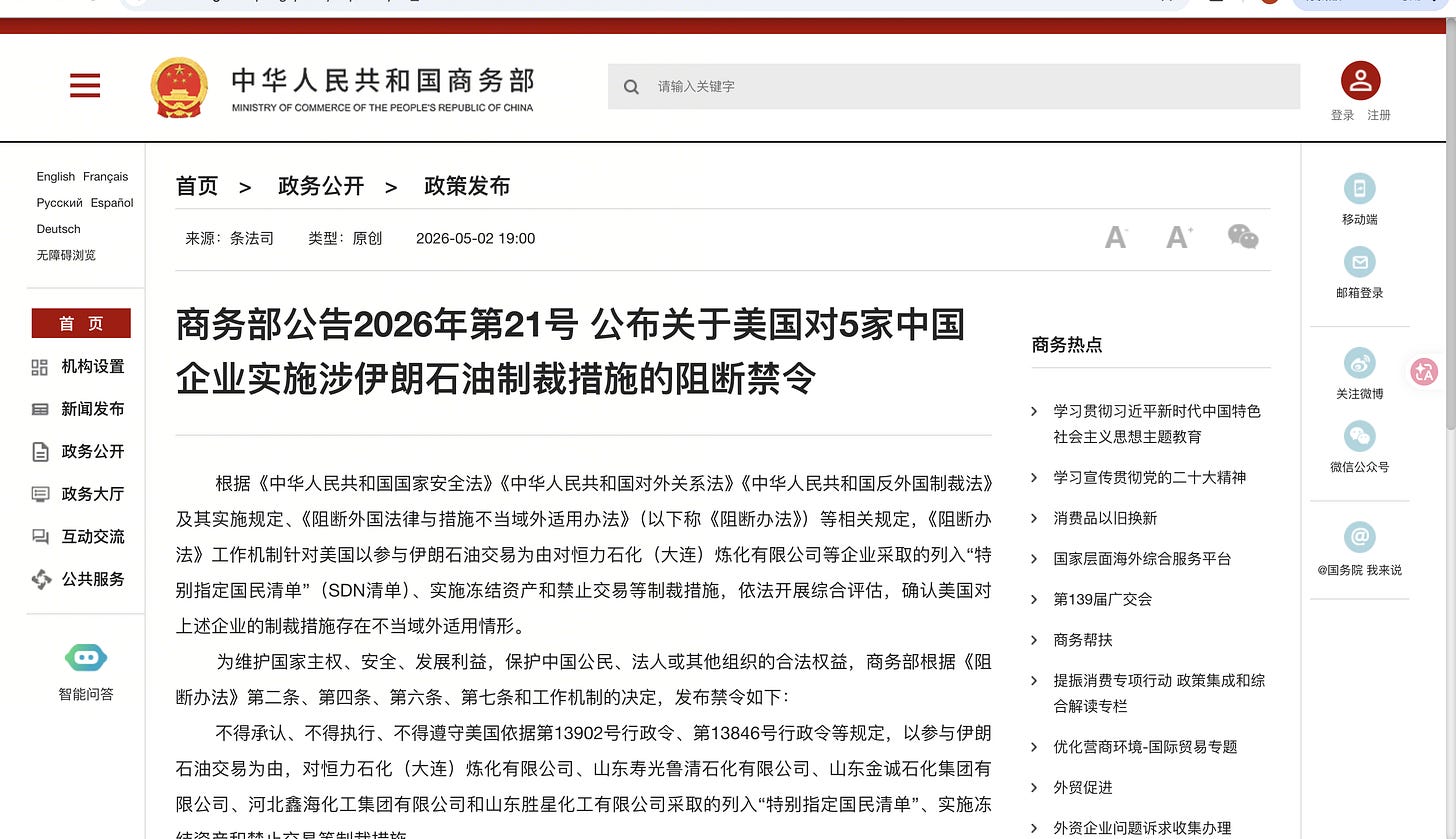
In a landmark move on May 2, 2026, China invoked its Blocking Statute and Anti-Foreign Sanctions Law for the first time to legally prohibit compliance with U.S. Treasury sanctions targeting Hengli Petrochemical and other Chinese 'teapot' refineries involved in Iranian oil transactions. This unprecedented activation of rules, which had been on the books since January 2021 but never enforced, represents a significant escalation in Beijing's legal retaliation strategy, signaling a firm rejection of what it deems unjustified extraterritorial U.S. sanctions that violate Chinese sovereignty. By issuing a prohibition order under MOFCOM, China explicitly declared that these U.S. sanctions shall not be recognized, enforced, or observed within its borders, marking a new frontier in the US-China economic conflict.
The timing of China's blocking order—issued just twelve days before the high-profile Trump-Xi summit in Beijing—was a deliberate legal test designed to challenge U.S. secondary sanctions jurisdiction at China's border. By instructing five Chinese companies not to recognize or comply with U.S. Treasury SDN designations, Beijing forced Washington into a high-stakes decision: either enforce secondary sanctions and risk a live confrontation at the summit or tacitly acknowledge the limits of its extraterritorial reach. This strategic move underscores China's intent to defend its financial institutions' access to the U.S. dollar system, particularly for major private refineries like Hengli with significant dollar exposure, thereby drawing a clear red line against U.S. sanctions pressure.
China’s anti-sanctions framework extends beyond mere blocking rules, encompassing mechanisms such as the Anti-Foreign Sanctions Law, the unreliable entity list, and newly enacted 2026 regulations that broaden Beijing’s capacity to penalize foreign firms deemed to threaten its supply chain security or enforce sanctions with improper extraterritorial jurisdiction. These tools empower Chinese parties to sue entities complying with foreign sanctions and impose fines, visa cancellations, and asset freezes, thereby intensifying legal risks for multinational companies. As James Hsiao of White & Case observes, companies now face a complex legal labyrinth where compliance with U.S. or EU sanctions may simultaneously trigger violations under Chinese countermeasures, amplifying regulatory unpredictability and operational complexity.
The activation of China’s blocking laws has forced multinational banks and companies to rethink their operational structures, often bifurcating their activities to manage conflicting compliance demands. Major banks are increasingly segregating their global arms—handling U.S.-compliant transactions—from local Chinese subsidiaries that must adhere to Beijing’s anti-sanctions directives, a strategy that escalates legal complexity and compliance costs. Meanwhile, Beijing’s nuanced approach, including contradictory signals such as reportedly pausing lending to Hengli Petrochemical while simultaneously enforcing blocking sanctions, reflects a delicate balancing act between signaling resistance to U.S. sanctions and managing domestic economic risks.



Compliance Caught in Crossfire
Multinational firms are forced to split operations and absorb soaring compliance costs as dueling US and Chinese laws create a no-win scenario, with even luxury brands and supply chains facing legal exposure, asset freezes, and operational paralysis.
Multinational companies are ensnared in an unprecedented dual-compliance quagmire as China’s Anti-Foreign Sanctions Law (AFSL) directly conflicts with U.S. sanctions regimes, forcing entities to navigate mutually exclusive legal obligations. For instance, Chinese firms and banks are barred from adhering to U.S. sanctions against Chinese entities, while U.S. secondary sanctions threaten to sever access to the American financial system for any party engaging with these Chinese firms, creating a no-win scenario. This legal tug-of-war compels major international banks to bifurcate their operations, segregating U.S.-compliant transactions within global arms and relegating non-compliant activities to local Chinese subsidiaries, as seen in the case of Hung Li Petrochemical, a mega refinery with significant U.S. dollar exposure caught at the epicenter of this sanctions standoff. Such operational compartmentalization, however, escalates compliance costs and complicates supply chain management, especially for companies with integrated cross-border operations.
The expanding Chinese anti-sanctions framework, particularly under Decree 835, has introduced multifaceted compliance risks for multinational corporations, exemplified by luxury watch brands like Cartier. These firms face a precarious balancing act: refusing service to clients on U.S. sanctions lists risks Chinese legal actions under Article 14 and inclusion on the Malicious Entity List, while compliance with U.S. sanctions exposes them to OFAC penalties. The rapid escalation of Chinese counter-sanctions—from just 3 Unreliable Entity List designations in 2024 to over 67 in 2025—signals a shift from symbolic retaliation to operational enforcement, with mechanisms including piercing liability across corporate groups and potential criminal charges, significantly amplifying legal exposure and operational uncertainty. Notably, despite these high stakes, major luxury groups have conspicuously remained silent on these challenges in their 2026 earnings calls, suggesting either strategic reticence or a lack of industry-wide acknowledgment.
Supply chain transparency and compliance have become critical yet increasingly fraught undertakings amid overlapping U.S. and Chinese regulations. Laws like the U.S. Uyghur Forced Labor Prevention Act demand exhaustive multi-tier supplier documentation to certify goods are free from forced labor, while Chinese Regulations 834 and 835 restrict tracing product origins within China, creating a direct legal conflict. Failure to reconcile these demands risks severe operational disruptions such as shipment detentions or destruction under U.S. Customs supervision. Consequently, companies are reevaluating their sourcing strategies, with many considering supplier diversification, regionalization, nearshoring, or domestic manufacturing to reduce compliance exposure and bolster resilience against geopolitical uncertainties.
The banking, logistics, and financial sectors are particularly vulnerable to the cascading effects of dual sanctions, as they grapple with opaque client networks and complex shipping arrangements that obscure full compliance. Financial institutions face daunting challenges in tracing multi-layered exposures to sanctioned entities, increasing the risk of secondary sanctions enforcement, while logistics and insurance providers remain exposed to liabilities from the final legs of sanctioned oil shipments, where gaps in transparency persist. The Bosch case, involving a $36 million fine for unauthorized exports to Huawei, underscores the high stakes and operational costs of compliance failures, even when self-disclosed. To mitigate these risks, companies are adopting sophisticated strategies such as ring-fencing corporate entities, transitioning to multi-currency clearing systems to reduce reliance on the U.S. dollar, and implementing asymmetric force majeure clauses to navigate the unpredictable enforcement landscape.

Decoupling Reshapes Global Flows
Rising capital restrictions, selective investment barriers, and regulatory gridlock in regions like Africa are fragmenting supply chains and capital markets, making seamless global business a relic of the past.
By early 2026, the escalating complexity and cost of coordinating global operations amid sanctions, tariffs, and geopolitical tensions have accelerated the US-China economic decoupling, fundamentally reshaping global supply chains. This structural shift, driven by factors such as reshoring, energy security, and AI infrastructure investments, has made execution itself a premium asset, forcing industries like energy, luxury goods, and technology to rethink capital allocation and business models. As one analysis noted, companies built on assumptions of cheap coordination are now the highest-risk, underscoring how the new economic landscape demands costly, sophisticated compliance and operational strategies.
The mutual tightening of capital flow restrictions between the US and China further entrenches economic decoupling, with China imposing outbound investment controls and redirecting mainland capital toward domestic and Hong Kong tech IPOs, including approximately 50 robotics companies in the pipeline. Meanwhile, the US, though not legislating outright bans, has weaponized mechanisms like CFIUS to obstruct Chinese foreign direct investment, particularly in tech mergers and acquisitions. This selective financial barrier reflects a strategic bifurcation of capital markets that deepens the divide between the two economic giants.
In Africa, the overlapping US and Chinese sanction regimes create a 'dual-compliance trap' that significantly raises transactional friction and compliance costs for businesses across mining, banking, telecoms, technology, energy, and infrastructure sectors. African firms face a paradox where complying with US secondary sanctions risks violating China’s Anti-Foreign Sanctions Law, which forbids adherence to foreign restrictive measures against Chinese entities. This regulatory gridlock disrupts capital flows and supply chains, as African banks preemptively sever ties with Chinese firms on US blacklists to maintain correspondent banking relationships, exacerbating liquidity chokepoints and currency conversion penalties.
The dominance of the US dollar and the SWIFT network in African trade intensifies these challenges, compelling local financial institutions to adopt stringent de-risking protocols that can freeze accounts and delay payments for Chinese-backed projects. To navigate this fraught environment, corporations are increasingly implementing a three-tiered mitigation strategy involving ring-fencing entities, shifting to multi-currency clearing systems, and embedding asymmetric force majeure clauses. This adaptive approach aims to manage the cost function of regulatory dualism and operational friction, highlighting the nuanced and evolving tactics required to operate amid the dual US-China sanction landscape.

Supply Chains Become C-Suite Strategy
Supply chain management has become a top executive priority as firms invest in advanced mapping and regional diversification to survive the dual regulatory squeeze and escalating geopolitical risk.
By mid-2026, corporations have elevated supply chain management from a traditional cost center to a strategic priority at the C-suite level, recognizing it as a critical lever for revenue generation and innovation. This shift is driven by the complex interplay of U.S. and Chinese regulations—such as the U.S. Uyghur Forced Labor Prevention Act and China’s Regulations 834 and 835—that place companies in a legal and operational bind, forcing them to rethink sourcing strategies. To navigate these conflicting demands, firms are increasingly diversifying their supply bases through regional sourcing, nearshoring, and domestic manufacturing, thereby enhancing long-term resilience and reducing compliance exposure amid escalating geopolitical tensions.
The heightened regulatory scrutiny has made comprehensive supply chain mapping and documentation indispensable, as failure to provide transparent evidence of supplier origins can result in severe operational disruptions, including shipment detentions or destruction under U.S. Customs enforcement. To address these challenges, companies are investing in advanced software and services capable of multi-tier supplier network identification, enabling them to trace vulnerabilities deep within complex global supply chains. This technological adoption is critical in a volatile, uncertain, complex, and ambiguous (VUCA) environment where interconnected disruptions ripple across industries, demanding sophisticated and proactive risk mitigation strategies.