Sanders’ AI wealth grab shakes up washington—and the billion-dollar bot boom
The gist
Bernie Sanders’ radical plan to seize half the equity of AI giants like OpenAI and Anthropic for public ownership is shaking up Washington and igniting a fierce national debate about who gets rich from the AI revolution.
What to know
- Sanders’ American AI Sovereign Wealth Fund Act would hit major AI firms with a one-time 50% equity tax, granting the government voting rights, board seats, and citizen dividends.
- The proposal is drawing rare bipartisan heat—including surprising support from Donald Trump—and is nudging lawmakers toward more moderate 5-10% government stakes tied to U.S. operations.
- AI companies face a public and political backlash, with two-thirds of Americans opposing new data centers and mounting pressure to slow AI development amid safety and valuation fears.
AI Wealth for the People?
Sanders’ radical equity tax aims to turn AI’s trillion-dollar windfall into citizen dividends and public control, challenging tech giants’ monopoly on future profits.
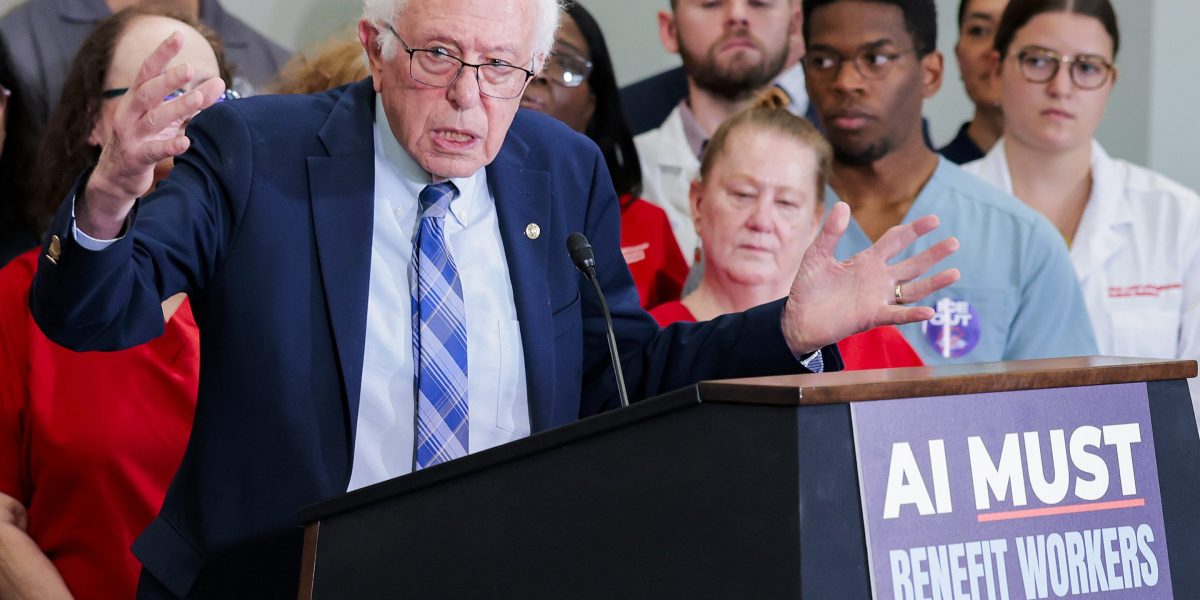
Senator Bernie Sanders' American AI Sovereign Wealth Fund Act proposes a groundbreaking one-time 50% equity tax on major AI companies like OpenAI, Anthropic, and xAI, aiming to create a public ownership stake that grants the government voting rights, board representation, and dividends to American citizens. Sanders frames AI as a collective human achievement whose immense wealth should benefit the public rather than a handful of tech oligarchs such as Elon Musk and Sam Altman, drawing parallels to the Alaska Permanent Fund as a model for redistributing resource-generated wealth. This proposal not only seeks to shift control of AI technology from private hands to the public but also envisions direct payments to Americans and funding for social programs, marking a significant political intervention to democratize AI's economic gains.
The American AI Sovereign Wealth Fund Act has sparked notable bipartisan interest, with figures across the political spectrum engaging in the debate over AI wealth redistribution and governance. Surprisingly, former President Donald Trump has expressed support for government equity stakes in AI firms, describing the idea of making the public a partner in the AI revolution as 'a beautiful thing,' signaling a convergence of populist concerns about AI's societal impact. Additionally, Senator Elizabeth Warren complements Sanders’ approach with her own AI taxation framework, advocating for higher corporate and capital-gains taxes, excise taxes on AI data centers, and a wealth tax on AI billionaires to ensure AI’s productivity gains benefit all Americans rather than concentrate wealth among a few investors.
While Sanders’ 50% equity tax is considered politically extreme and a 'nonstarter' by many experts, the proposal has effectively shifted the Overton window, making smaller government stakes or equity conditions—such as 5 to 10% shares tied to operating on U.S. soil using American data and energy—more plausible in future legislative negotiations. This evolving discourse reflects bipartisan momentum toward softer forms of AI nationalization, including prerelease federal reviews, national-security contracting, and equity-based partnerships, all aimed at balancing corporate power with public interest and addressing concerns about AI’s rapid development and wealth concentration in a few tech giants valued in the trillions.

Backlash Hits Big AI
Public resistance and political crackdowns on data centers, safety, and valuations are forcing AI firms to rethink their business models as skepticism surges and outages mount.
AI companies are grappling with a mounting backlash that threatens both their public image and operational capacity. A mid-2026 Gallup poll revealed that over two-thirds of adults oppose new AI data centers, with many preferring a nuclear plant nearby instead, while younger demographics show rising anger toward AI, with Gen Z's excitement dropping from 36% to 22%. This public resistance, coupled with political actions like Pennsylvania's repeal of AI data center tax breaks and Illinois' SB315 mandating costly independent safety audits, is forcing firms like Anthropic to reconsider business models and pricing strategies amid constrained compute resources and service outages.
Market dynamics are increasingly fraught as AI firms face skepticism over inflated valuations and the sustainability of their growth trajectories. Ray Dalio warned that Alphabet's $85 billion debt and equity offering exemplifies an investment bubble fueled by the difficulty in valuing AI technologies and the pressure to outspend competitors. He cautioned that wealth generated on paper may not convert into liquid assets, especially if wealth taxes compel owners to sell shares, potentially triggering market corrections. This economic reality constrains companies like Anthropic and OpenAI, which must demonstrate profitability and dominance in trillion-dollar markets to justify their sky-high valuations during IPOs.
Industry leaders are navigating a delicate balance between acknowledging AI risks and maintaining momentum amid regulatory and public scrutiny. OpenAI CEO Sam Altman has publicly revised earlier dire predictions about job losses, signaling a strategic shift to temper fears and negative sentiment. Meanwhile, companies emphasize internal security improvements, as Palo Alto Networks’ Nikesh highlights the use of advanced tools like Mythos to uncover previously unseen vulnerabilities. However, calls for regulatory pauses, such as Anthropic’s plea to slow frontier AI development, are met with skepticism given their impending IPO and competitive stakes, underscoring tensions between responsible innovation and market pressures.
Senator Sanders’ proposal for a 50% equity tax on AI companies has ignited sharp industry criticism and complicated market timing, especially as firms approach critical IPO milestones. The plan’s broad scope, potentially encompassing giants like Nvidia, raises profound questions about valuation and shareholder impacts. Critics, including the ex-Trump AI czar who derided the measure as a “stupidity tax,” highlight reputational and investment risks, while insiders view the timing as 'bizarre' and challenging to reconcile with firms’ capital-raising efforts. This controversy adds another layer of uncertainty to an already volatile AI investment landscape.




Can AI Dividends Deliver?
Turning massive government stakes in AI into real cash for Americans faces daunting hurdles—from illiquid equity and political risk to the challenge of governing tech built on global collaboration.
Senator Bernie Sanders' proposal for a 50% equity tax on major AI companies to fund the American AI Sovereign Wealth Fund introduces significant governance and economic challenges, particularly regarding the feasibility of dividends and public benefit distribution. Given that many tech firms, including AI labs like OpenAI and Anthropic, often delay returning cash to shareholders for decades, questions arise about when and how the government could realistically generate dividends to redistribute wealth to citizens. Analysts like Emad have calculated that even dividing half of OpenAI’s equity among all Americans would yield a modest $2,000 per person, underscoring the difficulty of translating large equity stakes into meaningful public wealth without destabilizing markets by flooding them with stock sales. This liquidity challenge is compounded by skepticism about political will to sell government-held shares, as administrations may avoid such moves to prevent budget shortfalls or political backlash, complicating the fund’s operational viability.
The governance implications of government equity stakes in AI firms are complex and multifaceted, involving voting rights, board representation, and the balancing act between regulation and ownership. Sanders’ plan envisions the government holding voting shares and board seats, potentially enabling regulatory control to enforce coordinated slowdowns in AI development to mitigate existential risks—a capability difficult to achieve through traditional regulation alone. However, this dual role as both regulator and shareholder creates ambiguity and tension, as critics question whether AI should be treated as an existential threat to be banned or a public good to be redistributed. Furthermore, legal and regulatory complexities surrounding intellectual property and AI training data, currently under judicial scrutiny, add layers of uncertainty to how government stakes might be justified or structured.
Economic and political economy challenges loom large over the implementation of a sovereign wealth fund with government ownership in AI companies, as the proposal risks distorting investment incentives and creating power imbalances. Investors may fear dilution and reduced returns if the government acquires large equity stakes, potentially discouraging investment in AI startups like Anthropic or Intel. Moreover, reliance on government-controlled income for redistribution raises concerns about political instability and dependency, with critics warning that citizens dependent on government payouts could face dangerous power-sharing dynamics tied to electoral cycles. These issues are further complicated by the global and collective nature of AI development, which challenges the legitimacy of a single nation claiming ownership over technology built on shared intellectual foundations.
While outright nationalization of AI firms is widely regarded as impractical due to their high valuations and the risk of stifling innovation, a softer form of public ownership through partial equity stakes is gaining traction as a theoretical and political possibility. Experts like Samuel Hammond argue that full government takeovers are unlikely, but smaller stakes—perhaps 5 to 10 percent—structured as conditions for operating on U.S. soil or using American data could become politically feasible, shifting the Overton window. This approach draws inspiration from models like Alaska’s oil profit-sharing program, which distributes dividends to residents, though scaling such legacy frameworks to the fast-evolving AI sector presents unique regulatory and implementation challenges. Additionally, the government’s strategy to avoid overdependence on any single AI provider by holding diversified stakes adds complexity to managing influence and ensuring balanced governance across multiple firms.




Rethinking Wealth in the AI Age
Universal basic income, decentralized ownership, and socialized AI dividends are reshaping debates on capitalism, as policymakers seek to democratize the spoils and risks of automation.
As AI firms approach dominating shares of the global economy, there is mounting pressure for mechanisms like universal basic income (UBI), universal basic services (UBS), or universal basic capital to redistribute AI-generated wealth broadly. This redistribution is framed not as socialism but as a libertarian restructuring that could dismantle inefficient government services by empowering individuals through market forces, reflecting a shift toward economic democracy where public ownership or dividend models socialize both the risks and rewards of AI advancements. The OpenAI Foundation’s nonprofit equity stakes exemplify this trend, with predictions that such entities will be called upon to underwrite social dividends, echoing Alaska’s oil dividend model as a precedent for sharing resource wealth with the public.
The unprecedented scale of wealth creation enabled by AI challenges traditional capitalist frameworks, particularly the conflation of market coordination with returns on capital, raising concerns about monopolistic rent-seeking and wealth accumulation disconnected from real production. AI’s exploitation of financial systems, such as high-frequency trading, underscores the risk of concentrated economic power, prompting calls to transition from a renter’s economy to an owner’s economy in software and AI. Universal basic capital, which grants individuals property rights and shareholder status rather than mere cash transfers, offers a promising model for economic democracy, though it faces challenges like market volatility and political sustainability of capital taxation.
The governance of AI-driven wealth redistribution must navigate the tension between centralized government control and the scalability of decentralized structures, as abundance in the AI economy requires decentralized compute access akin to foundational resources like land. Proposed models resemble a form of 'privatized socialism' or modern Fordism, where universal basic compute and equity enable mass participation in production and consumption. However, political economy considerations demand separating revenue sources, taxation methods, and distribution mechanisms—such as using broad-based consumption taxes to fund government equity purchases that are then distributed to citizens—mirroring privatized Social Security frameworks to ensure sustainability and broad-based benefit.
Looking beyond pure economic metrics, the AI-driven future may bifurcate into a machine economy automating production and innovation and a human economy centered on relational sectors where human presence adds unique value, preserving scarcity in human-involved services like the arts or hospitality. This duality complicates wealth distribution and taxation policies, as integrating human labor and preferences into an AI-dominated landscape requires nuanced approaches to socializing AI’s risks and rewards. Thought leaders like Alex Imas emphasize that while AI can replicate many functions, the intrinsic scarcity of human involvement will shape economic transitions and policy design in the post-AGI era.