Silicon carbide surge: wolfspeed and infineon race to power the $3 billion AI data center boom
The gist
Silicon carbide titans Wolfspeed and Infineon are waging an all-out race to power the $3 billion AI data center boom, slashing costs and turbocharging efficiency with next-gen chip tech.
What to know
- Wolfspeed’s Gen 4 TOLT silicon carbide chips and 300mm wafers, debuting in 2026, promise record-setting power density, cooling, and U.S. supply chain security for hyperscale AI data centers.
- Switching to 800VDC power architectures—enabled by advanced SiC semiconductors—is saving up to $8 million per 10 MW build and reducing copper use by 80% across new AI data centers.
- Industry giants like Infineon (targeting €2.5B AI revenue by 2027) and Wolfspeed are ramping up capacity and pivoting operations to dominate the $3.1 billion AI power semiconductor market.
Wolfspeed’s Cooling Edge
Wolfspeed’s Gen 4 TOLT chips and U.S.-made 300mm wafers are redefining AI data center reliability and security, setting the stage for a new era of domestically anchored, high-density power solutions.
Wolfspeed’s Gen 4 TOLT silicon carbide chips, launched in early 2026, mark a significant leap in addressing the soaring power and cooling demands of next-generation AI and hyperscale data centers. By leveraging advanced Gen 4 silicon carbide MOSFET technology and pioneering top-side cooling, the TOLT package enables higher power density and improved thermal performance, paving the way for smaller, more reliable power systems. This innovation is not a one-off: the Gen 4 TOLT portfolio is the second in a planned trilogy of top-side cooled product families, with Wolfspeed signaling further breakthroughs to come later in 2026, underscoring their commitment to staying ahead of AI’s relentless appetite for efficient, scalable power solutions.
Beyond technical prowess, Wolfspeed’s U.S.-based silicon carbide wafer production delivers a strategic edge, bolstering supply chain resilience at a time when AI data center expansion is both rapid and geopolitically sensitive. By anchoring wafer manufacturing domestically, Wolfspeed not only supports the explosive growth of AI infrastructure but also aligns with national priorities for technological self-sufficiency and leadership, making their 300mm wafer advances as much a matter of economic security as engineering excellence.

800VDC: Powering AI’s Future
The shift to 800VDC and silicon carbide semiconductors is slashing copper use, cutting millions in costs, and fueling a $3.1 billion annual market as legacy AC systems buckle under the demands of hyperscale AI.
The rapid adoption of 800VDC power architectures is fundamentally reshaping the energy landscape of AI data centers, enabling both dramatic efficiency gains and cost reductions. Enteligent’s 2026 white paper highlights how these high-voltage DC systems can slash copper usage by up to 80% and deliver $4–8 million in capital expenditure savings per 10 MW build, while also cutting annual operational energy costs by 8–12%. This shift is only possible thanks to the increasing deployment of advanced silicon carbide (SiC) and related power semiconductors, with companies like Onsemi reporting that power semi content per next-gen 1 MW AI rack has doubled to $100,000—underscoring the critical role these materials play in powering the next generation of energy-efficient, high-density AI infrastructure.
As AI rack power densities soar past 100 kW, legacy AC systems are buckling under the pressure, prompting a decisive industry pivot toward DC-native architectures and high-voltage power delivery. Industry groups such as the Open Compute Project are driving this transition, which not only improves thermal performance and scalability but also opens the door for innovative power semiconductor solutions. The market opportunity is immense: with an estimated 30GW of new AI compute added annually, the total addressable market for power semiconductors in AI data centers is projected to hit $3.1 billion per year, fueled by the relentless expansion of hyperscale AI infrastructure.
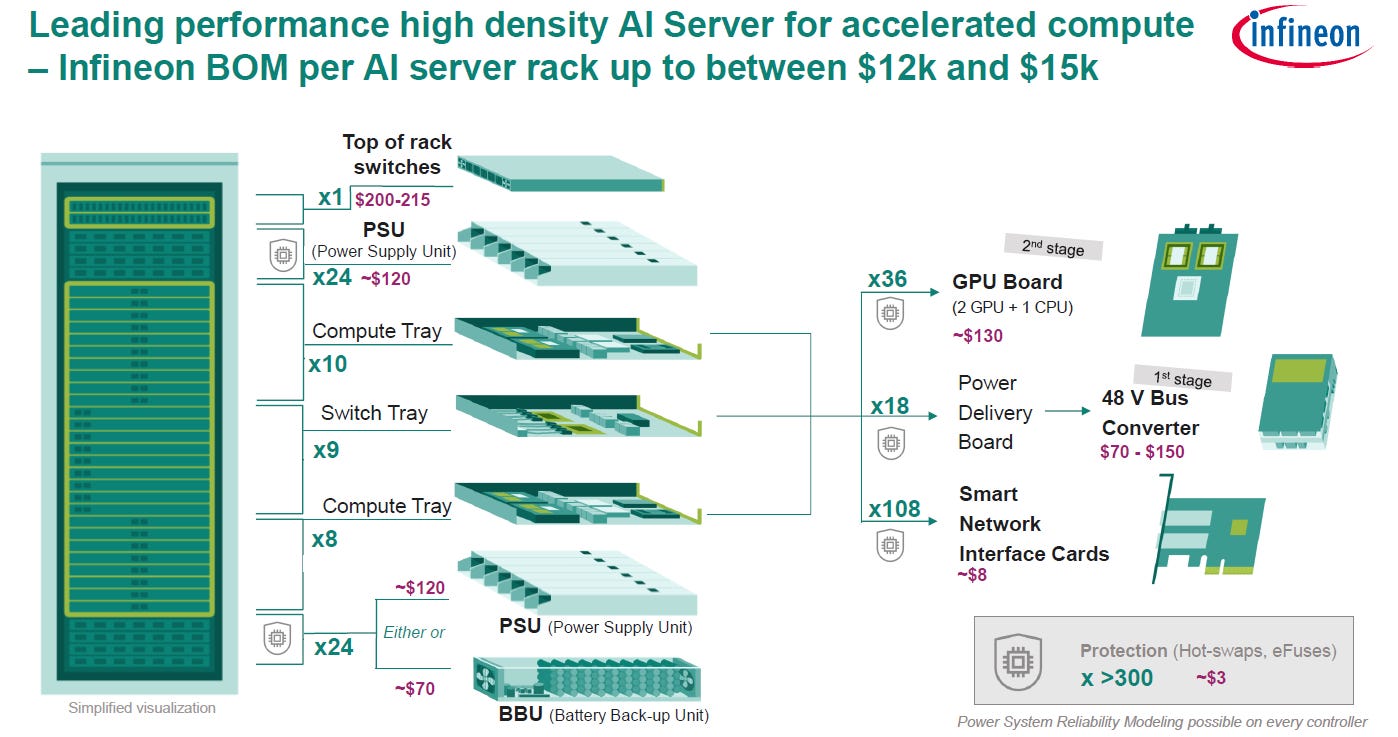
Industry leaders like Infineon are seizing the moment, positioning themselves at the forefront of the AI data center power revolution. Infineon’s CEO recently reaffirmed ambitious targets—€1.5 billion in AI-related revenues this fiscal year, with plans to reach €2.5 billion by 2027—while describing the surge in demand for vertical power delivery modules as 'the biggest opportunity I’ve seen for the company in the last 30 years.' To meet this demand, Infineon is fast-tracking the opening of its new Dresden fab, converting IGBT lines to AI MOSFET production, and investing €500 million to expand capacity, all in a bid to maintain market leadership as the technical and commercial stakes in AI power semiconductors reach unprecedented heights.

Wolfspeed’s AI-Driven Reinvention
Through bold restructuring, AI-powered manufacturing, and a strategic pivot under new leadership, Wolfspeed is transforming its operations to dominate the surging demand for advanced power semiconductors in AI data centers.
Wolfspeed’s transformation into an AI-driven manufacturing powerhouse has unfolded through a series of bold operational and strategic moves, beginning with a court-approved restructuring and equity partnership with Renesas Electronics America. This collaboration, formalized in early 2026 with CFIUS clearance and a Renesas board seat, provided Wolfspeed with the capital and governance support needed to double down on its silicon carbide leadership and diversify its customer base. By integrating advanced AI platforms like Snowflake and Cortex AI, Wolfspeed has reimagined its manufacturing processes—deploying generative AI agents such as WolfGPT to predict issues, enhance chip quality, and accelerate workforce training—creating a predictive, data-driven ecosystem that sets a new standard for efficiency and scalability in semiconductor production.
Under the leadership of new CEO Robert Feurle, Wolfspeed has embarked on a sweeping operational overhaul aimed at financial discipline and technological advancement, with a sharp focus on capturing the surging AI data center market. The company’s $6 billion, state-of-the-art SiC fab is now operational—though underutilized—prompting a strategic pivot to win high-growth deals in AI data centers, evidenced by a 50% quarter-over-quarter revenue jump and a major design win with Toyota. This transformation also includes a decisive shift from legacy 150-millimeter device production to more efficient 200-millimeter manufacturing, and a reorganization around four key verticals—automotive, industrial and energy, aerospace and defense, and materials—positioning Wolfspeed to capitalize on the higher voltage demands of next-gen AI and grid modernization applications.