Skeptics push back on SpaceX orbital data centers
The gist
SpaceX’s $2 trillion orbital data center gamble is facing fierce skepticism from industry heavyweights and investors, who question whether the vision can outrun technical and economic gravity.
What to know
- Industry leaders like SoftBank’s Masayoshi Son and Google’s orbital compute team peg just a 14% chance of a 1-megawatt space data center launching before 2029, citing major engineering and cost hurdles.
- SpaceX’s AI1 satellite and Starlink tech show progress on cooling and deployment, but radiation shielding, orbital debris, and radiator fins the size of small cities inflate costs to triple those of Earth-bound centers.
- Despite potential $72 billion annual revenue, the project’s massive $120 billion price tag, 5-year satellite throwaway cycles, and a sky-high 107x price-to-sales ratio have even bullish backers blinking at the risks.
Skeptics Challenge Musk’s Vision
Industry leaders and analysts question the near-term feasibility of SpaceX’s orbital data centers, arguing that massive technical and financial hurdles make Musk’s $2T bet more speculative faith than grounded reality.
A pronounced skepticism permeates expert and industry circles regarding SpaceX's ambitious vision for orbital data centers, with prominent figures like SoftBank's Masayoshi Son openly challenging Elon Musk's timeline and feasibility claims. While Musk asserts that 'the future of AI will be built in space,' many experts—including those from Google’s orbital compute team and competing startups—stress that significant breakthroughs in reducing rocket launch costs and mass-producing high-powered satellites are essential prerequisites, casting doubt on near-term realizations. This skepticism is echoed in market sentiment, where Kalshi traders assign only a 14% probability to a 1-megawatt orbital data center launching before 2029, highlighting a broad consensus that such infrastructure remains years, if not decades, away from commercial viability.
The debate between proponents of terrestrial versus space-based AI infrastructure underscores a fundamental tension between visionary potential and practical constraints. While Musk and supporters tout orbital data centers as a transformative new form factor capable of circumventing terrestrial regulatory hurdles like NIMBYism, critics emphasize the daunting engineering challenges—such as thermal management requiring radiator fins spanning tens of square kilometers at costs upwards of $250 billion and radiation shielding weighing millions of pounds—that inflate costs to roughly three times those of Earth-based facilities. These technical hurdles, coupled with SpaceX’s own IPO disclosures acknowledging reliance on 'technologies that do not exist,' fuel industry doubts about the economic and operational feasibility of orbital compute in the foreseeable future.
SpaceX’s staggering $2 trillion valuation largely hinges on the promise of orbital data centers, yet this figure starkly contrasts with traditional tech giants’ price-to-sales ratios, raising eyebrows among investors and analysts. With SpaceX trading at 107 times its 2025 revenue—far exceeding Amazon’s 4x or Apple’s 9x—critics like Charlie Munger acknowledge the company’s extraordinary engineering prowess but caution against its unconventional corporate structure and speculative valuation. Many industry voices argue that current investments in SpaceX are driven more by faith in Elon Musk’s ability to 'do the impossible' than by sound value investing principles, reflecting a broader debate about balancing visionary ambition with financial prudence.
Historical patterns in Elon Musk’s ambitious projects, such as the Hyperloop and Boring Company tunnels, which have struggled to reach fruition, further temper enthusiasm for the orbital data center timeline. Experts note that while Musk excels at selling accelerated futures, operational realities—like Starship’s still-unproven full reusability—cast doubt on his claim to begin flying orbital data centers as early as next year. Nonetheless, the influx of capital and a clear client base in space infrastructure differentiate this endeavor from past ventures, suggesting that while the timeline is aggressive, the scale and funding environment may eventually enable breakthroughs, keeping the debate between terrestrial and orbital AI infrastructure investment very much alive.



SpaceX Tackles Space Engineering
Radiation, heat dissipation, and orbital debris remain daunting obstacles, but SpaceX’s Starlink and AI1 satellites demonstrate real—if incremental—progress toward making large-scale orbital compute technically viable.
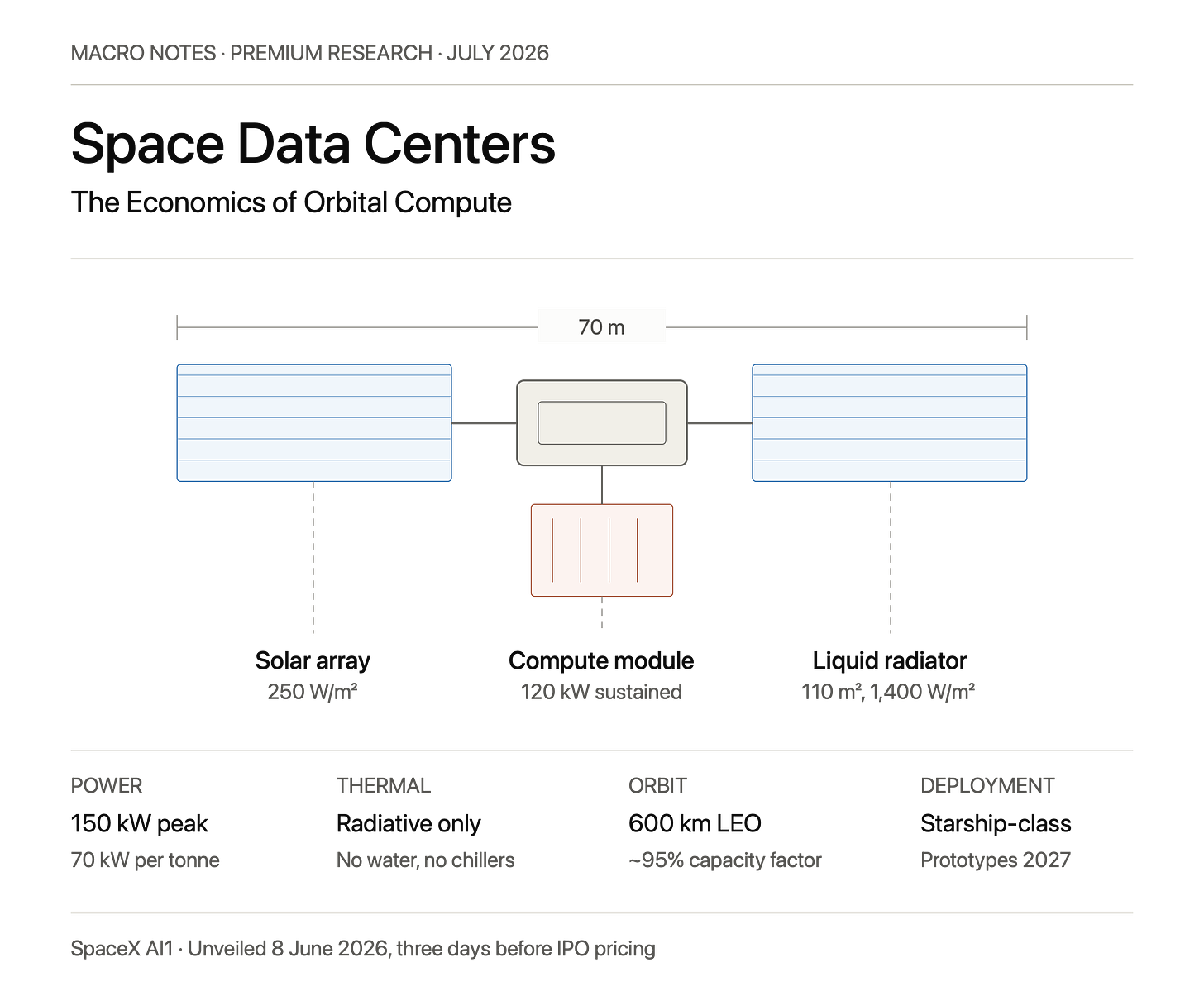
Operating high-performance AI data centers in orbit confronts formidable technical challenges, chiefly radiation exposure from the Van Allen belt and efficient heat dissipation in the vacuum of space. AI satellites flying at optimal altitudes around 1200 kilometers to minimize communication blackouts must contend with intensified radiation, which can cause bit flips and hardware degradation; however, studies like Google's Project Suncatcher demonstrate that standard chips endure nearly three times the expected five-year radiation dose before permanent damage, especially for inference workloads that tolerate errors better. Concurrently, thermal management innovations such as SpaceX's AI1 satellite featuring a 110-square-meter deployable liquid-cooled radiator and leveraging radiative cooling—where radiator mass constitutes about 19% of total satellite mass—highlight engineering strides in overcoming heat dissipation challenges in orbit.
The congested low Earth orbit environment, crowded by Starlink satellites operating between 400 and 460 kilometers and emerging AI compute satellites at higher altitudes, raises critical concerns about orbital debris and collision risks, demanding sophisticated anti-collision technologies and a new space supply chain to manage diverse orbits and unknown objects. Experts emphasize that protecting these trillion-dollar orbital investments requires not only advanced debris tracking but also operational experience gained from early deployments, which will be pivotal in refining orbital data center designs beyond initial AI-generated renderings that underestimate spacing and engineering complexities.
SpaceX’s existing Starlink constellation serves as a practical technological foundation for orbital data centers, demonstrating that onboard compute, laser-linked data transmission, and power/cooling systems can operate reliably and profitably at scale with over 10,000 satellites in orbit. Elon Musk has noted that much of the AI1 satellite technology builds upon Starlink V3 designs, indicating that the engineering challenges—while significant—are extensions of proven systems rather than entirely new problems. This continuity, combined with innovations like vertical integration of satellite manufacturing and handset compatibility for direct-to-phone connectivity, underpins the feasibility of space-based AI infrastructure despite the complex scaling required.
Addressing the mass and energy constraints of orbital data centers, SpaceX is pioneering the use of large solar arrays—up to 600 square meters generating 150 kW peak power on the AI1 satellite—and exploring emerging materials like perovskite solar cells to reduce panel weight from the current 1-2 metric tons. Proximity to the sun offers continuous solar energy and natural cryogenic heat dissipation, potentially overcoming terrestrial data center limitations in power and cooling. However, the primary economic and technical bottleneck remains launch costs, which hinge on achieving fully and rapidly reusable vehicles like Starship; success here could unlock a market opportunity estimated at $100 trillion, making the ambitious target of deploying 1 gigawatt of space-based AI compute power by 2027 a transformative milestone.





Orbital Compute’s Cost Curve Shifts
Falling launch and hardware costs are narrowing the gap with terrestrial data centers, but sky-high capital requirements and the throwaway satellite model threaten to delay profitability even as space-based AI infrastructure becomes more competitive.
The economic landscape for orbital data centers is marked by a complex interplay of high upfront capital expenditures and evolving cost structures, with recent breakthroughs by Google and NVIDIA significantly reducing the previously assumed 5–10x radiation protection premium. This shift has accelerated projections for cost parity with terrestrial GPU-hours, moving some techno-economic models to predict parity as early as 2028, while Elon Musk asserts it may be achievable today. Moreover, the unique advantage of space-based power availability circumvents terrestrial grid bottlenecks—such as the 2,300 GW backlog in U.S. interconnection queues causing multi-year delays and billions in acquisition costs—highlighting space as an expensive yet immediately accessible resource compared to terrestrial constraints.
Despite headline revenue potential exceeding $2.1 billion monthly from AI compute contracts, SpaceX's orbital data center venture faces significant cash flow challenges due to massive capital outlays estimated at $120 billion for 2 GW of additional compute capacity. While rental revenues could reach $72 billion annually under optimistic GPU utilization and pricing scenarios, the inability to service or upgrade satellites—resulting in a throwaway model every five years—exacerbates return on capital risks, contrasting sharply with terrestrial data centers where hardware refreshes are routine. This dynamic creates a prolonged negative cash flow period, raising concerns among active investors about the timing of profitability despite long-term growth prospects.
Launch costs remain the primary driver of orbital compute economics, with SpaceX's Starship targeting a transformative $100 per kilogram to Low Earth Orbit, potentially reducing orbital compute costs to roughly three times that of terrestrial data centers, down from a previous tenfold premium. Concurrently, hardware power generation costs have declined from $32 per watt in 2019 for Starlink V1 satellites to $22 per watt for Starlink V2 minis in 2023, with projections aiming for $10 per watt by 2031. These technological and cost improvements suggest orbital data centers could approach cost parity by 2035, though terrestrial power costs are unlikely to fall significantly due to mature infrastructure, making space-based compute an increasingly competitive, if still premium, option favored for scalability and rapid deployment in the AI race.
Institutional confidence in SpaceX's orbital AI data center initiative received a notable boost from JPMorgan CEO Jamie Dimon's rare endorsement, acknowledging the concept's technical feasibility while cautioning on execution and capital deployment risks. This endorsement arrives amid heightened scrutiny over SpaceX's cash runway, given the orbital data center project adds a capital-intensive layer atop existing heavy investments in Starship, Starlink, and terrestrial AI ventures. Credit markets reflect this cautious stance through higher risk pricing on SpaceX bonds, underscoring investor vigilance regarding capital allocation sequencing and operational risks such as Starship launch delays, which could materially impact cash flow and stock valuation despite SpaceX's strategic advantage as the sole Starship launch provider.