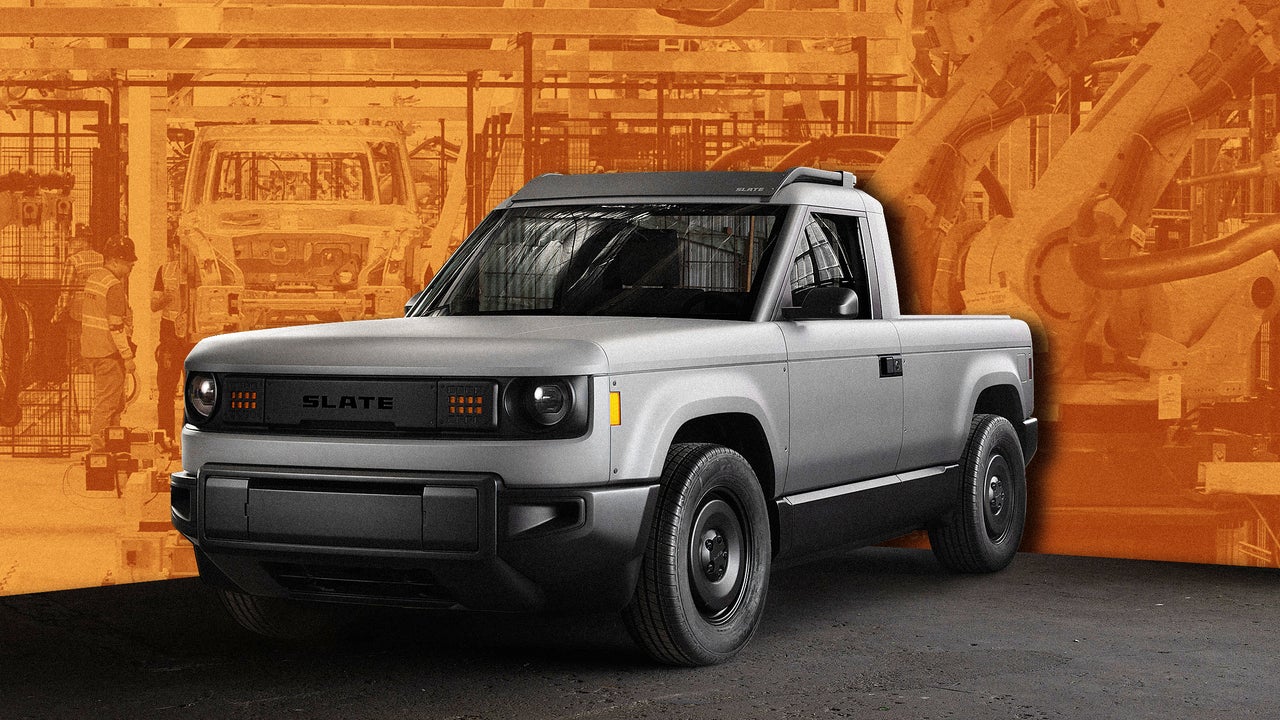
Slate auto’s $25k ‘blank slate’ pickup shocks EV market with no-frills minimalism—and a bold bet on simplicity
The gist
Slate Auto has stunned the EV market by launching a radically minimalist electric pickup for just $24,950, slashing costs and features to bet big on simplicity and affordability.
What to know
- The new ‘Blank Slate’ pickup is now the cheapest EV in the U.S., undercutting the Chevy Bolt and Nissan Leaf by several thousand dollars.
- Forget infotainment screens and power windows—Slate’s truck strips out all nonessentials, focusing on repairability, user customization, and workhorse utility.
- A switch to lithium iron phosphate batteries from nearby Gotion cut battery costs by 40% and boosted range to 205 miles, while streamlined Indiana production slashes manufacturing expenses.
The Return of the Bare-Bones Truck
Slate’s radical design strips away modern frills to revive a practical, customizable workhorse—putting repairability and owner freedom front and center.
Slate’s radical design strips away modern frills to revive a practical, customizable workhorse—putting repairability and owner freedom front and center.
Minimalism as Market Disruptor
By shunning tech overload and focusing on core utility, Slate’s sub-$25K pickup creates a new EV category, targeting fleet buyers and urban drivers with unmatched affordability.
Slate Auto’s radical minimalist design philosophy strips the electric pickup down to its bare essentials, eliminating traditional automotive luxuries such as infotainment screens, radios, carpeting, and even power windows. This bare-bones approach not only drastically reduces manufacturing complexity and cost but also aligns with the company’s mission to revive the once-popular concept of an affordable, highly useful two-door truck—a sentiment echoed by Tisha Johnson, Slate’s head of design, who lamented the disappearance of such practical vehicles from the market.
Beyond mere cost-cutting, Slate’s design process fundamentally rethinks which features truly matter to consumers, emphasizing repairability and user customization. Johnson highlights that the team questioned who should be able to repair the vehicle and whether owners should have the freedom to modify it over time, reflecting a shift toward empowering users rather than locking them into proprietary systems. This philosophy extends into manufacturing choices as well, with Slate’s factory notably lacking expensive paint shops and stamping equipment, which typically cost automakers hundreds of millions, thereby reinforcing affordability through streamlined production.

Lean Factories, Leaner Costs
Slate slashes capital expenses by reimagining manufacturing, ditching costly paint shops and tooling in favor of a streamlined, Indiana-based production model.
Slate Auto’s electric pickup truck disrupts the affordable EV market by launching at a groundbreaking $24,950, undercutting established competitors like the Chevy Bolt and Nissan Leaf, which start near $30,000. This price positions the Slate truck uniquely as the least expensive electric pickup and EV available in the U.S., creating a new category with no direct rivals and fulfilling the company’s promise of an accessible, American-made electric workhorse.
Beyond mere cost savings, Slate’s radical minimalism redefines EV design by stripping away nonessential features to hit its aggressive price point without sacrificing aesthetic appeal or basic comfort. Unlike many modern vehicles overloaded with tech, the Slate truck forgoes built-in Google infotainment and advanced route planning, opting instead for a bare-bones but functional approach that emphasizes utility, durability, and straightforward operation—qualities especially attractive to fleet operators and urban drivers.
While the Slate truck’s 205-mile estimated range trails the Chevy Bolt’s 262 miles and Nissan Leaf’s 303 miles, it compensates with robust utility specs including a 2,000-pound towing capacity and 1,500-pound payload, doubling initial projections and underscoring its focus on practical work applications over long-distance range. Charging speeds peak at 120 kW, enabling a 20-80% recharge in about 30 minutes, slightly slower than competitors but sufficient for typical daily and fleet use, especially with Level 2 AC charging completing a full recharge in roughly four hours.
Hands-on reviews praise the Slate truck for delivering a driving experience that belies its modest price, with smooth acceleration to 60 mph in eight seconds, comfortable seating, and competent handling over varied terrain. This combination of affordability, functional design, and solid performance reinforces Slate’s value proposition as a no-frills electric pickup that doesn’t feel cheap, appealing to buyers seeking straightforward, reliable transportation without the bells and whistles of pricier EVs.



Battery Tech That Cuts Costs
Switching to locally sourced LFP batteries and cell-to-pack architecture, Slate boosts range and slashes battery costs by 40%, all while meeting new federal tax credit rules.
Slate Auto revolutionizes traditional automotive manufacturing by eliminating costly infrastructure such as paint shops and stamping equipment, which can each run into hundreds of millions of dollars. Instead, its factory—housed in a former printing plant in Indiana—is optimized to produce a single, radically minimalist electric pickup model, focusing solely on essential features and safety, thereby significantly reducing capital expenditure and streamlining production.
In a strategic pivot driven by cost and supply chain considerations, Slate switched from nickel manganese cobalt (NMC) batteries to lithium iron phosphate (LFP) cells supplied by Gotion, whose Illinois factory is conveniently located near Slate’s plant. This move, enabled by recent changes in federal EV tax credit policies that now permit Chinese-sourced LFP batteries, reduces battery costs by approximately 40% and increases the standard driving range from 150 to 205 miles, aligning perfectly with Slate’s affordability and durability goals despite LFP’s lower energy density compared to NMC.
Complementing its battery chemistry shift, Slate embraces cutting-edge cell-to-pack technology, which eliminates intermediate modules by directly integrating cells into battery packs. This innovation not only enhances manufacturing efficiency and cost-effectiveness but also synergizes with the widespread industry adoption of LFP cells, underscoring Slate’s commitment to lean production and affordability in the EV market.
