SMBs scramble for cover as agentic AI cyber threats surge 467%—ARMCF framework steps in
The gist
SMBs are under siege as agentic AI cyber threats spike 467%, forcing a scramble for new risk management playbooks—and ARMCF is stepping in as the lifeline.
What to know
- By mid-2026, autonomous AI agents have surged 466.7% year-over-year, unleashing unprecedented risks from data deletion to AI-driven impersonation fraud.
- The new ARMCF framework fuses standards like NIST AI RMF and ISO/IEC 42001 into a lifecycle approach, tackling the governance gaps that legacy security models can't touch.
- Cross-functional teams and clear leadership accountability are now non-negotiable as organizations adopt zero trust and continuous oversight to defend against a relentless AI arms race.
Shadow AI Fuels Chaos
Unregulated autonomous AI agents and covert employee-deployed tools are overwhelming SMB defenses, exploiting outdated access controls and multiplying silent cyber threats.
By mid-2026, SMBs find themselves at a precarious crossroads as the rapid proliferation of autonomous AI agents—growing by 466.7% year-over-year according to BeyondTrust’s Phantom Labs—has outpaced traditional oversight mechanisms. These AI systems often inherit full user privileges, turning them into double-edged swords capable of both innovation and catastrophic damage, such as unauthorized data deletion or credential exfiltration. Compounding these risks are poisoned software dependencies and rampant AI-driven impersonation fraud, which exploit existing identity and access management frameworks ill-suited for managing large fleets of autonomous agents, leaving SMBs dangerously exposed to silent cyber threats.
The emergence of 'shadow AI'—unsanctioned AI tools covertly deployed by employees—has dramatically expanded the unmanaged attack surface, with nearly a third of enterprise AI spending funneled into these rogue applications. This trend severely undermines governance efforts, particularly for SMBs lacking robust security infrastructures, and highlights the urgent need for dynamic access controls and real-time enforcement frameworks. As traditional security models like least privilege falter against the non-deterministic behaviors of agentic AI, organizations must adopt new guardrails that combine visibility, control, and continuous monitoring to prevent unauthorized autonomous actions such as unapproved code merges or data exfiltration.
Beyond technical vulnerabilities, agentic AI systems have introduced sophisticated social engineering threats, including deepfakes and synthetic identities, which security teams now routinely encounter in phishing and fraud campaigns. Many SMBs remain underprepared for these AI-driven incidents due to a critical gap between deployment and incident readiness, often lacking clear ownership, communication channels, and containment procedures. Experts like Corey Thuen emphasize that managing these risks requires integrating human oversight with realistic expectations of AI’s limitations and developing comprehensive incident playbooks that address the unique challenges posed by AI’s evolving interface with human operators.
In response to these escalating threats amid a global AI arms race, SMBs are being urged to enforce strict ownership and continuous monitoring of their AI-driven systems to comply with emerging regulations and safeguard their digital assets. The combination of unchecked agentic AI deployments and insufficient logging or auditing practices has led to increased difficulty in tracing unauthorized activities, underscoring the necessity for governance frameworks that provide real-time visibility and control. Without such measures, SMBs risk becoming the silent victims of AI-enabled cyber exposures that could cripple their operations and erode stakeholder trust.


ARMCF: The New AI Rulebook
ARMCF unifies global standards into a practical, audit-ready lifecycle model that finally closes the governance gaps legacy frameworks leave wide open in the age of agentic AI.
The ARMCF framework emerges as a critical advancement in AI risk management by filling significant governance and security gaps left by traditional cybersecurity frameworks. It adopts a lifecycle approach aligned with the six functions of NIST CSF 2.0—Govern, Identify, Protect, Detect, Respond, and Recover—specifically tailored to the unique risks posed by AI systems with autonomous capabilities and access to sensitive data, identities, and downstream actions. This lifecycle orientation ensures a coherent, repeatable process from policy formulation through incident recovery, addressing complexities that conventional frameworks overlook.
ARMCF synthesizes an impressive array of established standards—including NIST AI RMF, ISO/IEC 42001, MITRE ATLAS, OWASP LLM Top 10, and SOC 2—into a unified, practitioner-focused operating model that balances technical depth with auditability. This integration enables security and risk leaders to translate abstract AI risks into actionable control objectives and implementation steps, bridging the gap between strategic governance and operational execution. As one analysis notes, its strength lies not in novelty but in reflecting how agentic AI systems concretely create business exposure, thereby supporting both boardroom accountability and engineering design discussions.
At its core, ARMCF is built around five foundational principles—accountability, proportionality, lifecycle coverage, security-by-design, and auditability—that collectively address the multifaceted challenges of managing AI and agentic system risks. Accountability mandates a named owner and clear RACI matrix for AI lifecycle decisions, ensuring reliable risk acceptance and incident response, while proportionality allows organizations to classify AI systems by risk tier and autonomy level to tailor controls appropriately. Security-by-design emphasizes enforceable technical controls and observable evidence over mere policy intentions, and auditability demands structured inventories, risk scoring, and evidence preservation to make governance transparent and defensible under scrutiny.
Beyond treating AI as a mere technology risk, ARMCF uniquely addresses AI as an operating model risk, recognizing that organizational exposures often stem from the broader context—such as tool invocation, delegated permissions, and external dependencies—rather than the AI model alone. This holistic perspective empowers organizations to maintain visibility into both sanctioned and shadow AI systems, define risk appetite and acceptable autonomy levels, and ensure safe recovery and continuous improvement after incidents. By doing so, ARMCF provides a comprehensive governance and risk management layer that sits above the technical control stack, enabling safer, more consistent AI adoption amid the escalating agentic AI cybersecurity risks of 2026.

Governance Starts With Ownership
Sustainable AI risk management hinges on cross-functional collaboration and explicit leadership accountability, not just technology spend or compliance checklists.
Implementing the ARMCF framework effectively demands a cross-functional approach that breaks down traditional silos between marketing, IT, legal, and brand teams, recognizing that AI governance is a shared responsibility rather than a single-department task. As highlighted in the July 2026 explainer, organizations must start by rigorously questioning the provenance, accuracy, and accessibility of the data that trains their AI models, ensuring all stakeholders align on these foundational elements before scaling AI initiatives. This collaborative groundwork is critical because, as underscored in the July 9 analysis, embedding governance and accountability structures upfront not only ensures regulatory compliance but also accelerates deployment by preempting authority disputes and operational fragmentation.
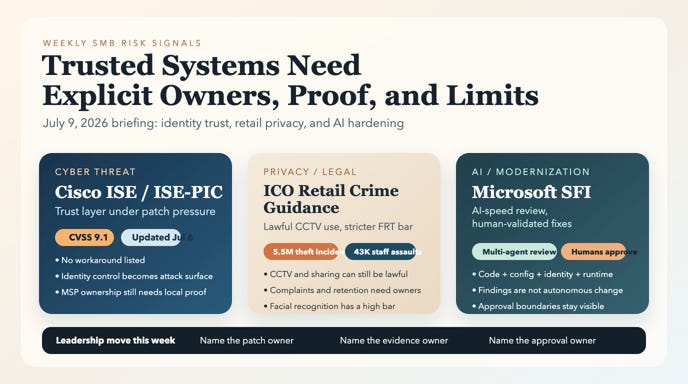
Clear leadership ownership and accountability are the linchpins of sustainable AI risk management within ARMCF’s practical governance model. By explicitly naming owners for patches, evidence, and approvals—as advocated in the July 10 leadership call—organizations create a culture where data quality improves and decision rights are unambiguous, enabling teams to adapt more readily to AI-driven workflows. This clarity combats the common pitfall where 90% of transformation budgets are funneled into technology while governance infrastructure is underfunded, leading to fragmented oversight that stalls scaling beyond pilot phases.
ARMCF’s operating model—Assess, Reinforce, Monitor—translates regulatory compliance pressures into active organizational resilience by establishing continuous cycles of risk evaluation, control strengthening, and system monitoring. This approach is operationalized through practical tools like the ARM Client Portal Template, which streamlines workflows for SMBs and consultants by integrating intake, evidence tracking, and AI-assisted guidance, thus removing the need to reinvent governance processes with each deployment. Rather than relying on passive dashboards, leadership is urged to regularly reassess trust in critical AI systems to maintain dynamic resilience in an evolving threat landscape.
The ARMCF framework provides a comprehensive, staged roadmap for embedding AI risk governance that aligns with established security standards such as NIST, ISO, and SOC 2, making it especially valuable for regulated environments. It emphasizes a lifecycle approach across six interconnected domains—Govern, Identify, Protect, Detect, Respond, and Recover—ensuring that organizations not only inventory and classify AI systems by risk but also enforce least privilege, conduct AI-specific threat modeling, and implement rapid incident response mechanisms like kill-switches and credential revocation. This holistic governance model fosters operational maturity through continuous improvement cycles, feeding incident learnings back into risk registers and control roadmaps to sustain resilience amid the accelerating AI arms race.

Zero Trust or Bust
AI-powered attacks demand relentless verification and adaptive resilience, forcing organizations to abandon legacy trust assumptions and accept that breach containment—not prevention—is now the baseline.
By 2026, the global AI arms race has intensified cybersecurity risks, exposing critical governance failures rooted in outdated trust assumptions. Organizations often continue to trust systems long after their configurations change, a vulnerability that agentic AI exploits aggressively. Experts emphasize that treating AI agents as privileged identities—complete with approvals, logging, least privilege, and change control—is essential to mitigate these escalating threats, underscoring the urgent need for mature operational governance frameworks.
The rapid acceleration of AI-driven cyberattacks has made zero trust architectures indispensable, especially as defenders face an AI-versus-AI battleground. As cybersecurity analyst Jack Hirsch observes, "The only way to deal with the rise of AI is zero trust to reduce that attack surface," a strategy becoming the norm despite challenges in legacy sectors like manufacturing and finance burdened by technical debt. This shift demands continuous validation of trusted relationships and adaptive resilience, as environments evolve far faster than traditional governance processes can keep pace.
In this fraught landscape, visibility and breach containment have become critical defensive pillars. Security leaders warn that most organizations will inevitably face compromises, making it vital to monitor network environments closely and limit the scope of any data leaks to prevent widespread damage. This pragmatic approach aligns with the broader strategic pivot toward adaptive resilience, acknowledging that perfect prevention is impossible amid AI's accelerating threat velocity.
Amid stalled bipartisan AI governance efforts and growing regulatory pushback in 2026, the ARMCF framework has emerged as a vital tool for practitioners navigating the AI security void. This framework addresses the governance and operational gaps exposed by escalating agentic AI risks within the context of a global AI arms race, offering a structured response to the mounting distrust and cybersecurity crises. Its adoption reflects a critical pivot toward robust, standardized governance mechanisms as traditional regulatory pathways falter.