Social security’s ticking clock: benefit cuts loom as demographics, debt, and division stall reform
The gist
Social Security’s main retirement fund is barreling toward insolvency by late 2032, threatening automatic benefit cuts that could slash retirees’ monthly checks by up to $500 and ignite a nationwide financial reckoning.
What to know
- The Old Age and Survivors Insurance trust fund is now projected to run dry between late 2032 and 2034, triggering 22–24% benefit cuts for millions of retirees.
- Demographic shifts—like aging baby boomers, lower birth rates, and reduced immigration—plus rising healthcare costs and tax cuts have accelerated the depletion timeline.
- With political gridlock stalling reform and 95% of voters demanding solutions, new AI tools like Boldin are helping over 150,000 users brace for potential Social Security shortfalls.
Retirement Cuts: The Hard Math
As the OASI trust fund barrels toward depletion, retirees face looming monthly reductions of $458–$500, with marginalized groups and millions nationwide bracing for the fallout of automatic benefit cuts.
By early 2026, projections from the Social Security Board of Trustees and watchdog groups like the Committee for a Responsible Federal Budget (CRFB) converge on a troubling timeline: the Old Age and Survivors Insurance (OASI) trust fund, which primarily finances retirement benefits, is expected to be depleted between late 2032 and 2034. Upon depletion, the program will no longer be able to pay full benefits, triggering automatic cuts estimated between 22% and 24%, which translates to an average monthly reduction of about $458 to $500 per retiree. This impending shortfall stems from expenditures outpacing income by $160 billion in 2025 and a growing 75-year actuarial deficit now at 4.42% of taxable payroll, underscoring a widening financial gap that has persisted since 2010.
While the OASI fund faces imminent depletion, the Disability Insurance (DI) trust fund bucks the trend with a stable and even improving reserve-to-cost ratio, highlighting a critical distinction within the Social Security system's financial mechanics. When combined, the Old-Age, Survivors, and Disability Insurance (OASDI) funds are projected to sustain full benefits until the third quarter of 2034, after which only about 83% of promised benefits would be payable, implying a roughly 17% across-the-board cut. This nuanced financial picture reveals that while retirement benefits bear the brunt of the shortfall, disability benefits remain comparatively secure, though the overall system still faces significant solvency challenges.
The projected benefit reductions carry profound social consequences, particularly for marginalized populations and people with disabilities who rely heavily on Social Security as a safety net. As payouts shrink from full benefits to approximately 78–83%, many older adults risk falling below the poverty line, exacerbating economic insecurity among vulnerable groups. Moreover, the scale of impact is vast: around 60 million Americans—including 54 million retired workers and 9 million survivors and dependents—stand to experience these cuts, with no state spared from what the CRFB describes as 'potentially devastating' reductions. This looming crisis has elevated Social Security financing to a front-line political issue, with 95% of voters expressing preference for candidates who propose credible solutions.
Addressing these looming cuts will require significant personal and policy adjustments. For instance, a 22% reduction in benefits could force new retirees to compensate for a monthly income loss of approximately $458, necessitating an estimated $137,280 in additional personal savings based on a 4% withdrawal rate. Younger workers face even steeper projected cuts—up to 33%—which could require over $200,000 in extra savings to maintain retirement security. Complicating the financial outlook, recent legislation such as the 2025 Social Security Fairness Act and tax provisions in the 2026 One Big Beautiful Bill have been factored into projections, slightly altering income and cost dynamics but not averting the fundamental solvency challenge.



Aging Boomers, Rising Debt
Surging mandatory spending and shrinking worker-to-beneficiary ratios have accelerated Social Security’s insolvency, fueling a fiscal spiral that outpaces national revenue and deepens U.S. debt.
Since 1980, mandatory spending on Social Security, Medicare, and Medicaid has surged, driven primarily by the aging baby boomer generation and increased life expectancy, resulting in beneficiaries drawing benefits for longer periods. Despite projections indicating Social Security is not fully funded beyond 2035, these non-discretionary expenses are legally required to grow over time regardless of tax income, creating an unsustainable fiscal trajectory that continues to fuel national debt growth.
By mid-2026, the Social Security trust fund depletion timeline worsened, with the main fund now expected to run dry in the fourth quarter of 2032—three months earlier than previously estimated. This accelerated strain is attributed to demographic shifts such as lower birth rates and reduced immigration, which shrink the worker-to-beneficiary ratio, alongside economic factors including tax cuts that have diminished revenue and rising healthcare costs that have driven mandatory spending growth beyond revenue increases.

Generational and Regional Fault Lines
Younger Americans and less affluent states face disproportionate risks from looming Social Security cuts, while older voters and wealthier regions wield power to protect their benefits, widening economic and political divides.
The Social Security solvency crisis starkly exposes intergenerational divides, as older generations, particularly baby boomers, have disproportionately benefited from federal spending and Social Security, while younger cohorts like Generation Z and millennials face greater financial insecurity and a mounting debt burden. Cerulli Associates data reveals that only 5% of Gen Z and 16% of millennials with 401(k)s expect Social Security as their primary retirement income source, compared to 49% of baby boomers, underscoring a looming shift in retirement security. This disparity is exacerbated by demographic trends such as slowing population growth and aging, which strain the system’s sustainability and mirror challenges long faced by Europe.
Geographic disparities compound the crisis, with states characterized by older populations and lower per capita incomes—such as Maine, West Virginia, and Vermont—facing the most severe economic impacts from Social Security benefit cuts projected for 2032. These states could see over 20% of their residents affected, with reductions exceeding 1% of state GDP, while wealthier Northeastern states like Connecticut and New Jersey confront cuts surpassing the national average of $500 per month. The Committee for a Responsible Federal Budget warns that no state will be spared from these potentially devastating reductions, which collectively amount to a $345 billion annual loss, or 1.1% of U.S. GDP, highlighting the uneven regional fallout and the urgency for policy intervention.
The political landscape reflects and reinforces these intergenerational and geographic divides, as older voters wield disproportionate wealth and political power to maintain Social Security benefits that favor their cohort, while younger voters, despite favoring reform, lack sufficient influence. For example, older voters in Kentucky recently supported candidates promising to preserve the status quo, such as Trump and his ally Gallrein, whereas younger voters backed reform-minded conservatives like Thomas Massie. This entrenched resistance among seniors—summed up by the blunt observation that 'the geezers don’t want to hear about it'—complicates efforts to address the insolvency crisis and risks deepening economic and political fractures across generations and states.
Voter Gridlock and Policy Paralysis
Public resistance to tax hikes and benefit cuts has deadlocked reform efforts, leaving lawmakers with unpopular options and intensifying electoral pressure as the insolvency deadline draws near.
By mid-2026, Americans remain deeply divided on how to address Social Security's looming insolvency, with overwhelming opposition to broad tax hikes or benefit cuts but notable support for targeted reforms such as reducing benefits for retirees with net worths exceeding $1 million. While only 26% of registered voters, including 31% of Republicans and 30% of young adults aged 18-29, back raising the retirement age, public misconceptions about the program’s funding mechanisms persist, complicating consensus. As Dan Rothschild highlights, there is a "massive gap" between public understanding and the reality of Social Security’s pay-as-you-go system, fueling polarized views on reform.
Political pressures intensify as the 2032 deadline for Social Security trust fund depletion approaches, with voters overwhelmingly demanding actionable plans; a Peterson Foundation poll found 95% of voters more likely to support candidates who propose solutions to the national debt and Social Security’s funding challenges, cutting across party lines. This urgency is making Social Security a central issue in upcoming Senate races, where strategists from both parties acknowledge that the combination of clear deadlines and projected 22% benefit cuts will make evasive answers politically untenable. However, a substantial portion of the public remains divided between those eager for reform and those preferring to defer the problem to future generations.
Lawmakers face a narrowing and politically fraught menu of policy options as they approach the insolvency cliff, constrained by strong voter resistance to tax increases and benefit reductions. Experts point to raising revenue by lifting or eliminating the payroll tax cap or slowing benefit growth as among the few viable paths, yet these remain deeply unpopular. Compounding the challenge, Senate filibuster rules prevent Social Security reforms from advancing through budget reconciliation, necessitating separate legislative tracks to avoid derailing broader fiscal efforts. The bipartisan Fiscal Commission Act (H.R. 3289), championed by Representatives Bill Huizenga (R-MI) and Scott Peters (D-CA), aims to navigate this impasse by producing two distinct recommendation sets with guaranteed up-or-down votes, reflecting a rare political attempt to break the stalemate.
Political inertia and institutional dysfunction have further complicated efforts to build public trust and legislative momentum, as evidenced by the delayed release of the Annual Social Security and Medicare Reports and the absence of concurrence from two public trustees due to decade-long vacancies. This lack of timely and transparent oversight undermines confidence in the solvency reporting process just as the program faces its most critical juncture since the bipartisan reforms of 1983, which, notably, did not prevent the re-election of lawmakers who supported politically difficult but necessary changes. The current environment thus presents both a daunting challenge and a historical precedent for surviving—and potentially thriving—through tough Social Security reforms.

Risky Fixes and Pragmatic Workarounds
From high-stakes stock market gambles to bipartisan fiscal commissions, policymakers are testing both bold and balanced strategies to bypass Senate gridlock and avert Social Security’s collapse.
By mid-2026, a bipartisan consensus emerged around the creation of a statutory fiscal commission tasked with producing two distinct recommendation sets: one focused solely on restoring Social Security's solvency, and another addressing broader federal budget sustainability. This approach, championed by Representative Bill Huizenga (R-MI) and Representative Scott Peters (D-CA) through the Fiscal Commission Act (H.R. 3289), aims to circumvent Senate filibusters by separating Social Security reform—excluded from budget reconciliation rules—from wider debt reduction measures that can pass without filibusters. Such structural legislative innovation reflects a pragmatic attempt to navigate Senate procedural hurdles while confronting the looming insolvency crisis.
The Cassidy-Kaine proposal to rescue Social Security by borrowing $1.5 trillion to invest heavily in stocks, thereby accumulating $25.1 trillion in debt over 75 years, has been met with skepticism due to its high-risk profile. Boston College simulations reveal that even optimistic 6.5% real returns would fail to cover the debt 64% of the time, with failure rates rising to 83% at a 4% return, underscoring the gamble's precariousness. Moreover, the massive $26.6 trillion debt load would likely elevate interest payments and depress stock market performance, compounding fiscal challenges and threatening the plan's viability.
A more tempered reform strategy gaining traction involves blending moderate payroll tax increases or benefit adjustments with partial stock market investment—around 40% of the Social Security trust fund—thereby balancing risk and reward. Boston College's analysis suggests this hybrid approach could sustain solvency indefinitely in most scenarios, avoiding the need for steeper future cuts or tax hikes. This nuanced perspective contrasts with all-or-nothing proposals and reflects a growing recognition that stock investments can play a constructive role if integrated prudently with traditional fiscal measures.
Conservative reform advocates continue to push for personal investment accounts, exemplified by Senator Ted Cruz's endorsement of 'Trump accounts,' which mirror Australia's superannuation system by allowing individuals to manage their Social Security contributions. This proposal signals an ideological shift toward privatization and individual control, aiming to reshape public attitudes about the payroll tax-funded model. While controversial, these accounts remain a key element in the broader debate over how to modernize Social Security amid fiscal pressures.
AI Tools for Uncertain Futures
Boldin’s AI-powered retirement platform now lets users simulate drastic Social Security cuts, empowering over 150,000 Americans to proactively plan for unpredictable benefit reductions and rising retirement costs.
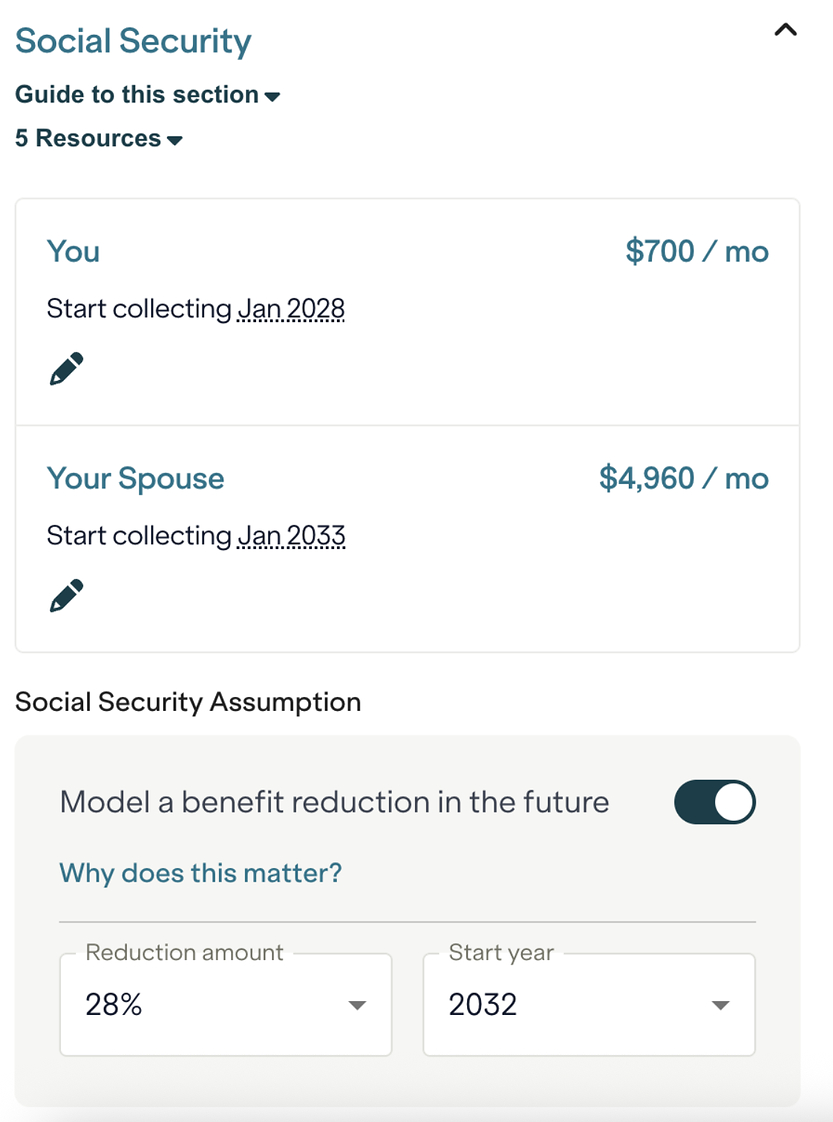
By early 2026, Boldin had emerged as a leading DIY retirement planning platform, boasting over 150,000 active monthly users who value its affordable, AI-augmented tools combined with optional fiduciary support. Its latest innovation—a Social Security benefit reduction modeling feature—enables future retirees to simulate various cut scenarios, including the Congressional Budget Office's forecasted 28% benefit reduction starting in 2032, thereby equipping users to proactively anticipate and adapt to looming Social Security uncertainties.
Beyond just Social Security projections, Boldin’s platform integrates a comprehensive suite of financial factors such as income, taxes, housing, and healthcare costs, delivering a holistic and nuanced retirement planning experience. This multi-dimensional approach empowers users to build confidence in their long-term financial strategies amid the growing unpredictability of retirement benefits and economic conditions.
