S&p 500’s ‘most hated rally’ wobbles as historic Thursday slump signals deeper market jitters
The gist
The S&P 500’s so-called ‘most hated rally’ is on shaky ground, as a rare streak of nine straight Thursday slumps—echoing 1929 and 2001—exposes deep cracks beneath the market’s recent bounce.
What to know
- Despite a 3% rally, the S&P 500 remains stuck below key resistance zones and has logged nine consecutive Thursday losses—a pattern not seen since the Great Depression and the dot-com crash.
- Geopolitical tension has cooled volatility, with the VIX plunging 23% below 20, but stubbornly high oil prices ($96–$97) are fueling sector rotations into energy and staples while crushing travel and discretionary stocks.
- Nearly $48 billion has surged into equities via volatility-linked funds and bullish options, yet persistent technical weakness and mechanical selling keep the market’s upside firmly capped.
Technical Fragility Exposed
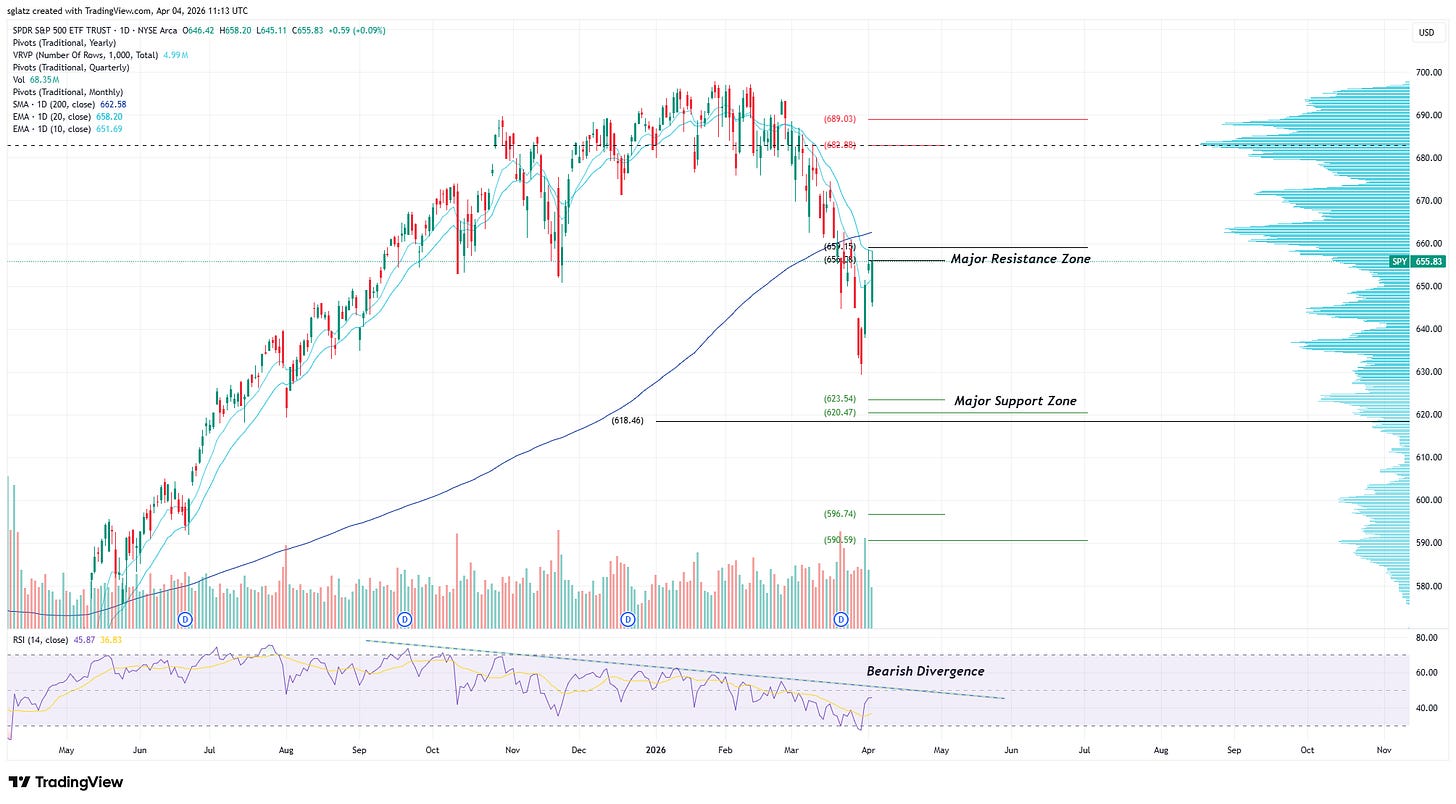
Despite a sharp rebound, the S&P 500’s momentum is undermined by persistent technical weakness, rare consecutive Thursday declines, and resistance at key chart levels.
The S&P 500's recent rally, while marked by a notable 3% gain off the lows, remains fragile as the market struggles to maintain higher price levels without immediate reversals. Sustained momentum improvements, such as elevated RSI readings that avoid extreme moves, are essential to confirm a genuine shift in market behavior rather than a transient bounce within a broader correction. Key technical levels, including supports around 6555–6567 and resistances at 6640–6662 and 6708–6723, will be critical in shaping near-term direction, especially as the market approaches the Easter holiday.
A rare and concerning pattern has emerged with the S&P 500 recording nine consecutive Thursday declines, a phenomenon previously seen only during the market crashes of 1929 and 2001. This streak likely reflects technical market dynamics such as weekly options expirations and institutional risk trimming ahead of weekends, reinforcing a structural vulnerability beneath the surface despite intermittent rallies. Such persistent weakness signals caution, underscoring that the market’s current momentum is underpinned by technical fragility rather than robust strength.
Technically, the S&P 500 remains below critical moving averages—the 50-day and 200-day—indicating significant resistance and a broken chart structure that complicates bullish narratives. The recent short squeeze rally, driven by hedge funds forced to cover large accumulated short positions, injected temporary upside momentum but did not resolve underlying bearish trends. Moreover, the index is trapped below pivotal resistance pivots near 6857, a triple point of control on the weekly profile, where dealer hedging dynamics and volatility regimes, including a suppressed VIX below 20.78, create a delicate balance between potential squeeze rallies and renewed downside pressure.
Volatility and momentum indicators paint a mixed but cautious picture: short-term realized volatility remains elevated relative to longer-term measures, sustaining a high-volatility regime that forces vol-control funds to reduce equity exposure and perpetuate selling pressure. Systematic flows from CTAs and volatility-sensitive funds continue to be bearish, while extreme short-side crowding, as indicated by the Systematic Positioning Index nearing -2, suggests that selling pressure may be thinning, setting the stage for a rapid reversal—though this has yet to materialize. Upcoming catalysts like CPI data add further uncertainty, with traders pricing in greater protection against downside surprises, highlighting the precarious technical environment.
Despite these headwinds, there are emerging signs of cautious optimism as the S&P 500 has reclaimed key daily levels around 6772.75 and 6799.75, indicating potential short-term upward momentum and a possible gap fill following recent geopolitical-driven volatility. Momentum indicators, including bullish options positioning and a sharp shift in call skew from defensive to aggressive within weeks, alongside systematic buying by volatility-linked funds and leveraged ETFs totaling nearly $48 billion, suggest that the market retains room to rebuild momentum. However, elevated oil prices, rising bond yields, and weak consumer sentiment temper enthusiasm, underscoring that any rally must navigate significant structural challenges.





Geopolitics Reshapes Market Winners
Energy, defense, and resource sectors are surging amid Middle East tensions and stubbornly high oil, while travel and consumer discretionary stocks face punishing losses.
Despite persistent headlines around the US-Iran conflict, market volatility has notably eased, with the VIX dropping about 23% this week and closing below 20 for the first time since hostilities began, signaling a reduction in investor fear. This calming in risk sentiment coincides with WTI crude oil maintaining strong momentum near $96-$97 per barrel, reflecting the market's acute sensitivity to Middle East developments where oil prices serve as a barometer for escalation or de-escalation. The interplay between subdued volatility and resilient oil prices underscores a cautious market that is digesting geopolitical risks without succumbing to panic.
The S&P 500's trajectory remains tightly bound to key technical thresholds amid geopolitical uncertainty, as it hovers near a critical resistance zone around the $659 pivot and the 200-day SMA, which must be decisively breached to confirm a sustained reversal. This technical battleground is further complicated by the failure of the Trump/Iran deal, which triggered a sharp market gap down to the pivotal 6857.25 monthly support level, intensifying the tug-of-war between bulls and bears and reshaping dealer hedging dynamics. While short squeeze rallies offer intermittent relief, the market's ability to reclaim daily support levels will be crucial in determining whether optimism can overcome structural vulnerabilities.
Sector leadership has sharply diverged as the geopolitical conflict reshapes market winners and losers: energy producers like ExxonMobil and Chevron, defense contractors such as Lockheed Martin and RTX Corp, along with gold miners and fertilizer companies, have surged—exemplified by the Energy sector's 33% year-to-date gain—while consumer discretionary sectors including airlines, cruise lines, and travel companies have suffered steep losses, with Carnival Corp plunging 12% on the war’s first day. This bifurcation reflects how rising fuel costs and operational disruptions are penalizing growth-sensitive industries even as defense and resource sectors capitalize on heightened demand and spending.
Market rallies have been volatile and closely tied to the ebb and flow of ceasefire prospects, with initial relief rallies driven largely by short covering failing to sustain momentum amid fragile peace talks and complex geopolitical hurdles like Israel’s involvement and contentious terms including sanctions removal and military withdrawals. Nevertheless, investors appear increasingly to price in a favorable resolution, as evidenced by the S&P 500’s nearly 11% rally in under ten days despite ongoing conflict, suggesting a shift toward trading the broader recovery path rather than the intricate details of negotiations. This cautious optimism is tempered by persistent inflationary pressures from elevated oil prices and supply chain disruptions, which continue to constrain Federal Reserve policy flexibility and weigh on growth sectors.





Breadth Breakdown and Forced Selling
Institutional risk trimming, mechanical selling by volatility-driven funds, and a historic Thursday losing streak reveal a market structure vulnerable to abrupt swings.
The S&P 500's market breadth is showing clear signs of deterioration, underscored by an unprecedented pattern of nine consecutive Thursday declines—a phenomenon previously seen only in 1929 and 2001—highlighting deep structural weaknesses. This persistent weekly selling pressure, likely driven by institutional behaviors such as risk trimming ahead of weekends and weekly options expirations, has contributed to the index trading below both its 50-day and 200-day moving averages, painting a broken technical picture as noted by market analysts.
Investor sentiment is shifting defensively, as evidenced by a pronounced sector rotation favoring consumer staples and energy over consumer discretionary sectors. The consumer discretionary to staples ratio has turned bearish, with staples and energy sectors like ExxonMobil and Chevron surging—ExxonMobil even posting its largest quarterly gain on record—while discretionary and travel-related companies such as American Airlines and Carnival Corp have been hammered, the latter dropping 12% on the first day of the Iran conflict. This rotation reflects a flight to safety amid geopolitical tensions and rising fuel costs that exacerbate vulnerabilities in demand-sensitive sectors.
Underlying structural vulnerabilities are further amplified by elevated volatility and mechanical selling from vol-control funds, which have been forced to reduce equity exposure as short-term realized volatility nearly doubled from 8-9% to 18.32%. This dynamic, combined with extreme short-side crowding indicated by the Systematic Positioning Index nearing -2, has fueled short squeeze rallies that provide only fragile relief. However, ongoing selling pressure from CTAs and vol-control funds, alongside the S&P 500's sustained trading below the gamma flip level, suggests that these rallies occur within a broken market structure prone to amplified price swings and heightened risk.
Compounding these challenges, sustained high oil prices—having jumped 60% and remained elevated for several weeks—historically presage significant market declines of at least 20% in the S&P 500, according to strategist Matt Malley. This energy price shock, while benefiting producers and defensive sectors, underscores the broader economic headwinds and structural fragilities that investors must navigate amid the current geopolitical and market volatility landscape.

Cautious Optimism Meets Skepticism
Short-lived rallies and heavy inflows into equities mask deep investor doubts, as persistent inflation, rapid news cycles, and light positioning keep confidence in check.
Investor sentiment remains a complex blend of cautious optimism and skepticism, as the recent S&P 500 rally—boosted by short covering following the US-Iran ceasefire—has been widely viewed as a relief rather than a sustainable uptrend. Despite the S&P 500's 2.5% intraday gain, the index closed near its opening level, reflecting fading stock performance and persistent inflation pressures that keep Treasury yields relatively elevated. This dynamic underscores structural market weaknesses that temper enthusiasm, with many investors reassessing portfolios amid ongoing geopolitical uncertainty and elevated oil prices around $97 WTI, which constrain Federal Reserve rate cut prospects.
The market's rapid information flow and democratization of analytical tools have compressed investor interpretations, resulting in greater consensus but also heightened fragility in positioning. As noted in the analysis, the market remains 'anchored in a world that no longer exists,' where traditional trading hours lag behind the nonstop flow of information, creating misalignments in investor reactions. Despite advances like AI and blockchain, human biases persist, fueling skepticism about the durability of short-term rallies driven by volatility collapses and geopolitical headlines.
Investor positioning reveals a cautious but gradually more optimistic stance, with institutional investors reversing conservative postures and volatility-linked funds turning net buyers—Nomura reports commodity trading advisors purchasing $20 billion and leveraged ETFs adding $27.5 billion in equities recently. This shift is accompanied by aggressive bullish options flows, as Chris Murphy of Susquehanna Financial Group highlights a swing from the most defensive three-month 25 delta call skew in nearly three years to the most bullish in three months. Yet, systematic positioning remains historically light, suggesting room for further exposure without destabilizing the market, even as many retail investors remain sidelined, wary of the rally's sustainability.
The prevailing investor mindset is characterized by a paradoxical 'most hated rally' scenario, where widespread disbelief coexists with a fear of missing out that draws discretionary buyers as the S&P 500 approaches new highs. Mark Cudmore encapsulates this cautious optimism, stating that investors are trading 'as if the war is effectively over' but remain mindful of lingering stagflation and supply chain disruptions. Insider buying has been present but limited, indicating tentative nibbling rather than robust conviction, which supports the view that the market may shift into a range-bound pattern rather than an artificial melt-up.