SpaceX IPO sparks tech rout as investors flee to safety
The gist
SpaceX’s $2 trillion IPO has thrown tech markets into chaos, sparking a sharp sector rotation and rattling even the AI chip giants.
What to know
- NVIDIA and other AI chip stocks have plunged despite strong fundamentals, as technical deleveraging and risk-off sentiment grip investors.
- Institutional money is fleeing growth tech for defensive sectors like healthcare, financials, and utilities as geopolitical and regulatory fears intensify.
- Crypto markets are shifting toward revenue-generating protocols with aggressive supply burns, prioritizing capital preservation over speculation.
SpaceX IPO Ignites Market Turmoil
The $2 trillion SpaceX IPO is fueling unprecedented volatility across tech, crypto, and infrastructure sectors, amplifying governance controversies and forcing investors to weigh AI-driven optimism against mounting global risks.
SpaceX's landmark $2 trillion IPO in mid-2026 has become a central catalyst for heightened volatility on Wall Street, profoundly impacting tech valuations and investor sentiment. This frenzy coincides with an intensifying AI arms race, where the IPO's timing amplifies governance controversies and fuels jitters across sectors, notably unsettling AI chip investors and triggering ripple effects through crypto, semiconductors, and cloud infrastructure markets. The convergence of SpaceX's market debut with Bitcoin's institutional shakeout underscores a broader cross-sector turbulence reshaping investment strategies amid a shifting tech valuation landscape.
Beyond immediate market gyrations, SpaceX's IPO mania is driving a strategic reshaping of AI and tech investing within a persistent secular bull market, simultaneously unlocking new growth avenues in healthcare and financial sectors powered by AI innovation. However, despite the explosive enthusiasm surrounding SpaceX's AI-driven space ambitions, investor focus is increasingly tempered by geopolitical tensions and economic uncertainties, prompting a cautious rotation toward traditional sectors. This nuanced dynamic reflects a market balancing groundbreaking tech optimism with pragmatic risk management amid global instability.




Semiconductor Shockwaves Spread
SpaceX’s IPO frenzy and hawkish Fed signals have triggered a global selloff in AI chips and semiconductors, exposing fragile investor confidence despite robust fundamentals and long-term growth projections.
SpaceX’s impending $2 trillion IPO has injected significant valuation risks into the AI chip market, unsettling investors and amplifying volatility across semiconductors and adjacent tech sectors. This IPO frenzy, combined with hawkish Federal Reserve signals, has intensified sector rotations and contributed to a stumble in semiconductor stocks despite ongoing AI enthusiasm, highlighting a fragile investor sentiment amid broader geopolitical tensions such as Iran-related uncertainties.
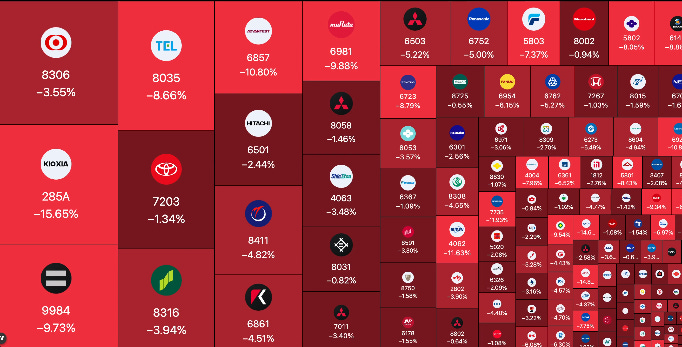
The semiconductor sector’s pronounced weakness, marked by heavy selling pressure notably in Japan, has triggered a global market correction that underscores turbulence in the AI chip race and the broader tech IPO mania. This regional selling reflects deep investor jitters about the sustainability of AI-driven growth narratives, as the tech sector grapples with the dual challenges of geopolitical instability and the recalibration of lofty valuations.
Despite headline volatility and sharp declines led by heavyweights like NVIDIA—whose major investment in OpenAI reignited debates over the justification of high AI expenditures—the underlying fundamentals of AI chip valuations remain compelling. NVIDIA’s PEG ratio of 0.6, driven by a projected 40% earnings growth, suggests that while the market is correcting, the semiconductor sector’s growth phase is expected to persist for at least two more years amid expanding AI use cases and data center build-outs.
The recent downturn in AI chip valuations is predominantly a technical correction fueled by deleveraging rather than fundamental deterioration, signaling a shift from speculative excess to more disciplined investment approaches. As the exuberant 'AI only goes up' narrative fades, the investor base is evolving towards cautious, long-term oriented players demanding real profitability and sustainable business models, which tempers risk appetite and contributes to ongoing tech sector volatility despite reasonable overall market valuations.




Defensive Sectors Take the Lead
A sustained investor rotation from growth tech to healthcare, financials, and international value stocks is signaling a major market recalibration reminiscent of the post-dotcom era, with defensive plays outperforming amid uncertainty.
By mid-2026, a pronounced sector rotation has taken hold, with institutional investors shifting capital away from AI-driven growth stocks—particularly in tech segments like AI chips and data centers—toward more defensive and value-oriented sectors such as healthcare, financials, and traditional industrials. Healthcare stocks have surged to new 52-week highs, while chipmakers like Sandisk have seen steep declines, dropping from 2300 to 1300. This sustained two-month rotation, marked by utilities gaining 2.2% on otherwise flat trading days and materials sectors also advancing nearly 2%, signals a significant market recalibration rather than a fleeting correction, reminiscent of the 2022 growth stock reset.
Market participants widely interpret this rotation as a healthy correction rather than the onset of a secular bear market, reflecting a necessary reassessment of stretched valuations in AI and tech growth stocks amid mounting geopolitical tensions and economic uncertainties. Rising oil prices and inflation fears, exacerbated by Middle East conflicts, have pushed investors toward defensive sectors like utilities, gold, and materials, which have outperformed amid higher 10-year Treasury yields. As one analyst put it, 'The market needs to find true value. It needs to assess the real winners and losers,' underscoring the shift from exuberant growth expectations to pragmatic value investing.
This rotation extends beyond domestic markets, with a notable pivot toward international equities, value stocks, and small caps, suggesting the emergence of a multi-year cycle favoring these segments. Charles Cunningham of Conductor ETFs highlights that current valuation disparities between U.S. and international markets, as well as between value and growth stocks, are at extremes unseen since the 1990s tech bubble, potentially heralding an 8 to 12-year cycle akin to the 2000s. Such a shift offers investors a strategic opportunity to capitalize on undervalued international and small-cap stocks as leadership in the market landscape evolves.
Despite the S&P 500 reaching record highs in 2026, the so-called Magnificent Seven tech giants—many linked to AI growth—have collectively declined about 3.7%, while the remaining 493 stocks surged approximately 12.9%, illustrating the breadth of the rotation away from concentrated tech dominance. Energy stocks have led the value sector's outperformance with gains around 22%, supported by materials and consumer staples, reflecting investor preference for sectors with tangible earnings amid uncertainty. However, the reclassification of companies like Amazon into the value category inflates these figures somewhat, with Amazon now 92% value-classified and technology’s weight in the Russell 1000 Value index rising from under 4% to nearly 18.6%, complicating pure growth versus value narratives.


Caution Trumps Hype in 2026
Escalating geopolitical and regulatory threats are pushing investors toward disciplined, diversified strategies and yield-generating assets, as short-term volatility upends traditional market logic and tempers tech euphoria.
Despite the landmark excitement surrounding SpaceX’s $2 trillion IPO and its AI-driven ambitions, investor sentiment in mid-2026 has decidedly tilted toward caution, driven by escalating geopolitical tensions and economic uncertainties. This cautious stance manifests in a preference for traditional sectors and yield-generating assets over speculative tech and crypto projects, as regulatory concerns like the impending CLARITY Act and macroeconomic risks—such as the Strategic Petroleum Reserve depletion—compound market anxieties. Investors are navigating a complex landscape where innovation and risk aversion collide, underscoring a broader shift toward measured, long-term strategies amid fierce competition for tech dominance and regulatory control.
The volatile interplay of geopolitical events—ranging from U.S. military actions in the Middle East to fluctuating oil prices—and regulatory uncertainty has fostered erratic market behavior that defies conventional logic, as noted by Jim Cramer’s characterization of the earnings season as a 'ball of confusion.' This environment has prompted investors to adopt a disciplined, long-term holding approach, avoiding reactionary moves to earnings or headlines and instead focusing on companies with durable competitive advantages. The resulting market dynamics feature rapid reversals and sector-specific anomalies, such as Nvidia’s stock rally amid AI optimism and utilities gaining despite rising Treasury yields, reflecting a nuanced recalibration of risk appetite.
Amid this 'risk-off' environment, prominent growth investors like Ron Baron emphasize deep fundamental research and portfolio diversification to manage the emotional and financial turbulence caused by highly correlated market movements. By prioritizing mission-driven companies with sustainable competitive moats—such as Tesla’s evolving Robo taxi and Cyber cab projects—investors maintain confidence despite short-term volatility and delays, underscoring a strategic patience that values long-term vision over market timing. This approach acknowledges that owning a concentrated portfolio of high-growth stocks like Tesla and SpaceX can amplify risk during geopolitical and economic shocks, making diversification essential to weathering the storm.
In the crypto space, heightened political noise combined with low liquidity and conviction has driven investors to seek precision and speed in execution tools, focusing on revenue-verified protocols with aggressive supply-burn mechanisms rather than speculative tokens. This tactical shift reflects a broader behavioral adaptation to an environment where regulatory clarity remains elusive and market volatility is exacerbated by geopolitical uncertainties, compelling investors to prioritize capital preservation and yield generation over high-risk gambles.