Stablecoin cards go mainstream: visa, stripe, and fintechs redraw the payments map
The gist
Stablecoin-powered payment cards have exploded into the mainstream, with Visa and Stripe turning crypto into everyday money at 175 million checkouts—and loyalty rewards and AI-driven spending are taking off next.
What to know
- Stablecoin card transaction volume soared from $100 million to $1.5 billion monthly between 2023 and 2025, fueled by innovators like Rain and Reap bypassing banks.
- Visa now handles over 90% of global on-chain stablecoin card volume through partnerships with Stripe and Bridge, unlocking access in 100+ countries.
- Regulatory breakthroughs like the EU’s MiCA and U.S. GENIUS Act have given stablecoins bank-grade status, while loyalty programs like Rain’s ‘Rewards’ are boosting user spend by 25%.
Fintechs Bypass Banks
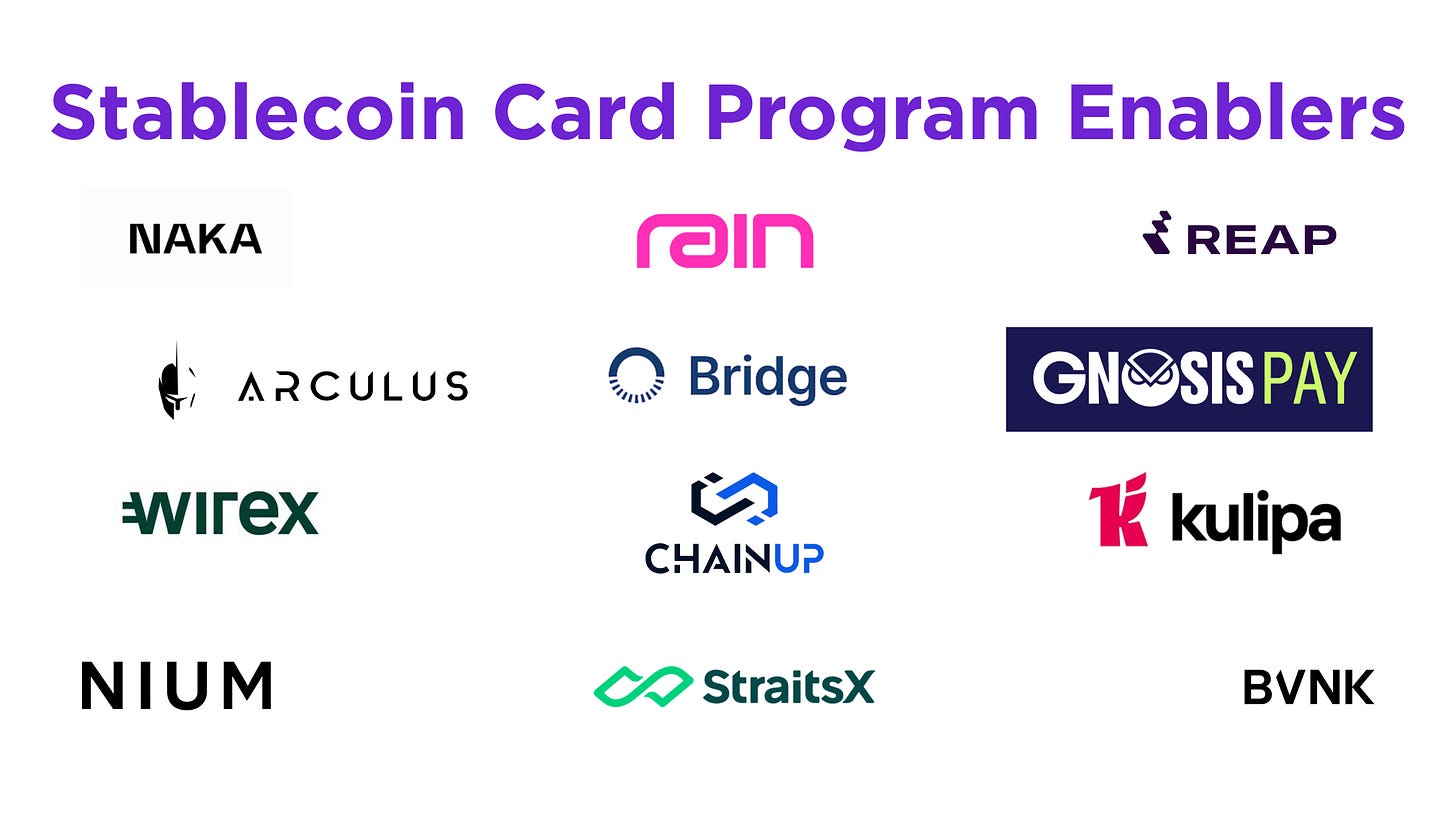
Full-stack issuers like Rain and Reap are reshaping the stablecoin card market by sidestepping banks, capturing more value per transaction and accelerating global adoption.
Stablecoin-powered crypto cards have surged dramatically from $100 million in monthly transaction volume in early 2023 to over $1.5 billion by late 2025, reflecting a 106% compound annual growth rate. This explosive expansion is underpinned by structural innovations such as the rise of full-stack issuers like Rain and Reap, who bypass traditional issuing banks by holding direct principal membership, thereby capturing greater economic value per transaction and streamlining program management.
Visa has emerged as the dominant payment network in the stablecoin card ecosystem, commanding over 90% of on-chain card volume through early infrastructure partnerships, despite Mastercard maintaining near parity in program counts. The collaboration between Visa and fintechs like Bridge and Stripe has been pivotal, enabling stablecoin-backed cards to reach over 100 countries and granting users access to more than 175 million merchant locations worldwide, effectively embedding stablecoins into mainstream payment rails.
Key platform launches by companies such as Nium and MoonPay have accelerated the deployment and usability of stablecoin cards by reducing program launch times from months to days and enabling seamless spending at traditional merchants. This wave of innovation, coupled with growing competition from fintech players and legacy firms like Western Union entering the space, signals a maturation of crypto payment infrastructure where stablecoins evolve from trading instruments to practical transaction tools bridging digital assets with everyday commerce.
The global adoption of stablecoin payment cards is geographically nuanced: markets like India and Argentina lead due to stablecoins addressing tangible financial challenges, while developed economies focus on capturing high-value user segments through sophisticated multi-asset wallets and programmable spending features. This evolution is exemplified by Revolut’s physical crypto-linked cards that normalize digital assets as wallet balances and by real-time conversion engines that shield merchants from volatility, collectively advancing stablecoin cards as programmable financial instruments integrated seamlessly into legacy payment systems.





Visa & Stripe Go Global
Visa and Stripe’s Bridge partnership turbocharged stablecoin card access to over 100 countries, with unified platforms slashing launch times and making crypto payments as seamless as traditional cards.
By early 2026, Visa and Stripe’s Bridge partnership had significantly expanded stablecoin-backed Visa card availability from 18 to over 100 countries, enabling users to spend stablecoins at more than 175 million merchant locations worldwide. This global rollout is underpinned by an innovative stablecoin settlement pilot with Lead Bank, a $4 billion Kansas City community bank that has become the default sponsor for crypto-native card programs. Visa’s commitment to supporting onchain business operations and programmable money movement, combined with Bridge’s facilitation of custom stablecoin use within card programs, exemplifies a strategic vertical integration approach that streamlines stablecoin payments and enhances operational efficiency across the payment stack.
Nium’s launch of a unified stablecoin card platform in March 2026 marked a pivotal infrastructure innovation by consolidating settlement compliance, card network integration, and stablecoin-to-fiat conversion into a single integration layer. This breakthrough reduced stablecoin card program launch times from months to mere days, representing a major leap toward turnkey solutions that simplify the complex crypto payment ecosystem. Such unified platforms address critical pain points by abstracting blockchain complexities and compliance hurdles, thereby accelerating mainstream adoption.
Stripe’s 2026 introduction of digital asset accounts and unified APIs revolutionized the stablecoin payment landscape by merging payments across tokens and chains, fiat on/off ramps, FX, yield integration, and custody into one seamless developer experience. Their integration of embedded Treasury components, fraud prevention tools like Radar—which helped Navan cut fraudulent disputes by 36%—and expanded card issuance capabilities demonstrates a holistic platform enhancement strategy. Notably, Stripe’s unified API, launched in partnership with Visa and Lead Bank, collapsed a five-vendor crypto card stack into a single interface, enabling developers to issue Visa-branded prepaid stablecoin cards with real-time authorization and dispute management, thereby simplifying compliance and settlement.
The evolution of crypto cards into dynamic, multi-asset wallets with automated optimization rules, as seen in Revolut’s physical crypto-linked cards, exemplifies the technological convergence of digital asset accounts and traditional payment rails. These cards act as compliant translation layers between decentralized blockchain assets and centralized payment networks, abstracting blockchain complexity from merchants and enabling real-time crypto-to-fiat conversion at point-of-sale. This integration depth, supported by Visa and Mastercard partnerships, not only reduces friction but also highlights the critical role of vertical integration in differentiating crypto cards by owning the deeper payment stack behind every swipe, thus driving broader stablecoin adoption in everyday commerce.


Stablecoins Become Boring—And Bank-Grade
Major acquisitions and strict regulations are transforming stablecoins from speculative assets into regulated, trusted payment infrastructure powering trillions in global transactions.
By early 2026, the stablecoin ecosystem has undergone a profound maturation, marked by a strategic pivot from speculative ventures to utility-driven infrastructure. This evolution is exemplified by major acquisitions such as Kraken’s purchase of Reap, Stripe’s $1.1 billion acquisition of Bridge, and Mastercard’s pending $1.8 billion deal for BVNK, signaling institutional confidence in stablecoin-powered financial access. As one analysis aptly puts it, “Crypto has managed the impossible; it has become boring,” reflecting a newfound focus on building reliable, ‘dull but useful tools’ that underpin long-term trust and viability in the stablecoin space.
Regulatory frameworks have crystallized stablecoins’ role as regulated financial instruments integral to mainstream payment systems. The EU’s MiCA regulation, fully enforced by July 2026, mandates all Crypto-Asset Service Providers to secure authorization, consolidating the market to 38 accredited Electronic Money Token issuers. Simultaneously, the U.S. GENIUS Act, with comprehensive FDIC and OCC rules issued by April 2026, integrates stablecoin issuance into the federal banking system, imposing reserve concentration limits that prevent any single institution from holding more than 40% of reserves. These regulatory milestones have elevated stablecoins like USDC and PYUSD to ‘bank-grade’ status, treated with prudential respect akin to commercial bank deposits, thus fostering a safer and more stable payment infrastructure.
The institutionalization and regulatory clarity surrounding stablecoins have propelled transaction volumes beyond traditional card networks, with stablecoin transfers reaching $27.6 trillion by 2024 and accelerating through 2026. This surge is bolstered by major payment companies—Visa, Mastercard, Stripe, PayPal, and Western Union—integrating stablecoin rails into their existing products, signaling broad industry acceptance. Moreover, transparent reserve management practices, exemplified by Circle’s USDC with its 100% liquid asset backing and SEC-registered money-market fund custody, have become a cornerstone of trust, contrasting with more opaque approaches like Tether’s. Such developments underscore stablecoins’ transition from fringe speculative assets to foundational programmable cash instruments shaping the future of global payments.
Stablecoins have evolved into recognized policy objects, attracting scrutiny from global financial authorities including the BIS, IMF, ECB, and Federal Reserve, each highlighting both their transformative potential and inherent risks such as run risk, bank disintermediation, and macro-financial instability. The Federal Reserve’s post-GENIUS Act stance acknowledges stablecoins as meaningful payment innovations while emphasizing the need for robust illicit finance controls and prudential safeguards. This regulatory maturation reflects a delicate balancing act: fostering innovation and mainstream adoption while safeguarding financial stability and monetary sovereignty in an increasingly tokenized economy.




Loyalty Drives Stablecoin Spend
Retailers and fintechs are embedding loyalty rewards directly into stablecoin cards, fueling a 25% surge in user spending and setting the stage for programmable, AI-powered commerce.
By mid-2026, the integration of loyalty programs into stablecoin payment ecosystems has emerged as a pivotal driver of mainstream adoption, with large retailers launching branded stablecoins linked to cashback and exclusive rewards, while smaller merchants leverage white-labeled stablecoins via third-party processors. This trend gained momentum following the GENIUS Act's passage, which legitimized stablecoins as regulated financial instruments, prompting retailers to view stablecoin-based loyalty models as strategic tools for margin relief and competitive differentiation.
Rain's June 2026 launch of 'Rewards,' a native loyalty platform embedded within its stablecoin card issuing stack, exemplifies the shift toward seamlessly integrating traditional financial incentives—such as points, travel rewards, and statement credits—directly into blockchain payment products. CEO Farooq Malik highlighted a 25% increase in spending among Rewards users during a beta with Avalanche Card, underscoring how embedded loyalty programs are becoming essential for user acquisition and retention in the increasingly competitive stablecoin card market.
Beyond loyalty, stablecoins’ programmability and 24/7 settlement capabilities are unlocking innovative use cases in agentic commerce, where AI agents autonomously execute purchases on behalf of consumers, enabling frictionless, always-on transactions that traditional payment systems cannot support. This technological synergy positions stablecoins not just as payment vehicles but as foundational infrastructure for next-generation retail spending, which Deloitte projects will exceed $200 billion in the U.S. by 2030—accounting for approximately 2.5% of all domestic noncash transactions.