Sticker shock nation: soaring essentials and stagnant wages squeeze americans across the board
The gist
Americans are facing a historic squeeze as soaring essentials, stagnant real wages, and record debt collide to erode household security and reshape the nation’s financial landscape.
What to know
- Since 2020, basics like gas, auto insurance, and electricity have shot up over 40-56%, while real wage growth limped along at just 3.7%.
- Household debt hit an all-time high of $18.8 trillion by mid-2026, with savings rates cratering to 3.6% and delinquency rates rising across mortgages and credit cards.
- A 41% spike in medical debt and a 40.5% surge in gas prices—fueled by the Iran war—have pushed consumer sentiment to a four-year low, with 66% of Americans slashing discretionary spending.
Essentials Outpace Paychecks
Skyrocketing costs for basics like gas, electricity, and insurance are forcing Americans to make painful trade-offs as wage gains fail to keep up.
Since 2020, essential living costs such as gas services, electricity, auto insurance, and home insurance have surged dramatically—gas services and auto insurance each rising by 56%, electricity by 41%, and home insurance by 14%—far outpacing the modest 3.7% growth in real wages over six years. This inflation acts as an invisible catalyst, disrupting the delicate balance between earnings and debt, intensifying financial strain on American households as their purchasing power erodes despite nominal wage increases of 31%.
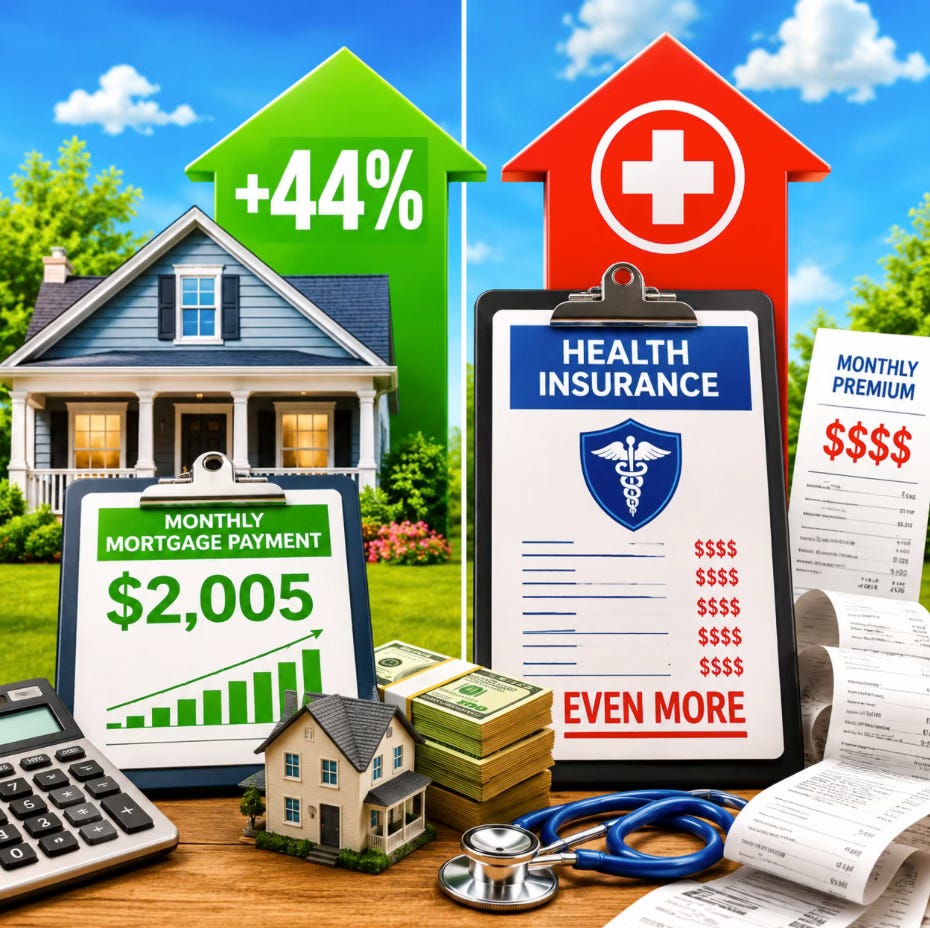
Housing costs have emerged as a critical pressure point, with mortgage payments soaring 44% since 2021 to an average of $2,005 monthly, while property taxes climbed 15% over five years and homeowners’ insurance skyrocketed 70% due to climate risk pricing. This steep rise, coupled with health insurance costs now exceeding $2,200 per month—surpassing even mortgage payments—forces many, especially those on fixed incomes, to make difficult financial decisions, including seeking emergency support and cutting back on essentials.
Energy costs, exacerbated by geopolitical tensions such as the Iran war, have sharply increased, with gasoline prices jumping over 40% year-over-year and averaging around $4.50 per gallon nationally by mid-2026. These surges have added nearly $750 in quarterly expenses per household and contributed to inflation spikes that outpace wage growth, eroding consumer spending power and pushing two-thirds of Americans to slash discretionary spending amid rising grocery and utility bills.
The cumulative effect of rising essential costs—housing, healthcare, energy, and food—has created a financial 'math problem' for many families whose incomes remain stagnant, forcing drastic lifestyle changes such as moving, selling homes, or cutting back severely on non-essentials. As Kerigan Rosado puts it, escalating prices for necessities like food, gas, and electricity have led to halted spending in other areas, underscoring the persistent erosion of the American standard of living and fueling widespread economic anxiety reflected in declining consumer confidence.





Wage Growth’s Hidden Crisis
Stagnant real wages and surging living costs are eroding middle-class security and widening the gap between high- and low-income households—even for six-figure earners.
Since 2020, nominal wages in the U.S. have increased by approximately 31%, yet when adjusted for inflation, real wage growth has been a mere 3.7%, illustrating how soaring prices have largely eroded purchasing power. This stagnation in real income is starkly contrasted by the sharp rise in essential costs—gas services up 56%, electricity 41%, and auto insurance 56%—which disproportionately strain middle- and lower-income households, undermining middle-class prosperity despite a seemingly robust economy.
Lower-income Americans are increasingly forced to dip into savings to cover everyday expenses, with Kraft Heinz CEO Steve Cahillane highlighting 'negative cash flows' among these groups. Despite cutting back on gas consumption by 7%, households earning under $40,000 still spent 12% more on fuel in March, underscoring how inflation-driven energy costs exacerbate financial stress and widen the gap between high- and low-income earners beyond levels seen during the 2022 price spikes following the Ukraine conflict.
Financial strain extends beyond lower earners; even six-figure professionals like nurse practitioner Kris Massey describe their situations as 'untenable' amid years of rapid price increases and job instability. This widespread stagnation in real wages, coupled with a decade-high wealth gap, has led many workers to max out overtime and halt retirement contributions, signaling a breaking point where economic growth no longer translates into financial security for the majority fueling it.
By mid-2026, inflation spikes—fueled notably by a 40.5% surge in gasoline prices linked to geopolitical tensions—have pushed consumer inflation to 4.2% year-over-year, causing real wages to decline by nearly 0.8%. This erosion of purchasing power, combined with rising food and rent costs expected to climb 5.8% and 7.4% respectively, has intensified financial anxiety, with 66% of Americans living paycheck to paycheck and growing fears of job loss and debt delinquency, particularly among lower- and middle-income groups.



Debt and Savings Squeeze
Record household debt and plummeting savings rates are pushing more Americans to rely on credit and cut retirement contributions, threatening long-term financial stability.
Despite nominal wage increases of about 31% since 2020, real wage growth has barely kept pace at 3.7%, as inflation and soaring essential costs—gas up 56%, electricity 41%, and auto insurance 56%—have outstripped income gains. This imbalance has forced American families, especially lower-income households, into difficult financial trade-offs, such as cutting back on savings or relying more heavily on credit, with the personal savings rate plummeting to 3.6% in March 2026, the lowest since the 2022 'revenge spending' surge. Kraft Heinz CEO Steve Cahillane highlights this strain, noting negative cash flows among lower-income groups dipping into savings just to cover rising expenses.
Household debt burdens have reached unprecedented levels, with total debt hitting a record $18.8 trillion in Q1 2026 and delinquency rates climbing across mortgages, auto loans, credit cards, and student loans. While some progress is seen in long-term student loan repayments—delinquencies over 90 days fell from 16.2% to 10.9%—the overall financial picture is grim, exacerbated by stalled job growth and a 10.9% rise in energy costs since the Iran war began. This environment has pushed bankruptcy filings higher for three consecutive years and forced many workers to halt retirement contributions and max out overtime hours just to stay afloat.
The financial squeeze extends beyond debt to the erosion of household savings and retirement security, as soaring costs for essentials like mortgage payments—which surged 44% to an average of $2,005 monthly—and health insurance, now exceeding $2,200 per month, severely limit disposable income. LIMRA's 2026 BEAT Study reveals that rising medical premiums have led over three-quarters of workers to face premium hikes, with nearly three-quarters of Gen Z workers cutting retirement contributions and other workplace benefits. Kimberly Landry of LIMRA warns that even a 1% reduction in 401(k) contributions can cost a Gen Z worker $20,000 over a 40-year career, underscoring the long-term consequences of these trade-offs.
Underlying this crisis is a widespread financial vulnerability to unexpected medical expenses and income loss, with only 45% of employees able to cover a $2,000 emergency medical bill and the majority struggling to maintain living expenses if a breadwinner loses income. The Employee Benefit Research Institute found that over half of those facing higher healthcare costs cut discretionary spending, about one-third struggled with bills, and one-quarter reduced retirement savings, painting a stark picture of how rising healthcare costs are forcing Americans into difficult financial trade-offs that threaten their long-term financial stability.

Anxiety Across All Incomes
Financial stress is now so widespread that even high earners are shopping at discount stores, as nearly two-thirds of Americans live paycheck to paycheck.
By early 2026, consumer sentiment in the U.S. had sunk to historic lows, with 55% of Americans reporting their financial situations were worsening for the fifth consecutive year, a trend sharply driven by the persistent high costs of essentials like housing, gas, and healthcare. Despite inflation easing from its 2022 peak, rising ancillary housing expenses—such as a 15% increase in property taxes and a 70% surge in homeowners insurance due to climate risk pricing—have compounded affordability challenges, pushing many households to cut discretionary spending and intensify financial anxiety across demographics.
Economic uncertainty fueled by geopolitical tensions, notably the Iran war, alongside domestic political pressures, has exacerbated consumer fears, driving inflation spikes—such as a 40.5% rise in gasoline prices—and eroding real wages by nearly 0.8%. This volatile environment has forced workers like 24-year-old Uber driver Cameron Toroni to grapple with rent costs that far outpace their incomes, while even higher earners like nurse practitioner Kris Massey face financial strain after months of unemployment, illustrating the broad demographic reach of this financial unease.
Financial anxiety permeates all income levels, with nearly two-thirds of Americans living paycheck to paycheck and many dipping into savings to cover essentials, as noted by Kraft Heinz CEO Steve Cahillane. The pressure is so acute that Walmart CEO John Furner observed an uptick in six-figure earners shopping at discount retailers, signaling a widespread retrenchment in spending habits. This retrenchment is reflected in surveys showing 66% of Americans slashing discretionary spending, with lower- and middle-income households bearing the brunt of eroded purchasing power amid a widening wealth gap.
Healthcare affordability has emerged as a critical flashpoint of financial anxiety, with only 49% of U.S. adults considered 'cost secure' in 2025, down sharply from 61% in 2022. Rising medical expenses contribute significantly to daily stress, disproportionately affecting younger adults, women, and older populations alike. Personal stories like that of Inger Perez, who shared, 'I literally was crying last night because I’m nervous about what I’m going to find out and how much care that is and how much money that is,' underscore the emotional toll of these economic pressures and the pervasive fear surrounding healthcare costs.

Medical Debt’s New Trap
Exploding medical bills and high-deductible insurance plans are driving millions deeper into debt, with policy fixes often compounding the burden instead of easing it.
By mid-2026, the U.S. healthcare system's affordability crisis had deepened, with roughly 100 million Americans—41% of working-age adults—carrying a staggering $220 billion in medical debt, severely undermining their financial stability and credit access. The expansion of 'skinny' and catastrophic insurance plans featuring deductibles as high as $31,000 has left many exposed to crippling out-of-pocket costs, as exemplified by David Stahl, a teacher who, despite choosing a high-deductible plan with a health savings account, faced a $7,400 emergency room bill after his son's injuries, now paying $175 monthly to manage hospital debt. This trend reflects a systemic failure where insurance products intended to provide coverage instead gamble on consumers' ability to avoid serious illness, often exacerbating financial vulnerability rather than alleviating it.
Policy proposals under the Trump administration to allow insurers to offer loans for medical debt effectively shift the financial burden onto patients, potentially increasing their indebtedness through interest payments rather than providing genuine relief. Critics argue these measures exploit patients' desperation, turning healthcare affordability into a profit center for insurance companies rather than addressing the root causes of medical debt. This approach compounds the challenges faced by individuals already struggling with high premiums and deductibles, as it fails to stem the tide of escalating healthcare costs or improve access to quality care.
Rising healthcare premiums are forcing American workers, especially younger generations like Gen Z, to make difficult financial trade-offs, including cutting retirement savings and other benefits, thereby jeopardizing their long-term economic security. LIMRA's 2026 study reveals that over three-quarters of workers faced premium hikes, with nearly three-quarters of Gen Z respondents reducing spending elsewhere to cope. Moreover, only 45% of employees felt capable of covering an unexpected $2,000 medical bill, highlighting significant gaps in supplemental insurance coverage and underscoring the precariousness of many households’ financial resilience amid rising healthcare costs.
Recent polling from late 2025 into 2026 paints a grim picture of healthcare affordability, with only 49% of U.S. adults considered 'cost secure'—a sharp decline from 61% in 2022—amid record-high anxiety about affording care. This erosion of cost security disproportionately affects vulnerable groups such as young adults, women, and older adults, with only about one-third of those under 30 feeling secure. Stories like Twannetta Weaver’s, who delayed her college graduation due to overwhelming medical bills from a back injury despite having a high-deductible plan, and Inger Perez’s experience with limited provider networks in lower-cost ACA plans, illustrate how high deductibles and out-of-pocket costs force patients to make painful sacrifices, further restricting access to quality healthcare.



Iran War Fuels Inflation Spiral
Geopolitical shocks from the Iran conflict have triggered massive energy price spikes and a sharp drop in economic confidence, deepening household financial pain and reshaping the political landscape.
The ongoing Iran war has significantly intensified economic anxieties among Americans, with over 55% reporting a worsening financial situation—the lowest economic sentiment since the Great Recession. This geopolitical conflict has directly fueled a 4.2% inflation spike as of May 2026, driven largely by soaring energy costs, including a 40.5% surge in gasoline prices, which have collectively cost U.S. households nearly $100 billion in just three months, according to Moody’s Analytics. These inflationary pressures have eroded real wages by approximately 0.8%, pushing consumer sentiment to a four-year low and exacerbating financial strain on households already grappling with rising mortgage and health insurance costs.
Economic pressures stemming from the Iran war and persistent inflation have heightened political risks for the Trump administration ahead of the November 2026 midterm elections. President Trump’s approval rating has dipped to 34%, reflecting widespread skepticism about his economic stewardship amid rising household debt—now a record $18.8 trillion—and increasing delinquency rates across mortgages, auto loans, and credit cards. As four in ten Americans worry about paying monthly bills, these financial strains disproportionately impact lower-income groups, potentially shifting voter behavior and challenging Republican prospects in key battlegrounds.
While the Federal Reserve contemplates rate hikes to combat inflation, financial markets like the S&P 500 have shown surprising resilience, underscoring complex economic dynamics influenced by geopolitical developments. Optimism around a potential U.S.-Iran peace agreement briefly eased oil prices, suggesting that diplomatic breakthroughs could alleviate inflationary pressures. However, ongoing refinery disruptions and energy cost volatility continue to stoke inflation, offsetting fiscal policy benefits such as Trump’s tax cuts and complicating the economic landscape as the nation approaches critical elections.
The intersection of escalating household expenses and geopolitical instability has created a volatile environment that threatens both economic stability and political outcomes. With inflation continuing to deteriorate as the Iran war drags on, essential costs like gas and healthcare are rising sharply, intensifying financial hardship for American families. This sustained economic strain not only undermines consumer confidence but also raises the stakes for policymakers and politicians, as voter sentiment increasingly hinges on the resolution of these intertwined economic and geopolitical crises.