Stock market soars, wallets suffer: america’s k-shaped divide hits breaking point
The gist
America’s economy is booming for the wealthy, but millions are buckling under debt, sky-high prices, and a historic divide that’s pushing wallets—and patience—to the breaking point.
What to know
- The top 40% now control 85% of U.S. wealth, riding a 90% stock market surge while credit card delinquencies among lower-income households hit levels not seen since 2011.
- Gasoline prices are flirting with $4 per gallon after a 35% spike in crude oil, squeezing budgets as 28 million Americans skip meals to afford essentials.
- AI and tight labor markets threaten 20% of jobs in the next five years, fueling anxiety as consumer sentiment slumps to a record-low 48.2 despite headline GDP and market gains.
America’s Economic Chasm Widens
Wealthy Americans accelerate luxury spending as most households face stagnant wages, mounting debt, and a Gini coefficient now higher than pre-revolutionary France.
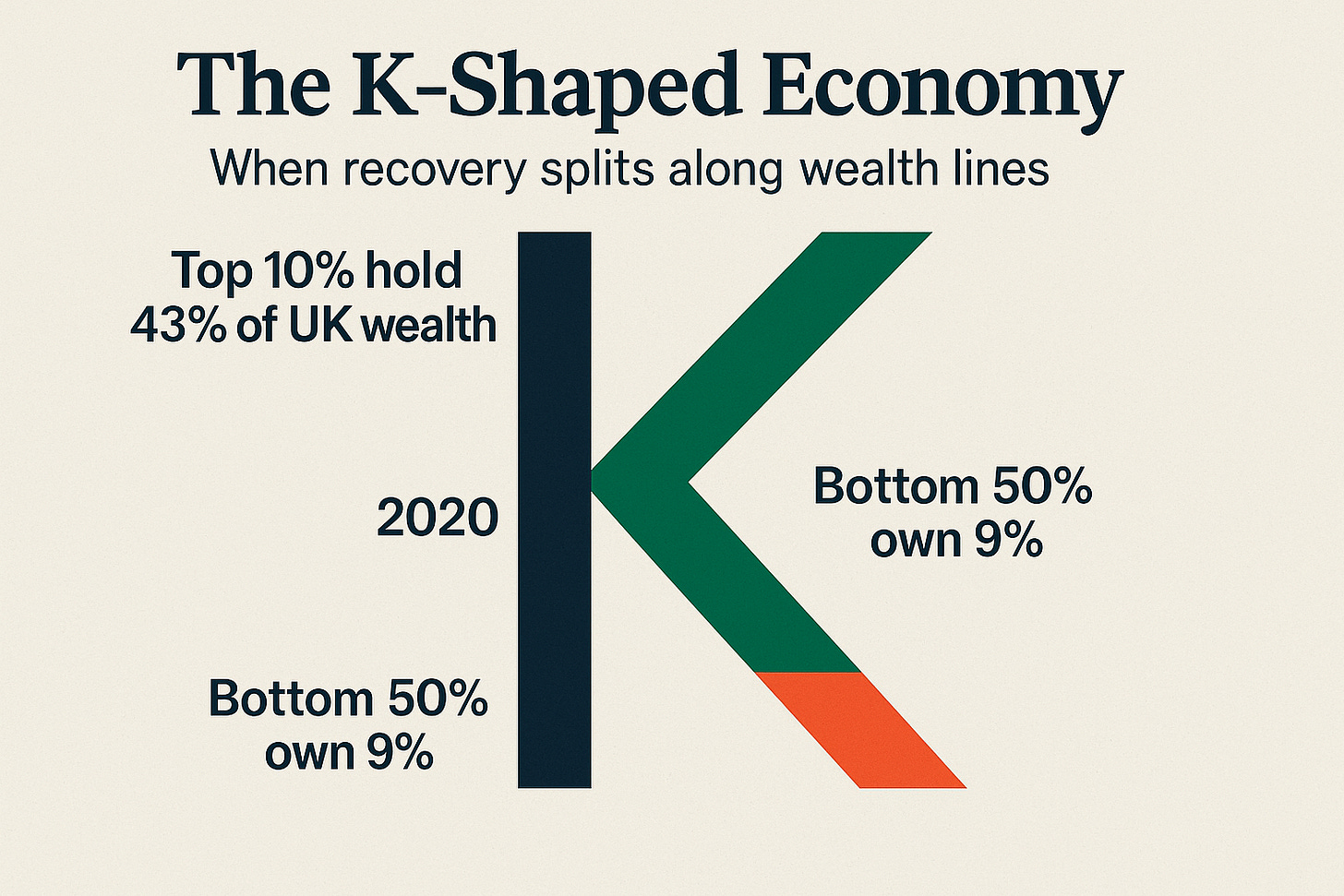
The K-shaped recovery vividly illustrates a growing economic chasm where wealthier households reap the benefits of soaring asset values and discretionary spending, while lower- and middle-income groups grapple with stagnant wages, rising debt, and shrinking savings. For instance, Morgan Stanley reports that the top 40% control 85% of America’s wealth, much of it tied to stock markets that have surged over 90% in three years, enabling affluent consumers to maintain or even increase premium spending, as seen in Delta’s expectation that premium and business travel revenue will surpass main cabin by 2026. Conversely, lower-income consumers are cutting back on essentials and discretionary purchases, with McDonald’s CEO noting that many are skipping meals or eating at home, and Federal Reserve research revealing a sharp decline in gasoline consumption among this group. This divergence is further underscored by credit trends: while mortgage delinquencies remain historically low among homeowners, credit card delinquencies have reached levels not seen since 2011, signaling acute financial stress among less wealthy Americans who increasingly rely on debt to cover daily expenses.
Despite headline economic indicators like a 2.2% GDP growth and a 16% rise in the S&P 500, the lived experience for most Americans tells a starkly different story marked by financial fragility and widening inequality. Nearly two-thirds live paycheck to paycheck, with 28 million skipping meals to afford medication, and young homebuyers’ share plummeting from 40% in the 1990s to 21% today. The U.S. Gini coefficient has soared to an alarming 0.85—surpassing the 0.83 level France had in 1789—highlighting the severity of income inequality and its potential social consequences. As economist Gary Hoover summarized, “Things are holding steady or improving for those at the top, and declining for those at the bottom,” a sentiment echoed by Peter Atwater’s observation of a “sea of despair” among lower-income groups contrasted with a small cohort experiencing intense certainty and control.
The economic divide is further exacerbated by the fading of fiscal supports and rising costs in 2026, which Goldman Sachs economist David Mericle warns will deepen the K-shaped recovery’s impact. While some earlier analyses suggested a more uniform inflation and income trend, the erosion of relief measures and spikes in essentials like gasoline disproportionately strain lower-income households. This is reflected in rising personal loan applications and credit card usage among financially stressed groups, with 57% of those behind on credit card payments expecting repayment to take six months or longer. Meanwhile, homeowners—who typically have a median net worth nearly 40 times that of renters—continue to manage mortgage debt effectively, reinforcing the divide between those cushioned by assets and those vulnerable to economic shocks.




Credit Stress Hits All Ranks
Rising delinquencies and depleted savings are pushing even middle-class and affluent Americans into a precarious cycle of debt, with credit card balances at a record $1.28 trillion.
Consumer financial stress has intensified dramatically since late 2025, with credit card delinquencies reaching levels not seen since the Great Depression and auto loan delinquencies rising across all income groups. Initially concentrated among lower-income households struggling with limited savings and inflation, by 2023 middle- and higher-income consumers also faced mounting pressures as major expenses like rent, childcare, and education scaled with income, eroding their financial buffers. Despite a brief easing in auto loan delinquencies among wealthier households by mid-2023, the overall trend points to a broadening crisis in consumer credit health, underscored by a personal savings rate plummeting to stressed levels around 3.5% and credit card balances soaring to $1.28 trillion with APRs averaging 22.3%.
This growing reliance on credit to fund spending amid stagnant real incomes and depleted savings has created a precarious financial landscape, especially for vulnerable groups. Younger consumers, burdened by student debt and high housing costs, are increasingly turning to multiple coping strategies including credit card installment plans, which have surged from 23% to 36% usage between 2025 and 2026, reflecting a preference for predictable repayment amid rising delinquency rates. Meanwhile, the bottom 50% of earners face a stark reality of rising delinquencies and plummeting savings, with nearly 10% of student loan balances over 90 days late and credit card delinquency rates climbing to a 15-year high, highlighting a K-shaped recovery where economic resilience is unevenly distributed.
Despite headline consumer spending growth supporting roughly two-thirds of US GDP and sectors like travel and dining out showing resilience, this strength masks deepening financial fragility beneath the surface. Inflationary pressures, particularly soaring energy costs with gasoline nearing $4 per gallon, have squeezed discretionary budgets, forcing many households—especially lower and middle income—to reduce spending, rely more heavily on credit, and adopt complex financial management strategies. Consumer confidence has plummeted to its lowest since 2014, with the University of Michigan’s Consumer Sentiment Index hitting an all-time low of 48.2 in May 2026, signaling that the current consumption levels may be unsustainable as financial buffers vanish and debt burdens mount.
The widening economic divide is starkly evident in debt dynamics, where homeowners with median net worths near $400,000 manage mortgage debt sustainably with low delinquency rates, while renters and lower-income groups—often carrying unsecured and high-interest debt—face escalating financial strain. This disparity fuels a K-shaped recovery, as noted by economist Gary Hoover: 'things are holding steady or improving for those at the top, and declining for those at the bottom.' The growing dependence on credit and installment plans among those least able to afford it, combined with rising fraud losses and shrinking savings, underscores the unsustainable nature of current consumer financial health and foreshadows potential market vulnerabilities akin to those preceding the 2008 crisis.


Stagflation Pressures Mount
Service-sector inflation and global energy shocks are driving up costs and squeezing households, with persistent wage pressures and tariffs fueling a ‘stagflation light’ economy.
Persistent inflationary pressures in the services sector, especially health care, are fueled by labor market constraints such as declining immigration and accelerating retirements, which keep wage pressures elevated despite slowing demand. Michael Reid highlights that health care alone is expected to add 50,000 to 60,000 jobs monthly over the next five years, sustaining inflation in service-intensive areas even as overall growth remains below trend, creating a 'stagflation light' environment reinforced by tariffs and supply chain disruptions.
Geopolitical tensions in the Middle East, notably the Iran war and disruptions at the Strait of Hormuz, have triggered a sharp surge in oil prices—U.S. crude oil spiked 35% in one week with Brent briefly hitting $119—exacerbating energy costs that cascade through global supply chains. This energy shock, affecting 20% of the world’s oil supply and 35% of fertilizer exports, has intensified inflationary pressures on consumer goods, disproportionately burdening lower-income households who face rising credit delinquencies and shrinking discretionary budgets.
The combined effect of rising energy prices and a weakening labor market is heightening stagflation risks, complicating Federal Reserve policy as core inflation stubbornly remains above 3% and wage growth fails to keep pace with surging costs. Gasoline prices nearing $4 per gallon—already $3.93 in Florida and $6.16 in California—are causing 'sticker shock' that forces consumers, particularly lower-income earners, to alter spending habits by switching gas stations, carpooling, or considering electric vehicles, while credit card debt surges amid increasing APRs, deepening financial insecurity.
Energy inflation is squeezing household budgets across multiple essential categories—housing, transportation, food, and utilities—leading to behavioral shifts such as breaking up purchases and cutting discretionary spending, especially among lower-income consumers with limited flexibility. Although some short-term cushions like unspent tax refunds temporarily soften the blow, the persistent rise in energy costs and geopolitical uncertainty elevate recession risks to around 40%, with consumer confidence and spending increasingly polarized along income lines as higher-income households sustain premium product demand while others retrench.






AI Fuels Job Market Anxiety
AI-driven disruption threatens 20% of jobs and amplifies wage stagnation, forcing the Fed to juggle persistent inflation with rising unemployment risks.
AI is poised to disrupt about 20% of occupations within the next three to five years, fundamentally altering work patterns as noted by Joe Davis, who highlights this as the most significant shift in daily work routines in over 25 years. While AI-driven productivity gains may benefit a majority of workers, this transformation fuels anxiety amid rising unemployment risks and wage stagnation, especially for lower-income households, complicating the Federal Reserve’s challenge of balancing price stability with maximum employment.
By late 2025, the labor market showed clear signs of strain with unemployment expected to rise to 4.7% by year-end, driven by a hiring pullback in rate-sensitive sectors such as manufacturing and small businesses, as Veronica Clark explains. This bifurcation sees smaller firms struggling under restrictive rates while larger corporations like Digital Bridge continue to thrive, underscoring a divided economy where robust corporate earnings coexist with weakening job prospects for many workers.
The labor market challenges are compounded by demographic shifts—falling immigration and accelerating retirements—that sustain wage pressures despite slowing demand, with healthcare employment expanding by 50,000 to 60,000 jobs monthly due to an aging population. The Federal Reserve appears to be running the economy hot to maintain employment levels and offset early-stage AI disruptions, aiming to mitigate automation-driven job losses even as uncertainties linger around tariff impacts and inflation.
Young, debt-burdened workers face mounting difficulties as AI adoption curtails hiring in white-collar entry-level roles, exacerbating financial stress amid rising credit card interest and auto loan delinquencies. Despite these pressures, labor market data has yet to fully reflect the strain, with lower quit rates and fewer opportunities for higher-paying jobs, while manual labor sectors reliant on immigrant workers increasingly turn to automation—such as automated mowers in landscaping—highlighting a labor market in flux as unemployment climbs and economic insecurity deepens by early 2026.
Spending Splits the Consumer
Affluent shoppers prop up retail and restaurant sales while lower-income and younger Americans cut back, rely on credit, and mask deeper financial fragility.
By late 2025, corporate earnings revealed a stark economic divide in consumer spending patterns, with wealthier households maintaining resilient demand while lower-income groups exhibited marked caution. McDonald’s CEO highlighted persistent weakness among lower-income consumers, a trend echoed by slowing same-store sales at Chipotle, Cava, and Sweetgreen. This bifurcation prompted retail and restaurant sectors to adjust strategies amid economic uncertainty, as seen in Sweetgreen’s lowered sales guidance and DoorDash’s stock decline despite revenue growth, reflecting investor skepticism about the sustainability of current spending levels and concerns over inflated valuations.
Entering 2026, the consumer spending landscape remained sharply divided, with affluent households driving overall resilience while middle- and mass-affluent groups faced growing financial stress. Analyst Joe Feldman described the mass affluent—those in the 70th to 90th income percentiles—as aspirational shoppers constrained by slower wage growth and tougher job prospects, impacting retailers like Saks, which struggled due to pandemic-era overpricing and management missteps. Meanwhile, value-oriented retailers such as Walmart saw gains, contrasting with slight declines at TJ Maxx, illustrating shifting consumer preferences amid economic uncertainty.
Despite record-low consumer sentiment plunging to historic lows by mid-2026, especially among middle-aged consumers, spending remained robust but increasingly precarious. Consumers are outpacing income growth—adjusted spending rose 2.6% through November 2025 while disposable income grew only 1%—forcing many to deplete savings or rely on credit. This dynamic is particularly acute for younger and lower-income consumers who employ multiple coping strategies such as cutting discretionary spending, using installment plans, and borrowing from family, underscoring a widening K-shaped recovery where wealthier households sustain spending and mask deeper financial strains.
Retail sector performance and strategies reflect this growing divide, with companies serving higher-income consumers or essentials better positioned amid economic headwinds. Walmart’s broad appeal to both lower-income essentials shoppers and higher earners trading down contrasts with TJX’s focus on wealthier consumers seeking premium brands at discounts. Meanwhile, rising gasoline prices—surging 21% due to Middle East conflicts—have squeezed lower-income households disproportionately, leading to cautious spending that depresses discretionary categories like beer, while premium beverage brands show resilience. Analysts warn that consumer discretionary stocks exposed to lower-income consumers face the greatest risks, as the disconnect between record-high stock markets and record-low consumer sentiment signals potential for a significant spending slowdown.






Fed’s Tightrope Gets Riskier
The Federal Reserve faces a no-win scenario as sticky inflation, tariff shocks, and AI-driven labor shifts limit policy options and deepen the K-shaped divide.
The Federal Reserve is navigating a precarious balancing act between controlling persistent inflation and supporting employment amid complex challenges such as tariff-induced price pressures and AI-driven labor disruptions. As Joe Davis noted, the Fed is operating in a 'data blind spot' trying to manage sticky inflation while asset prices inflate, with tariff-related costs disproportionately burdening lower-income households and exacerbating economic divides. This complexity is compounded by structural labor market shifts, including declining immigration and accelerating retirements, which keep unemployment low but wage pressures high, forcing the Fed to tolerate some labor market tightness to preserve jobs as AI reshapes the workforce.
By early 2026, the Fed’s policy stance is expected to shift toward easing, with analysts like Veronica Clark forecasting interest rate cuts in January and March in response to a weakening labor market, despite ongoing inflation risks. However, this dovish tilt is complicated by geopolitical energy shocks and rising import inflation, which threaten to keep inflation sticky around 3%, as highlighted by recent PCE data and the Iran war oil shock. These pressures limit the Fed’s ability to cut rates without risking a resurgence of inflation, underscoring the constrained effectiveness of traditional monetary tools in the current stagflation-like environment.
Economic insecurity remains a pressing political and social issue, with half of Americans living paycheck to paycheck and affordability—especially healthcare costs—dominating voter concerns ahead of midterms. Despite wage gains and Social Security adjustments cushioning higher-income groups, lower-income households face delayed inflation effects and rising credit card delinquencies, as Ian Wyatt and other analysts emphasize. This growing divide limits the impact of policy measures, with the administration largely reliant on cyclical economic improvements and temporary boosts from tax refunds and stimulus, while structural challenges and depleted savings constrain consumer resilience and spending.
The Fed’s dual mandate is increasingly difficult to fulfill as persistent inflation, driven by labor supply constraints and geopolitical tensions, clashes with a cooling labor market and fragile consumer finances. Chair Jerome Powell’s admission that net job creation is 'pretty close to zero' despite positive GDP and stock market signals highlights the uneven recovery. Meanwhile, political leadership’s dismissive stance toward consumer hardships amid inflation and geopolitical crises, as noted by Kevin Hassett, further underscores the limitations of current policy tools to bridge the widening economic divide and address affordability challenges effectively.