Super el niño looms: global race to avert climate chaos
The gist
A record-breaking super El Niño could hit by late 2026, unleashing global weather chaos and threatening food security on a scale not seen since the 19th century.
What to know
- NOAA puts the odds of a super El Niño at 63–70% by mid-to-late 2026, with impacts possibly surpassing the catastrophic 1877 event.
- Global agencies like FAO and WFP are scrambling for $202 million to shield nearly 9 million people across 22 high-risk countries from floods, droughts, and hunger.
- India’s Telangana state is rolling out hyper-local crop plans and water management, while UN leaders call for urgent fossil fuel cuts to reduce long-term El Niño risk.
El Niño’s Deadly Legacy
Super El Niño events have repeatedly triggered global famines, regime collapses, and stark inequalities—revealing that political and economic readiness, not just climate, determines who survives the chaos.
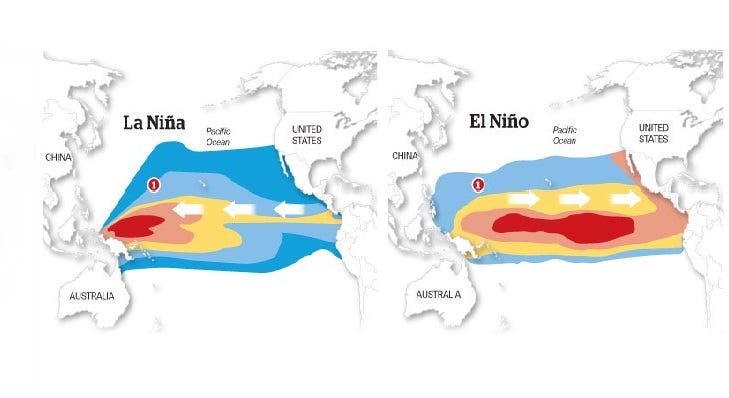
A super El Niño is defined by anomalously high sea surface temperatures in the tropical Pacific, triggered when the Walker circulation weakens and trade winds lose strength, allowing warm waters to shift eastward toward South America. This phenomenon, part of the ENSO cycle that recurs every 2 to 7 years, disrupts global weather patterns, causing droughts, floods, and heatwaves worldwide. NOAA's 2026 forecasts estimate a 63% to 70% chance of an exceptionally intense El Niño event developing by mid to late 2026, potentially surpassing the historic 1877 event in magnitude and climatic impact.
Historically, super El Niño events have precipitated severe social crises, including famines and epidemics that disproportionately affected vulnerable populations and strained governance structures. The 1877 El Niño alone resulted in tens of millions of deaths across India, China, Egypt, and Brazil, with David Wallace-Wells highlighting the 'lasting social consequences' that feudal systems were ill-equipped to manage. Even earlier, around 2180 BCE, droughts linked to ENSO disruptions contributed to the collapse of Egypt's Old Kingdom, underscoring the profound societal vulnerabilities to these climatic shifts.
The forthcoming super El Niño's impacts will be unevenly distributed, shaped by each country's political economy and preparedness. For instance, China’s substantial investments in food and energy self-sufficiency may buffer it against global supply chain shocks, while India remains 'remarkably susceptible' to disruptions amid rising temperatures and fragile food systems. This disparity highlights how socioeconomic factors critically influence resilience to El Niño-induced climatic extremes.
Recent El Niño events, such as the 2023-2024 episode, have already demonstrated the phenomenon's capacity to exacerbate extreme weather and social stress, triggering droughts and famines in southern Africa and unprecedented floods in southern Brazil. These events contributed to 2024 becoming the hottest year on record, signaling how super El Niño episodes compound existing climate change trends to intensify global vulnerabilities.


Anticipating Disaster, Not Reacting
Countries and aid agencies are pivoting to early interventions and ecosystem defenses, deploying risk maps, resilient crops, and cash assistance to outmaneuver El Niño’s threats before they spiral into humanitarian crises.
By mid-2026, global and national preparedness strategies for El Niño have coalesced around anticipatory actions such as early planting, risk mapping, and robust early warning systems. Countries like Indonesia promote early rice planting to mitigate drought, India prepares contingency plans for over 300 vulnerable districts by shifting to short-cycle, low-water crops, and Peru develops detailed risk maps to identify vulnerable populations and infrastructure. These efforts are complemented by ecosystem protection measures—healthy forests, wetlands, and watersheds serve as natural buffers that regulate water cycles and reduce flood and erosion risks, while early warning systems enable communities to organize shelters, protect the elderly, and safeguard livestock.
International organizations such as the FAO and World Food Programme have taken a leading role in coordinating anticipatory interventions, launching a joint appeal in July 2026 seeking $202 million to protect nearly 9 million people across 22 high-risk countries including Cameroon, Colombia, Ethiopia, Kenya, and Madagascar. Their strategy emphasizes financial support, distribution of drought- and flood-resistant seeds, water management investments, veterinary care, and anticipatory cash assistance to farmers and pastoralists. This proactive approach aims to prevent El Niño-induced droughts and floods from escalating into full-blown humanitarian crises by scaling up early interventions and strengthening early warning systems.
Recognizing that El Niño impacts disproportionately affect regions already grappling with conflict and economic stress, global preparedness efforts are increasingly tailored to address compounded vulnerabilities. Jorge Alvar-Beltrán, FAO Natural Resources Officer, underscores that “this new phase will hit hardest in places that are already vulnerable and have limited coping capacity,” highlighting the necessity for context-specific mitigation strategies that integrate climate resilience with socio-political realities. This nuanced focus ensures that resources and interventions are directed where they can most effectively reduce risk and enhance community resilience.
While immediate mitigation focuses on anticipatory actions and ecosystem protection, global leaders stress that addressing El Niño’s root causes requires broader climate action. UN Secretary-General António Guterres emphasized that the only effective long-term response is “una acción climática a la altura de la crisis, que pase por acabar con la adicción a los combustibles fósiles y acelerar la transición a las energías renovables,” calling for an accelerated shift away from fossil fuels toward renewable energy to reduce the frequency and severity of climate extremes like El Niño.
Telangana’s Hyper-Local Defense
Telangana’s district-level strategies—combining climate-smart farming and targeted water management—aim to shield the state’s most vulnerable communities from El Niño’s double blow of drought and floods.
Telangana has transitioned from reactive crisis management to proactive, district-specific planning to mitigate El Niño’s multifaceted impacts, emphasizing continuous monitoring of rainfall, soil moisture, and vegetation as CRIDA director Vinod Kumar Singh advocates. This comprehensive approach integrates agricultural resilience with socio-economic safeguards, recognizing El Niño as a challenge that threatens livelihoods, food security, and exacerbates inequalities among vulnerable groups such as small farmers and low-income urban households, as highlighted by Professor Jeena T Srinivasan.
Agricultural adaptation in Telangana is finely tuned to local agro-climatic conditions, promoting delayed sowing, short-duration and drought-tolerant crops, and intercropping to withstand dry spells. Districts like Adilabad, Karimnagar, and Nalgonda are encouraged to replace water-intensive crops with pulses, millets, groundnut, sesame, and horticulture varieties, while soil moisture conservation and scientific nutrient management underpin these strategies, reflecting a nuanced shift towards climate-resilient cultivation.
Water management reforms are central to Telangana’s long-term resilience, with targeted investments in rainwater harvesting, groundwater recharge, farm ponds, check dams, and micro-irrigation systems such as drip and sprinkler irrigation. District-specific initiatives—like expanding farm ponds in Adilabad and drip irrigation in Mahabubnagar—demonstrate a granular approach to tackling the dual threats of drought and floods exacerbated by El Niño, as emphasized by water expert B. Venkateswara Rao.
To ensure effective implementation, Telangana’s preparedness plan incorporates timely logistical support and robust multi-departmental coordination, guaranteeing seed and fertilizer availability alongside strengthened weather advisories. Complementing these technical measures are social safety nets including village-level awareness campaigns in Karimnagar, toll-free farmer advisory services in Khammam, and district control rooms in Mahabubnagar, all designed to enhance real-time responsiveness and bolster farmer resilience amid climatic uncertainties.