Supreme court supercharges executive power as democracy ratings plunge: states and activists mount resistance
The gist
The Supreme Court has turbocharged presidential power and gutted voting protections, plunging U.S. democracy ratings while fueling a nationwide showdown between state resistance and an emboldened executive.
What to know
- A 2026 Supreme Court ruling gave Trump sweeping control over the DOJ, enabling politicized prosecutions and reviving debunked voter fraud claims.
- The Trump administration created a $1.776 billion DOJ fund for convicted allies and orchestrated nationwide voter roll purges that disproportionately disenfranchised minorities.
- State-level backlash is mounting—like Virginia’s court overturning a Democratic redistricting referendum—while democracy ratings hit record lows amid right-wing media consolidation.
Roberts Court Reshapes Power
Chief Justice Roberts’ decades-long campaign to expand presidential authority and dismantle voting protections has enabled politicized prosecutions, systematic voter disenfranchisement, and the sidelining of historic safeguards like the Hatch Act.
Chief Justice John Roberts has played a central role in expanding presidential control over the Department of Justice, notably through a 2026 Supreme Court ruling that granted Donald Trump unprecedented authority to direct DOJ investigations, effectively eroding the department's traditional independence. This legal shift, cited by Trump's lawyer John Lauro to claim criminal immunity, has enabled politicized prosecutions defended by Trump-appointed officials like Acting Attorney General Todd Blanche, who controversially asserted it was the president's 'right, and indeed...duty' to target political enemies. Such developments have sidelined longstanding safeguards like the Hatch Act, which since 1939 barred federal employees from election interference, allowing the DOJ under Trump to revive debunked voter fraud claims and dismiss ethical concerns about prosecutors investigating their own boss.
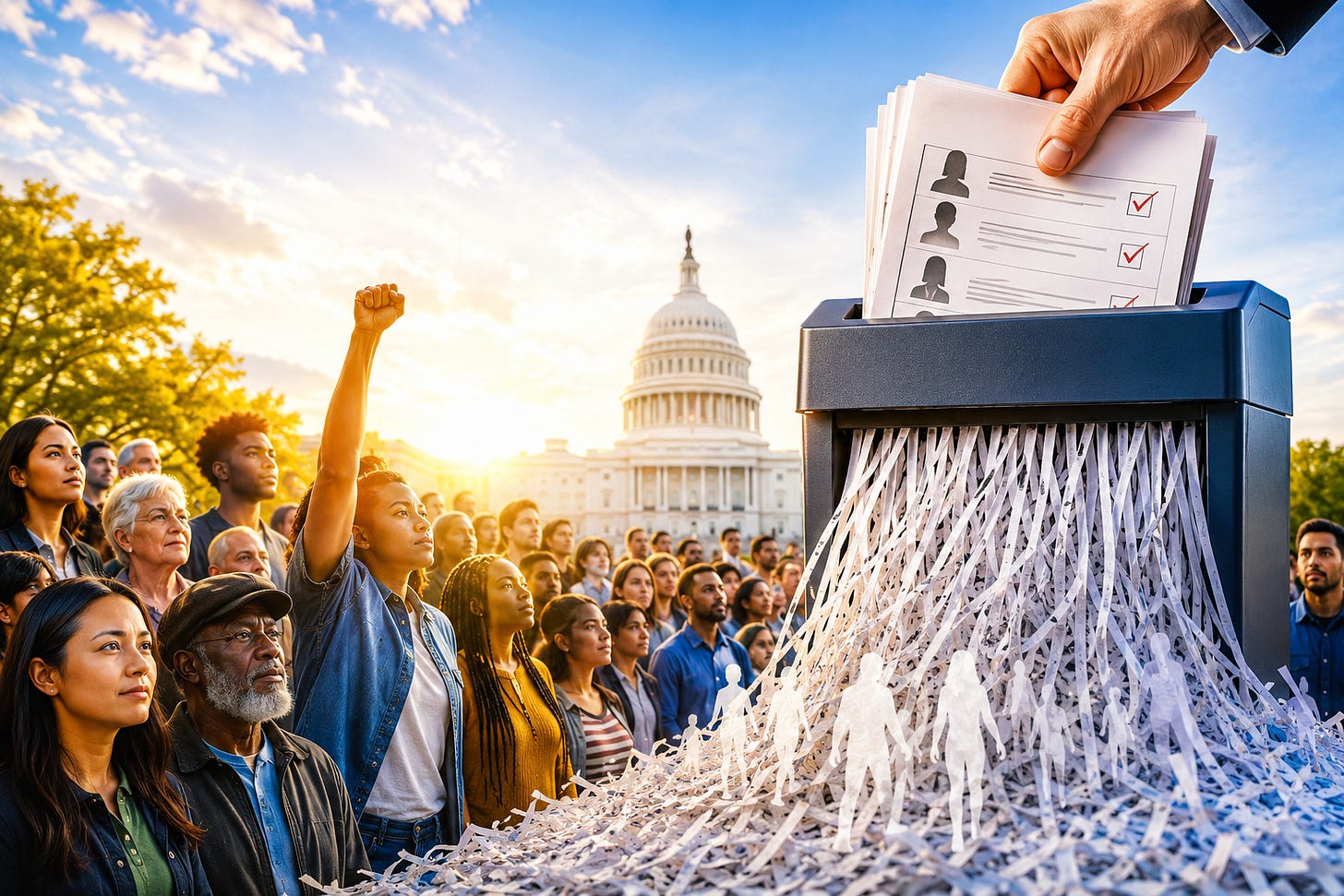
The Roberts Court has systematically undermined voting rights and democratic representation by gutting the Voting Rights Act and enabling partisan gerrymandering, as seen in the 2026 decisions that allowed state legislatures, including Tennessee’s, to redraw districts to disenfranchise Black voters. Roberts’ opposition to these protections dates back to a 1982 memo advocating their dismantling for the Reagan administration, reflecting a judicial agenda aligned with protecting conservative, billionaire interests. This erosion of electoral fairness was further exemplified by the Virginia Supreme Court’s politically motivated 4-3 ruling that overturned a voter-approved redistricting referendum, disenfranchising three million voters and threatening Democratic prospects in upcoming elections.
In a coordinated effort to suppress votes, the Trump administration has orchestrated a nationwide purge of voter rolls by demanding states hand over detailed voter data—including sensitive information like social security numbers and voting histories—with a 45-day deadline to remove 'ineligible voters.' This tactic echoes the 2000 Florida purge that disproportionately targeted Black and Hispanic voters, undermining election integrity and participation. Several GOP-controlled states, such as Texas and Ohio, have complied, facilitating these purges, while the Supreme Court, led by Roberts and Justice Alito, has abetted these efforts by relying on misleading data to dismantle key voting protections, effectively 'lying to our faces' as critics note.
Beyond legal maneuvers, the Trump administration has sought to destabilize election security by attempting to ban Dominion Voting Systems machines nationwide based on debunked conspiracy theories, with election-security czar Kurt Olsen pushing for a Commerce Department ban despite a $787 million Fox News defamation settlement. This effort involved misrepresenting foreign chip origins to manufacture a national security threat, thereby circumventing state-controlled election authority. Additionally, pressure on at least eight states to provide confidential election records and reopen dismissed fraud cases, coupled with proposals to replace audited machines with vulnerable hand-counted ballots, reveal a strategic campaign to erode judicial independence and election integrity. MAGA loyalists like Marjorie Taylor Greene have even publicly warned of potential authoritarian moves such as canceling the 2028 election, signaling a broader normalization of authoritarian governance centered on loyalty, retaliation, and concentrated executive power.




Corruption Becomes Policy
The Trump administration’s billion-dollar fund for convicted allies and efforts to shield the president from IRS scrutiny signal a seismic collapse of accountability, as partisan loyalty trumps constitutional limits and corruption is openly institutionalized.
By mid-2026, the Trump administration's blatant normalization of corruption reached unprecedented levels, epitomized by the Justice Department's establishment of a $1.776 billion fund to compensate Trump’s allies convicted of seditious conspiracy related to January 6th, a move sharply criticized as a 'political grievance fund' that flagrantly violates the Fourteenth Amendment’s prohibition against paying debts incurred in aid of insurrection. Representative Jamie Raskin condemned this as a dangerous disregard for constitutional limits, illustrating how partisan loyalty has overridden foundational principles of transparency and accountability, effectively enabling what one commentator called 'the most corrupt, lawless administration in American history' to operate with near impunity.
This erosion of democratic norms is further exacerbated by a pervasive partisan double standard that rationalizes corruption depending on who commits it. As Tom Bilyeu and other analysts observed, actions once universally condemned are now subject to revisionist histories and selective outrage, with corruption becoming 'cool' among certain factions. This shift has led to a toxic political environment where mutual disdain replaces a shared commitment to ethical governance, and calls for independent investigations into insider trading and other abuses go unheeded as both parties retreat into entrenched partisanship, wielding corruption as a political weapon rather than confronting it as a systemic problem.
The administration’s audacious attempt to institutionalize immunity from IRS audits for Trump and his business empire—via a one-page document signed by Acting Attorney General Todd Blanche declaring the government 'forever barred' from auditing Trump’s taxes—exemplifies the brazen efforts to place the president above the law. Legal experts and senators, including Sen. Ron Wyden, widely condemned this move as lacking any legal authority, underscoring the erosion of accountability mechanisms. Compounding this, the regime’s scheme to divert $1 billion of taxpayer funds, including $220 million earmarked for Trump’s private ballroom under the guise of Secret Service funding, was blocked by Senate parliamentarian Elizabeth MacDonough, highlighting both the depth of insider favoritism and the fragile institutional checks still resisting outright corruption.
Partisan loyalty continues to undermine transparency and accountability, as demonstrated by Trump’s immediate demand to fire Senate parliamentarian Elizabeth MacDonough after she blocked the corrupt funding scheme, with Senate Majority Leader John Thune refusing only for pragmatic reasons tied to legislative functionality rather than principle. This episode reveals a troubling dynamic where political expediency trumps ethical governance, allowing corrupt practices to persist under the veneer of party allegiance and strategic calculation, further destabilizing democratic institutions and eroding public trust.

State Resistance and Setbacks
From judicial reversals of voter-approved reforms to grassroots boycotts and targeted purges of anti-gerrymandering lawmakers, the battle over redistricting exposes the fierce, uneven fight for electoral fairness in the face of weakened federal protections.
The Virginia Supreme Court's May 2026 decision to strike down a voter-approved Democratic redistricting plan underscores the judiciary's pivotal role in shaping electoral maps and maintaining partisan advantages. By preserving a GOP-favored 6–5 House district split despite a referendum that would have shifted it dramatically to 10–1 Democratic control, the court not only nullified the will of 3 million voters but also highlighted the complex legal battles states face following the Supreme Court's limitations on race-based districting. This unprecedented ruling, described as 'cold water for Democrats,' exemplifies the broader national struggle over partisan gerrymandering amid weakened federal voting protections.
Resistance to authoritarian redistricting efforts is uneven across states, with blue trifecta states like California moving swiftly to protect democratic maps ahead of the 2028 cycle, while red states experience aggressive Trump-backed purges of lawmakers opposing gerrymandering. For example, Indiana primaries saw incumbents who resisted partisan mapmaking ousted by Trump-endorsed challengers, signaling a harsh political environment for defenders of electoral integrity. Meanwhile, Tennessee's legislature eliminated its sole Black-majority district shortly after the Supreme Court gutted the Voting Rights Act, illustrating how weakened federal safeguards embolden state-level disenfranchisement.
Beyond courts and legislatures, grassroots mobilization and political victories are vital frontlines in resisting authoritarian agendas. The NAACP's 'Out of Bounds' campaign, urging Black athletes to boycott public universities in eight Southern states over unfair maps, alongside the Congressional Black Caucus blocking the SCORE Act, demonstrate coordinated efforts to protect Black political power. Simultaneously, Keisha Lance Bottoms’ decisive win in Georgia’s Democratic gubernatorial primary and mass protests in Mississippi against Gov. Tate Reeves’s voting rights attacks reveal how state-level activism and electoral success are pushing back against attempts to undermine democracy.
State and local officials are increasingly forming coalitions to enforce legal accountability and safeguard voter rights against authoritarian overreach. The formation of FAFO, a coalition of nine prosecutors led by Philadelphia DA Larry Krasner, exemplifies this trend, with Krasner warning that voter intimidation will face consequences. Judicial resistance also extends to immigration policies, where over 10,000 court decisions—including rulings by Trump-appointed judges—have struck down aggressive ICE deportation rules, illustrating a robust, multifaceted state-level pushback to preserve democratic norms and human rights.


Media Power and Misinformation
Right-wing media consolidation and executive-driven misinformation campaigns have crippled independent journalism and destabilized election trust, accelerating America’s democratic decline and leaving public oversight in crisis.
By 2025, authoritative democracy indices such as V-Dem, Freedom House, and the Economist Intelligence Unit documented a stark decline in the health of American democracy, with ratings falling below critical thresholds not seen in decades and about 70% of Americans expressing dissatisfaction. This decline is particularly acute compared to other G7 nations, especially in areas like checks and balances and political rights, underscoring systemic challenges that have eroded foundational democratic governance in the U.S.
The consolidation of media ownership by right-wing billionaires including Jeff Bezos, the Ellison family, and the Murdochs has severely undermined independent journalism, a cornerstone for democratic accountability. By acquiring newspapers and TV networks and purging dissenting voices, these media moguls have diminished the watchdog role of the press, exacerbating public mistrust and weakening the democratic fabric at a time when transparency is most needed.
The Trump administration’s efforts to delegitimize election infrastructure, notably through attempts to ban Dominion Voting Systems based on thoroughly debunked conspiracy theories, exemplify how misinformation and executive overreach threaten democratic election processes. When no credible national security threat was found, officials resorted to fabricating justifications, such as mischaracterizing equipment origins, while pressuring states to release confidential election records and reopen dismissed fraud cases, thereby undermining constitutional protections of state-controlled elections.
Despite the administration’s push to replace the current election system—which combines electronic machines with paper trails and is broadly supported by experts like University of Michigan’s Alex Halderman—with hand-counted paper ballots, experts warn this would introduce chaos and heighten fraud risks. This clash highlights a broader erosion of democratic norms, where attempts to manipulate election security measures serve political ends rather than safeguarding the integrity of the vote.