Synopsys bets big on AI fusion, but acquisition growing pains rattle investors
The gist
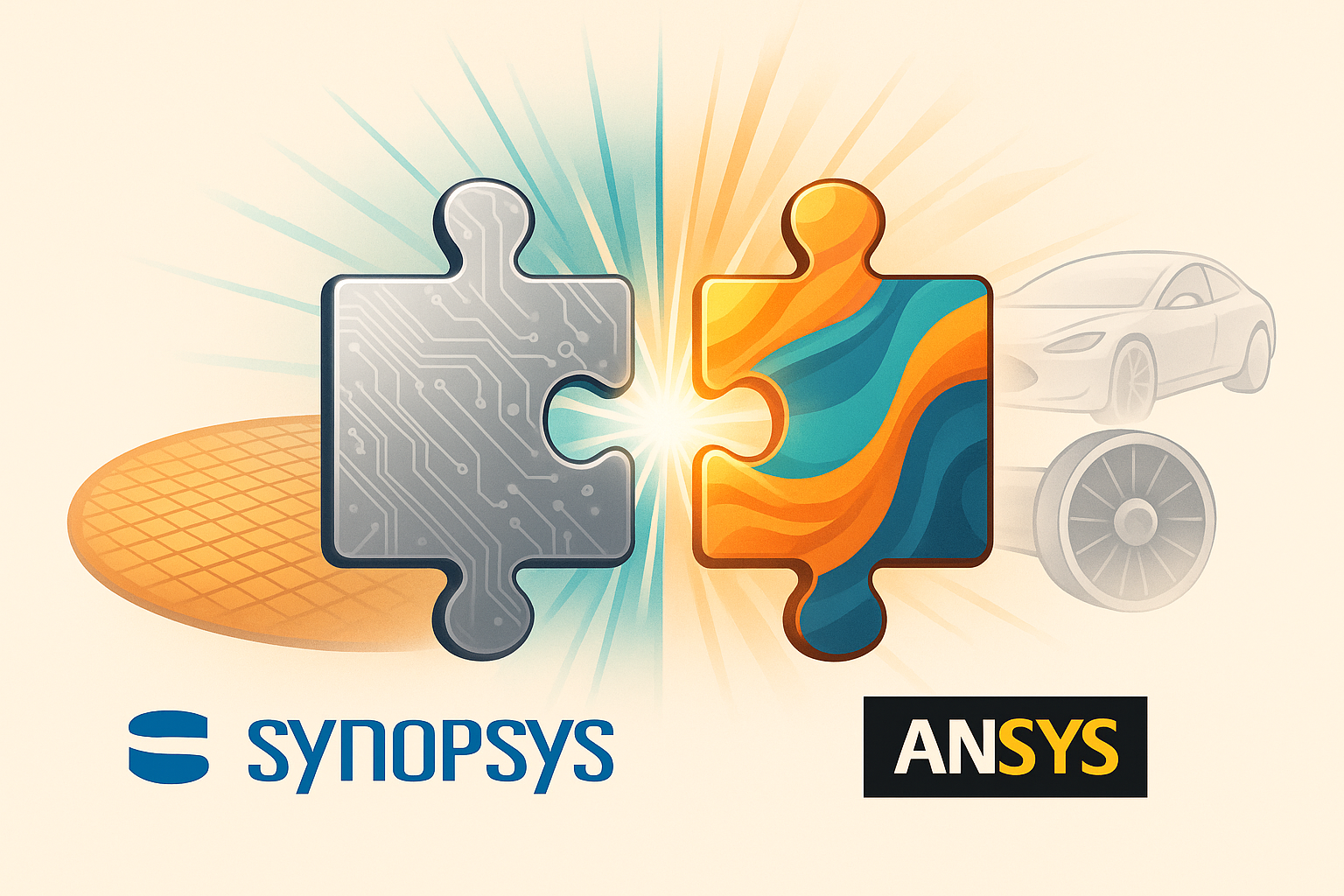
Synopsys is betting $35 billion on fusing AI and simulation with its ANSYS acquisition, chasing silicon-to-systems dominance—just as soaring revenue meets investor jitters over integration pains and debt.
What to know
- The $35B Synopsys-ANSYS merger generated $652.4M in Q2 FY2026 and aims for nearly $3B ANSYS-driven revenue this year, fueling an AI-powered design platform.
- Aggressive $3.46B debt paydown and $400M in cost synergies—fast-tracked by Elliott Management—have pumped non-GAAP margins to 39.5% despite a 95% GAAP net income plunge on heavy amortization.
- Analysts are cautiously bullish with $600 price targets and a 46% EDA-simulation market share, but legacy segment softness, $10B debt, and a 20% stock drop keep nerves high.
AI Fusion Transforms Chip Design
By integrating ANSYS’s simulation tech with its EDA platform, Synopsys is building an AI-powered ecosystem that redefines chip and system design far beyond traditional tools.
The $35 billion acquisition of ANSYS by Synopsys strategically fuses ANSYS's advanced multiphysics simulation capabilities with Synopsys's established electronic design automation (EDA) platform, creating AI-enabled Multiphysics Fusion solutions that significantly accelerate critical chip design processes such as timing signoff, design closure, and multi-die workflows. By early 2026, Synopsys had already reported $652.4 million in ANSYS-related revenue for Q2 FY2026, underscoring how this integration extends Synopsys’s platform well beyond traditional EDA tools into a broader engineering software ecosystem.
This integration positions Synopsys as a unified, AI-centric platform that bridges silicon-to-systems workflows, enhancing its relevance in complex semiconductor and system design programs that often span multiple years. The release of AI-accelerated Multiphysics Fusion flows directly ties ANSYS’s golden signoff analysis into commercially available solutions, reinforcing Synopsys’s ambition to be central to next-generation chip and system development, with management projecting approximately $2.96 billion in ANSYS revenue for fiscal 2026 as a testament to this strategic expansion.

Synergy Push Drives Margins, Masks Pain
Aggressive cost-cutting and integration, led by Elliott Management, are boosting Synopsys’s non-GAAP margins even as massive amortization from the ANSYS deal nearly wipes out GAAP profits.
Elliott Management’s strategic involvement, highlighted by managing partner Jesse Cohn joining Synopsys’ board in June 2026, has been pivotal in accelerating the realization of $400 million in Ansys integration cost synergies. This push has enabled Synopsys to target achieving roughly half of these synergies by fiscal year-end, directly fueling margin expansion and operational efficiency gains within the combined entity.
Synopsys’ operational discipline post-acquisition is evident in the steady improvement of non-GAAP operating margins, which climbed to 39.5% in Q2 fiscal 2026 and are projected to approach 44% by Q4. This margin expansion reflects both the tangible benefits of Ansys synergy realization and tighter cost controls, with the Design Automation segment alone seeing adjusted operating margins rise from 40.9% to 43.3%, signaling early but meaningful integration success.
Despite these operational strides, the financial picture on a GAAP basis remains burdened by substantial amortization expenses stemming from the $35 billion acquisition. Quarterly amortization of acquired intangibles compresses GAAP profitability by approximately $403.6 million, contributing to a dramatic 95% year-over-year decline in GAAP net income and underscoring the heavy accounting costs that mask Synopsys’ underlying performance.
Balancing this financial strain, Synopsys management has demonstrated robust fiscal discipline by aggressively reducing debt, paying down $3.46 billion in the first half of fiscal 2026 alone. This proactive deleveraging effort supports financial stability amid ongoing integration challenges and positions the company to capitalize on synergy-driven margin improvements without compromising its balance sheet health.
Investor Jitters Amid AI Ambitions
Despite bullish analyst targets and dominant market share, Synopsys faces valuation uncertainty and profit headwinds as debt, amortization, and legacy segment struggles weigh on investor confidence.
Investor sentiment toward Synopsys remains cautiously optimistic amid a complex interplay of AI-driven growth prospects and legacy segment headwinds. Despite a recent 13.61% decline in shares over the past month, analysts like Bank of America and Piper Sandler have upgraded price targets to $600 and Overweight ratings respectively, buoyed by Synopsys’ commanding 46% share of the combined EDA-simulation market and a robust 42% year-over-year revenue surge in Q2 FY2026. This cautious optimism is reflected in a 24/7 Wall St. price target implying roughly 24% upside, underscoring investor belief in the company’s AI growth trajectory even as legacy challenges temper enthusiasm.
Valuation models present a nuanced picture, balancing promising growth assumptions against significant risks tied to the Ansys acquisition and legacy segment softness. While forward multiples near 31x and adjusted operating margins around 43.3% suggest favorable risk-reward dynamics contingent on timely Ansys integration and sustained mid-teens revenue growth, downside scenarios factor in a hefty $10 billion long-term debt load and $403.6 million quarterly amortization costs. Furthermore, the stock’s predictability rank of 2/5 stars and divergent intrinsic valuations—$394.50 by earnings-based DCF versus a $655.78 GF Value™—highlight investor uncertainty about long-term discount rates and growth assumptions amid evolving market conditions.
Investor confidence is further shaped by near-term profit pressures from acquisition-related amortization and legacy segment softness, notably in Design IP, which has softened to $454.2 million amid securities litigation concerns. However, strategic divestitures like the Processor IP Solutions sale, combined with 91% institutional ownership and bullish analyst upgrades, suggest that the market views these legacy challenges as manageable. CEO Aart de Geus’s emphasis on AI’s role in scaling semiconductor complexity, alongside a robust $11.4 billion backlog and expanding Design Automation margins, underpin bullish price targets as high as $653, reinforcing a cautiously positive valuation outlook despite these headwinds.
Looking toward 2030, achieving a stock price near $1,100 hinges on significant multiple expansion or materially higher EPS fueled by AI growth and successful Ansys synergy realization. However, persistent risks such as sustained Design IP share loss and potential semiconductor R&D budget cuts—driven by export controls or capex resets—pose substantial threats to this upside. Despite a nearly 20% share price decline over the past year, the company’s 42% revenue growth and raised guidance to $14.76 non-GAAP EPS midpoint reflect strong underlying demand, supporting a cautiously optimistic long-term valuation outlook that depends heavily on navigating regulatory and operational challenges.