Taiwan’s energy tug-of-war: nuclear comeback, AI power crunch, and green gridlock deepen crisis
The gist
Taiwan’s energy crisis is spiraling as nuclear gridlock, soaring AI power demands, and geopolitical choke points collide to threaten the island’s economic stability.
What to know
- Taiwan faces a fierce political tug-of-war over nuclear versus renewables, stalling clear decarbonization and leaving the grid vulnerable just as AI data center demand explodes.
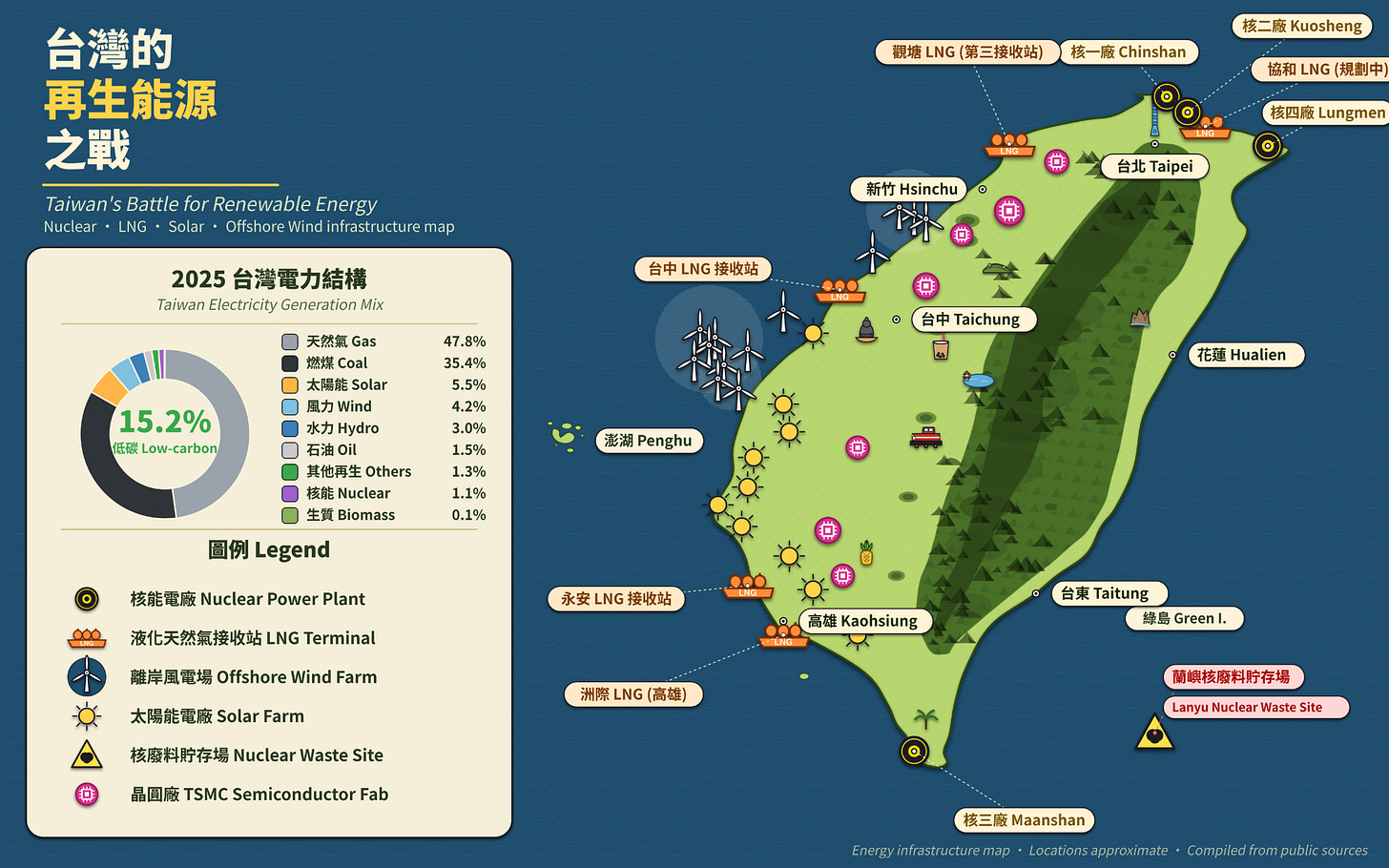
- Only 11 days of LNG reserves and a 140% surge in gas prices—driven by the Iran war, Hormuz closure, and Chinese naval pressure—have exposed Taiwan’s acute energy insecurity.
- Taipower’s market monopoly, corruption scandals, and flawed localization rules are bottlenecking clean energy projects, while TSMC and tech giants strain the grid and force policy U-turns.
Energy Wars Divide Taiwan
Fierce political polarization over nuclear versus renewables has paralyzed Taiwan’s decarbonization strategy, fueling public distrust and deepening societal rifts as AI-driven grid stress mounts.
Taiwan’s 2026 energy landscape is deeply fractured by a fierce political polarization between advocates for a nuclear energy revival and proponents of ambitious renewable energy deployment. This divide is exemplified by intense public debates and smear campaigns against projects like the LMAN nuclear plant, which have stalled coherent decarbonization strategies amid rising AI data center demands and grid challenges. The Democratic Progressive Party’s entrenched anti-nuclear stance further complicates efforts to address escalating energy poverty and geopolitical risks, leaving Taiwan caught in a high-stakes tug-of-war that mirrors global clean energy tensions.
The polarization over energy policy not only obstructs Taiwan’s clean energy transition but also deepens societal fractures, as public confidence wanes amid viral controversies such as the irradiated water stunt spotlighting nuclear fears. These divisions exacerbate security vulnerabilities amid escalating US-China tensions and the broader global energy crisis, making it increasingly difficult for Taiwan to craft unified, strategic responses to its multifaceted energy challenges. As a microcosm of global energy debates, Taiwan’s internal discord underscores how political polarization can derail renewable progress and intensify societal and geopolitical instability.


Geopolitics Fuels Energy Peril
Taiwan’s near-total reliance on imported LNG leaves it dangerously exposed to Chinese naval pressure and Middle Eastern conflict, threatening economic stability as global energy shocks ripple through its supply chains.
Taiwan's overwhelming dependence on imported energy—97% of its supply, with liquefied natural gas (LNG) constituting a major share—renders it acutely vulnerable to geopolitical disruptions. The island holds only about 11 days of LNG reserves, while Chinese naval forces have increasingly exerted subtle blockade tactics, encircling Taiwan and threatening to strangle critical sea lanes without open conflict. This strategic pressure directly jeopardizes Taiwan's economic stability by imperiling the maritime routes essential for its energy imports.
The closure of the Strait of Hormuz amid the Iran war and damage to Qatar's largest LNG complex have sent Asian spot natural gas prices soaring over 140%, sharply escalating Taiwan's energy costs and supply risks. Given that roughly one-third of Taiwan's LNG imports originate from Qatar, these regional conflicts compound the island's energy security challenges, intertwining local vulnerabilities with broader Middle Eastern instability and global market ripples.
Taiwan's pursuit of energy independence and clean energy diversification is increasingly shaped by the intensifying US-China rivalry, which complicates its energy transition and LNG trade. Under mounting US pressure, Taiwan's energy strategy navigates a complex geopolitical landscape where regional security dynamics and escalating tensions heighten supply chain risks, forcing Taipei to balance ambitious clean energy goals against the immediate imperative of securing stable imports amid Chinese naval coercion.
Corruption Stalls Clean Power
Taipower’s monopoly and flawed localization policies, compounded by corruption and land disputes, have turned Taiwan’s renewable energy rollout into a costly, politically charged gridlock.
Taiwan’s renewable energy ambitions in 2026 are severely hampered by a toxic mix of entrenched corruption scandals and monopolistic market controls, particularly dominated by Taipower’s stranglehold over the energy sector. This oligopolistic grip not only throttles innovation in battery storage markets but also fuels political rivalries and regulatory battles over clean energy subsidies, undermining public trust and stalling smart energy progress just as global decarbonization demands intensify.
Localization mandates intended to boost domestic supply chains have paradoxically backfired, complicating Taiwan’s offshore wind projects and exposing deep political and economic fractures that mirror the broader US-China rivalry. These flawed policies, combined with geopolitical tensions in the Indo-Pacific, have transformed Taiwan’s once-ambitious offshore wind program into a costly quagmire, where strategic planning clashes with market realities and regional security concerns.
Beyond policy and corruption, Taiwan’s renewable energy rollout is throttled by acute land scarcity and persistent disputes, especially impacting solar energy installations. These land conflicts, coupled with political and public resistance causing crippling permitting delays, create a bottleneck that stifles clean energy expansion amid escalating geopolitical and economic tensions in the region.
Grid bottlenecks and political vendettas further complicate the scaling of renewable infrastructure, forcing a cautious pivot toward behind-the-meter battery storage solutions rather than broader systemic upgrades. This hesitancy reflects Taiwan’s struggle to balance urgent energy demands—exacerbated by surging AI data center consumption—and the fragile regional security environment, leaving clean energy progress caught in a web of regulatory hurdles and strategic uncertainty.
AI Boom Overloads the Grid
TSMC’s massive power appetite and surging AI data center demand are forcing Taiwan to reverse decades-old nuclear policies, exposing the grid’s fragility and the urgent need for energy resilience.
Taiwan's semiconductor giant TSMC, which consumes about 10% of the island's electricity, is central to global AI compute capacity, making the sector's soaring energy demands a strategic national concern. As Ethan Thornton highlights, the rapid expansion of AI and semiconductor industries has created a critical energy and compute bottleneck, necessitating urgent industrial resilience measures including supply chain security and factory scaling to sustain growth without systemic failure.
The explosive growth of AI data centers is reshaping Taiwan’s power market by intensifying electricity shortages and grid bottlenecks, which severely constrain new data center development despite high demand from tech giants. For instance, projects like an 80-megawatt data center had to be split into phases across multiple townships due to grid limitations, underscoring the urgent need for Taiwan’s energy planning to reconcile these pressures with decarbonization goals amid political upheaval.
In response to these mounting pressures, Taiwan has reversed a four-decade anti-nuclear stance to restart reactors, aiming to meet the surging energy demands of AI data centers while pursuing climate targets. This policy shift reflects the acute tension between skyrocketing AI sector consumption, sluggish renewable deployment hindered by the state power monopoly, and escalating geopolitical and energy market tensions, as highlighted by multiple analyses emphasizing the strategic imperative of reliable, low-carbon power.
The financing landscape for clean energy infrastructure is evolving rapidly as infrastructure funds and tech companies increase investments to support AI data center growth, yet these projects require robust risk coverage to unlock capital. Jason Kaminsky of kWh Analytics stresses that without adequate insurance, renewable projects face delays, illustrating how financial mechanisms are as critical as technical solutions in addressing Taiwan’s energy bottlenecks amid soaring AI-driven electricity demand.
