Tariffs, tech, and turbulence: 2026 ushers in the age of supply chain survival mode
The gist
Global supply chains have entered survival mode in 2026, as geopolitical showdowns, tariff wars, and AI-driven demand for critical minerals force companies to rethink everything from sourcing to strategy.
What to know
- The U.S.-China rivalry and ongoing regional conflicts have pushed the EU to cut Russian energy and Chinese minerals, while the U.S. slaps up to 15% tariffs on tech imports to lure investments from giants like Samsung and SK Hynix.
- Facing relentless tariff volatility, 85.6% of U.S. importers now front-load shipments, 79% have diversified suppliers into Southeast Asia and India, and 40% use bonded warehouses or FTZs to dodge rising costs.
- The era of predictable trade is over—AI-powered, multi-source supply chains and granular, real-time risk management have become the new normal as firms race to stay ahead of regulatory shocks and decoupling.
Geopolitics Reshapes Supply Chains
Global supply chains are being directly weaponized as geopolitical flashpoints and competition over critical minerals drive strategic realignments, with national security now dictating trade flows.
By early 2026, geopolitical volatility remains sharply elevated, driven by intensifying great-power competition and unresolved regional conflicts such as the Russia-Ukraine war, which, despite early resistance to concessions, faces mounting pressures that may prompt negotiations later in the year. Concurrently, the European Union is strategically recalibrating its supply chains by reducing dependence on Russian energy and Chinese minerals while accelerating defense integration and independent support for Ukraine, signaling a significant shift in geopolitical and economic alignments that will reverberate through global supply chains.
The U.S.–China rivalry continues to be a central axis of supply chain risk in 2026, particularly as rapid expansion of AI data centers intensifies demand for critical minerals and memory chips, commodities that have become geopolitical ammunition in the emerging AI arms race. As Ted Krantz, CEO of interos.ai, emphasizes, 'Supply chain risk is now a board-level imperative,' yet many organizations remain reactive, risking losses upwards of $60 million amid escalating tariff uncertainties and trade disputes rooted in prior administrations' policies.
Supply chains have evolved into direct geopolitical targets, with disruptions increasingly shaped by converging shocks including tariff policies, labor challenges, and the weaponization of data sovereignty. Geopolitical hotspots such as Ukraine, Venezuela, Iran, and the looming Taiwan question are actively influencing supply chain volatility, underscoring a new era where control over rare earth minerals and AI sovereignty will determine competitive advantage and national security outcomes in 2026.


Tariff Turbulence Redefines Trade
America's evolving tariff strategy—targeted, escalating, and leveraged for investment—has fractured global trade agreements, creating a fragmented landscape where defense ties and political leverage determine economic outcomes.
By early 2026, the Trump administration had pivoted its tariff strategy following the Supreme Court's rejection of the International Emergency Economic Powers Act as a legal basis, opting instead for a 10% tariff with plans to escalate to 15% or higher. This recalibration aims not only to protect domestic industries but also to coerce foreign tech giants like Samsung and SK Hynix into boosting U.S. investments, with Commerce Secretary Howard Lutnick signaling potential tariff hikes if these commitments falter. Such moves have sown considerable uncertainty among major trading partners—including the EU, India, South Korea, and Taiwan—delaying trade agreement ratifications and investment decisions amid fears of escalating tariff volatility.
The post-trade war landscape has morphed into an entrenched era of structural protectionism marked by regionalization and nuanced tariff applications rather than broad-based trade wars. Average effective U.S. tariffs have climbed to around 10%, the highest since World War II, with a complex, industry- and partner-specific tariff matrix emerging. China faces the steepest tariffs due to overproduction and non-market practices, followed by Southeast Asia, then allies like Japan and Europe, while the Western Hemisphere enjoys relatively lower tariffs to encourage nearshoring. This concentric tariff architecture reflects a strategic recalibration prioritizing geopolitical and supply chain considerations over traditional free trade norms.
U.S. trade agreements with key allies such as Western Europe, Japan, and South Korea currently function more as fragile 'truces' than finalized deals, constrained by these nations' defense dependence on the U.S. and subject to shifting demands from the administration. In contrast, emerging markets like China, India, and Brazil—lacking such defense leverage—face heightened trade tensions exacerbated by ongoing U.S. investigations, including a sweeping forced labor probe launched in March 2024 covering over 60 economies and potentially underpinning a new tariff regime affecting up to 85% of global trade. Meanwhile, smaller nations without defense ties are increasingly subject to evolving U.S.-imposed export terms, and wealthy Gulf states leverage investment pledges to secure market access, underscoring a fragmented and dynamic global trade environment.
The rapid and sweeping tariff policy shifts over the past year have fundamentally transformed tariffs from predictable cost factors into dynamic variables actively managed through sophisticated trade execution strategies. Companies have moved beyond reactive 'panic routing' to deliberate redesigns emphasizing flexibility, with transportation modes shifting markedly—air freight surged by approximately 12 percentage points and truck freight by 8 points, while ocean freight declined by 10–12 points and failed to rebound. This complexity is compounded by a near doubling in Harmonized Tariff Schedule classification sequences per entry, challenging manual compliance and elevating route intelligence to a strategic asset as new trade corridors emerge and others collapse under policy pressures.





AI and Agility Rule Logistics
Facing relentless disruption, logistics leaders have pivoted to AI-driven operations, extreme shipment rerouting, and diversified sourcing, transforming supply chains into flexible, risk-resilient networks.
By early 2026, companies and logistics providers have embraced a multifaceted approach to counter ongoing supply chain volatility, prominently integrating artificial intelligence and supply chain re-engineering to enhance resilience. According to Agility's February 2026 survey, 98% of logistics executives reported AI adoption in operations, while 97% had shifted production or sourcing, underscoring a widespread pivot toward technological and strategic agility. Meanwhile, the Gulf Cooperation Council (GCC) countries have emerged as resilient logistics hubs by investing heavily in AI, energy transition, and talent development, leveraging their unique geopolitical positioning to maintain favorable relations with both the U.S. and China and thrive amid global trade fragmentation.
Tariff-induced disruptions in 2025 catalyzed a profound supply chain reset, with 85.6% of U.S. importers front-loading shipments to preempt rising costs, signaling a strategic shift from reactive to proactive supply chain management. This frontloading, coupled with accelerated sourcing diversification away from China—where nearly 79% of companies expanded supplier bases into Southeast Asia and India—reflects a deliberate effort to mitigate trade volatility. Additionally, over 40% of companies effectively employed bonded warehouses and Foreign Trade Zones (FTZs) as tariff mitigation tools, while contract negotiations with ocean carriers increasingly prioritized flexibility, with 31.2% securing adaptable terms and 20.2% shifting freight to the spot market to navigate unpredictable trade policies.
The logistics industry has responded to trade disruptions with extensive network redesigns and dynamic routing strategies, evidenced by a staggering 2,400% surge in international shipment rerouting throughout 2025, as reported by ePost Global. Companies diversified carrier networks and adopted Delivered Duty Paid (DDP) models to mitigate delivery risks amid carrier performance variability, while also emphasizing precise customs compliance and geographic considerations, especially for sensitive sectors like electronics and luxury goods. These adaptive measures, including shifting 26% to 50% of freight to new routes or modes and expanding container freight stations and transloading, have collectively enhanced supply chain agility and congestion risk reduction.
Facing structural tariff unpredictability and geopolitical fragmentation, companies have evolved from broad country-level sourcing decisions toward nuanced, product- and material-specific risk management. As Pierre Courtemanche articulates, the critical question has shifted from 'China or not China?' to 'which inputs carry what risks and have ready alternatives?' This has driven shorter contract durations, maintenance of qualified alternate suppliers, and re-engineered procurement strategies to incorporate emerging costs such as the EU’s Carbon Border Adjustment Mechanism and Chinese export controls on critical minerals. Despite pressures to diversify, China’s unparalleled manufacturing ecosystem—offering unmatched speed in tooling and engineering iterations—remains central, prompting firms to rebalance rather than outright replace Chinese sourcing while updating cost models to factor in antidumping duties, sustainability compliance, and capital costs on in-transit inventory.


Decoupling Drives Tech Realignment
Structural US-China decoupling and export controls have fractured the tech sector, with semiconductors and rare earths at the center of a global scramble for resource and innovation security.
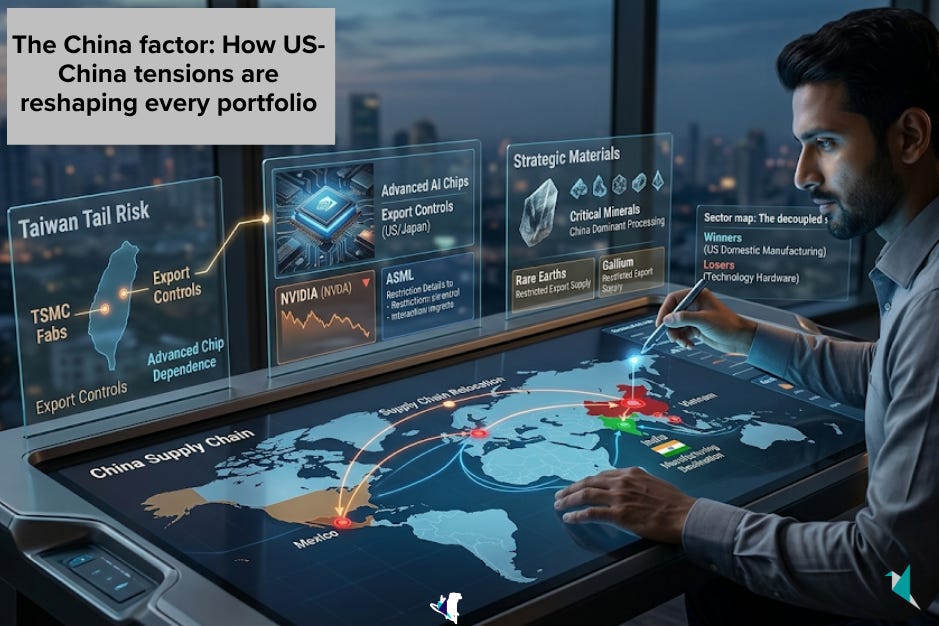
By early 2026, the US-China economic relationship has transitioned from episodic trade wars into a permanent structural decoupling marked by heightened protectionism and regionalization rather than globalization. Average effective tariffs between the US and its trading partners have surged to around 10%, the highest since World War II, with future tariff negotiations focusing strategically on critical assets like rare earth minerals, underscoring a realignment of supply chains around technology and resource security.
This decoupling is selective and nuanced: while dual-use technologies face stringent restrictions, broad trade in consumer goods persists, reflecting a 'small yard, high fence' approach advocated by the Biden administration. Concurrently, China is evolving from a manufacturing hub 'in China, for the world' to a model emphasizing global investment and talent flows, exemplified by Jensen Huang’s observation that 50% of AI talent originates from China, indicating a complex interplay of fragmentation and partial recoupling.
The semiconductor industry epitomizes the structural shifts driven by export controls and geopolitical risks, particularly Taiwan’s centrality through TSMC, which injects a persistent risk premium into tech valuations. US-led export controls, supported by allies like the Netherlands and Japan, have severely limited China’s access to advanced chips and manufacturing equipment, prompting China to accelerate domestic semiconductor investments despite multi-year challenges, while China’s tightening grip on rare-earth processing and critical mineral exports exacerbates vulnerabilities in Western supply chains.
This deliberate decoupling, initiated during the 2018–2019 trade war and hardened through the COVID-19 pandemic and successive export controls culminating in the 2025 'Liberation Day' tariff regime, has fundamentally altered corporate supply chain strategies. Multinational firms like Tesla and Apple continue significant operations in China, balancing diversification with market exposure, but the structural nature of this realignment signals a decade-long recalibration of global economic integration and supply chain planning.

Resilience Over Forecasting
Companies have abandoned certainty for adaptability, using AI-powered intelligence and collaborative supplier networks to outmaneuver persistent volatility and regulatory shocks.
By early 2026, physical goods firms have largely abandoned the pursuit of forecast certainty, recognizing that structural volatility driven by geopolitical instability demands operational flexibility and probabilistic thinking. Rather than attempting to eliminate uncertainty, companies are redesigning their supply chains into strategic intelligence systems that emphasize collaboration, transparency, and mutual resilience, sharing demand data and coordinating inventory strategies closely with suppliers to enhance network stability.
Artificial intelligence has become a cornerstone of this new operational paradigm, enabling firms to integrate real-time data streams—from shipping and weather to commodity prices and geopolitical events—into sophisticated machine learning models. These systems not only detect demand fluctuations earlier but also simulate alternative sourcing and routing scenarios, allowing companies to preemptively mitigate disruptions before they escalate into crises.
In the realm of China sourcing, companies have shifted from traditional risk management to crisis management amid converging structural forces, as noted by Ugo Flumian’s observation of 'five structural forces landing simultaneously.' This has led to shorter contract durations and the maintenance of qualified alternative suppliers even if unused, reflecting a nuanced approach to risk amid rapid regulatory changes such as the Carbon Border Adjustment Mechanism (CBAM), which has already driven 15-20% cost increases for Chinese steel and aluminum.
Navigating supply chain risks now requires granular, product-level assessments rather than broad country-level decisions. As Pierre Courtemanche emphasizes, the critical question is not simply 'China or not China?' but rather 'which inputs carry what risks, and which alternatives are ready?' This nuanced approach includes tracing critical components like rare earth magnets in electric motors back to their origins to ensure true resilience, while also updating cost models to factor in new regulatory and capital costs. Despite diversification pressures, companies rarely exit China entirely due to its unmatched manufacturing ecosystem and speed in tooling and engineering iteration, making risk rebalancing a more practical strategy than outright departure.