Teladoc bets on integrated care as BetterHelp stumbles
The gist
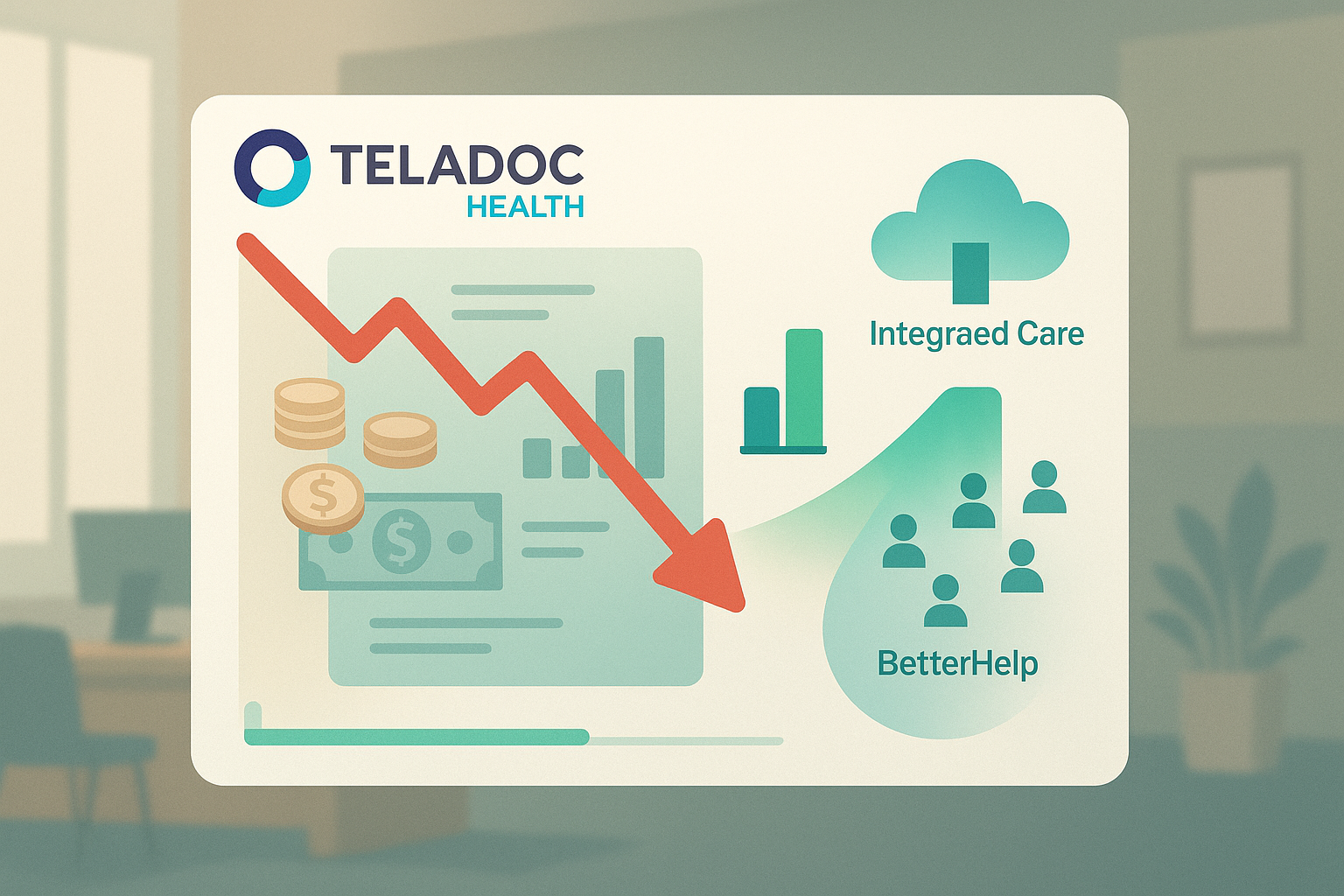
Teladoc’s high-flying BetterHelp platform is dragging down the company as its risky pivot to insurance reimbursement slashes revenue, while only its Integrated Care unit stands between investors and more pain.
What to know
- BetterHelp’s switch from cash-pay to insurance has triggered a 12% revenue drop and an 11% decline in paying users, forcing Teladoc to slash its 2026 revenue outlook.
- The Integrated Care segment is the bright spot, posting a 0.7% revenue boost to $394.3M in Q2 2026 and a 14% jump in chronic care enrollments.
- New CFO Michael Grasher is cracking down on costs, but with shares near multi-year lows and net losses up to $181M expected in 2026, investors remain wary.
BetterHelp’s Insurance Gamble
Shifting from cash-pay to insurance has gutted BetterHelp’s margins and user base, exposing Teladoc to fierce competition and a riskier growth path.
BetterHelp's transition from a higher-margin cash-pay model to insurance-based reimbursement has significantly strained Teladoc's revenue and margins, prompting a downward revision of its 2026 revenue guidance to between $2.362 billion and $2.447 billion. This shift has led to a notable decline in paying users and revenue, with BetterHelp's revenue dropping 12% year over year and paying users falling by 11%, underscoring the operational and financial challenges inherent in adapting to a more complex reimbursement environment.
The ongoing pressures from BetterHelp's evolving business model have heightened investor uncertainty and contributed to Teladoc's stock trading near multi-year lows. Analysts emphasize reimbursement risk and weaker margins as central threats, with some forecasting annual revenue declines around 3.1%. These challenges are compounded by increased competition from platforms offering hybrid virtual and in-person care, which erodes BetterHelp's differentiation and complicates efforts to stabilize growth and profitability.
In response to these margin pressures and churn risks, Teladoc appointed Michael Grasher as CFO, whose background in insurance-focused financial governance signals a strategic pivot toward tighter cost control and operational efficiency. While this leadership change aims to mitigate near-term financial risks associated with BetterHelp's transition, it does not yet materially alter the challenging risk-reward balance facing the platform or the broader company’s profitability outlook, as reflected in projected net losses of up to $181 million for 2026.

Integrated Care Powers Ahead
Teladoc’s Integrated Care segment is driving profit and stability, fueled by chronic care enrollments, strategic partnerships, and a new unified care platform.
Teladoc Health's Integrated Care segment has emerged as a critical growth engine, delivering steady revenue increases and margin improvements that contrast with challenges elsewhere in the company. In Q2 2026, revenues rose modestly by 0.7% year over year to $394.3 million, buoyed by a 30% surge in hybrid care revenues and a 7% increase in international revenue driven by strategic moves like the Telecare acquisition and Walmart partnerships. This expansion beyond traditional channels underscores Integrated Care’s growing strategic importance as a diversified and resilient business unit.
The segment’s growth is further fueled by robust enrollment in chronic care programs, which reached 1.27 million members by mid-2026, marking a 14% year-over-year increase largely due to the rising adoption of multi-condition bundles. This enrollment growth, combined with enterprise contracts and innovative offerings like Teladoc One—a unified care model integrating multidisciplinary teams and AI support set for broader rollout in early 2027—positions Integrated Care on a clear path to sustainable revenue expansion independent of traditional membership spikes.
Integrated Care has transitioned into Teladoc’s primary profit driver, generating $65.2 million in adjusted EBITDA in Q2 2026 compared to a mere $0.5 million from BetterHelp, highlighting its pivotal role in stabilizing the company’s financial outlook. Analysts emphasize that this segment’s improving margins and growing revenue per member not only provide a stabilizing force amid broader company challenges but also underpin a compelling investment thesis, with Teladoc’s stock trading at just 7–8 times expected free cash flow and significant upside potential if Integrated Care continues its trajectory.
As Teladoc increasingly hinges its investment case on Integrated Care’s ability to scale earnings, the segment’s strategic significance grows, potentially transforming it into the company’s main earnings engine. This shift reflects a broader healthcare platform vision where Integrated Care’s enterprise contracts and chronic care services offer a steadier, more predictable profit growth path, which could unlock substantial shareholder value as the company navigates the transition challenges faced by other units.

New CFO, New Discipline
Michael Grasher’s arrival signals a decisive pivot to cost control and financial rigor as Teladoc battles mounting losses and an uncertain recovery.
The appointment of Michael Grasher as Teladoc Health's CFO marks a strategic pivot toward enhanced financial discipline and more rigorous capital allocation, leveraging his deep expertise in insurance-focused financial governance and equity research. Grasher inherits a challenging roadmap, with the company projecting a net loss between $136 million and $181 million on revenues of approximately $2.4 billion in 2026, underscoring the delicate balance Teladoc must strike between sustaining growth and improving profitability.
While Grasher’s arrival signals a clear directional shift toward tighter cost control and financial stewardship, it does not immediately alter the near-term risk-reward profile amid ongoing margin pressures from BetterHelp’s transition to insurance reimbursement and execution hurdles in Integrated Care. This leadership change coincides with a strategic reset aimed at stabilizing the equity story, which has faced weak momentum and share price declines, highlighting the CFO’s critical role in navigating these operational headwinds.
Investor optimism around Grasher’s tenure is tied closely to his ability to drive free cash flow resilience and manage the complex insurance shift within BetterHelp, which together form the backbone of a valuation narrative that pegs fair value at around $15.00 per share. This underscores the importance of disciplined financial management and strategic cost control in transforming Teladoc’s growth story into a higher-quality, more sustainable profit model.
Investor Faith at a Crossroads
With shares at historic lows and analysts split, Teladoc’s future hangs between the drag of BetterHelp and the promise of Integrated Care’s resilience.
Investor sentiment toward Teladoc Health remains decidedly mixed as the company grapples with operational headwinds, notably the transition of its BetterHelp platform from a higher-margin cash-pay model to insurance-based reimbursement. This shift has pressured revenues and margins, prompting a downward revision of 2026 revenue guidance and fueling concerns about the resilience of Teladoc's evolving business model amid an ongoing securities-law investigation. While BetterHelp's struggles have dampened enthusiasm, the Integrated Care segment's steady growth and improving margins offer a counterbalance, leading analysts and investors to adopt a cautious, neutral stance reflected in hold ratings and a Value Score of B.
Teladoc shares are trading at depressed levels, near multi-year lows, with a forward Price-to-Sales ratio of 0.47X compared to the industry average of 0.53X, underscoring the market's skepticism. Despite this, valuation metrics suggest significant upside potential, as the stock currently trades at just 7–8 times expected free cash flow and fair value estimates range widely from $7.97 to as high as $21 per share. This divergence reflects a split analyst community: some emphasize risks from BetterHelp's insurance pivot and telehealth competition, while others highlight Teladoc's strong cash reserves exceeding $750 million and a cash-generative business model that could underpin a turnaround if operational challenges are managed effectively.
The long-term viability of Teladoc Health remains a subject of debate among analysts, with some expressing skepticism about the company's ability to establish a sustainable competitive advantage amid intense telehealth competition and margin pressures from BetterHelp's insurance transition. This uncertainty is compounded by recent earnings estimate revisions showing a projected 21.9% increase in 2026 loss per share to 89 cents, reflecting cautious optimism tempered by operational challenges. Consequently, investor sentiment is conflicted, balancing the promise of Integrated Care's growth and free cash flow against the persistent drag from BetterHelp's declining revenues and user base, which has contributed to a staggering 95% loss in shareholder value over five years.