Toast sizzles in restaurants, expands to retail—but investors still want the check
The gist
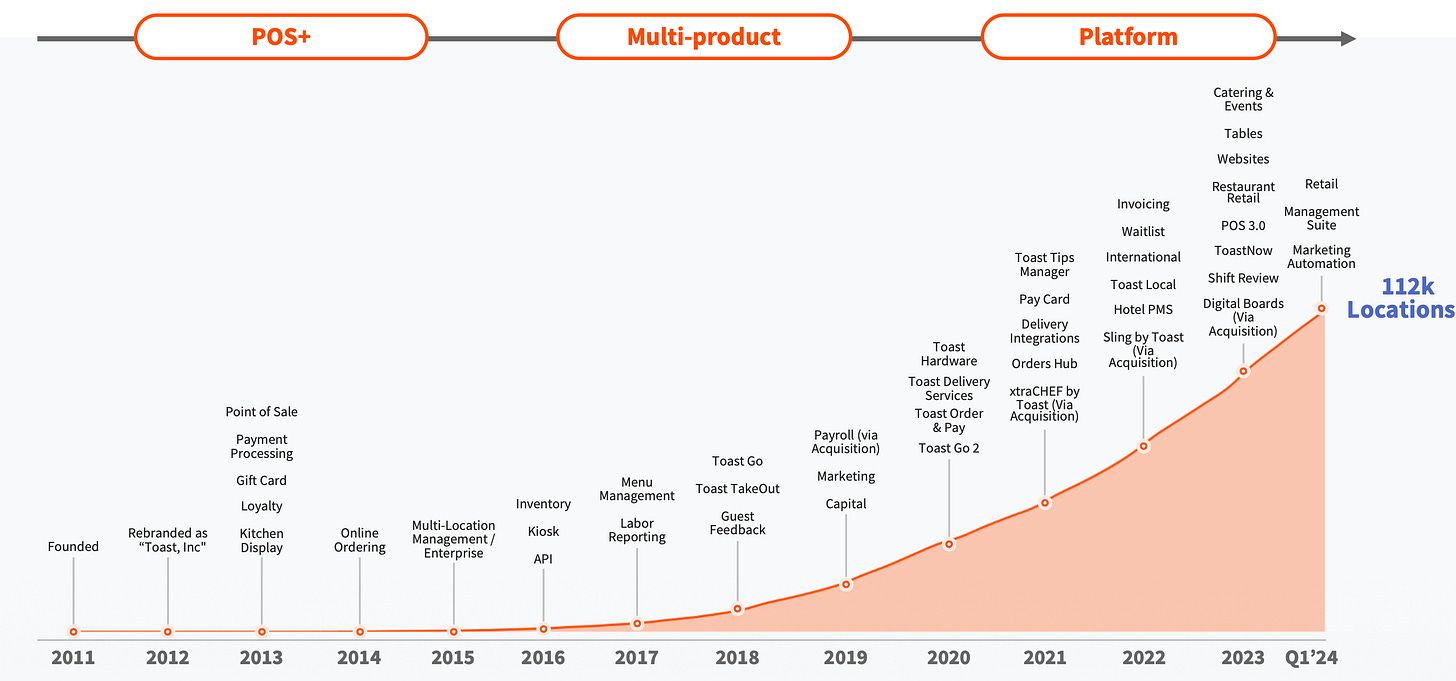
Toast has cooked up massive growth, jumping from 5% to 20% U.S. restaurant market share and expanding boldly into retail—even as Wall Street remains hungry for real profits.
What to know
- Toast now powers 171,000 locations and processed a sizzling $204 billion in payments, reflecting deep penetration across SMBs and Michelin-starred restaurants alike.
- The company has aggressively diversified, targeting a 10x larger market by moving into retail, grocery, and international sectors with vertical-specific tech.
- Despite 27% recurring gross profit growth and S&P MidCap 400 inclusion, Toast’s stock has dropped over 50% from its peak, highlighting persistent investor skepticism.
Founders’ Pivot Powers Growth
Toast’s founding team blended hands-on technical prowess with bold vision, enabling a rapid evolution from SMB focus to tackling the complex demands of enterprise and international markets.
Founded by the dynamic trio of Steve, John, and their longtime collaborator, Toast’s early days were marked by a blend of complementary expertise—John as the CTO and a 10x engineer focused on building scalable foundations, and Steve as the visionary innovator pushing bold ideas. This synergy allowed the team to iteratively develop core capabilities before productizing them, reflecting a hands-on, experimental approach to solving restaurateurs’ pain points. However, the company’s initial focus on SMBs soon expanded, requiring a strategic pivot to serve mid-market, enterprise, and international segments, each with distinct operational complexities. This evolution underscored the challenge of scaling an integrated restaurant management platform that could simultaneously power e-commerce for smaller clients while navigating the demands of enterprise sales and diverse global markets.

From Niche to National Force
Toast’s meteoric rise saw it expand from 5% to 20% U.S. restaurant market share by mid-2026, processing $204 billion annually and capturing both neighborhood diners and Michelin-starred establishments.
Since its IPO, Toast has demonstrated remarkable growth, expanding its market share in U.S. restaurants from approximately 5% to about 20% by mid-2026, primarily targeting small and medium-sized businesses. This rapid expansion is underscored by the platform now powering roughly 171,000 restaurant locations nationwide, a 22% year-over-year increase that highlights Toast's deepening penetration in the SMB restaurant sector.
Toast's influence extends beyond sheer numbers, as evidenced by its processing of $204 billion in gross payment volume over the trailing twelve months—an amount representing nearly half a percent of the entire U.S. GDP. This staggering financial throughput not only reflects the platform's critical role in restaurant transactions but also signals its substantial economic footprint and ambition to dominate the market.
While Toast's footprint is strongest among SMBs, its platform also commands prestige in the fine dining arena, powering over half of all Michelin-starred restaurants and more than a third of James Beard Award winners in the United States. This broad adoption illustrates the company's versatile appeal across the restaurant spectrum, from casual eateries to culinary elites.
Despite these operational milestones and record-setting results, Toast's stock price has faced headwinds, declining roughly 50% from its all-time high by mid-2026. This market skepticism appears tied to investor wariness toward sectors like payment processing and vertical-market software, which remain out of favor despite the company's robust growth and expanding market share.

Retail Ambitions Redefine Scope
Toast’s expansion into retail, grocery, and international markets unlocked a tenfold increase in addressable market, with tailored solutions fueling one of its fastest-growing business lines.
By mid-2026, Toast had strategically broadened its horizons beyond its initial stronghold in U.S. SMB restaurants, where it grew from a 5% to about 20% market share. Recognizing the inherent ceiling in capturing even half of this segment, the company pivoted to a multi-vector growth strategy encompassing retail, enterprise restaurants, and international markets. As CEO Jack Hirsch articulated, these three vectors collectively represent a 10x+ expansion in total addressable market, exemplified by early international adoption such as a London supermarket integrating Toast’s platform.
Retail emerged as a pivotal new vertical for Toast, targeting SMBs across grocery stores, gas stations, convenience shops, and clothing outlets by tapping into the massive $7-8 trillion local commerce spend outside restaurants. This deliberate move leveraged local commerce dynamics to fuel one of Toast’s fastest-growing business lines, with plans to scale both upmarket and internationally. The company’s approach to this diverse retail landscape involved crafting vertical-specific solutions that unify disparate business types—such as grocery, coffee shops, and light retail—on a single platform, offering features like selective tipping and consolidated reporting, which merchants have lauded as a competitive edge over legacy systems.
Fintech Focus Meets Margin Pressure
Despite dominating restaurant tech with deep, specialized workflows, Toast’s hybrid payment and software model has led to aggressive reinvestment, lagging margins, and a misunderstood stock valuation.
By early 2026, Toast had carved out a distinctive niche in the fintech landscape by focusing exclusively on restaurant-specific workflows and operational features, setting it apart from broader platforms like Fiserv's Clover and Block's Square, which cater to diverse merchant types but lack depth in full-service and multi-location restaurant needs. This specialization is underscored by Toast powering roughly 171,000 locations, including over half of all Michelin-starred restaurants and more than a third of James Beard Award winners in the U.S., highlighting its entrenched position within the high-end and mainstream dining sectors.
Despite impressive operational scale—processing $204 billion in gross payment volume with 22% year-over-year location growth—Toast’s financial metrics reveal a company still in the throes of aggressive reinvestment. Its lower gross and net margins reflect prioritization of long-term platform expansion through customer acquisition, product innovation, and hardware subsidies, while improving Return on Invested Capital (ROIC) signals management’s gradual success in translating growth into economic value, even as efficiency metrics lag more mature fintech peers.
Toast’s dual identity as both a payment processor and a vertical-market software provider complicates its competitive positioning and investor perception. Unlike Adyen, which dominates enterprise payment processing with a global footprint but lacks a full restaurant operating platform, Toast’s unique software-driven value proposition is tightly integrated with restaurant operations. However, this hybrid model has contributed to a depressed stock valuation amid a broader market retreat from both payment processors and vertical software companies, despite Toast quietly building one of the most compelling vertical AI businesses in restaurant technology—a development the market has yet to fully recognize or reward.

AI Innovation Drives Expansion
Advanced AI tools like Toast IQ Grow and Drive-Thru anchor Toast’s push to triple its footprint, embedding data-driven solutions that deepen customer reliance and operational efficiency.
By early 2026, Toast had firmly embedded AI-driven innovation at the core of its product evolution strategy, launching advanced tools like Toast IQ Grow and Toast Drive-Thru to sharpen customer marketing and streamline operational efficiency. These innovations, including the foundational Toast IQ and Toast Advertising platforms, not only enhance the overall value of the Toast ecosystem but also deepen customer reliance by offering tailored, data-driven solutions that address the nuanced challenges of restaurant operations. This strategic emphasis on AI-powered capabilities is pivotal as Toast ambitiously aims to scale its footprint from approximately 156,000 locations to over 500,000, signaling a transformative approach to expanding its restaurant operating system through continuous product innovation.

Mixed Markets, Relentless Execution
Soaring profits and inclusion in the S&P MidCap 400 contrast with a volatile stock price, as Toast’s operational gains are met by investor skepticism and persistent valuation headwinds.
By early 2026, Toast showcased robust financial momentum with a 27% year-over-year surge in recurring gross profit and operating income jumping to $110 million from $43 million in Q1 2025, underpinned by a substantial scale of $2.2 billion in Annual Recurring Revenue and $51.3 billion in Gross Payment Volume. The company also expanded its footprint by 22% to approximately 171,000 locations, while innovating with AI-driven solutions like Toast IQ Grow and Toast Drive-Thru to enhance customer marketing and operational efficiency, signaling a strategic push to deepen market penetration and product differentiation.
Despite this strong growth trajectory, Toast's market reception has been mixed. The stock experienced a sharp 16% decline after Q1 2026 results due to missing EBITDA guidance, reflecting investor sensitivity to profitability metrics even as revenue grew 21.9% year-over-year and met expectations. This pattern mirrors broader vertical software sector challenges, where companies like Adobe also faced stock declines despite beating revenue estimates and raising guidance, highlighting a market grappling with cautious outlooks amid geopolitical uncertainties.
Investor sentiment remains cautiously optimistic as Toast trades at a forward price-to-sales ratio of 1.9x with a 30.2% implied return, supported by expected revenue growth near 20% and positive EBITDA guidance revisions. However, shares remain down 22.7% year-to-date and volatile due to concerns over softer second-quarter EBITDA forecasts, underscoring ongoing valuation pressures despite operational gains. The recent announcement of Toast’s inclusion in the S&P MidCap 400 index sparked a 6.7% stock surge, reflecting anticipated demand from index funds, yet the long-term investor return since its 2021 IPO—where a $1,000 investment has fallen to about $420—illustrates persistent market caution.