Token tensions and efficiency wars: AI giants battle for cost-effective brains in 2026
The gist
AI giants are locked in a fierce battle to deliver smarter, faster, and cheaper models—forcing enterprises to rethink how they deploy and pay for intelligence in 2026.
What to know
- Google’s Gemma 4 uses a sparse Mixture-of-Experts architecture to match 70B-model performance at the cost of an 8B model, raising the bar for efficiency.
- Anthropic’s Claude Opus 4.7 ramps up token usage by 30% with a new tokenizer, driving up costs and squeezing user quotas across the board.
- No single model dominates: Claude Opus 4.7, DeepSeek V4, and OpenAI’s GPT-5.4/5.5 tie on top benchmarks, sparking a cutthroat race in AI cost, speed, and enterprise utility.
Architectures Rewrite Efficiency Rules
Breakthroughs in sparse expert routing, mixed-precision quantization, and radically compressed attention caches are slashing inference costs and memory footprints, setting a new bar for scalable LLM deployment.
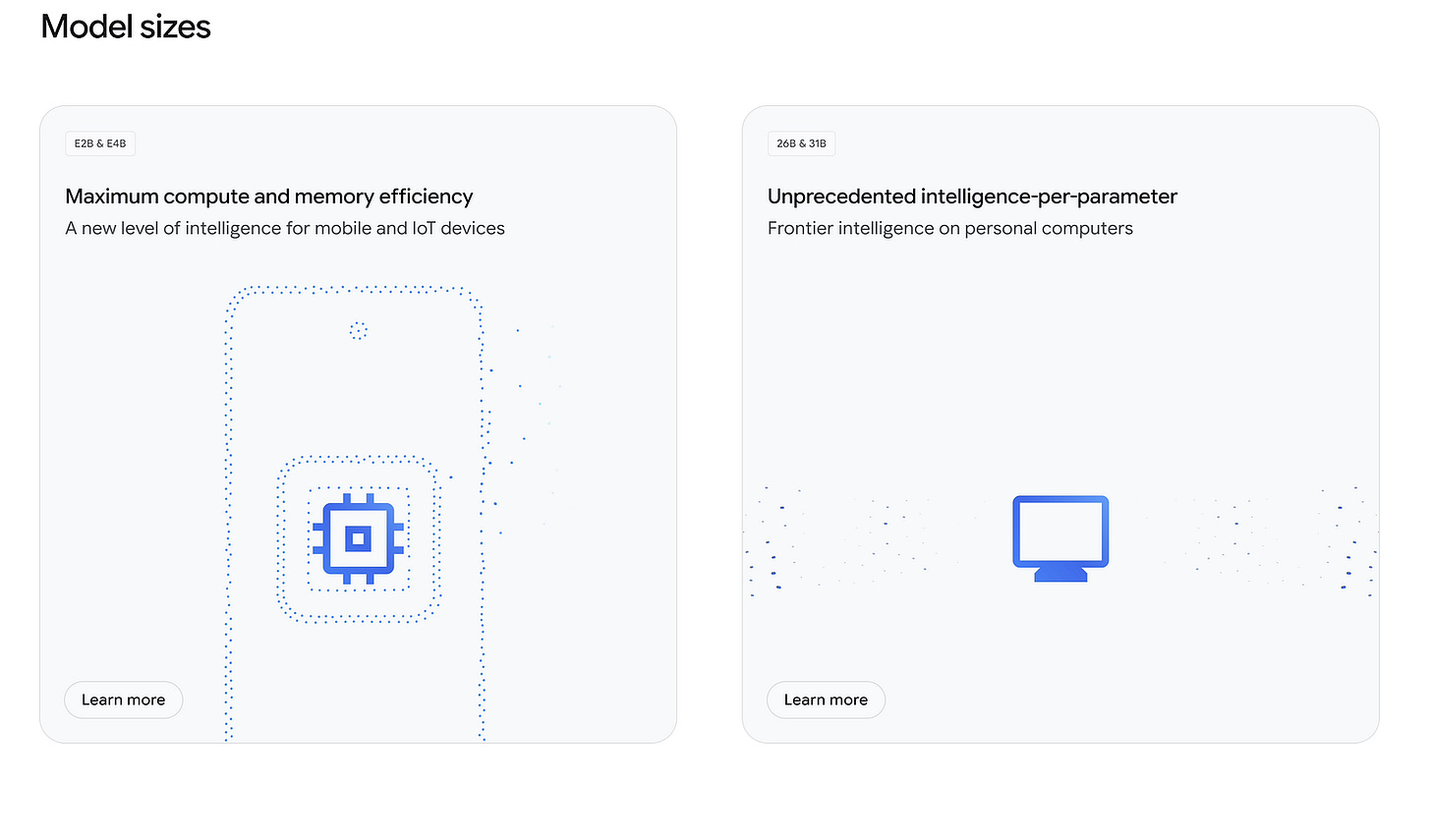
Google’s Gemma 4 model exemplifies cutting-edge architectural innovation by integrating a hybrid Mixture-of-Experts (MoE) design that activates only 6.25% of its 128 experts per token, combining sparse expert routing with an always-on dense feed-forward network to maintain output quality. This approach enables the 26B parameter model to deliver reasoning performance comparable to a 70B dense model while incurring inference costs akin to an 8B model, dramatically enhancing cost-efficiency and setting a new standard for scalable AI architectures.
Quantization techniques have matured into a cornerstone for efficient large language model deployment, with 4-bit quantization (Q4_K_M) becoming the recommended baseline for local LLMs due to its ability to reduce memory footprint to approximately 0.6–0.7 GB per billion parameters while preserving near full-precision accuracy. DeepSeek V4 further pushes this envelope by employing mixed FP4 and FP8 precision—assigning FP4 to MoE expert weights and FP8 to attention and normalization parameters—enabling the entire model to fit on a single 8×B200 node and significantly lowering inference resource demands.
Advances in caching and attention mechanisms have yielded substantial performance and memory efficiency gains, as seen in DeepSeek V4 Pro’s hybrid attention architecture that combines shared and compressed key-value vectors with sparse and sliding-window attention to achieve a tenfold reduction in KV cache size compared to its predecessor. Complementary innovations like FP4 index and FP8 attention caches further halve the memory footprint, while Google’s Gemma 4 introduces tailored Grouped-Query Attention and K=V weight sharing, collectively revolutionizing LLM caching strategies and enabling faster, more cost-effective inference across edge and server environments.
Hardware-aware architectural optimizations targeting GPU memory hierarchies have become critical for reducing transformer inference latency, with techniques like Flash Attention processing attention computations in blocks within ultra-fast on-chip memory to avoid the costly materialization of full attention matrices. Given that on-chip GPU memory bandwidth exceeds off-chip by a factor of ten, these strategies cut latency to as low as 35 milliseconds and underscore the importance of minimizing data transfer bottlenecks to unlock efficient transformer performance.




Token Crunch Drives Workflow Pain
Anthropic’s aggressive tokenizer overhaul has triggered a surge in token costs and user restrictions, forcing enterprises to overhaul API usage and grapple with tighter resource bottlenecks.
Anthropic's Claude Opus 4.7 model introduces a revamped tokenizer that increases token consumption by roughly 30% to 1.35 times per input compared to its predecessor, significantly inflating operational costs and exacerbating existing GPU and compute resource constraints. This surge in token usage has forced Anthropic to reduce user quotas and limit public access to more advanced models like Mythos, underscoring the acute token crunch and infrastructure bottlenecks the company faces in 2026.
To address the rising token costs and efficiency challenges, Opus 4.7 introduces finer-grained control mechanisms such as an 'extra high' effort level between 'high' and 'max,' enabling users to better balance reasoning quality against latency on complex tasks. However, this adaptive thinking parameter also demands developers update their API calls to avoid errors, reflecting a trade-off between flexibility and workflow complexity amid escalating inference expenses.
Despite Claude Opus 4.7’s dominance in enterprise AI benchmarks for writing and coding, users have voiced frustration over the steep token costs and workflow inefficiencies, highlighting persistent challenges in managing token budgets within evolving AI workflows. While a $20 monthly budget suffices for casual interactions, running agents on Opus 4.7 proves considerably more expensive by default, emphasizing the ongoing tension between model capability and cost-effectiveness in real-world deployments.
Beyond model-specific tokenizer impacts, broader cost optimization strategies like those employed in retrieval-augmented generation (RAG) demonstrate that fine-grained token control—such as generating compact, structured knowledge units averaging under 100 tokens—can slash token counts by over threefold and simultaneously boost vector accuracy by more than 13%. This multi-layered approach is critical given the asymmetric GPU utilization during inference, where prefill phases saturate compute resources but decoding is memory-bandwidth bound, necessitating sophisticated optimizations to close a 5–8x cost-efficiency gap.



No Clear Winner in AI Showdown
Each top-tier model carves out a unique edge—Claude Opus 4.7 dominates complex reasoning, DeepSeek V4 wins on cost, and GPT-5.5 pushes token efficiency—leaving enterprises to navigate tough trade-offs between performance, price, and reliability.
Claude Opus 4.7 marks a significant evolution over its predecessor with enhanced visual reasoning, coding prowess, and a new tokenizer that collectively boost its reliability on complex tasks, albeit at the cost of increased token consumption. Benchmarks position it competitively between Opus 4.6 and the unreleased Mythos preview, with notable gains such as an 87.6% score on SWE-bench Verified and a 77.3% on MCP-Atlas tool-use, underscoring its targeted strengths in coding and agentic tool use. However, this performance leap comes with a trade-off: the model’s default xhigh reasoning level burns more tokens, reflecting the ongoing balance between inference cost and task reliability in enterprise deployments.
The 2026 AI landscape is fiercely competitive, with Claude Opus 4.7, DeepSeek V4, and OpenAI’s GPT-5.4/5.5 each carving out distinct niches. While Opus 4.7 leads in writing quality, earnings call integration, and citation rigor, DeepSeek V4 excels in analytical depth and cost efficiency, boasting per-task costs as low as $0.007 for its Flash tier—roughly 50 times cheaper than Claude. GPT-5.4 remains the fastest full-suite model with a 105-second average runtime and strong system design, though it trails in coding detail and multi-step reasoning. GPT-5.5 intensifies the race by setting new token efficiency and pricing benchmarks, delivering top-tier intelligence per dollar with integrated Codex superapp tools, further shaking up enterprise workflows and developer ecosystems.
Benchmarking reveals nuanced trade-offs that enterprises must navigate: Claude Opus 4.7 commands premium pricing—around $7.43 per ARC-AGI-2 task—offering superior output quality and multi-step reasoning but facing criticism over soaring token costs and workflow frictions. DeepSeek V4’s adaptive Thinking Mode enhances reasoning quality in financial and coding tasks but introduces reliability and timeout challenges, highlighting the operational complexities of deploying advanced models. Meanwhile, GPT-5.4 balances cost and speed effectively but no longer leads in coding quality. This dynamic underscores a broader industry tension where performance gains are tempered by cost-efficiency constraints and evolving security and workflow demands.
Despite fierce competition, the top models—Claude Opus 4.7, DeepSeek V4, and GPT-5.4—are locked in a statistical dead heat on overall intelligence benchmarks, each scoring 57 on the Artificial Analysis Intelligence Index, dubbed “the greatest tie in Artificial Analysis history.” This parity reflects a fragmented competitive landscape where Anthropic’s strength in writing and citation rigor, DeepSeek’s analytical depth and cost leadership, and OpenAI’s speed and system design excellence create a three-way race. Enterprises must therefore weigh domain-specific strengths against cost and operational trade-offs, as no single model currently dominates across all critical AI performance dimensions.





Enterprise AI Faces Cost Reality
Skyrocketing token expenses and operational glitches are forcing companies to prioritize agile workflow adaptation and cost control over raw model power, as the pace of AI innovation outstrips traditional fine-tuning strategies.
Despite Claude Opus 4.7's dominance in enterprise AI writing and coding benchmarks with over 95% task completion, enterprises grapple with significant workflow disruptions stemming from high token costs and frequent inference glitches. These challenges, compounded by evolving evaluation metrics and fierce competition from models like DeepSeek V4, underscore the complex reality behind the AI hype, revealing that operational scaling requires more than just raw model performance—it demands robust, cost-aware workflow adaptations.
Enterprises are increasingly navigating a delicate balance between intelligence and cost-efficiency, as exemplified by the trade-offs between frontier models like Claude Opus 4.7 and GPT 5.5 versus more economical alternatives such as DeepSeek V4 Pro. While the former lead in intelligence, their higher token costs push organizations to adapt workflows that prioritize scalable deployment and cost containment, with DeepSeek’s strong benchmarks at a fraction of the cost reshaping enterprise AI strategies, especially in sectors like financial research and coding.
The hyper-accelerated pace of AI innovation in 2026, driven by self-improving architectures and rapid model releases, is forcing enterprises to rethink traditional costly fine-tuning approaches. Instead, there is a pronounced shift toward agile post-training adaptations that enable continuous workflow evolution, allowing organizations to survive and grow amid frequent updates and shifting cost pressures. This operational pivot reflects a broader trend where adaptability and efficiency in AI workflows have become critical competitive differentiators.