Trump tariffs ignite trade wars with allies and China
The gist
Trump's sweeping tariffs on China, Canada, and Australia have set off a global trade firefight—shaking alliances, disrupting supply chains, and igniting economic retaliation.
What to know
- The Trump administration slapped 50% tariffs on $20B of Canadian goods and layered nearly 100% duties on Chinese semiconductors, triggering tit-for-tat retaliation and trade chaos.
- Canada and China are rerouting goods through over 40 countries to dodge U.S. tariffs, forcing the White House to deploy AI-driven customs crackdowns.
- A Supreme Court ruling clipped presidential tariff powers, but Trump’s team is stacking tariffs under old trade laws and launching new forced labor probes to keep the pressure on.
Allies Turn Adversaries
Trump’s unprecedented tariffs on Canada triggered fierce retaliation and forced North American supply chains to realign, straining historic alliances and threatening massive job losses.
The Trump administration's aggressive tariff strategy dramatically escalated trade tensions with Canada by imposing unprecedented 50% tariffs on roughly $20 billion worth of goods, including dairy, alcohol, electronics, and even hockey equipment. These tariffs, enacted under the rarely used Section 338 of the Tariff Act of 1930, bypassed traditional investigations and layered atop existing levies such as forced labor tariffs, compounding the financial strain on Canadian exporters and threatening significant job losses within affected sectors.
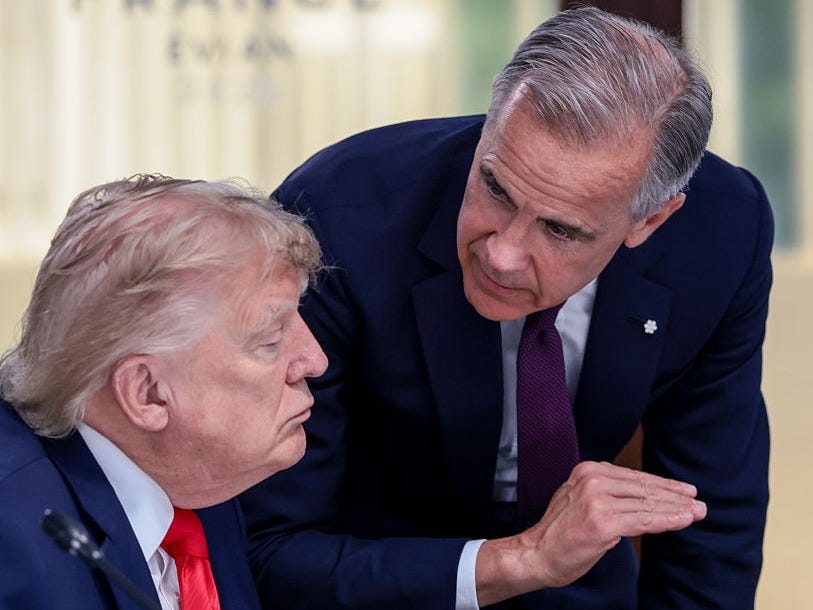
Canada responded swiftly and decisively with dollar-for-dollar retaliatory tariffs targeting a broad spectrum of U.S. industries including steel, dairy, appliances, and electronics, marking a significant escalation in the trade conflict between two historically close allies. Prime Minister Mark Carney framed the dispute as an economic and political gamble, emphasizing a united Canadian front and committing to sustained support for affected industries beyond the current U.S. administration, while provincial leaders like Ontario’s Doug Ford threatened drastic countermeasures such as cutting off electricity exports to the U.S.
The tariff escalation disrupted longstanding North American trade dynamics, compelling Canada to pivot strategically by diversifying supply chains, notably increasing electric vehicle imports from China as a countermeasure to U.S. tariffs. Meanwhile, Mexico found itself in a precarious position, needing to rapidly adapt manufacturing sectors like automotive to avoid becoming collateral damage in the intensifying trade war, highlighting the complex interplay of economic leverage and domestic political pressures shaping the Trump administration's tariff policies.
Underlying the tariff impositions were political calculations aimed at short-term electoral gains and correcting perceived trade imbalances, with President Trump framing the tariffs as a necessary response to longstanding Canadian 'abuse' of U.S. markets. However, last-minute changes in U.S. negotiation demands, including restrictions on Canada's trade autonomy and cultural protections, led to a breakdown in talks and deepened mistrust, casting doubt on the future stability of the USMCA and signaling a protracted period of trade uncertainty and geopolitical friction among close allies.

China’s Evasion Playbook
Chinese exporters are exploiting global backchannels to dodge U.S. tariffs, costing billions and exposing the limits of Washington’s enforcement—even as new semiconductor duties reshape tech supply chains.
The Trump administration's tariff strategy against China has evolved into a sophisticated, multi-layered approach that combines legacy Section 301 tariffs with new measures targeting overcapacity and semiconductors, pushing total duties on some Chinese goods near 70%. This includes a calibrated 7.5% tariff designed to penalize China's flood of underpriced exports without jeopardizing the ongoing trade truce or a planned summit with President Xi Jinping. The administration balances strategic pressure with flexibility, using tariff suspensions and negotiations through the U.S.-China Board of Trade to manage economic and geopolitical risks while maintaining leverage over critical sectors like semiconductors.
Despite the robust tariff framework, enforcement challenges persist as Chinese exporters exploit a widespread evasion scheme by rerouting goods through around 40 complicit countries—including USMCA partners like Mexico and Canada, as well as Southeast Asian nations—to bypass U.S. duties. This 'scam' is estimated to cost the U.S. up to $26 billion annually, undermining the tariffs’ intended impact on penalizing underpriced Chinese exports and protecting the U.S. manufacturing base. While the White House is investing in AI-driven customs enforcement to combat this problem, critics highlight the lack of direct penalties against China, reflecting geopolitical caution and complicating efforts to fully contain China's trade circumvention tactics.
The administration’s semiconductor tariffs form a cornerstone of its broader economic security agenda, aiming not only to penalize China’s excess industrial capacity but also to incentivize reshoring of critical technology manufacturing to the U.S. Plans to expand tariffs to cover servers, laptops, and gaming hardware underscore this layered strategy, with President Trump signaling intentions to impose duties approaching 100% on semiconductors and chips—while exempting companies investing in domestic production. This targeted approach reflects a dual objective: safeguarding national security by reducing reliance on Chinese technology and fostering substantial domestic investment, which has already attracted hundreds of billions of dollars.


Allied Trust Erodes
Dubious forced labor tariffs on Australia have undermined a century-old alliance, prompting allies to rethink their reliance on the U.S. amid rising unilateralism and fraying Western cohesion.
The Trump administration's forced labor tariffs on Australia rest on dubious grounds, given Australia's stringent labor laws that surpass even those of the United States and the absence of credible evidence supporting forced labor claims in Australian exports. Gregory Copley highlights this discrepancy, emphasizing that the justification for these tariffs does not hold up against Australia's robust labor protections. This move reflects a broader unilateral trade approach under Trump that sidelines traditional alliances, as seen in the weakening legal and political ties despite ongoing cooperation in security frameworks like AUKUS.
Although the economic repercussions for Australia are minimal—impacting a limited range of exports such as aluminum and steel—the tariffs have inflicted significant diplomatic damage on a steadfast ally that has fought alongside the U.S. in every major conflict since the Boxer Rebellion. Copley notes that the tariffs are largely symbolic yet deeply provocative, raising questions about the rationale behind imposing spurious taxes on close partners and straining a relationship built on over a century of military and strategic collaboration.
This tariff imposition has catalyzed a strategic recalibration among allies like Australia and Canada, prompting them to reduce their dependence on the United States amid concerns over the reliability of U.S. trade commitments. Copley warns that such unilateral protectionist policies risk eroding the cohesion and long-term structure of the Western alliance, signaling a potential shift in geopolitical alignments even as operational cooperation in agreements like AUKUS continues.

Legal Limits, Tactical Shifts
A Supreme Court ruling slashed presidential tariff powers, pushing the administration to stack old trade laws and short-term surcharges in a high-stakes legal and diplomatic balancing act.
The 2026 Supreme Court ruling in Learning Resources, Inc. v. Trump significantly curtailed presidential tariff powers by declaring that the International Emergency Economic Powers Act (IEEPA) does not authorize tariff imposition, compelling the administration to rescind tariffs imposed under IEEPA while preserving those under Sections 232 and 301. To sustain pressure on China and other nations despite these legal constraints, the administration layered multiple tariff authorities, notably launching new Section 301 investigations into forced labor practices affecting 60 economies, including China, resulting in tariffs ranging from 10% to 12.5%. This multifaceted approach reflects a strategic adaptation to maintain leverage within the narrowed scope of executive authority.
In response to the Supreme Court’s limitations, the Trump administration pivoted to Section 122 of the Trade Act of 1974, instituting a temporary 10% import surcharge for 150 days starting February 24, exploiting this provision’s allowance for short-term tariffs up to 15% without congressional approval. Concurrently, the administration proposed a calibrated new 7.5% tariff targeting China’s excess industrial capacity, designed to penalize underpriced exports without undermining the ongoing trade truce or the planned summit between Trump and Xi Jinping. This nuanced tariff layering, combining forced labor tariffs and targeted surcharges, exemplifies a legal workaround balancing assertive trade policy with diplomatic considerations.
Amid these executive maneuvers, Congress faces pivotal decisions regarding the future scope of presidential tariff authority, weighing options to maintain, modify, or revoke delegated powers and potentially impose stricter requirements or demand congressional approval for tariff-related agreements. This legislative crossroads underscores the ongoing tension between executive agility in trade policy and the imperative for legislative oversight, shaping the contours of U.S.-China trade relations in the post-Supreme Court ruling era.