US admits multipolar world as alliances fray, risks rise
The gist
The U.S. has officially conceded to a multipolar world, scrambling to shore up its waning influence as alliances unravel and nuclear risks mount.
What to know
- By late 2025, the U.S. National Security Strategy shifted focus from global dominance to Western Hemisphere hegemony amid fracturing transatlantic partnerships.
- Great-power rivalries with Russia, China, and the UK have escalated territorial conflicts and nuclear brinkmanship, with no stable diplomatic guardrails in place.
- Technological and economic strains, rising cyberattacks, and a crumbling arms control regime threaten to upend global stability and drive nuclear proliferation.
Alliances Unravel, Spheres Rise
Western alliances fracture as the U.S. pivots to hemispheric dominance, with rivals like China and Russia dismantling global institutions and innovation ecosystems eroding under political and economic strain.
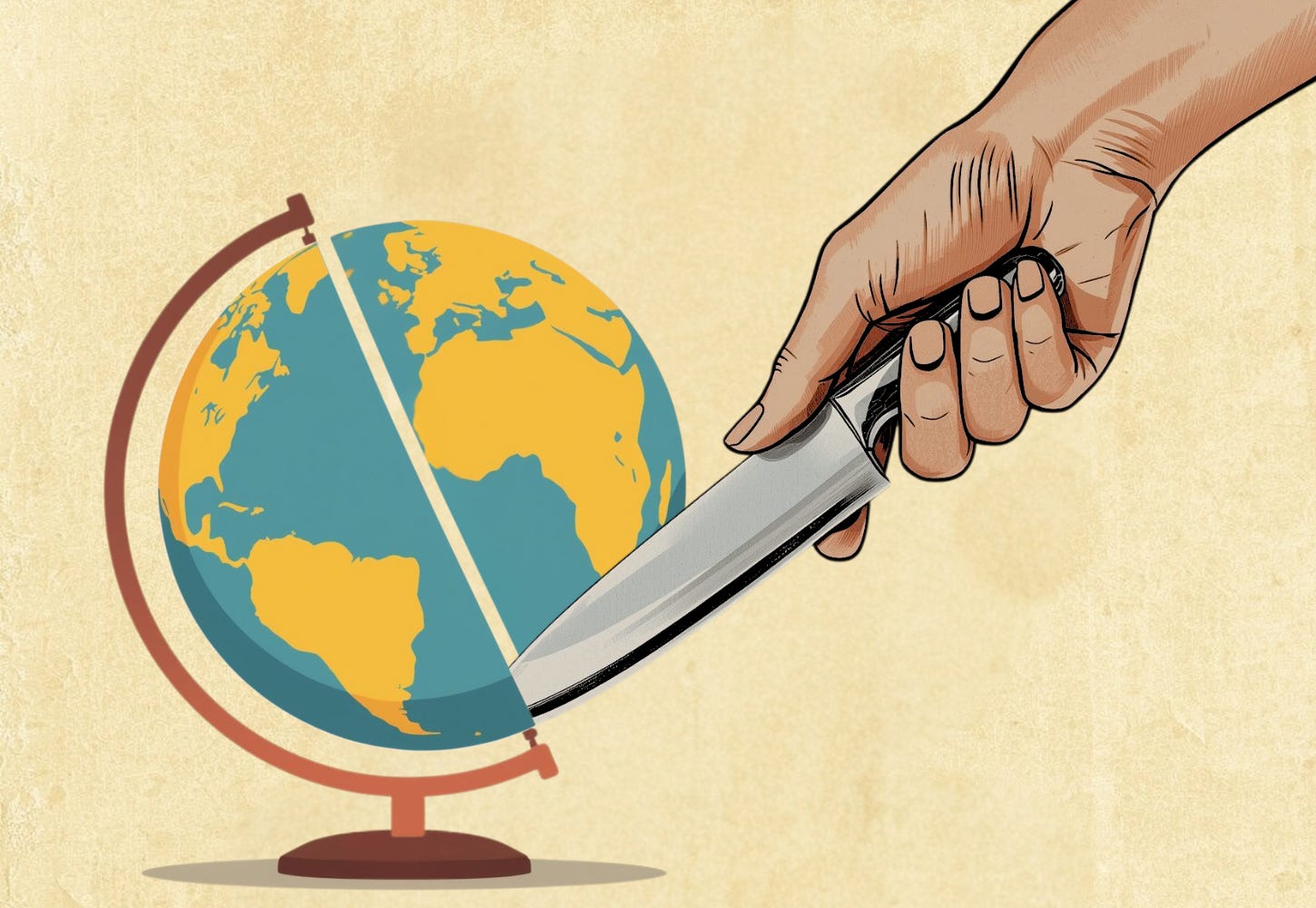
By late 2025, the U.S. National Security Strategy openly recognized the emergence of a multipolar world defined by competing spheres of influence, marking a clear departure from the post-Cold War unipolar dominance. This strategic retrenchment was accompanied by a pivot away from traditional transatlantic partnerships toward prioritizing Western Hemisphere hegemony, as evidenced by fracturing alliances in Europe where leaders like Friedrich Merz declared that 'the West no longer exists' and the Pope criticized U.S. efforts perceived as divisive. The breakdown of ceasefires in regions such as Southeast Asia, despite U.S. diplomatic efforts, further underscored the declining American influence in global conflict resolution.
The erosion of the U.S.-led global order accelerated as China and Russia systematically undermined key international institutions like the World Trade Organization and the United Nations through strategic vetoes and persistent obstruction, paralyzing global governance on crises from Ukraine to the Rohingya. Moscow’s ambitions to dominate European politics and Beijing’s goal to supplant the U.S. as the foundational global power represent an existential challenge to the liberal international order. This multipronged assault was compounded by decades of weak U.S. leadership since the Clinton era, characterized by a lack of national security resolve that allowed adversaries to erode the post-1945 system.
By early 2026, the shift toward a 19th-century spheres-of-influence mindset raised alarms among U.S. officials like Antony Blinken, who warned that such territorial control obsessions risked repeating historical catastrophes akin to World War I. The unraveling of alliances and partnerships, coupled with the dismantling of the U.S. innovation ecosystem—once fueled by robust federal-university collaboration and R&D investments growing from 1.5% to 3.5% of GDP—threatened America's technological edge and global leadership. Meanwhile, the Munich Security Conference highlighted the rise of 'wrecking ball politics,' where leaders prefer dismantling institutions rather than reforming them, and geopolitics became securitized with urgent rearmament and deterrence supplanting cooperative conflict prevention.
Throughout 2026, the U.S. remained the preeminent military and economic power, but its strategic choice to withdraw from leading collective security, free trade, and democracy promotion created a vacuum of global leadership that fueled instability without triggering outright conflict. Europe’s move toward strategic independence, exemplified by France’s alignment with Russia and China to block a UN Security Council resolution on the Strait of Hormuz and restrict U.S. military overflights, signaled a fracturing of traditional alliances. This gradual transition away from Pax Americana, described by analysts as a 'self-inflicted default,' evoked historical parallels to the interregnum between British and American hegemony that precipitated the 1930s Depression, underscoring the immediate geopolitical risks of U.S. retrenchment amid ongoing conflicts like the US-Iran war and surging oil prices.




Europe’s Autonomy Gamble
European leaders reject U.S. dominance, seeking new alignments as regional powers hedge between great powers and transactional alliances reshape the balance of influence.
By late 2025, the U.S. National Security Strategy explicitly acknowledged the emergence of a multipolar world defined by competing spheres of influence, marking a decisive shift from the post-Cold War unipolar order dominated by Washington. This recognition coincided with growing European apprehension about becoming a geopolitical battleground between the U.S. and Russia, especially amid provocative allegations that the NSS aimed to pull countries like Italy, Poland, Hungary, and Austria out of the EU. European leaders such as Friedrich Merz and even the Pope openly criticized U.S. policies perceived as transactional and divisive, signaling a fracturing transatlantic alliance and Europe’s search for a more autonomous role amid U.S. retrenchment and isolationism.
The global order is crystallizing into a new 'Concert of Great Powers,' exemplified by the proposed 'C5' grouping intended to supplant the G7, reflecting the rise of regional power blocs and strategic realignments. Major powers are territorializing their influence: the U.S. reasserts the Monroe Doctrine in the Western Hemisphere, Russia consolidates dominance in Eastern Europe, China expands into Africa and the Middle East, and the UK emphasizes Euro-Atlantic primacy. However, unlike historical precedents, this multipolar competition lacks the diplomatic frameworks to negotiate stable spheres of influence, leading to heightened risks of unrestrained rivalry and conflict as military power across domains becomes paramount.
Middle powers and regional actors are increasingly exercising strategic agency amid great power rivalries, navigating complex interdependencies rather than binary alignments. Asia, for instance, largely disregards U.S. calls, focusing instead on managing relations with China and regional dynamics involving countries like Cambodia and Thailand. Similarly, African states leverage both Chinese infrastructure investments and Western multilateral resources to expand development autonomy, as seen in projects like the Lobito Corridor. This nuanced hedging is mirrored by traditional U.S. allies such as Europe, Canada, and India, which maintain security ties with Washington while economically diversifying partnerships with blocs like the EU, China, and Australia, underscoring a multipolar world where no single power dictates terms.
Europe’s role in this evolving multipolar landscape is marked by fragmentation, ideological rigidity, and a weakening reliance on the rules-based legal order that once underpinned its security and identity. Under the Trump 2.0 administration, transactional U.S. diplomacy—exemplified by disputes like the Greenland flare-up and restrictions on U.S. military overflights by France and Austria—has left Europe in an 'extremely humiliating yet helpless position,' as Zheng Ge notes. While the UK under Keir Starmer seeks to project influence through NATO and multilateralism, it faces a 'misalignment' within the Anglo-American special relationship due to aggressive U.S. diplomacy. Concurrently, Europe's far-right pragmatism, with its domestic focus, could paradoxically improve relations with China, contrasting sharply with the current deteriorated EU-China ties driven by values-based opposition, though internal far-right political challenges remain significant.


Rivalries Escalate, Risks Multiply
Unchecked great-power competition, covert coordination among authoritarians, and the risk of nuclear escalation in Ukraine threaten to plunge Europe into a new era of instability.
By late 2025, the geopolitical landscape had crystallized into a multipolar world marked by intensifying great-power rivalries and emerging spheres of influence, as acknowledged in Donald Trump’s National Security Strategy. This shift unsettled Europe, where fears grew of becoming a battleground between the US and Russia, especially amid allegations that the NSS sought to pull key EU members like Italy and Poland out of the bloc, signaling deepening conflict dynamics. Meanwhile, the US flexed its strategic muscle in the Americas through actions such as seizing tankers off Venezuela and raiding Iranian ships, reflecting heightened tensions involving Russia and Iran, while Asia focused on managing its own complex rivalries, notably China’s expanding influence over Cambodia and Thailand and concerns about Chinese triads, underscoring a fragmented global order with competing regional priorities.
Into early 2026, the great-power rivalry intensified with the US, Russia, China, and the UK asserting territorial spheres reminiscent of Cold War-era imperialism, yet lacking the diplomatic frameworks that once stabilized such arrangements. As Gabriel Elefteriu observed, this absence of clear, sustainable agreements has led to unrestrained military competition across all domains, including space, while Dr. Euan Graham warned that the world was already fragmenting into distinct spheres dominated by China in East Asia, Russia in Europe, and the US retreating into the Western Hemisphere—leaving allies vulnerable and complicating global stability. Meanwhile, authoritarian powers like China and Russia deepened covert coordination through sanction evasion and disinformation campaigns, further complicating the strategic competition.
The Ukraine-Russia war escalated dangerously through 2026, with John Mearsheimer highlighting the growing nuclear risks as both sides misinterpret red lines and intentions. Russian debates over responding to Ukrainian strikes with conventional attacks on NATO countries or even limited nuclear use in Eastern Europe underscore the precariousness of deterrence, especially as the US faces depleted munitions stockpiles and cannot meaningfully rearm Ukraine further. Viktor Bout echoed these concerns, warning that the conflict had morphed into a broader ideological and religious struggle, with drone warfare targeting civilian sites and Europe edging closer to a potential World War III scenario, where Russia might resort to nuclear weapons if it perceives existential threats. This grim outlook is compounded by Europe's self-destructive economic and political decisions, such as cutting off Russian energy, which deepen the conflict and heighten the risk of escalation.
The conflict’s international dimensions have expanded significantly, with Russia relying heavily on a fragile authoritarian alliance involving China, Iran, and North Korea to sustain its war efforts. China has supplied technology and purchased Russian oil, North Korea has provided thousands of troops and ballistic missiles—exceeding Russia’s own production capacity—and Iran has supplied drones while escalating its own regional conflicts. Ukraine’s recent drone strikes in the Caspian Sea targeting Iranian-Russian supply lines signal a new battlefront that intertwines the Russia-Ukraine war with US-Iran tensions, as Washington seeks to encircle Iran with economic and military pressure. This axis of revisionist powers also deepens cyber and hybrid warfare cooperation, complicating conflict dynamics amid US naval overstretch and strategic recalibrations, while domestic US politics, including former President Trump’s cautious warming to Ukraine, influence the scope and nature of support.
Amid these tensions, the nuclear landscape grows increasingly unstable as traditional deterrence frays. The expansion of nuclear umbrellas by allies like France to cover Europe and Asia, alongside emerging nuclear ambitions in countries such as Japan, South Korea, Turkey, Saudi Arabia, and the UAE, threatens to unravel the Nuclear Non-Proliferation Treaty. This erosion of faith in US security guarantees raises the specter of nuclear proliferation and the first use of nuclear weapons since 1945. Calls for the US to modernize its nuclear arsenal, including theater nuclear options like sea-launched cruise missiles, grow louder as Russia conducts tactical nuclear drills and the risk of a nuclear escalation in the Ukraine conflict looms ominously.



Ideologies Collide, Diplomacy Shifts
U.S.-China competition is now defined by clashing worldviews and pragmatic, transactional diplomacy, with states leveraging both sides to maximize autonomy and innovation.
The U.S.-China rivalry is fundamentally shaped by contrasting ideological frameworks: the U.S. champions individualism rooted in Enlightenment liberalism, while China emphasizes a Confucian-inspired collectivism that prioritizes interdependence and collective welfare, as embodied in its “Community of Shared Future for Mankind” concept formalized between 2013 and 2018. This ideological divergence underpins tensions in global governance, with the U.S. advocating universal human rights and a rules-based order, whereas China defends state sovereignty and pluralistic governance models, highlighting a clash not just of power but of competing visions for world order.
By mid-2026, the global shift toward multipolarity has compelled states to adopt pragmatic, transactional diplomacy that transcends ideological divides. This is evident in trilateral cooperation efforts among the U.S., China, and Europe on development finance reforms and AI risk-sharing, as noted by Yang Jiemian and Zhang Chong, and in China’s proposal to establish a UN innovation hub in Shenzhen or Hangzhou to link its frontier technology clusters with Global South developmental needs, leveraging Hong Kong’s financial infrastructure under the 'One Country, Two Systems' framework. These initiatives illustrate how economic hedging and new cooperative frameworks are becoming essential tools for navigating a fragmented world order.
Pragmatic diplomacy also manifests in regional and bilateral contexts where states leverage great-power competition to expand their autonomy. African nations, for example, strategically engage both Chinese and Western resources to advance infrastructure projects like the Lobito Corridor, which combines Chinese-built infrastructure with U.S. and European support to reduce dependency on any single power, as Liu Ye highlights. Similarly, the U.S. deepens transactional defense cooperation with Ukraine through licensed Patriot missile production and industrial collaboration with Lockheed Martin, signaling a shift toward technology sharing and strategic realignment amid ongoing conflict.
Following President Trump’s July 2026 visit to Beijing, U.S.-China relations have stabilized into a more pragmatic engagement pattern that acknowledges the enduring nature of their competition without a foreseeable victor, reflecting a multipolar world where other actors exercise greater agency. Countries like Singapore exemplify this trend by refusing to pick sides and instead pursuing economic engagement with both powers based on national interests. As analysts emphasize, this multipolar context demands recognition that global governance is no longer a bilateral contest but a complex interplay where 'everyone else matters as well' and holds unprecedented influence.

Innovation Edge Under Siege
America’s R&D leadership and technological dominance face unprecedented threats from cyberattacks, military modernization gaps, and energy shocks that fuel economic insecurity.
By early 2026, the United States faced a critical inflection point in its technological and economic leadership, rooted in its historic alliance between government, academia, and research institutions that had boosted R&D investment from 1.5% post-WWII to 3.5% by the end of the Biden administration. However, this ecosystem is now under strain due to cuts in R&D and talent retention challenges, exemplified by Mark Zuckerberg’s initial AI hires, threatening America's global innovation edge amid a multipolar world where autocratic regimes actively undermine democratic powers through election meddling and societal discord, reflecting a departure from outdated spheres-of-influence mentalities reminiscent of pre-World War I tensions.
Technological innovation and cyber threats have surged to the forefront of global risk assessments, with cyberattacks topping the Munich Security Index and revisionist powers like China, Russia, Iran, and North Korea integrating hybrid warfare tactics targeting critical infrastructure through sophisticated malware campaigns such as China’s Volt Typhoon program. Concurrently, military modernization has accelerated, driven by urgent rearmament and deterrence strategies amid rising conflict risks, with Russia advancing tactical nuclear weapons capabilities while the US lags in theater nuclear options, raising concerns about nuclear blackmail and underscoring the need for rapid modernization including sea-launched cruise missiles.
Energy supply disruptions have compounded economic pressures and global instability, as exemplified by Israeli strikes on Iranian gas fields during the US-Iran war that pushed Brent crude above $107 per barrel, while a critical shortage of refined petroleum products—down 8.3 million barrels per day due to declining US and European refining capacity and Ukrainian drone strikes on Russian facilities—has driven sustained increases in global energy and food prices. These supply shocks, exacerbated by Houthi attacks in the Red Sea, are reshaping strategic calculations and intensifying economic vulnerabilities worldwide.
The shifting multipolar order amplifies the importance of trilateral public-goods provision in development finance and AI risk-sharing, with China’s expanding role challenging traditional governance models like the Paris Club and prompting proposals for a UN innovation hub in Shenzhen or Hangzhou to link Chinese tech clusters with Global South developmental needs. Meanwhile, African states leverage Chinese and Western infrastructure investments, such as the Lobito Corridor, to enhance development autonomy, illustrating how economic modernization and technological governance are becoming pivotal arenas for strategic realignments. At the same time, the erosion of arms control frameworks, particularly the potential collapse of the Nuclear Non-Proliferation Treaty, coupled with allies’ waning faith in US extended nuclear deterrence, heightens proliferation risks, compelling the US to urgently reestablish its credibility to prevent destabilizing cascades in Europe and Asia.


Nuclear Brinkmanship Returns
The collapse of arms control, relentless cyber offensives, and unchecked nuclear modernization are pushing the world closer to a new era of nuclear risk and global instability.
The collapse of arms control, relentless cyber offensives, and unchecked nuclear modernization are pushing the world closer to a new era of nuclear risk and global instability.