Versailles memorandum sparks fury as Iran leverages U.S. disarray, fueling fears of diplomatic defeat
The gist
A controversial, non-binding Iran deal signed at Versailles has sparked outrage, with critics claiming U.S. confusion handed Tehran dangerous new leverage and exposed American diplomatic weakness.
What to know
- The 2026 Versailles memorandum gave Iran temporary control over the Strait of Hormuz and a $300 billion reconstruction fund, despite failing to secure strict nuclear limits.
- President Trump’s erratic deal claims and military threats sowed global mistrust, letting Iran exploit U.S. disarray and stalling negotiations.
- Bipartisan U.S. backlash and Israeli opposition have intensified, as the fragile deal fuels fears of renewed conflict and a major U.S. military buildup in the Middle East.
Shattered Trust, Stalled Talks
Years of broken promises and economic temptations fueled deep Iranian skepticism, dooming nuclear negotiations before they began.
The initial diplomatic efforts to revive the JCPOA after the U.S. withdrawal were deeply hampered by Iranian mistrust and fundamental disagreements over deal terms, particularly concerning the extension of nuclear program constraints. Iranian skepticism was not unfounded, as the legacy of President Trump's abrupt withdrawal in 2018 cast a long shadow, with fears that future U.S. administrations might similarly abandon the agreement. As one analyst reflected, “Maybe the president Biden's successor does exactly what President Trump does ... I wish that President Trump had not torn up the original deal. We'd be in a very different position.”
Despite close cooperation with European allies—including France, Britain, Germany, and the EU—the 2022 talks to reanimate the JCPOA stalled because the deal Iran was willing to accept was deemed inadequate by the U.S. and its partners. The Geneva negotiations, while showing moments of significant progress as noted by Oman’s foreign minister, ultimately revealed deep disagreements over terms, with leaked provisions suggesting concessions that many believed favored Iran, such as unblocking $25 billion in frozen assets and lifting oil sanctions. German Chancellor Merz’s remark that “Trump was being played by Iranian negotiators earlier in the process” encapsulates the pervasive mistrust that stalled momentum.
The revived deal promised Iran substantial economic incentives, including unlocking $141 billion in frozen assets, doubling oil exports within a year, and potentially adding between $600 billion and $1 trillion to Iran’s GDP by 2040, according to Brandeis University researchers. These prospects provided a powerful motivation for Tehran to engage diplomatically despite lingering mistrust. However, uncertainty about Iran’s nuclear intentions—especially whether the fatwa against nuclear weapons issued by the late Supreme Leader would endure—added ambiguity to early negotiations, complicating efforts to build lasting confidence.
The aftermath of the U.S. withdrawal saw Iran aggressively expand its nuclear enrichment program, further complicating revival efforts and deepening mistrust. Although there was hope that renewed negotiations could halt enrichment activities, as one analyst noted, “If we can get through a ceasefire agreement and if we can get back to the table, I'm hopeful that we can get back to a place where there's not enrichment happening, but we have a long way to go.” This stalled progress in Geneva set the stage for prolonged diplomatic difficulties that would define the fragile revival attempts.

Negotiations Collapse, Risks Rise
Iran’s outright rejection of U.S. demands and internal unrest left both sides entrenched, intensifying nuclear risks and diplomatic paralysis.
By early 2026, nuclear negotiations in Geneva collapsed under the weight of irreconcilable demands, with Iran firmly rejecting key U.S. conditions such as enrichment caps and dismantlement of facilities. Despite Iran’s limited offer of a three-year enrichment pause and uranium shipment to Russia, Supreme Leader Khamenei publicly dismissed these as nonstarters, framing uranium enrichment as an "absolute right" and a "clear red line." Meanwhile, U.S. public messaging, including statements from former JCPOA negotiator Rob Malley, maintained an overly optimistic or even misleading narrative about the prospects for a "short-term, fragile arrangement," contrasting starkly with Iran’s escalating threats and categorical refusals.
The diplomatic stalemate was compounded by political vulnerabilities and messaging contradictions on both sides. While the White House projected imminent continuation of talks—claiming new rounds "could be happening over the next two days" even after collapse—Vice President Vance’s candid admission that "the ball is in the Iranian court" underscored a lack of U.S. leverage or next steps. Concurrently, Iran’s internal unrest, with 5,000 Iraqi militia patrolling streets amid chants against Khamenei, and his theological categorization of casualties, highlighted the regime’s precarious position, complicating any political willingness to compromise and providing fertile ground for spoilers opposed to negotiation success.
The enduring failure of the 2015 JCPOA deal casts a long shadow over current talks, as it notoriously neglected Iran’s plutonium pathway to nuclear weapons via spent fuel at the Bashir reactor. Experts estimate this oversight leaves Iran capable of producing between 200 and 400 nuclear weapons, underscoring the illusory nature of past agreements and Iran’s unwavering strategic determination to acquire nuclear arms. This unresolved proliferation risk adds another layer of complexity and mistrust, further entrenching the negotiation stalemate.


Trump’s Mixed Signals Backfire
Erratic deal claims and threats from Trump empowered Iran’s hardliners, undermining U.S. credibility and leaving negotiations in chaos.
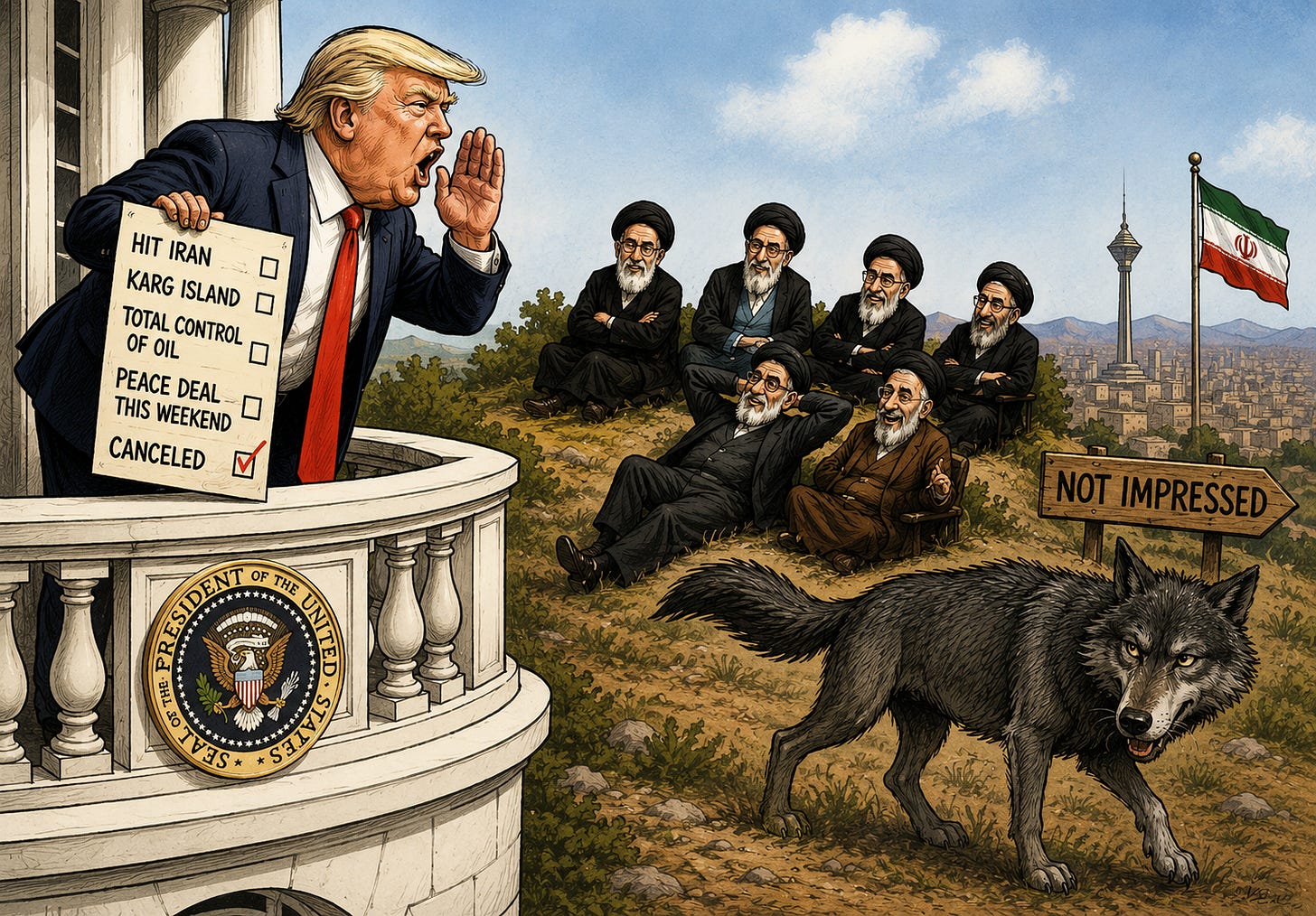
President Trump's repeated public proclamations of imminent deals with Iran, such as declaring the agreement 'largely negotiated' and stating 'we have a deal and we will let the details out shortly,' starkly contrast with Iran's consistent denials of any final agreement, as emphasized by Tehran’s Foreign Ministry spokesman Esmail Baghaei. This pattern, observed since mid-April with about thirty claims of near-deal status, has fostered widespread skepticism and eroded both Trump's personal credibility and that of the United States on the global stage, with critics like Marco Rubio labeling the situation a 'pure clown show.'
Trump's negotiation style, marked by rapid oscillations between aggressive military threats—such as the announced intention to seize Kharg Island and take 'total control' of Iran’s oil and gas industry—and conciliatory overtures, has produced contradictory messaging that confuses both Iran and international observers. This erratic approach, including last-minute cancellations of strikes that coincided with claims of imminent deals, undermines the seriousness of U.S. threats and has led analysts to compare Trump to 'the boy who cried wolf,' as his simultaneous signals of annihilation and peace have dulled the impact of U.S. warnings.
Iran's hardline leadership has strategically exploited Trump's public declarations and domestic political pressures, particularly the looming midterm elections, to stall negotiations and weaken the U.S. position. While Trump expected Iran to negotiate in a manner akin to his own dealmaking style, this misreading has resulted in repeated confusion and miscalculations, with Iran maintaining leverage by treating the ongoing talks as a memorandum of understanding rather than a final agreement. This dynamic reveals a fundamental misunderstanding of the complex, multi-phased negotiation process and contributes to the perception that Trump is 'in over his head.'
The cumulative effect of Trump's contradictory public statements, premature victory claims, and transparent negotiation tactics has significantly undermined U.S. credibility and complicated diplomatic efforts. By openly revealing his intentions and simultaneously acting as both buyer and seller in the negotiations, Trump has removed any incentive for Iran to commit to a deal, leaving the process mired in uncertainty. As one analyst noted, 'there is no deal. There are talks, there is a draft, and there is a president announcing victory; these are not the same thing,' highlighting the strategic consequences of this fragile and performative negotiation approach.



Political Firestorm at Home and Abroad
The deal’s fallout exposed deep rifts in U.S. politics and fractured alliances, putting Israeli security and American unity on the line.
The Iran nuclear deal has ignited fierce domestic political divisions in the United States, with President Trump’s staunch opposition epitomizing a polarized environment where bipartisan skepticism prevails. Prominent Republicans like Senator Bill Cassidy labeled it “the worst foreign policy blunder in decades,” while Democrats such as Senator Chris Murphy condemned it as a “disastrous humiliation,” highlighting concerns over the deal’s opacity and perceived concessions to Iran. This domestic backlash is compounded by critiques from former allies and media figures including Ben Shapiro and Tucker Carlson, underscoring the deal’s fragility and the administration’s struggle to maintain political cohesion amid accusations of weakness and lack of transparency.
Internationally, the deal has strained longstanding alliances, particularly between the U.S. and its European and Indo-Pacific partners, as well as with Israel. European leaders like Germany’s Merz openly questioned the deal’s value and expressed skepticism about Trump’s negotiation tactics, fracturing transatlantic unity ahead of the G7 summit. Meanwhile, Israeli Prime Minister Benjamin Netanyahu faces a political crossroads, pressured to oppose Trump’s approach to preserve his political survival amid fears that the deal empowers Iran and sidelines Israeli security concerns. This diplomatic friction is further evidenced by Trump’s selective bilateral meetings at the G7, notably excluding key leaders such as Netanyahu and Zelenskyy, signaling alliance tensions and divergent strategic priorities.
The deal’s fallout has also exposed a misalignment between U.S. pragmatic interests and Israel’s existential anxieties, fueling tensions within the U.S.-Israel relationship. While Israeli hardliners like Ben-Gvir and Smotrich vocally oppose the agreement, fearing it will enable Hezbollah and other proxies, U.S. officials, including voices like J.D. Vance, argue that American interests remain paramount and sanctions will persist if Iran continues supporting terrorism. This dynamic illustrates a complex balancing act where the U.S. seeks regional stability and broader diplomatic gains, even as it navigates Israeli skepticism and the challenge of maintaining a united front against Iranian influence.
Adding to the political complexity, the deal’s format as a memorandum of understanding rather than a finalized agreement has fueled suspicion and criticism regarding its legitimacy and strategic value. With over 39 memoranda announced and a 60-day negotiation window allowing either side to walk away, critics argue the deal is more a political maneuver than a substantive resolution, designed partly to influence markets and manage optics. This ambiguity has intensified domestic political fallout, with accusations that the administration capitulated due to political fatigue rather than strategic calculation, further eroding trust among allies and within U.S. political ranks.



Versailles Venue Fuels Resentment
The symbolic Hall of Mirrors set the stage for a deal widely seen as American capitulation, amplifying perceptions of U.S. decline.
The memorandum of understanding related to the Iran nuclear deal was signed electronically around the time of the 2026 G7 summit in France, marking a tentative and fragile step toward renewed negotiations. European leaders, present alongside President Trump, expressed uncertainty about the deal’s finalization and sought to maintain the original JCPOA framework, underscoring Europe’s pivotal role in shaping the diplomatic narrative amid ongoing global security talks.
The choice of the Palace of Versailles—specifically the Hall of Mirrors—as the signing venue was laden with historical symbolism, evoking the infamous 1919 Treaty of Versailles known for its themes of surrender, reparations, and humiliation. This setting unintentionally cast the U.S. as a diminished power conceding to Iran, a perception amplified by French President Emmanuel Macron’s apparent strategic use of the venue to underscore American decline and diplomatic weakness.
Despite the Trump administration’s framing of the memorandum as a deal, experts widely criticized it as a non-binding agreement lacking substantive terms or enforceability, effectively ceding leverage to Iran. With Iran maintaining control over strategic assets like the Strait of Hormuz and missile stockpiles, the U.S. appeared to accept a weaker position, fueling narratives of American strategic retreat and diminished global credibility.
The memorandum’s provisions, including a 60-day reopening of the Strait of Hormuz and a $300 billion reconstruction fund for Iran, alongside clauses granting Israel veto power over Lebanese peace terms, reveal a complex and precarious armistice. These elements not only underscore the fragility of the agreement but also hint at potential future entanglements, further complicating the U.S.’s strategic calculus in the Middle East.


Military Standoff Looms Large
With diplomacy at a dead end, the U.S. and Iran edged closer to conflict as military buildups and strategic ambiguity redefined the balance of power.
By early 2026, the fragile Iran nuclear deal had reached an impasse, with both Israel and the White House signaling that diplomacy had 'reached their limit,' sharply increasing the risk of military conflict. This deadlock prompted the largest U.S. military buildup in the Middle East since 2003, including the deployment of the USS Gerald R. Ford carrier strike group and over 50 stealth fighters, underscoring the escalating tensions. Meanwhile, Iran’s brief closure of the Strait of Hormuz—a critical chokepoint for 20% of the world’s oil—highlighted the precariousness of regional security, as markets largely shrugged off the immediate impact but remained vulnerable to sudden shocks should hostilities erupt.
The deal’s strategic consequences have reverberated through regional alliances and global diplomacy, effectively legitimizing the Iranian regime while sowing discord between Israel and the United States. As Natalie Amiri observed, the agreement 'brought a wedge' between these longtime allies, complicating efforts to maintain a unified front. At the 2026 G7 summit, the Iran deal overshadowed other critical agenda items such as AI and Ukraine aid, illustrating its geopolitical gravity. Germany’s Chancellor Friedrich Merz’s insistence on unconditional reopening of the Strait of Hormuz further emphasized the deal’s implications for control over this vital maritime artery.
The memorandum of understanding signed between the U.S. and Iran is widely regarded as a fragile and ambiguous arrangement rather than a definitive peace deal. Analysts like Heather and Tom Nichols highlight that Iran emerges strategically stronger, retaining control over its missile stockpiles and leveraging the Strait of Hormuz as a bargaining chip, while the U.S. appears weakened and constrained in its options. This dynamic has led to growing U.S. reticence to re-engage militarily, effectively ceding leverage to the IRGC and allowing Iran to consolidate control over critical regional assets, raising profound doubts about the durability of peace and the credibility of U.S. foreign policy.
The deal’s broader geopolitical fallout includes the effective transfer of control over the Strait of Hormuz to Iran, albeit temporarily reopened for only 60 days, and the release of $100 to $120 billion in frozen Iranian funds. This financial empowerment is expected to bolster Iran and its proxies like Hezbollah, Hamas, and Iraqi militias for decades, fueling regional instability. Moreover, the agreement’s vague commitments on military deployments and commercial vessel passage, combined with Israel’s de facto veto power—given Lebanon’s prominence in the accord—cast a long shadow over the prospect of lasting peace. The U.S. also pledged a significant $300 billion investment in Iran’s reconstruction, signaling a major shift in regional economic dynamics amid waning American influence.
