Vertical AI surges: $3.5b market upends SaaS status quo
The gist
Vertical AI is flipping the SaaS script, surging to a projected $3.5 billion category by 2026 as specialized, agentic AI platforms outpace generic tools in regulated industries.
What to know
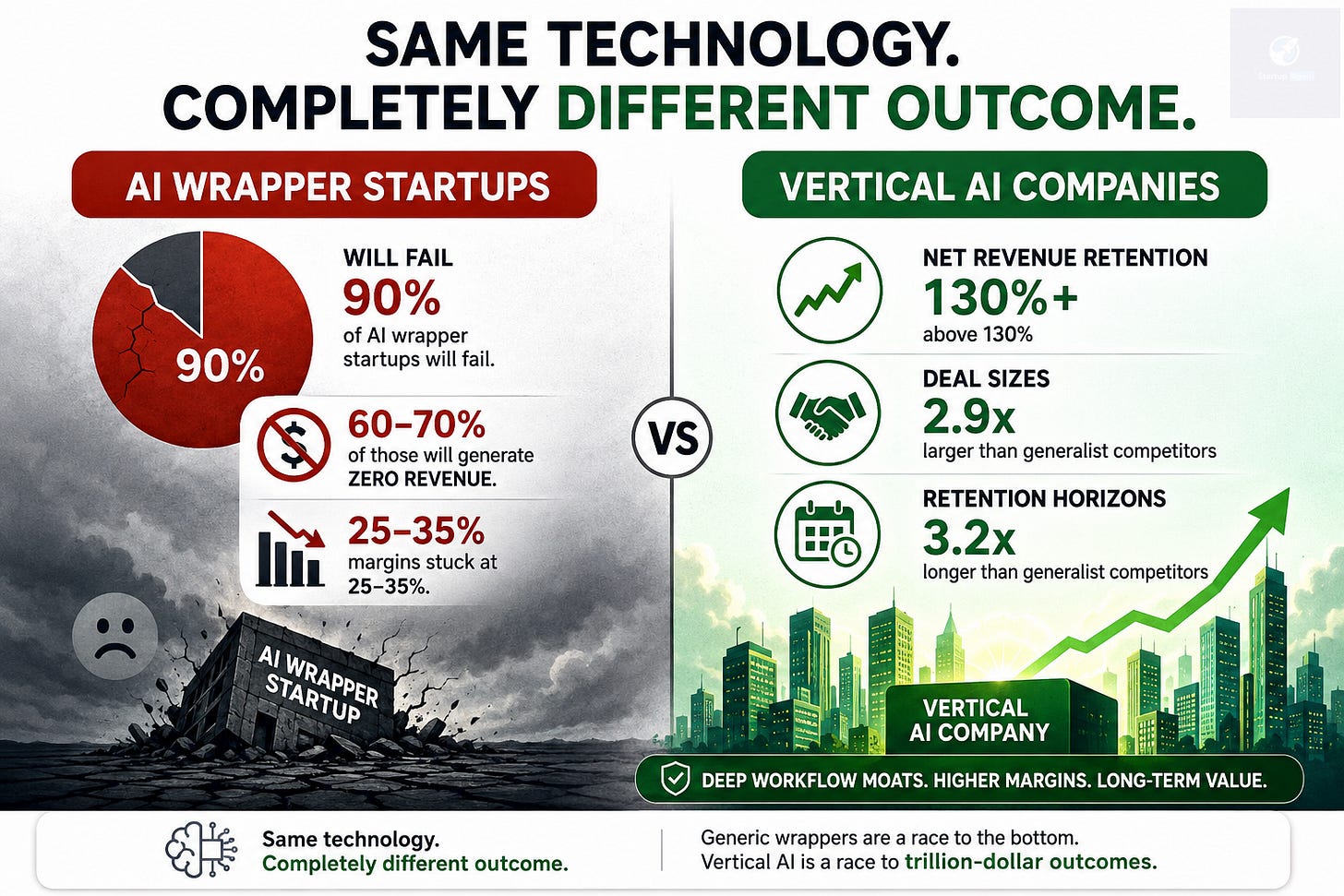
- Platforms like GC AI and Harvey AI are automating complex legal and financial workflows, driving net revenue retention above 130% and dramatically increasing deal sizes.
- Healthcare leaders such as Embold Health and Doctronic have achieved clinical validation and regulatory integration, making compliance and safety the new enterprise AI gold standard.
- Investor dollars are flooding into vertical AI—35 new unicorns emerged in 2025, with ARR multiples soaring to 15–20x and over half of enterprises deploying vertical AI solutions by mid-2026.
Workflow Wedges Win Vertical AI
Vertical AI startups are dismantling SaaS incumbents by embedding deeply into industry-specific workflows, slashing adoption barriers and accelerating ROI from months to minutes.
The emergence of vertical AI as industry-specific wedges has been a transformative force in overcoming long-standing resistance to digitization within specialized sectors. By embedding deeply into workflows—such as legal research or contract review—these AI tools reduce adoption barriers and accelerate time-to-value from months to mere minutes. For instance, Harvey AI enables law firms to complete legal research in minutes, while GC AI’s seamless integration into Microsoft Word propelled it from $1M to $10M ARR in under a year by addressing the distinct needs of in-house legal teams, a rapidly growing segment managing over $300 billion in annual legal spend.
Vertical AI’s growth follows a phased model that begins with targeting high-pain workflows to capture critical data, then expands into broader platform capabilities including fintech and marketplace features. This approach is exemplified by companies like Tire Tutor, which built a user-friendly platform connecting wholesalers to retailers, and Supio, which leverages canonical data schemas to create golden master objects enabling real-time insights in legal workflows. By simplifying complex processes and demonstrating rapid ROI—such as replacing $50k-$75k annual front desk labor with AI voice agents—vertical AI tools have proven their ability to disrupt entrenched SaaS incumbents in niche industries.
By 2025-2026, vertical AI had crystallized into a $3.5 billion category, driven by solutions that require no complex integration or training and deliver immediate value to mid-market companies. This narrow focus on industry, workflow, and buyer persona shortens sales cycles and accelerates ROI, meeting strong SME demand where 91% report efficiency gains and 76% increased innovation from generative AI. Despite the dominance of core AI platforms like ChatGPT, market preference remains firmly with specialized vertical products, echoing historic platform shifts where unbundled, domain-specific solutions outcompete generic platforms by addressing precise use cases with superior traction and user adoption.
Since around 2024, vertical AI agents have gained traction in complex domains such as legal, healthcare, and finance by embedding domain-specific knowledge to automate intricate workflows like legal case research, medical scribing, and insurance data retrieval. While early solutions faced user dissatisfaction, ongoing innovation by startups in hubs like New York reflects a maturing market that increasingly values specialized AI agents capable of deep task automation, signaling vertical AI’s growing role as indispensable tools tailored to the nuanced demands of these industries.





From Records to Action
Vertical AI platforms are evolving from passive data stores to active, agentic systems that automate complex decisions within native workflows, shifting defensibility from data lock-in to proprietary decision layers.
By late 2025, vertical AI platforms like GC AI had transcended their origins as mere data repositories to become integral systems of action that automate high-volume, regulated workflows with embedded domain expertise. GC AI’s seamless integration into Microsoft Word, enabling lawyers to receive AI-driven redline suggestions based on company-specific playbooks, exemplifies how these platforms embed agentic AI decision-making directly into native workflows, creating defensibility that generic AI tools cannot replicate.
Into early 2026, this evolution accelerated as vertical AI expanded beyond traditional software-savvy sectors to previously software-naïve industries like tire retail and medical records. Innovators such as Jason and Jerry Zwo demonstrated that extracting canonical data schemas from documents enables real-time, autonomous decision-making—transforming labor-intensive tasks like front desk operations or demand letter generation into streamlined, AI-driven workflows, thereby unlocking new value and defensibility.
By February and March 2026, thought leaders like Scott Hoke and Nic highlighted a fundamental shift in vertical SaaS: from systems of record that passively store data to systems of action that autonomously govern multi-step processes such as invoicing and payment reconciliation. The traditional moat of data stickiness eroded as AI-enabled harmonization facilitated easy migration, shifting competitive advantage to proprietary 'context graphs'—decision layers capturing the rationale behind workflow actions, which train AI models to execute next steps and create a new, workflow-embedded defensibility.
By mid-2026, vertical AI platforms had firmly established themselves as autonomous agents rather than mere tools, exemplified by systems that not only analyze but also act—such as filing solar permits across all 50 states or managing compliance risks—creating moats impervious to foundational AI model updates. This transition to embedded domain expertise and agentic AI drove substantial business impact, with vertical AI companies achieving net revenue retention above 130%, deal sizes nearly three times larger than generalist AI competitors, and retention horizons over three times longer.

Clinical AI’s Compliance Race
Healthcare AI leaders are winning enterprise trust by building rigorous validation and regulatory frameworks, making compliance-driven integration—not raw model power—the new moat in clinical automation.
By early 2026, vertical AI solutions in healthcare had matured significantly through rigorous clinical validation and regulatory alignment, exemplified by Embold Health’s expansion of specialty-specific quality models in oncology and other fields, coupled with generative AI enhancements that improved provider decision support. Their acquisition by Quantum Health in mid-2025 underscored a strategic consolidation aimed at scaling personalized, evidence-based care navigation, while external validations from the Validation Institute and HITRUST’s r2 assessment bolstered enterprise trust and adoption. Similarly, Stanford Healthcare transitioned from pilots to scaled AI deployments with tools like Chat EHR and tumor board preparation agents that streamline clinical workflows and augment physician decision-making, reflecting a broader sector-wide shift toward integrating AI within regulated healthcare environments.
Navigating regulatory frameworks remains a critical challenge and differentiator for vertical AI in healthcare, as demonstrated by Doctronic’s AI doctor platform which operates under strict licensure constraints—practicing medicine only in Utah while providing diagnostic guidance with disclaimers elsewhere. This hybrid model, combining AI diagnostics with licensed telehealth physicians across all 50 states, highlights the necessity of embedding clinical validation and governance to achieve enterprise-scale adoption. Moreover, OpenAI’s 2025 launch of ChatGPT Health, developed through partnerships with domain experts like Color Health and bwell Connected Health, further validates that success in clinical AI demands deep regulatory navigation and integration rather than reliance on general-purpose foundation models, which have repeatedly faltered due to reliability and compliance gaps.
The healthcare AI landscape is increasingly recognizing that regulatory oversight will soon mandate platform-level clearances, compelling companies to proactively build robust validation infrastructures including outcome data collection, safety monitoring, and transparent audit trails. This strategic foresight favors narrowly focused clinical AI tools with clearly defined scopes—such as medication reconciliation or urgent imaging review—that are easier to validate against clinical standards. Additionally, firms providing compliance and monitoring infrastructure gain a structural advantage by enabling safer deployment of foundation models across health systems lacking machine learning operations expertise, emphasizing that integration, transparency, and clinical workflow alignment trump raw model accuracy in driving enterprise adoption.
Beyond healthcare, vertical AI solutions have demonstrated sector-specific maturation and regulatory integration in legal and insurance industries, with companies like Harvey and Evisort in legal, and illumend by myCOI in insurance, leading enterprise adoption through AI-driven workflows that automate complex research, compliance verification, and contract analysis. illumend’s award-winning platform, featuring the conversational AI 'Lumie,' exemplifies this progression by delivering real-time compliance insights with auditability and regulatory rigor, processing thousands of documents daily with 90% accuracy and reducing review times by 99%. While legal AI adoption remains cautious due to risk aversion, the ongoing innovation and gradual acceptance signal a transformative shift toward agent-first workflows that reconcile domain expertise with regulatory demands across these highly regulated sectors.




Investor Frenzy Reshapes Moats
A flood of capital is fueling vertical AI unicorns that command premium valuations by leveraging proprietary, regulation-ready data and industry-specific workflows, leaving generic AI platforms behind.
The vertical AI sector experienced an unprecedented surge in funding throughout 2025, culminating in the emergence of 35 new unicorns, each surpassing roughly $90 million ARR at the billion-dollar valuation threshold. This rapid capital influx, with $42 billion of dry powder earmarked for vertical AI among the top 25 firms and over 180 Series B/C companies poised to raise substantial rounds, underscores robust market validation and investor confidence. By 2026, vertical AI had solidified its position as a $3.5 billion category, tripling investment from the previous year and signaling a transformative shift in enterprise software landscapes.
Investor sentiment has decisively pivoted from generic horizontal AI infrastructure toward proprietary data assets and regulatory-approved datasets as the core moat for vertical AI platforms. For instance, Abridge’s repository of over two million hours of de-identified clinical audio exemplifies the premium placed on domain-specific, compliant data over massive but generic model parameters. This strategic shift is further reinforced by the superior revenue retention and valuation multiples vertical AI companies command—posting net revenue retention above 130% and ARR multiples between 15x and 20x—highlighting the defensibility of specialized workflow knowledge against disruptive foundation model updates.
Market traction is accelerating as vertical AI solutions increasingly focus on specialized agentic workflows tailored to specific industries and buyer personas, enabling products that deliver immediate value without complex configuration or IT deployment. This focus has dramatically shortened go-to-market cycles in regulated verticals from 30 months to just 11 months by 2025, with over half of enterprises running AI agents in production by mid-2026 and nearly a quarter actively scaling deployments. The resulting 'great unbundling' mirrors historic platform shifts, where vertical AI disaggregates generic platforms like ChatGPT into finely tuned, industry-specific applications that better fit operational rhythms, particularly in mid-market segments.
Looking ahead, 2026 is poised to be a landmark year for vertical AI, driven by deep regulatory expertise, integration moats, and the maturation of proprietary workflow knowledge cultivated through extensive real-world deployments. In healthcare, for example, durable competitive advantages arise from embedded Forward Deployed Engineer models that generate unique workflow insights, which are unlikely to be commoditized even as integration tooling advances. This accumulation of domain-specific knowledge not only fortifies platform defensibility but also promises to reduce customization burdens over time, enabling vertical AI to reshape 30 to 40% of the $450 billion global vertical SaaS market by 2028 and unlock a trillion-dollar opportunity.