Vertical AI surges as enterprises demand custom, hybrid models
The gist
Vertical AI is exploding as enterprises demand smarter, domain-savvy models that outpace generic AI and deliver jaw-dropping productivity in regulated sectors.
What to know
- JPMC, Harvey AI, and Abridge are seeing 50-80% productivity gains by deploying custom, regulator-approved AI models with deep industry expertise.
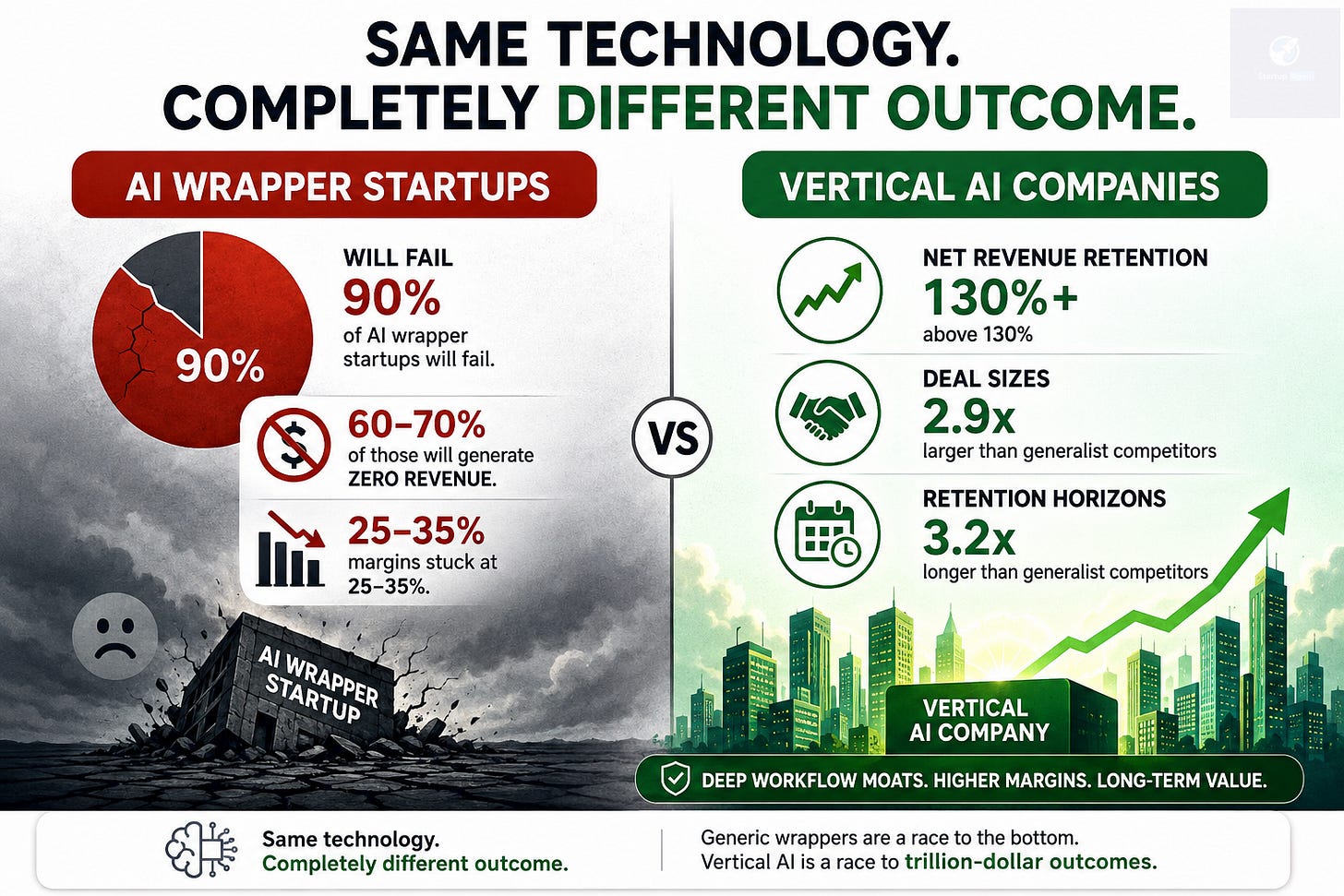
- Vertical AI firms are creating billion-dollar moats with proprietary data and sticky, autonomous systems, spawning 35 new unicorns set to cross $1B ARR in 2025.
- Hybrid AI—blending local and cloud models—is emerging as the cost-effective playbook for 2026, letting enterprises orchestrate ensembles for lasting competitive edge.
Beyond Accuracy: AI’s Real Test
Enterprise AI reliability hinges on nuanced evaluation frameworks that blend technical accuracy with real-world outcomes and bias mitigation, demanding cross-disciplinary collaboration and robust foundational architectures.
Translating cutting-edge AI research into reliable, enterprise-ready models demands a nuanced evaluation framework that goes beyond traditional technical metrics. Elizabeth Lingg of Contextual AI underscores the importance of correlating 'inner loop' metrics like accuracy with 'outer loop' outcomes such as customer satisfaction and the elusive 'vibe check,' while also employing diverse evaluation metrics to mitigate model bias and sycophancy. Addressing challenges like AI hallucinations requires moving past binary assessments to incorporate confidence ratings, thereby enhancing real-world reliability and ensuring models are both specialized and grounded for enterprise deployment.
Effective collaboration between research and engineering teams is pivotal in adapting academic AI breakthroughs into production-grade solutions. Elizabeth Lingg highlights the unexpected complexity of this translation process, which involves coordinating multiple disciplines to tailor innovations for real-world applications. Moreover, organizations must recognize that simply adopting AI tools does not resolve systemic engineering bottlenecks; instead, AI must be strategically applied to specific organizational challenges with a clear understanding of underlying complexities, echoing Aviator’s critique of the misplaced focus on tool selection over problem-solving.
Enterprise AI model development is increasingly characterized by a strategic balance between generalized frontier models and specialized domain intelligence. While models like Gemini offer broad reasoning capabilities as 'jack of all trades,' they often lack the domain-specific expertise critical for sectors such as healthcare or finance. This specialization requires substantial engineering effort in data harmonization and knowledge graph construction, reminiscent of the SAP challenges of the 1990s, as exemplified by large banks like JPMC. The debate continues over whether frontier AI vendors like OpenAI and Anthropic will evolve into enterprise software providers or if independent software vendors will fill this niche, but all agree that a robust foundational AI architecture is essential before effective tooling can be deployed.
The AI landscape is moving away from the notion of a universal model toward a diverse ecosystem of specialized models tailored to distinct industries and use cases. Frontier labs diverge widely in their objectives and optimization strategies—OpenAI prioritizes user engagement, while Anthropic focuses on productivity and value extraction—reflecting fundamentally different theses on AI’s path forward. This divergence is further amplified by some labs’ deliberate rejection of popular benchmarks like Alpaca, which they argue incentivize hallucinations. Concurrently, the democratization of AI development is accelerating, with startups leveraging reinforcement learning to fine-tune smaller open-source models that outperform larger generalist models in niche domains, though sustaining this edge requires continuous iteration to keep pace with rapidly advancing base models.




Vertical AI’s Defensible Edge
Domain-specific AI models are building billion-dollar moats by embedding proprietary data and expertise directly into workflows, enabling rapid adoption and sticky, autonomous systems in regulated industries.
Vertical AI wedges have emerged as powerful catalysts for rapid adoption in complex and regulated industries by delivering immediate, domain-aware value that generic horizontal AI cannot match. Companies like Harvey AI and Abridge demonstrate productivity gains of 50-80% by embedding deep industry knowledge—such as legal case law or HIPAA-compliant clinical workflows—directly into their tools, transforming AI from a 'nice to have' into a 'must have' solution. This targeted integration approach allows these AI solutions to selectively connect with critical data sources like patient notes or claims data without disrupting existing core systems, enabling seamless adoption and high ROI from day one.
The competitive moat in vertical AI has shifted decisively from sheer model size to the possession of proprietary, regulator-approved data and embedded domain expertise, which create defensible barriers to entry in specialized markets. For instance, Abridge’s 2 million hours of de-identified clinical audio data far outweighs the value of large generic models trained on public internet data, while companies like ChipAgents leverage years of encoded semiconductor vocabulary to avoid the pitfalls of 'confident nonsense' from horizontal models. This domain specificity not only accelerates market penetration—evidenced by 35 new vertical AI unicorns crossing the billion-dollar ARR threshold in 2025—but also supports sustainable growth with normalized revenue multiples and gross margins surpassing horizontal AI peers.
A transformative shift from systems of record to systems of action is redefining vertical AI’s role in enterprise workflows, where AI agents autonomously execute complex, multi-step processes rather than merely storing data or generating insights. As Scott Hoke articulates, these systems 'decide what happens next—and then do it,' enabling automation of intricate tasks such as revenue cycle management in outpatient healthcare or Medicaid-compliant care coordination in home care. This evolution creates new defensibility through proprietary 'context graphs' that capture decision rationale within workflows, establishing sticky switching costs and embedding AI deeply into mission-critical operations.
Successful vertical AI adoption hinges not only on technical excellence but also on disciplined go-to-market strategies that prioritize rapid feedback loops, practical solutions over AI hype, and deep integration into existing workflows and ecosystems. Founders emphasize that buyers in vertical markets often prioritize tangible problem-solving over AI branding, making traditional sales tactics like outbound calls and boots-on-the-ground presence essential. Companies such as Casca illustrate that full-system replacements of legacy infrastructure unlock outsized economic returns and durable moats by targeting structurally broken, high-cost processes, while Google’s Gemini Enterprise for Legal exemplifies embedding AI agents directly into legal workflows to automate complex tasks and accelerate adoption.


AI Agents Power New Workflows
AI agent orchestration is transforming from fragmented pilots to democratized, scaled ecosystems where non-engineers shape workflows and enterprises seek unified management across diverse business functions.
The orchestration of AI agents within enterprise workflows is evolving from isolated pilots to expansive, cohesive ecosystems that empower broad user bases and deliver measurable business outcomes. Tools like 'Please Fix' exemplify this shift by enabling non-engineers to actively participate in product development, effectively expanding the engineering team and democratizing workflow contributions. This democratization is reflected in the scale of adoption, with a quarter of a million users debugging nearly 800,000 issues monthly, illustrating how AI-enhanced workflows are becoming integral to operational success.
Despite growing enthusiasm, the creation of a unified AI agent orchestration layer remains a significant challenge in 2026, as current platforms are fragmented and lack fully open APIs necessary for comprehensive management. Enterprises express a pressing need not for more autonomous agents but for a simplified, unified human interface that consolidates interactions across multiple AI agents, reducing operational overhead and complexity. Salesforce currently serves as the closest practical management hub where diverse AI agents intersect, though it stops short of being a true orchestration platform, highlighting the gap between aspiration and current capabilities.
The dominant use of AI agents in software engineering—accounting for nearly half of all tool calls on Anthropic’s public API—stems from the domain’s testable outputs, reversible errors, and rapid feedback loops, making it an ideal proving ground for autonomous agents. However, emerging sectors such as healthcare, finance, and cybersecurity are beginning to adopt AI agents cautiously, emphasizing human oversight and safeguards to mitigate risk. This strategic expansion signals a transition from developer-centric tools to operational business layers where agents automate complex workflows and compliance tasks, moving enterprises closer to integrated AI ecosystems with tangible impact.
Scaling AI agent deployments requires a strategic, connected approach that aligns agents with clear business objectives such as revenue growth or cost reduction, while embedding governance, security, and compliance frameworks akin to those applied to human workers. Arun Chandra emphasizes that the efficacy of AI agents hinges on their access to relevant data and context, underscoring the necessity of integrating agents deeply within backend systems to enable autonomous, evidence-based decision-making. As organizations transition from pilots to production workloads, the focus shifts from generating outputs to achieving meaningful outcomes like risk reduction and improved customer experience, demanding flexible orchestration frameworks that balance innovation with control.



Customization Outpaces Generic Models
Enterprises are driving cost and performance gains by fine-tuning smaller, proprietary AI models that outperform generalist solutions in high-stakes, domain-specific applications.
Customization through fine-tuning and reinforcement learning has proven essential for enterprises seeking AI models that meet specific, high-stakes use cases beyond the reach of generic frontier models. For instance, an accounting software firm boosted model accuracy by 20-30% with limited high-quality data, while startups like Harvey and OpenEvidence have crafted domain-specific models that outperform OpenAI’s generalist offerings in healthcare and legal fields. Despite most enterprises still relying on base frontier models like DT 5.1, innovators are pushing customization to embed proprietary knowledge and optimize performance tailored to unique workflows and regulatory demands.
Continuous optimization is critical as frontier models rapidly evolve, often surpassing earlier fine-tuned versions, compelling companies to maintain an ongoing cycle of post-training updates to sustain competitive advantage. YC startups initially outperformed GPT-3.5 through reinforcement learning but had to adapt quickly when GPT-4.5 and 5.1 arrived. This dynamic environment underscores the necessity of robust infrastructure platforms like Modal, which support reinforcement learning loops and sandboxed agent environments, enabling enterprises such as Decagon and Ramp to continuously refine AI agents integrated deeply into their workflows.
The economic imperative of customization is increasingly clear, with cost efficiency now driving enterprises to develop smaller, purpose-built AI models that leverage proprietary data and unique user signals. Applied Compute’s CEO Yash Patil highlights that cost, not capability, is the primary motivator for custom models, which outperform frontier models on narrow, high-value tasks for clients like DoorDash. Moreover, companies like Thomson Reuters and Legora invest heavily in fine-tuning and post-training to build durable competitive advantages, emphasizing that owning and continuously improving AI intelligence is preferable to renting generic models from providers like OpenAI or Anthropic.
Strategic AI customization involves more than fine-tuning; it requires a vertically integrated, sovereign AI stack that orchestrates multiple models—frontier, custom, and third-party—while embedding proprietary workflows, ethical ownership, and domain-specific knowledge. This approach enables enterprises to balance performance, cost, and privacy, as seen in sectors like law and apparel where tailored models sync with supply chains or mitigate hallucination risks. Leaders like Garrett Lord and Joel Hron advocate starting with task evaluation and agent orchestration before fine-tuning, ensuring AI systems continuously improve by leveraging organizational knowledge and proprietary evaluation data that companies guard fiercely to maintain their edge.



AI Demands Workflow Reinvention
Sustained AI success requires organizations to overhaul workflows, governance, and capabilities—treating AI as a strategic asset rather than a bolt-on tool and ensuring sovereignty over critical intelligence layers.
Achieving sustainable AI success in enterprises demands a fundamental redesign of workflows and organizational capabilities to integrate AI models effectively within domain-specific contexts. As Arun Chandra emphasizes, organizations must align AI deployment with clear business objectives and rethink workflows rather than merely layering AI onto existing processes. This involves overcoming the 'activation energy' barrier by orchestrating data and processes across business units, as seen in complex environments like JPMorgan Chase and AWS, where harmonizing proprietary data with frontier models requires iterative, ERP-like efforts.
Robust AI governance and operational frameworks are critical to managing the complexity of AI adoption at scale, especially as enterprises transition from isolated pilots to integrated, agentic AI workflows. Experts like Gonçalo Borrêga highlight that orchestration challenges—such as security, permissions, and policy enforcement across multi-agent systems—demand consistent engineering and governance layers that transcend vendor lock-in. This governance must evolve to treat AI agents with the same standards as human workers, ensuring trust, privacy, and compliance while enabling cross-functional collaboration and change management.
Building organizational capabilities around AI requires a strategic balance between leveraging frontier models and developing specialized, proprietary AI tailored to unique domain expertise and workflows. Thomson Reuters’ $40 million investment exemplifies how focusing on domain-specific models can create a compounding competitive advantage, while startups like Bridge maintain differentiation by embedding AI deeply into clinician workflows that frontier models cannot replicate. This approach underscores the importance of AI sovereignty—owning critical AI layers that matter strategically—while still collaborating with frontier model providers to orchestrate multi-model environments efficiently.
Overcoming enterprise AI adoption barriers hinges on fostering cross-functional collaboration, ethical AI governance, and continuous workflow integration that respects expert ownership and organizational knowledge. Legal tech’s slow AI adoption illustrates the cultural and risk-averse challenges that require redesigning workflows to position AI as a partnership tool enhancing efficiency and risk management. Meanwhile, frameworks like Onyx’s ethical AI model ownership and Anthropic’s human-in-the-loop agent supervision demonstrate how embedding governance and respecting data sovereignty not only mitigate ethical concerns but also enhance AI effectiveness and trust within organizations.



Hybrid AI: The New Enterprise Standard
Enterprises are slashing costs and boosting agility by orchestrating hybrid AI deployments that blend local, cloud, open source, and custom models—breaking single-vendor dependency and fueling US-led innovation.
By early September 2026, hybrid AI deployments have emerged as a strategic approach for enterprises aiming to optimize efficiency and cost. This model dynamically routes tasks between local and cloud AI systems, leveraging local models on accessible hardware like second lowest memory MacBooks for simpler tasks to minimize latency and expenses, while reserving large cloud models for complex challenges such as coding agents. This nuanced orchestration not only reduces operational costs—sometimes effectively to zero by utilizing open-source models on existing infrastructure—but also balances performance demands with geographic diversity in model sourcing, blending US, European, and Chinese AI innovations.
Looking ahead, the AI ecosystem is set to be defined by enterprises adopting an ensemble of models that integrate open source, frontier, and custom-trained AI tailored to specific tasks and cost efficiencies. This hybrid strategy is bolstered by robust American innovation, with Nvidia and venture capital fueling a surge in high-quality open source AI development, positioning the US as a formidable leader in the evolving landscape. As enterprises increasingly own and orchestrate specialized AI intelligence—combining proprietary data with diverse model types—they move away from dependence on single providers, enabling sustainable competitive advantages through precise, task-optimized AI deployment.
