Vertical SaaS AI agents shift from record-keeping to action
The gist
Vertical SaaS AI agents are vaulting from passive record-keepers to powerhouse workflow engines, automating complex tasks and redrawing competitive lines in regulated industries.
What to know
- Domain-specific AI agents like Harvey AI and Abridge are driving 50–80% productivity gains by embedding deeply into legal and healthcare workflows and slashing adoption timelines from months to minutes.
- Platforms are shifting from mere data storage to dynamic systems of action, with proprietary decision layers—rather than raw data—now forming the new competitive moat.
- AI-powered SaaS is transforming document-heavy sectors such as law, healthcare, and finance, while companies like CoCounsel and Payouts.com are pairing AI autonomy with strict human oversight to ensure compliance and trust.
AI Wedges Transform Workflows
Domain-specific AI agents are rapidly embedding into regulated industries, turning high-friction adoption into a catalyst for expansive SaaS platforms that automate core workflows and unlock new revenue streams.
Domain-specific AI agents have emerged as critical wedge products in vertical SaaS by embedding deeply into specialized workflows, drastically lowering adoption barriers that have stymied digitization in regulated industries for decades. Unlike generic horizontal AI tools that yield modest productivity improvements, these vertical AI wedges deliver outsized gains—often between 50-80%—by understanding nuanced domain context and integrating selectively with source-of-record systems, as exemplified by Harvey AI in legal research and Abridge in healthcare. This embedding not only accelerates time-to-value from months to minutes but also creates natural expansion pathways into adjacent workflows, data infrastructure, embedded fintech, and marketplaces, enabling vertical SaaS platforms to evolve into comprehensive operating systems over multi-year horizons.
The strategic focus on domain-specific workflows allows vertical AI agents like GC AI to penetrate high-value, underserved market segments such as in-house legal teams, which control over $300 billion in annual legal spend and are growing twice as fast as law firm lawyers. By integrating directly into familiar tools like Microsoft Word and automating repetitive, high-frequency contract review tasks common across industries including SaaS, fintech, and healthcare, GC AI exemplifies how vertical AI wedges unlock rapid adoption and expansion in complex, regulated environments. This approach contrasts sharply with prior legal AI efforts aimed predominantly at billable law firm work, highlighting how vertical AI agents serve as wedge products by solving real-world workflow pain points at scale.
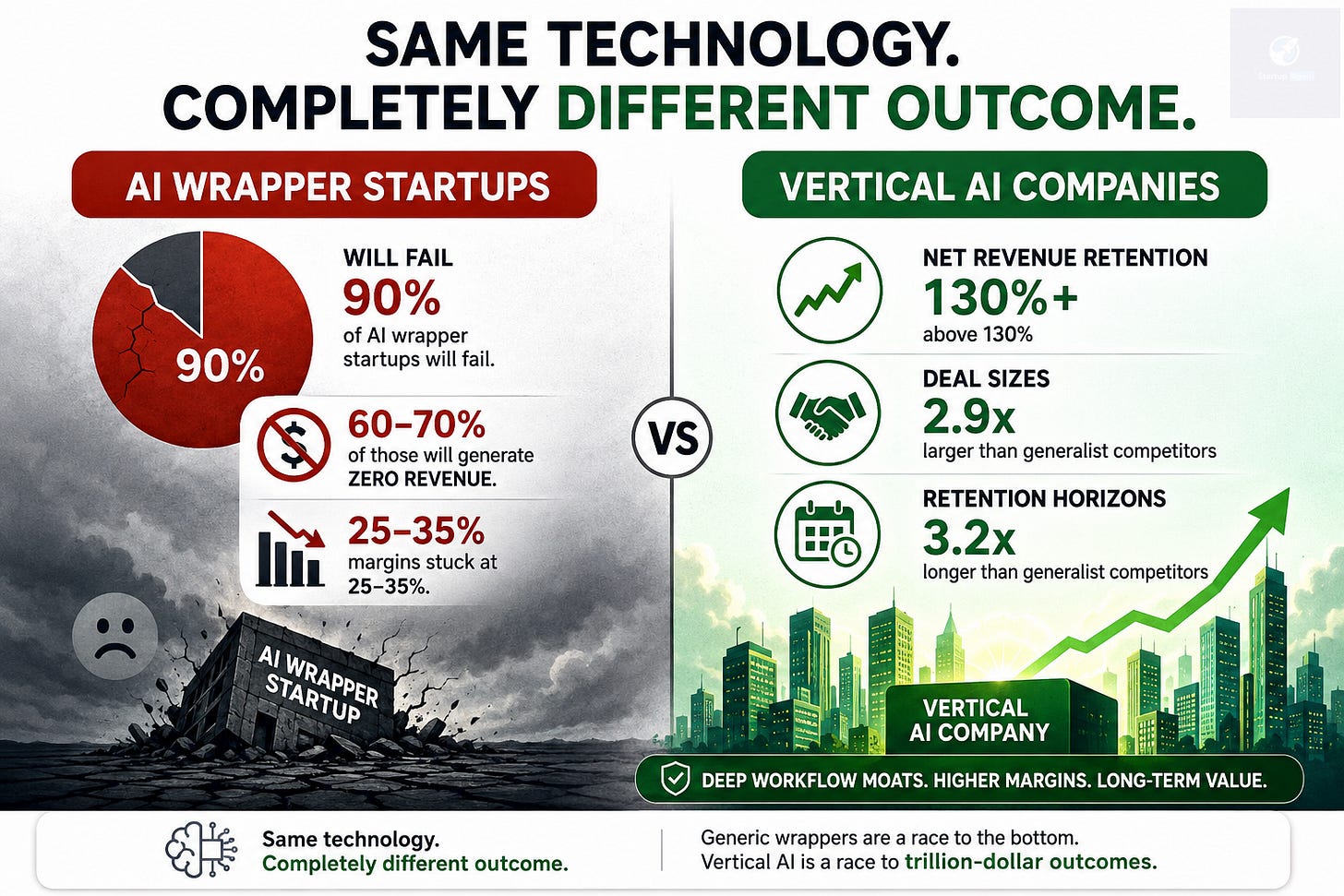
By mid-2025, the rise of agentic workflows—AI agents autonomously embedded within domain-specific processes—marked the true inflection point for vertical SaaS growth, compressing go-to-market cycles in regulated verticals from 30 months to just 11. This acceleration is fueled by proprietary, regulator-approved datasets and workflow integration moats that horizontal AI players cannot easily replicate, such as Abridge’s 2 million hours of de-identified clinical audio data. Vertical AI companies are now posting net revenue retention rates above 130%, deal sizes nearly three times larger than generalist competitors, and retention horizons over three times longer, underscoring how deeply embedded AI agents create defensible moats and premium valuations by automating end-to-end workflows rather than merely adding AI-powered features.
The vertical AI wave reflects a broader historical pattern where unbundling generic platforms leads to specialized businesses dominating specific categories, as seen with WhatsApp and Instagram breaking away from Facebook. Most users prefer buying specialized, domain-focused AI products rather than building their own, ensuring sustained demand for vertical AI agents tailored to complex professional needs in legal, healthcare, and finance. Startups like Harvey and Evisort in legal, Accordance and Abridge in healthcare, and Hebia and Rogo in finance exemplify this maturation, leveraging codified knowledge bases such as tax codes and GAAP to deliver highly productive AI agents that automate deep research and compliance workflows. This shift from AI tools to autonomous agents embedded in workflows is pivotal for creating scalable, defensible SaaS products that drive rapid vertical expansion.



From Records to Real Action
Vertical SaaS is shifting from passive data storage to AI-driven systems that autonomously execute decisions, with defensibility now built on proprietary decision layers instead of raw data.
By early 2026, vertical SaaS platforms are decisively moving away from being mere systems of record—passive repositories that simply store data—to becoming dynamic systems of action that actively govern workflows and automate decision-making. As Scott Hoke of AQL Growth succinctly puts it, “A system of record stores what happened. A system of action decides what happens next — and then does it.” This evolution is driven by AI’s ability to execute complex, multi-step processes autonomously, such as generating and sending invoices, managing follow-ups, and reconciling accounts, thereby transforming operational value far beyond simple notifications or alerts.
This shift from record-keeping to action-oriented platforms also redefines competitive moats in vertical SaaS. Traditional switching costs based on data stickiness are rapidly eroding as AI-powered tools make data migration and harmonization trivial—Nic’s experience of effortlessly switching internal systems by leveraging AI exemplifies this trend. Consequently, defensibility now hinges on proprietary context graphs or decision layers that capture not just data but the rationale behind decisions within workflows, embedding the platform deeply into business processes and making it harder to dislodge.
The new vertical SaaS playbook emphasizes speed and targeted functionality over building monolithic ERP systems upfront. Companies like Qualia illustrate the imperative to aggressively develop AI-native features to stay relevant; Nate from Qualia warns that without such offensive innovation, customer retention within two years would be unlikely. This approach starts with solving a specific, painful problem to quickly generate revenue and validate market fit, then incrementally building the critical 20% of ERP functionality that truly matters—underscoring how legacy systems of record risk becoming prisons if they fail to adapt swiftly to AI-driven workflows.
Underlying these transformations is the critical role of clean, structured workflows and data, which serve as the foundation for effective AI integration. The magic of AI in vertical SaaS only materializes when it intersects with well-defined, interpretable processes, enabling platforms to automate decision-making reliably. This necessity gives existing systems of record a potential advantage—provided they can rapidly evolve to incorporate AI—highlighting a nuanced balance between legacy data infrastructure and the agility required for AI-powered systems of action.
Human Oversight Meets AI Autonomy
Leading platforms are blending agentic AI with rigorous human-in-the-loop governance, ensuring automation breakthroughs in law and finance remain compliant, accurate, and trusted.
By mid-2026, leading vertical SaaS players like CoCounsel and Payouts.com have demonstrated that embedding human-in-the-loop governance is indispensable for deploying AI agents in high-stakes, regulated workflows. CoCounsel’s responsible AI team rigorously analyzes hallucination and bias risks before market release, reflecting a cautious approach necessary in legal tech’s risk-averse culture where, as one expert noted, "lawyers are being paid not to screw things up." Similarly, Payouts.com’s Digital Employee agents autonomously execute complex finance workflows but escalate ambiguous cases for human review, ensuring accuracy and compliance under stringent SOC 2 Type II and PCI-DSS Level 1 standards. This hybrid model balances automation breakthroughs with essential human oversight to maintain trust and regulatory alignment.
The evolution from Retrieval-Augmented Generation to agentic AI models, as seen in CoCounsel’s integration with Westlaw Practical Law, underscores the necessity of embedding AI deeply within authoritative content while simultaneously enforcing rigorous governance frameworks. Laura from CoCounsel highlights that this agentic approach unlocks complex legal work products previously unattainable, but it also demands robust oversight to manage the amplified risks inherent in such sophisticated AI workflows. This shift exemplifies how responsible AI practices must evolve alongside technological advances to safeguard accuracy and compliance in sensitive domains.
Across finance and revenue operations, organizations are adopting strong governance cultures that emphasize experimentation balanced with risk management, as noted in INTHEBLACK’s July 2026 analysis. High-performing firms implement defined processes for human validation of AI outputs, recognizing that tolerance for inaccuracies varies by risk appetite. Finance teams and CFOs remain deeply involved from initial AI deployment through daily operations, instituting redundancies and approval rules to catch errors before they impact billing or invoicing. This layered human-in-the-loop framework not only prevents costly mistakes but also builds organizational confidence in AI-driven automation.
The broader narrative emerging by mid-2026 is that AI agents are not replacements but partners enhancing human capability, particularly in regulated verticals like legal and finance. This partnership model fosters trust by ensuring AI outputs are reviewed and refined as needed, mitigating ethical risks such as inaccuracy and explainability. As organizations embrace this paradigm, they recognize that successful AI adoption requires a culture shift toward experimentation coupled with strong governance to manage ethical and operational risks effectively.




AI Revolutionizes Legacy Sectors
AI-powered vertical SaaS is breaking into document-heavy industries—like tire shops, law, and healthcare—by standardizing unstructured data and automating complex processes that once resisted digitization.
By early 2026, AI-powered vertical SaaS platforms began revolutionizing traditionally low-tech and document-heavy industries such as tire shops, legal, and healthcare by extracting and standardizing complex schemas from unstructured documents. Innovators like Jason, who built a user-friendly supply chain platform for tire shops, and Jerry Zwo at Supio, who enabled actionable insights from Kaiser medical records, demonstrate how these solutions unlock operational efficiency and open software adoption in sectors previously untouched by digital workflows.
The legal sector exemplifies AI’s transformative impact on vertical SaaS, with companies like Filevine and SmartAdvocate embedding AI natively into their case management systems to automate data ingestion, reduce manual entry, and enhance decision-making. Filevine’s legal AI now drives more revenue than traditional case management, while SmartAdvocate’s Smart Intelligence integrates AI features such as voice agents and negotiation assistants directly into workflows, eliminating the need for multiple disparate tools and reshaping how law firms manage cases.
AI agents are redefining finance and accounting workflows by automating end-to-end processes traditionally reliant on human labor, such as invoice processing, reconciliations, and month-end close activities. Payouts.com’s Digital Employee, for example, autonomously handles complex finance tasks with human oversight only for ambiguous cases, while firms leverage no-code tools and pre-built templates to customize automation. This shift addresses talent shortages and compliance challenges, enabling finance professionals to focus on higher-value work and improving operational efficiency across departments.
Recent innovations in accounting, such as Suralink’s Client Document Prescreen Agent, highlight how AI-powered vertical SaaS is enhancing accuracy and client collaboration by proactively identifying document issues and reducing engagement preparation time by up to 30%. Complementary agentic tools like Multi-Level Vouching and Version Compare agents streamline complex workflows, while improved client data control addresses validation challenges faced by 71% of firms, collectively accelerating processes and boosting client satisfaction.