Visa, stripe double down on stablecoin cards
The gist
Stablecoins have broken out of the crypto sandbox and are now the backbone of global payments, with giants like Visa, Mastercard, and Stripe racing to own the rails.
What to know
- The 2025 GENIUS Act brought federal clarity to stablecoins, unlocking a wave of institutional adoption and a $4 trillion market forecast by 2030.
- Mastercard and Stripe made multi-billion-dollar acquisitions (BVNK and Bridge) to build compliant stablecoin infrastructure, while Visa and Swift rolled out 24/7 on-chain settlement across 50+ countries.
- Stablecoin transaction volumes soared past $10 trillion monthly by 2026, with the 'Mullet Strategy' making real-time, low-cost payments seamless and invisible to end users.
Wall Street Embraces Stablecoins
Major banks and payment giants shifted from crypto caution to full-scale stablecoin integration after the GENIUS Act, merging traditional finance with compliant digital assets.
The regulatory landscape in 2025 underwent a pivotal transformation under the Trump administration and subsequent bipartisan efforts, notably the GENIUS Act signed into law in July 2025, which established a clear federal framework for payment stablecoins requiring issuers to maintain high-quality liquid reserves and operate under federal oversight. This regulatory clarity emboldened major financial institutions such as JP Morgan, Wells Fargo, Visa, Mastercard, and PayPal to transition from cautious experimentation with cryptocurrencies toward actively integrating compliant stablecoin settlement layers, signaling a strategic pivot from risk-laden crypto ventures to regulated, efficient payment infrastructures.
Early 2025 witnessed a surge of pilot projects and partnerships that illustrated institutional commitment to stablecoins as a foundational payment technology. Citigroup’s collaboration with Coinbase to pilot stablecoin payment services, Visa’s expansion of its stablecoin network across eight tokens and 40 countries, and BlackRock’s tokenization of its money market fund for trading on decentralized exchanges like UniswapX exemplify this shift. These initiatives, alongside over 250 projects by banks, payment processors, and credit card companies, underscore a broad industry movement toward leveraging stablecoins for faster, cheaper, and more transparent cross-border payments, with Citigroup forecasting a $4 trillion stablecoin market by 2030.
The regulatory momentum extended into structural legitimacy as digital asset firms secured historic federal banking charters in 2025, effectively dissolving previous barriers between traditional banking and crypto. This milestone, coupled with major banks like Bank of America and Standard Chartered embracing crypto services and investments, marked the official merger of crypto and banking sectors. The Clearing House’s development of a tokenized deposit network and SoFi’s issuance of SoFiUSD—the first stablecoin by a US national bank backed by liquid assets and redeemable 1:1 for fiat—highlight early institutional pilots that blend regulatory compliance with innovative payment solutions, enabling 24/7/365 cross-border transfers with reduced costs.
Washington’s evolving regulatory attitude in 2025 fostered a permissioned environment that encouraged developers and innovators to creatively explore stablecoin-based payment solutions, as noted by Coinbase’s chief policy officer Farar Sherzad. This sea change catalyzed widespread institutional engagement, with companies like Checkout.com upgrading platforms to facilitate stablecoin transactions for consumers and vendors, and major players such as Visa, Mastercard, Stripe, and Coinbase reportedly collaborating on new stablecoin issuances by early 2026. Meanwhile, international regulatory developments, including Hong Kong’s anticipated issuance of stablecoin licenses and Japan’s push for yen-based stablecoins and crypto ETFs, further signal a global strategic shift toward embedding stablecoins as compliant, scalable rails within mainstream financial infrastructure.





Payments Giants Race for Rails
Stripe and Mastercard’s billion-dollar acquisitions ignited a fintech arms race, rapidly onboarding banks and e-commerce to stablecoin-powered, blockchain-based payment infrastructure.
The stablecoin payments infrastructure landscape has rapidly evolved through strategic acquisitions and partnerships that accelerate adoption among major financial players. Stripe’s acquisition of Bridge in 2024 catalyzed a swift shift from early-stage developer interest to engagement with large fintechs, banks, and e-commerce treasury teams, compressing five years of adoption into a single year and spawning collaborations with firms like Remit and Ramp. Meanwhile, Mastercard’s $1.8 billion acquisition of BVNK in early 2026 further underscores the commitment of legacy payment giants to build scalable, compliant stablecoin rails that enable businesses to transact, convert, and settle payments across major blockchain networks, signaling a broader industry embrace of blockchain-based payment infrastructure.
Legacy payment networks are actively integrating blockchain technology to enhance cross-border and programmable payment capabilities, exemplified by Swift’s collaboration with Consensys to develop a blockchain prototype for instant interbank cross-border payments enforced by smart contracts. This initiative, backed by a coalition of over 30 major institutions including Bank of America and Citi, aligns with Ethereum’s ecosystem and marks a pivotal step in traditional financial institutions adopting crypto infrastructure. Concurrently, Visa and Mastercard are quietly rebuilding their back-end systems to incorporate stablecoin settlement layers, maintaining familiar front-end card experiences while enabling 24/7 on-chain settlement and improved capital efficiency through innovations like USDC-based T+0 settlement.
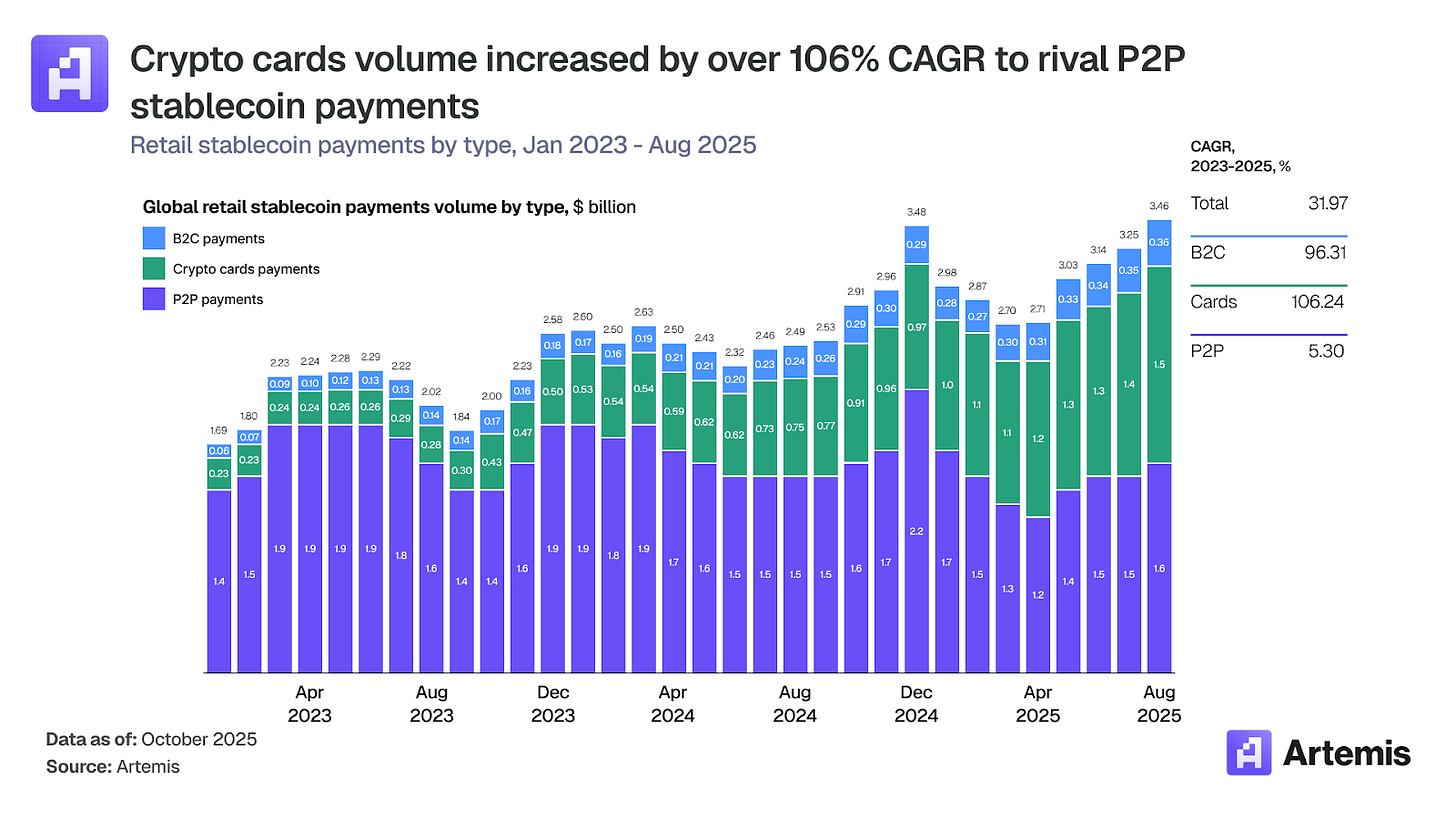
Stablecoin-powered cards have emerged as a dominant bridge between crypto and traditional payments, with monthly volumes soaring from $100 million in early 2023 to over $1.5 billion by late 2025, driven largely by Visa’s early partnerships that capture over 90% of on-chain card volume despite Mastercard’s program count parity. Full-stack issuers such as Rain and Reap represent a structural innovation by combining program management, direct principal membership, and issuance, bypassing traditional banks and reducing collateral requirements by up to 60%. Geographically, adoption is concentrated in markets like India and Argentina where stablecoins address specific needs such as crypto-backed credit and inflation-hedging debit cards, while in developed markets, the focus is on serving differentiated, high-value segments.
The stablecoin ecosystem’s maturation is increasingly driven by collaborative platforms and consortiums that emphasize interoperability, compliance, and seamless integration with existing financial rails. Notably, Stripe, Visa, and Mastercard are forming a joint stablecoin platform to challenge incumbents like Tether and Circle, leveraging their unparalleled global payment networks and recent fintech acquisitions to create a standardized, infrastructure-neutral framework. This shift from token issuance to controlling the money movement infrastructure is echoed in initiatives like Visa’s Stablecoin Platform (VSP), which bundles issuance, wallet infrastructure, and payment connectivity into a managed environment supporting treasury and liquidity use cases, thereby lowering operational barriers for institutions and signaling a strategic pivot toward embedding stablecoins within regulated finance rather than treating them as standalone products.





Stablecoins Become Financial Backbone
With transaction volumes surpassing $10 trillion monthly, stablecoins evolved from speculative assets to core settlement layers, powering both mainstream card programs and global B2B payments.
The mainstream adoption of stablecoins accelerated dramatically following strategic acquisitions and regulatory milestones, notably the Stripe acquisition of Bridge in late 2025, which propelled stablecoins from niche early adopters to major fintechs, banks, and treasury teams of large e-commerce companies, effectively compressing five years of adoption into months. This momentum was further catalyzed by the passage of the GENIUS Act in July 2025, the first federal regulatory framework for dollar-pegged stablecoins, which provided critical clarity and guardrails that encouraged banks and payment networks to integrate stablecoins into their core infrastructure, as evidenced by partnerships with platforms like Remit, Ramp, and payment giants such as Visa and Mastercard expanding stablecoin services globally.
By early 2026, stablecoins had transitioned into foundational settlement layers for global payments, with transaction volumes surpassing $10 trillion monthly—outpacing Visa since Q1 2025—and institutional adoption expanding rapidly. Visa alone reported a $7 billion annual stablecoin settlement run rate by mid-2026, supporting over 130 stablecoin-linked card programs across 50 countries, while Revolut enabled zero-fee stablecoin conversions for over 65 million users. These developments underscore stablecoins’ integration into mainstream financial infrastructure, where crypto cards serve as critical bridges, enabling millions to spend stablecoins seamlessly at traditional merchants and facilitating superior cross-border value storage.
Institutional collaboration and innovation have been pivotal in expanding stablecoin services, with major banks like Citi partnering with Coinbase to pilot on-chain stablecoin payments for institutional clients, aiming to offer programmable, cost-efficient, and 24/7 settlement capabilities. Concurrently, fintech firms such as CoinSub and Checkout.com are embedding stablecoin infrastructure into existing payment platforms, enabling merchants to accept crypto payments without workflow disruptions. This ecosystem-wide integration reflects a strategic shift from competing over stablecoin issuance to controlling critical infrastructure layers—card issuance, settlement, and custody—facilitating stablecoins’ seamless incorporation into traditional financial systems.
The ongoing expansion of stablecoin adoption is supported by a global wave of regulatory recognition and market innovation, with regions like Asia Pacific—especially Singapore and Japan—advancing licensing and legal frameworks that promote stablecoin use for cross-border payments and digital asset exposure. Meanwhile, major payment networks including Mastercard have launched crypto partner programs integrating over 85 companies to mainstream stablecoin payments, and firms like BlackRock are tokenizing assets on decentralized exchanges, signaling a convergence of traditional finance and digital assets. This regulatory and institutional embrace, coupled with growing consumer-facing initiatives such as Meta’s stablecoin payouts and MoonPay’s stablecoin debit cards, marks stablecoins’ definitive shift from experimental crypto tokens to indispensable components of the global payments infrastructure.



Invisible Blockchain, Real-World Impact
The 'Mullet Strategy' lets stablecoins operate behind legacy payment interfaces, quietly modernizing global payments while shielding users from blockchain complexity.
By early 2026, the 'Mullet Strategy' emerged as a defining approach to integrating stablecoins invisibly within legacy payment and banking systems, enabling real-time, low-cost B2B settlements without requiring end users to engage with blockchain technology. Companies like Circle, Bridge, Visa, and Mastercard are pioneering this model by embedding stablecoins beneath familiar front-end interfaces such as card networks and bank dashboards, preserving user experience while upgrading the underlying settlement infrastructure. This approach emphasizes bank-grade compliance, operational efficiency, and seamless API integrations, effectively transforming stablecoins from standalone financial instruments into foundational ledger upgrades that coexist alongside decades-old legacy software.
The invisible integration of stablecoins addresses the longstanding limitations of traditional payment rails like SWIFT, which suffer from high costs, slow speeds, and opaque processes due to their outdated architecture. Stablecoin rails, exemplified by the surge to $33 trillion in transaction volume in 2025 driven largely by USDC, enable continuous, on-chain settlement that bypasses correspondent banking delays and reduces liquidity friction. This shift not only accelerates cross-border B2B payments—particularly in corridors such as the US to Latin America and Asia—but also improves treasury management by reducing idle balances and enabling tokenized receivables finance, all while maintaining the familiar workflows merchants and consumers rely on.
A critical factor in stablecoin adoption within legacy systems is the abstraction of blockchain complexity and custody away from merchants and end users, which aligns with enterprise compliance and risk frameworks. As industry experts emphasize, mainstream B2B adoption hinges on selling 'invisible infrastructure' rather than 'crypto,' ensuring that stablecoins operate as a back-end settlement layer beneath trusted front-end interfaces like PayPal or Stripe. This separation of custody and seamless integration reduces operational overhead, avoids new reconciliation burdens, and leverages existing regulatory familiarity, making stablecoins a practical upgrade rather than a disruptive overhaul for financial institutions and merchants alike.
The race to build invisible stablecoin infrastructure is increasingly recognized as the true battleground beyond the tokens themselves, with strategic moves like MoonPay’s acquisition of Iron underscoring the value of connecting digital tokens to traditional financial systems. Legacy payment giants Visa and Mastercard are evolving complementary roles—Visa modernizing settlement layers through pilots allowing USDC-based settlement seven days a week, and Mastercard expanding multi-token network capabilities—while new infrastructure providers such as WasabiCard focus on bridging stablecoins with global payment networks and local compliance frameworks. This layered ecosystem approach ensures that stablecoins enhance capital efficiency and treasury automation without disrupting the consumer or merchant experience.



Infrastructure, Not Tokens, Wins
Legacy players are consolidating the stablecoin stack, shifting focus from token launches to controlling the rails that will define the next generation of programmable, compliant payments.
Since 2025, legacy finance and fintech giants have aggressively pursued control over stablecoin settlement infrastructure through a flurry of acquisitions and strategic partnerships, signaling a decisive shift from token issuance to owning the foundational payment rails. Mastercard's $1.8 billion acquisition of BVNK, Stripe's $1.1 billion purchase of Bridge, and Coinbase's multiple acquisitions exemplify this consolidation trend, as these firms race to dominate the next-generation payment ecosystem projected to exceed $1 trillion in stablecoin market value within five years. This strategic pivot underscores the recognition that 'it’s infrastructure, not tokens, stupid,' with players like Visa, Mastercard, Stripe, and Coinbase forming consortia to standardize and embed stablecoins into mainstream financial systems, thereby reshaping traditional payment economics and competitive dynamics.
The evolving business models around stablecoins reflect a transformation in legacy finance’s approach, integrating programmable 24/7 payment systems, tokenized credit products, and on-chain settlement capabilities to meet growing institutional demand. Citi’s partnership with Coinbase to pilot stablecoin payments and launch crypto custody services by 2026, alongside Mastercard and Visa embedding stablecoins like USDC and SoFiUSD into their global networks, illustrate this shift toward hybrid payment systems where traditional card networks evolve into orchestration layers providing trust, compliance, and seamless user experience. This integration is further accelerated by fintech innovations such as Stripe’s Machine Payments Protocol, which aims to unify fiat and crypto transactions under AI-driven commerce metering.
Regulatory uncertainty remains a significant factor shaping the competitive landscape and consolidation in stablecoin infrastructure, with ongoing debates around frameworks like the Genius Act and state-level regulatory principles influencing firms’ strategic decisions. While regulators like the U.S. OCC have taken landmark steps—such as granting Stripe’s Bridge a national trust bank charter—banks still face challenges navigating ambiguous guidance, often experiencing delays or vetoes that complicate stablecoin adoption. This regulatory backdrop has prompted legacy and fintech players to form consortia and tokenized deposit networks, balancing innovation with compliance to secure market leadership amid a fragmented and evolving legal environment.
The race to dominate stablecoin settlement infrastructure is increasingly defined by strategic collaborations and competitive positioning among major payment networks and fintech platforms, with Visa, Mastercard, Stripe, and Coinbase spearheading consortia to challenge incumbents like Tether and Circle. Mastercard’s Crypto Partner Program, enlisting over 85 companies including Binance and Circle, alongside Stripe’s potential acquisition of PayPal, exemplify efforts to consolidate control over the stablecoin settlement backbone. This competitive dynamic is further intensified by the normalization of stablecoins within traditional payment ecosystems, where firms leverage stablecoin infrastructure to enhance cross-border payments, reduce costs by up to 90%, and lock in supplier networks, thereby reshaping the future of global commerce.

AI and Agents Rewrite Payments
Payment giants like Visa, Mastercard, and Stripe are fusing AI, stablecoins, and programmable protocols, paving the way for autonomous, agent-driven commerce at internet scale.
By early 2026, legacy finance giants like Mastercard and Stripe are aggressively positioning themselves at the forefront of a financial stack rewrite driven by AI and programmable payments. Mastercard’s $1.8 billion acquisition of BVNK, which manages $30 billion in stablecoin volume, prepares it to handle a future where even 5% of its $9 trillion payment flows could migrate on-chain. Meanwhile, Stripe’s launch of the Machine Payments Protocol (MPP) embeds it at the protocol layer, enabling seamless agent-native transactions across fiat and crypto rails, potentially owning the metering layer of AI-driven commerce. These moves underscore a broader shift where AI acts as an economic actor reshaping how value is created, moved, and monetized, signaling a transition to machine-driven, programmable payments infrastructure.
The stablecoin ecosystem is rapidly scaling both in volume and geographic reach, with institutional adoption and regulatory frameworks maturing in tandem. Circle’s USDC circulation surged 72% to $75.3 billion, reflecting robust institutional confidence, while BNP Paribas launched a tokenized money market fund on Ethereum, exemplifying blockchain’s growing foothold in traditional finance. Regulatory bodies like the OCC and the UK’s FCA are actively crafting guardrails and sandboxes to foster safer stablecoin innovation. Simultaneously, Meta’s exploration of stablecoin integration for its 3 billion-plus users signals a push toward mainstream, global-scale adoption, embedding stablecoins into everyday digital commerce.
Visa is pioneering the convergence of AI-driven payment automation, stablecoin settlement, and tokenization to build a foundational layer for the internet economy. CEO Ryan McInerney’s vision of 'agentic commerce'—where AI software agents autonomously execute transactions—relies on Visa’s expanding stablecoin settlement infrastructure, which has grown over 50% quarter-over-quarter to a $7 billion annual run rate across multiple blockchains and 18 countries, with a target of 100+ by year-end. Visa’s development of AI tools like 'Agent Score' and 'Agentic Directory' to verify and empower autonomous agents, alongside partnerships with Polygon, Aave, Ripple, and Stripe, highlights a strategic commitment to integrating AI, blockchain, and tokenized assets into a seamless, scalable payments ecosystem.
The future of digital money movement is characterized by a hybrid landscape where stablecoins, tokenized deposits, and AI-driven automation coexist to transform global commerce. Regions like Asia Pacific, with its mobile-first, cross-border trade environment, are ideal proving grounds for stablecoin adoption, enabling 24/7 digital cash flows that bypass traditional banking constraints. Meanwhile, banks are innovating by converting traditional deposits into programmable digital money that operates continuously, blending legal stability with crypto flexibility. Japan’s regulatory push for yen-based stablecoins and crypto ETFs further exemplifies this trend toward regulated, scalable infrastructure. Collectively, these developments signal a new era where stablecoins serve as foundational rails for payments, settlement, and treasury operations, quietly embedding crypto into everyday financial infrastructure and enabling AI agents to become the dominant foreign exchange participants within a decade.