Voice AI breaks free from screens—but privacy fears surge
The gist
Voice AI is breaking out of your phone and into the real world—but the price for always-on convenience is a privacy minefield no one has defused.
What to know
- Voice assistants have gone from slow, screen-tethered helpers to real-time, always-listening AIs thanks to 2026 breakthroughs in low-latency audio and hybrid cloud-on-device models.
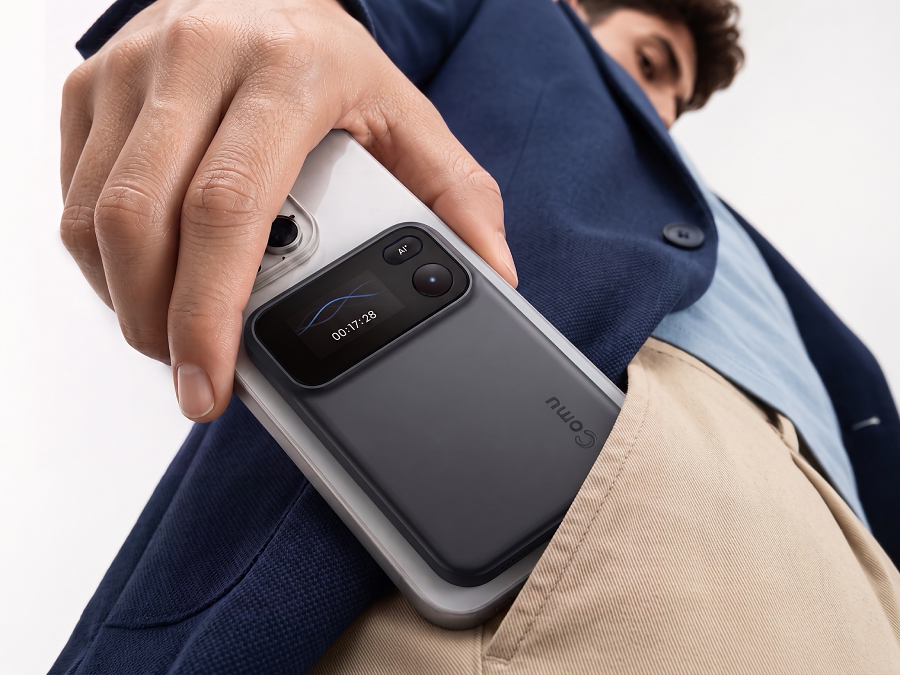
- Dedicated hardware like Comu Action Pro, Hemory, and Soulog Sense now turn conversations into searchable memory—boasting 70+ hours of recording and wearable form factors.
- Features like Apple Watch Live Rewind and Siri Recap blur the line between helpful and creepy, fueling a fierce new debate over consent and whether you’re always being recorded.
Touchscreens Set the Rules
For nearly two decades, mobile devices trained us to tap and swipe—making voice an afterthought layered onto a world built for screens, not speech.
The modern mobile interface was set in 2007, when Apple introduced the iPhone in January and released it in June, “establishing direct manipulation via multitouch displays as the primary mobile interaction paradigm.” That shift mattered because it made screens, taps, swipes, and visual navigation the default grammar of computing on phones, creating a baseline in which voice was not the main way people operated devices but a secondary mode layered onto an interaction model built around looking at and touching apps.
That touchscreen logic still defined mainstream mobile use years later: “This model, exemplified by the iPhone 4 in 2010, required users to tap, type, and navigate visually through apps and screens.” Even as voice assistants arrived—Apple launched Siri as a voice feature on the iPhone 4S in October 2011, followed by Google Now in July 2012 and Amazon Alexa in November 2014—they were introduced as optional helpers inside an app-and-screen world, not as replacements for the dominant interface itself.
Voice AI Breaks Latency Barriers
2026 marked the leap as ultra-fast, always-on voice models—powered by hybrid cloud and on-device tech—made speaking to machines as seamless as talking to people.
What changed in 2026 was not just that voice models got better, but that they became deployable as a continuous interface. Mati Staniszewski told TechCrunch that voice models have “moved beyond simply mimicking human speech — including emotion and intonation — to working in tandem with the reasoning capabilities of large language models,” while ElevenLabs is “working toward a hybrid approach that blends cloud and on-device processing” for headphones and wearables where voice becomes a constant companion, and is “already partnering with Meta” to embed that capability into consumer platforms.
The other reason voice could become primary is that the economics and latency finally support always-on use in real products. Deepgram’s Scott Stephenson said there are “over 2,000 products” built on its stack as “a voice interface,” while Microsoft claimed transcription that was “10x faster than GPT-Transcribe,” and Artificial Analysis measured 2.0% word error, about 400x real time, with diarization and 60 languages; Meta priced streaming transcription at $0.18 per hour, and Inworld’s Realtime TTS-2 reached sub-100ms time to first byte, with a 25ms Flash variant.



Conversations, Not Commands
Voice interfaces now handle real, interruptible dialogue thanks to end-to-end systems that listen, think, and respond with near-human timing.
What changed was not that machines suddenly learned to transcribe speech, but that voice stacks got fast and integrated enough to behave like conversation. On The MAD Podcast with Matt Turck, Neil Zeghidour was framed as “one of the very top AI researchers… and a key architect of the rapid evolution of voice AI towards real time native audio intelligence,” and the host contrasted today with a period when voice was “robotic, slow, and frustrating”; Zeghidour’s point was that, compared with “12 years ago,” the remaining gap is now visibly smaller because latency, naturalness, and accuracy improved together.
The technical threshold was crossing from turn-based pipelines to end-to-end systems that can decide, midstream, whether to wait, speak, or yield. Next Big App said, “OpenAI is rebuilding their audio model from scratch (launching Q1 2026) to fix latency and handle interruptions like a real human,” adding that “With OpenAI’s new low-latency audio model coming in Q1 2026, Voice UI (VUI) will finally be usable”; on TWIML, the benchmark was human timing itself—models should be interruptible in roughly 150 milliseconds, while token timing matters because “if you have 10 tokens per second then… each token covers about 100 milliseconds.”




Wearables Become Memory Machines
Dedicated devices like Comu Action Pro and Hemory do more than record—they turn hours of spoken life into searchable, actionable digital memories.
The interface shift became a product shift when companies stopped treating voice as a feature and started shipping dedicated objects built to capture speech reliably in the wild. On Aug. 12, 2026 /PRNewswire/, Comu Action Pro was pitched as a pocket-sized AI workmate, with a 6-microphone adaptive array for improved voice capture in group settings, AI-powered noise reduction for complex, noisy environments, and up to 70 hours of recording capability for long meetings, full-day interviews, and travel, then turning those conversations into emails, drafts, and action lists.
What made that hardware consumer-ready was not recording alone but the closed loop from capture to usable output across wearable and pocket form factors. Dynamic Business described Hemory as offering automatic audio-to-text transcription in up to 100 languages across mobile and Apple Watch, while Android Authority said Soulog Sense was at just 0.124 inches thick and delivered more than 50 hours of continuous recording on a full charge, and TechCrunch’s headline showed investors now see always-on listening itself as a product category. The replacement logic was explicit in the conversation around the Dot, where a $100 subscription was framed as something these devices could justify replacing, alongside the $26 million raise for Ambi.

Consent Gets Complicated
Always-on features like Live Rewind and Siri Recap mean you might be recorded anytime, fueling anxiety over what’s captured—and whether you ever truly know.
The biggest reason voice-first AI remains contested is not whether the systems work, but what they require socially: acceptance that devices are effectively always listening. TechCrunch wrote that Apple is trying to get consumers to accept a new reality in which tech is always listening, with the watch able to process live audio and transcribe what was said, a shift that unsettles people because it blurs the boundary between hearing, recording, and later turning speech into searchable memory. As one discussion put it, transparency matters because you may not know what is being captured, and that uncertainty itself feeds privacy anxiety.
That ambiguity becomes concrete in features like Live Rewind, which works when you click a button on your Apple Watch and it shows a transcription of 15 seconds before, even though a speaker in The Deep View objected that this means the watch was listening to you all the time. N2K Networks noted that Series 12’s audio intelligence lets live rewind turn the previous 15 seconds of conversation into text, while Siri Recap produces AI generated summaries of conversations throughout the day, raising the core question of whether alerts amount to meaningful consent. The same critique was put more bluntly: you should always assume everything you say is being recorded period 247 these.