West africa bets big on solar, storage, and data-driven power
The gist
West Africa is turbocharging its clean energy future with big bets on solar, battery storage, and smart financing to bridge the region’s toughest power gaps.
What to know
- A $11.3 million facility from the African Development Bank and Nordic Development Fund turns future Peace Renewable Energy Certificate revenues into upfront financing for mini-grids in 14 fragile African states.
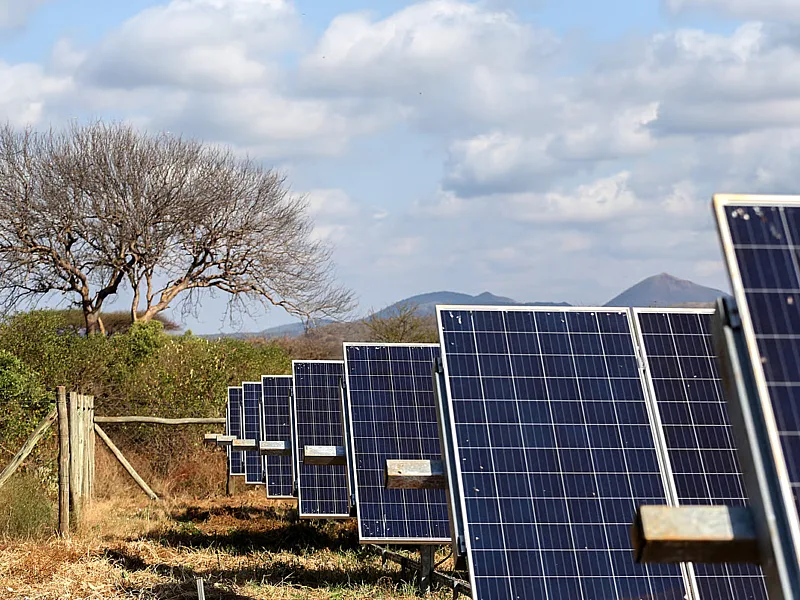
- Niger’s 200 MW solar plant in Niamey will pair with batteries to slash fossil-fuel imports and power the country’s push for 30% renewables by 2030.
- Senegal’s new data-driven energy planning unit has already lined up over 800 MW of solar and storage projects, while IRENA projects West Africa could deploy 568 MW of solar mini-grids—if smart rules and tariffs fall into place.
P-RECs: Climate Finance’s New Edge
By converting future Peace Renewable Energy Certificate revenues into upfront cash, fragile African states can finally unlock mini-grid projects that mainstream investors have long ignored—if transparency and true additionality are rigorously enforced.
The African Development Bank (AfDB) and Nordic Development Fund's $11.3 million facility innovatively bridges corporate climate finance with renewable mini-grid projects in 14 fragile African states by converting future Peace Renewable Energy Certificate (P-REC) revenues into upfront hard-currency funding. This approach addresses the critical financing gap in regions where conventional capital is scarce, enabling projects that might otherwise struggle to secure investment to move forward with reliable funding.
P-RECs uniquely enhance the appeal and bankability of mini-grid projects by embedding a peace-and-development dimension that directs corporate climate finance towards fragile states, complementing traditional tariffs and concessional capital with predictable certificate income. However, the mechanism's credibility hinges on ensuring true additionality—meaning these certificates must unlock genuinely new projects rather than repackaging existing revenue streams—as well as transparent registries and robust governance to prevent double counting and guarantee that electricity delivery benefits local communities.
To sustain trust and maximize impact, facility managers and corporate buyers are urged to maintain transparency by publicly sharing project selection criteria, revenue flows, certificate ownership, and verified connection outcomes. This openness not only supports accountability but also facilitates the integration of mini-grids into national electrification strategies, ensuring that corporate climate finance translates into tangible energy access improvements in fragile contexts.

Niamey’s Solar Storage Leap
Niger’s 200 MW solar plant, paired with batteries, is set to transform grid stability and energy security by slashing costly fossil imports and delivering reliable power where outages have been the norm.
Niger's ambitious 200 MW solar photovoltaic plant in Niamey, developed through a public-private partnership, marks a significant stride toward enhancing the country's energy landscape by directly addressing grid reliability and reducing dependence on costly fossil fuel imports from neighboring Nigeria. This project, which will supply electricity to NIGELEC at a competitive rate of 35 CFA francs per kWh, aligns closely with Niger’s national renewable energy strategy aiming for 30% renewable integration by 2030, leveraging the country's abundant solar potential to meet rising electricity demand while bolstering energy security.
A pivotal feature of the Niamey solar project is its integrated battery energy storage system, which significantly enhances grid flexibility by capturing surplus solar energy during peak production and dispatching it during periods of low sunlight or high demand. This storage capability directly addresses Niamey’s chronic electricity shortages and supply interruptions, ensuring a more stable and reliable power supply that supports both residential and industrial consumers, thereby exemplifying how large-scale solar projects can transcend mere generation to become foundational pillars of resilient energy infrastructure.
Senegal’s Data-Driven Energy Shift
Senegal’s new government modeling unit is closing the rural energy gap by embedding scenario analysis into policy, directly driving over 800 MW of solar and storage investments aligned with real-world needs.
By September 2026, Senegal had made significant strides in institutionalizing data-driven energy planning through the creation of a dedicated government energy planning and modeling unit, supported by capacity-building efforts across a dozen national institutions. This strategic move enables the production of investment-grade analyses and masterplans that are critical for aligning policy and investment priorities. The approach is particularly focused on closing the rural energy access gap, which still affects approximately 15% of the population in last-mile communities, while also balancing the challenges of rising demand and constrained fiscal resources.
The integration of scenario modeling into Senegal’s energy planning has had a tangible impact on the country’s energy transition trajectory, directly influencing investment decisions and policy updates. This data-informed methodology has facilitated the addition of over 800 MW of committed solar PV and battery storage projects to the pre-2030 energy pipeline, reflecting a clear alignment between analytical insights and actionable commitments. By embedding these models into policy frameworks, Senegal is not only advancing its climate commitments but also ensuring that its energy infrastructure development is both strategic and sustainable.
Mini-Grids Need More Than Tech
West Africa’s solar mini-grid boom hinges not just on batteries but on clear rules, local skills, and community-driven planning to ensure affordable, reliable power reaches millions beyond the grid.
By early 2026, IRENA's analysis revealed a compelling near-term market for solar PV mini-grids with battery storage across Burkina Faso, Mali, Nigeria, and Senegal, identifying 568 MW of capacity capable of serving around 21 million people, with Nigeria alone accounting for nearly 400 MW. This large-scale deployment hinges on an estimated 2.25 GWh of battery storage needed by 2030 to meet tier 2 demand levels, underscoring the critical role of batteries in scaling access and achieving universal electrification goals in West Africa.
Battery-backed mini-grids not only reduce reliance on costly and volatile diesel fuel—offering a discounted lifetime value of approximately $20,000 per typical community mini-grid by cutting diesel consumption—but also enhance energy security and service reliability. By storing solar energy for use during periods of low sunlight or peak demand, these systems improve electricity quality for homes and vital community services like clinics and schools, while shielding users from fuel price shocks and logistical challenges inherent in landlocked countries.
The path to successful large-scale deployment of battery-backed mini-grids demands more than technology; it requires robust regulatory frameworks, including transparent licensing, consumer-protective tariffs, and clear integration policies with national grids. IRENA emphasizes the importance of developing technical skills, safety standards, and local content policies, alongside community engagement in planning and service design to ensure affordability, revenue sustainability, and alignment with actual user needs rather than theoretical models.
Under scenarios of constrained national grid expansion, battery-backed mini-grids become indispensable, potentially providing electricity access to between 60 and 110 million people by serving demand levels from tier 3 upwards. This shift highlights mini-grids as a dominant solution for rural electrification in West Africa, particularly where extending the central grid is economically or logistically unfeasible.