Why most enterprise AI still fails to scale
The gist
Most enterprise AI projects flop because they automate the surface, while the real winners overhaul workflows, governance, and culture from the ground up.
What to know
- Nearly 90% of organizations see zero enterprise-wide EBIT impact from AI—success stories like Uber Freight win by redesigning work, not just automating tasks.
- Embedding AI into core workflows with human-in-the-loop collaboration drives real gains, like a 40% upsell boost and 23% more ancillary revenue for leaders who get it right.
- New, adaptive governance and rigorous management—think audit trails, kill switches, and continuous monitoring—are now essential to keep AI agents in check and avoid costly fiascos like Amazon’s $1.8 million AI blunder.
Beyond Automation: True AI Value
AI only delivers enterprise impact when organizations overhaul their workflows and governance, not when they simply automate existing dysfunction.
Surface-level AI adoption often results in isolated improvements that fail to address the deeper systemic issues within organizations. Many companies, as noted in 2025 analyses, apply AI to optimize broken systems without redesigning workflows or governance, leading to accelerated dysfunction where some teams speed up while others become bottlenecked. Uber Freight exemplifies success by fundamentally changing work representation, decision-making control, and governance rather than automating existing tasks, highlighting that true AI value demands systemic organizational transformation rather than local optimizations.
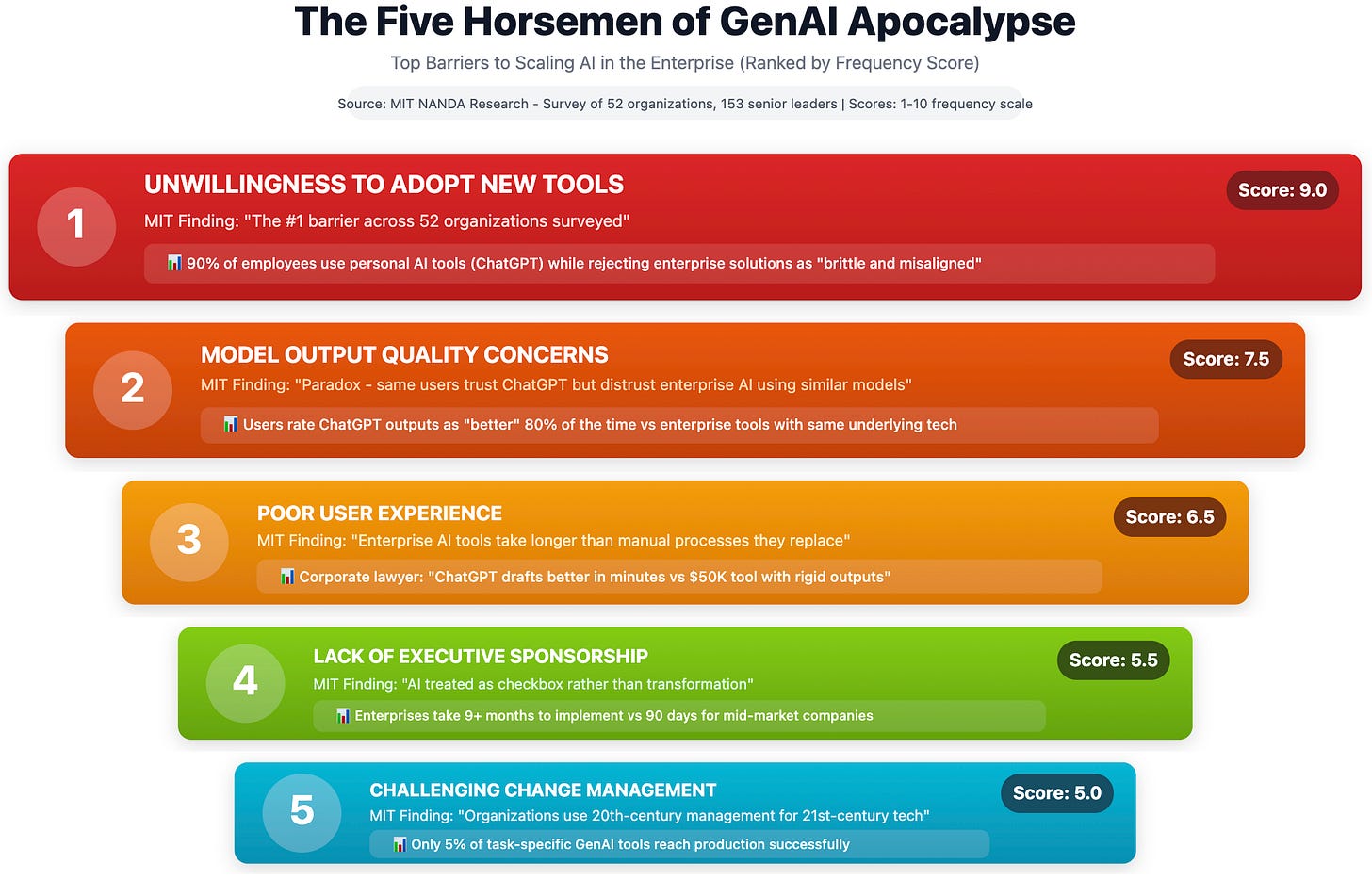
By mid-2026, it became clear that the primary barrier to effective AI adoption is organizational readiness and alignment, not technology or budget constraints. Employees often reject AI tools that are brittle, overengineered, or misaligned with actual workflows, resulting in expensive solutions that slow processes rather than improve them. Leaders like Megan Cullen-Meyer emphasize treating AI deployment as a transformation of work processes involving role realignment and reskilling, while Anjali Shaikh stresses the critical need for top-down commitment to drive operating model changes essential for AI to deliver value.
The analogy to electrification underscores that simply overlaying AI onto existing workflows without systemic redesign yields minimal productivity gains and can perpetuate outdated architectures. McKinsey’s 2025 report and subsequent analyses reveal that nearly 90% of organizations using AI in some function see no significant enterprise-wide EBIT impact, as AI implementations often replicate legacy decision-making patterns and manual handoffs. This organizational inertia, reinforced by Conway’s Law, means that without intentional redesign of incentives, decision rights, and governance, AI remains a tool-level improvement rather than a driver of transformational growth.
Recent studies and expert commentary highlight that the missing ingredient in many AI pilots is 'activation energy'—the complex orchestration of data, workflows, and organizational processes needed to create integrated, agentic AI systems. MIT’s Project NANDA found that 95% of generative AI pilots fail to move the P&L due to lack of workflow integration, where AI outputs are not embedded into operational systems like CRM or sales processes. This gap between AI capability and enterprise context, compounded by poor data quality and fragmented governance, means that superficial automation often results in 'random acts of AI' that do not scale or deliver measurable business value.

Human-AI Collaboration Redefined
Integrating AI into core workflows succeeds only when human judgment and adaptive processes are woven into every step, enabling real business gains.
AI integration in enterprise workflows transcends mere task automation, demanding a fundamental redesign of operational processes that coordinates interconnected subprocesses and roles. Jerrell’s case study illustrates this by transforming a field technician’s manual search into a comprehensive service system linking route planning, inventory, diagnostics, and customer history, boosting upsell conversions by 40%. This shift from reactive to proactive human-AI collaboration, as seen in the hotel chain’s AI-driven guest experience personalization yielding 23% more ancillary revenue, underscores the necessity of embedding human judgment through human-in-the-loop models that augment rather than replace decision-making.
Successful AI adoption hinges on incremental, workflow-grounded integration that respects the complexity and informal nuances of actual work practices. Experts emphasize understanding existing processes deeply before automation, as AI systems often fail to capture the subtle, informal adjustments employees make daily. Human judgment remains indispensable for handling exceptions and variations that AI cannot anticipate, necessitating deliberate design of human-in-the-loop interventions where humans validate, interpret, and retain final decision authority, especially in high-stakes or regulated contexts like fintech loan approvals.
The evolving role of AI agents is reshaping organizational structures and human roles, shifting employees from direct execution to managing and collaborating with AI. This transformation requires redefining workflows to accommodate AI’s capacity for speed and scale, as well as establishing governance models that balance centralized oversight with decentralized domain control. Companies like Klarna have learned that over-automation can degrade service quality, prompting reinvestment in human roles focused on creativity, relationship-building, and complex problem-solving, supported by reskilling programs emphasizing human-agent collaboration.
Embedding human judgment as a core feature—not a safety net—of AI workflows enhances reliability, trust, and business value. Human-in-the-loop patterns, such as preapproval, post-review, real-time collaboration, and escalation, enable AI to handle routine tasks while reserving nuanced decisions for humans, as exemplified by Amazon’s escalation system and Serval’s ITSM ticketing solution. Transparency, seamless integration into existing workflows, and fostering early advocates within teams are critical to building trust and accelerating adoption, ensuring AI augments human capabilities without eroding accountability or user confidence.




Adaptive Governance for AI Agents
Modern AI governance demands dynamic, cross-functional controls and continuous oversight, moving beyond static policies to balance autonomy with accountability.
Governance for agentic AI has evolved from static, human-in-the-loop models mandated by regulatory compliance in industries like finance, where human approval remains essential for accountability, to more adaptive frameworks that balance AI autonomy with human oversight. By early 2026, companies like Anthropic demonstrated a shift from micro-approval to delegation plus intervention, allowing AI agents to operate with increasing independence while humans step in only when necessary, reflecting a nuanced balance between automation and human judgment especially critical where errors can have significant consequences.
Traditional AI governance frameworks, built around fixed risk tiers and periodic reviews, are proving inadequate for the dynamic, branching workflows of autonomous AI agents. Thought leaders such as Engin and Hand advocate for dimensional governance centered on fluid dimensions of Decision Authority, Process Autonomy, and Accountability that adjust based on task criticality and context, enabling continuous, adaptive monitoring rather than one-time risk assessments. This architecture-led approach recognizes that agents may have full autonomy in low-risk tasks but require shared or full human decision authority in high-stakes scenarios, ensuring traceability and auditability across complex multi-step decision chains.
As autonomous AI agents become integral to enterprise workflows, governance must transcend siloed policies to become an embedded, cross-functional operating model involving legal, security, IT, data, and business teams. Frameworks like ARMCF exemplify this evolution by integrating strategic leadership decisions on acceptable autonomy with operational controls such as identity management, risk registers, and incident response, emphasizing clear ownership and accountability at every stage. Companies like Visionet and Workday are pioneering architecture-led governance that decomposes AI workflows into governable units with layered control logic, ensuring agents act within defined guardrails and that their actions are observable, auditable, and reversible.
Despite rapid adoption of agentic AI, many organizations face a governance gap characterized by limited visibility into AI agent actions, inconsistent accountability, and insufficient risk mitigation, with only about 18% having active controls and less than half clearly defining ownership. Experts like Jack Nelson and Mark Taylor stress that AI agents must be treated as privileged employees with scoped permissions, real-time monitoring, and kill switches to prevent unauthorized or harmful actions, while human accountability remains non-negotiable. This necessitates evolving governance from static policies to adaptive, architecture-led frameworks that enforce accountability at runtime, balancing AI autonomy with human oversight to maintain trust and prevent costly errors, as exemplified by incidents like Amazon’s $1.8 million AI mishap.





Observability and Control at Scale
Without deep traceability, security guardrails, and relentless cost management, enterprises risk losing control—and blowing budgets—on runaway AI operations.
Operational excellence in managing AI agents hinges on comprehensive observability that captures the entire reasoning chain, enabling teams to trace decisions from tool calls to confidence scores. This deep traceability, combined with automated scoring methods like 'LLM-as-a-judge' and human-in-the-loop reviews, accelerates incident resolution and builds user trust. Companies such as Pythian emphasize continuous monitoring and prompt tuning to address model drift and performance degradation, underscoring that without robust observability, AI teams are effectively 'flying blind' and unable to systematically improve agent behavior over time.
Security and governance must be architected into AI agent systems from inception to mitigate the expanded attack surface inherent in autonomous operations. Essential measures include runtime sandboxing, scoped permissions, encrypted communications, immutable audit trails, and semantic governance layers that evaluate agent intent before granting data access. Platforms like Workday differentiate themselves by tightly integrating guardrails with authoritative systems of record, while industry leaders stress the necessity of kill switches and multi-layered scrutiny to detect and halt anomalous behaviors, as exemplified by ServiceNow's proactive agent monitoring.
Cost control remains a critical challenge as enterprises grapple with rapidly escalating AI expenses, with some reporting tenfold increases year-over-year. Effective strategies involve managing token consumption through 'thinking budgets,' dynamic model routing to cheaper models for simpler tasks, hierarchical caching to reduce redundant computations, and software optimizations like quantization and intelligent batching. Industry voices like Atul Arya caution that operational costs extend beyond initial labor savings to include integration, monitoring, and human-in-the-loop overhead, highlighting the importance of establishing clear baselines and continuous cost modeling to avoid budget overruns.
Scaling AI agents from pilots to production demands traditional management rigor applied to AI workflows, including clear role definitions, reporting lines, escalation paths, and lifecycle management to prevent operational failures such as duplicated work or hallucinated processes. Despite AI’s autonomous capabilities, human oversight remains indispensable for guiding agent behavior, ensuring quality, and managing exceptions. Enterprises like Salesforce serve as partial management layers but lack unified orchestration, prompting calls for integrated interfaces where humans and AI agents collaborate seamlessly. This governed autonomy approach balances innovation with control, addressing the prevalent risk of 'agent sprawl' and aligning AI actions with business metrics and compliance frameworks.


Culture: The Real AI Roadblock
Organizational resistance and misaligned leadership—not technical limits—are why most enterprise AI projects fail to deliver measurable returns.
The foremost challenge in embedding AI deeply into enterprises is not technological capability but overcoming cultural resistance and organizational misalignment. Employees often reject AI tools perceived as brittle, overengineered, and disconnected from their actual workflows, leading to low adoption despite significant investments. As highlighted by the MIT GenAI Divide study, 95% of AI projects fail to deliver measurable returns primarily due to organizational design flaws rather than technical shortcomings, underscoring the necessity for companies to rethink authority, decision-making, and embed AI solutions that genuinely reflect real work practices rather than imposing rigid, ill-fitting systems.
Executive sponsorship plays a critical yet frequently misunderstood role in AI adoption, where leaders often authorize AI initiatives without grasping their operational complexities or alignment with user needs. This disconnect results in investments that fail to resonate with frontline employees, such as sales teams who resist interruptions to meet targets, or users who demand transparency and error tolerance from AI systems. Companies like Zapier demonstrate that voluntary adoption driven by leadership who actively educate and showcase AI’s value fosters deeper cultural integration, while mandates without genuine engagement resemble the futile act of 'bolting an electric motor onto a steam engine,' leading to poor uptake and minimal impact.
Organizational transformation for AI integration demands a fundamental redesign of workflows, roles, and governance structures to support continuous human-AI collaboration rather than isolated automation. This includes establishing dedicated AI platform engineering teams responsible for governance, security, and tooling, alongside cross-functional playbooks and clear frameworks defining AI autonomy with auditability and accountability. As enterprises like Pythian and WEX illustrate, empowering distributed teams with self-service templates and AI agents that share context enables ongoing workflow innovation, while leadership must clarify decision rights and escalation paths to manage the increased pace and volume of AI-generated outputs effectively.
Sustained AI adoption hinges on cultural shifts that embrace AI as a transformative enterprise capability rather than a mere technology upgrade. This involves redefining knowledge worker roles from task execution to governance of AI-driven systems, fostering AI literacy across all organizational levels, and cultivating a culture that rewards experimentation and fast learning over being right. Leaders must embed governance by design, balancing centralized oversight with decentralized innovation through structures like AI Centres of Excellence, while addressing trust, transparency, and accountability to mitigate risks inherent in autonomous AI agents. As Dr. Sanjeev Rastogi and others emphasize, intelligence must become the operating model, with leadership actively shaping strategy and embedding AI deeply into workflows and decision-making.





Workflow Orchestration: The Growth Engine
Companies that master AI workflow orchestration—integrating data, processes, and governance—are the ones turning pilots into enterprise-wide value and competitive advantage.
A critical barrier to scaling enterprise AI beyond pilots is the underestimated complexity of workflow orchestration, often described as the 'activation energy' needed to integrate AI seamlessly into enterprise data systems and processes. This orchestration goes far beyond simple LLM interactions on desktops, requiring harmonization of data across business units to create actionable, agentic contexts. Startups like Sierra exemplify how mastering this orchestration can unlock rapid growth, achieving milestones such as $100 million ARR by embedding AI agents directly into workflows rather than isolated experiments.
Realizing measurable business value from AI demands that organizations move past AI curiosity and experimentation toward embedding AI into core operational workflows with clear, quantifiable outcomes. Studies reveal that only a small fraction of companies—around 5% per BCG and 12% of CEOs in PwC’s survey—see significant ROI, highlighting a widespread gap between investment and value. This gap underscores the necessity of aligning AI initiatives with specific, measurable business problems, as emphasized by supply chain leaders who focus on automating the most painful processes and obsessively measuring ROI to fund further scaling.
The true competitive advantage in enterprise AI lies in robust workflow orchestration layers that integrate AI outputs into end-to-end business processes, supported by high-quality data and strong governance frameworks. Gartner forecasts that over 40% of agentic AI projects will be cancelled by 2027 due to unclear ROI and weak governance, making orchestration—including permissions, audit trails, and exception handling—a foundational necessity. As Atul Arya notes, measuring ROI must encompass the full operational cost stack, including integration, maintenance, and human oversight, not just model accuracy or speed.
Successful enterprise AI scaling depends on embedding AI into existing systems and workflows with a connected operating model that bridges strategy, engineering, orchestration, and governance. Visionet’s approach, which reduced manual underwriting effort by 40% for a global reinsurer, illustrates how integrating AI with CRM, ERP, and business processes—not just deploying models—drives tangible ROI. This shift from pilots to scalable AI-driven operations requires a multi-year commitment to process redesign and treating AI agents as a coordinated workforce with clear decision rights and accountability.