3D-printed drones and robot boats rewrite navy logistics
The gist
The US Navy just 3D-printed combat drones and critical parts at sea, slashing resupply times and unleashing autonomous robot boats to rewrite naval logistics.
What to know
- Firestorm Labs' xCell microfactory aboard the USS Essex 3D-printed and deployed 12 Squall FPV drones during RIMPAC 2026, using them in live counter-UAS exercises.
- Over 1,000 essential parts—including drone and helicopter spares—were manufactured on-demand, even amid 12-foot waves, eliminating weeks-long supply delays.
- A 42-foot Kaikoa drone boat autonomously delivered a 3D-printed part 40 nautical miles to Canada's MV Asterix, proving unmanned, jam-resistant resupply is ready for prime time.
Combat-Ready Drones, On Demand
3D-printed drones manufactured at sea shifted naval logistics from slow shipments to rapid, mission-ready deployment—even amid rough ocean conditions.
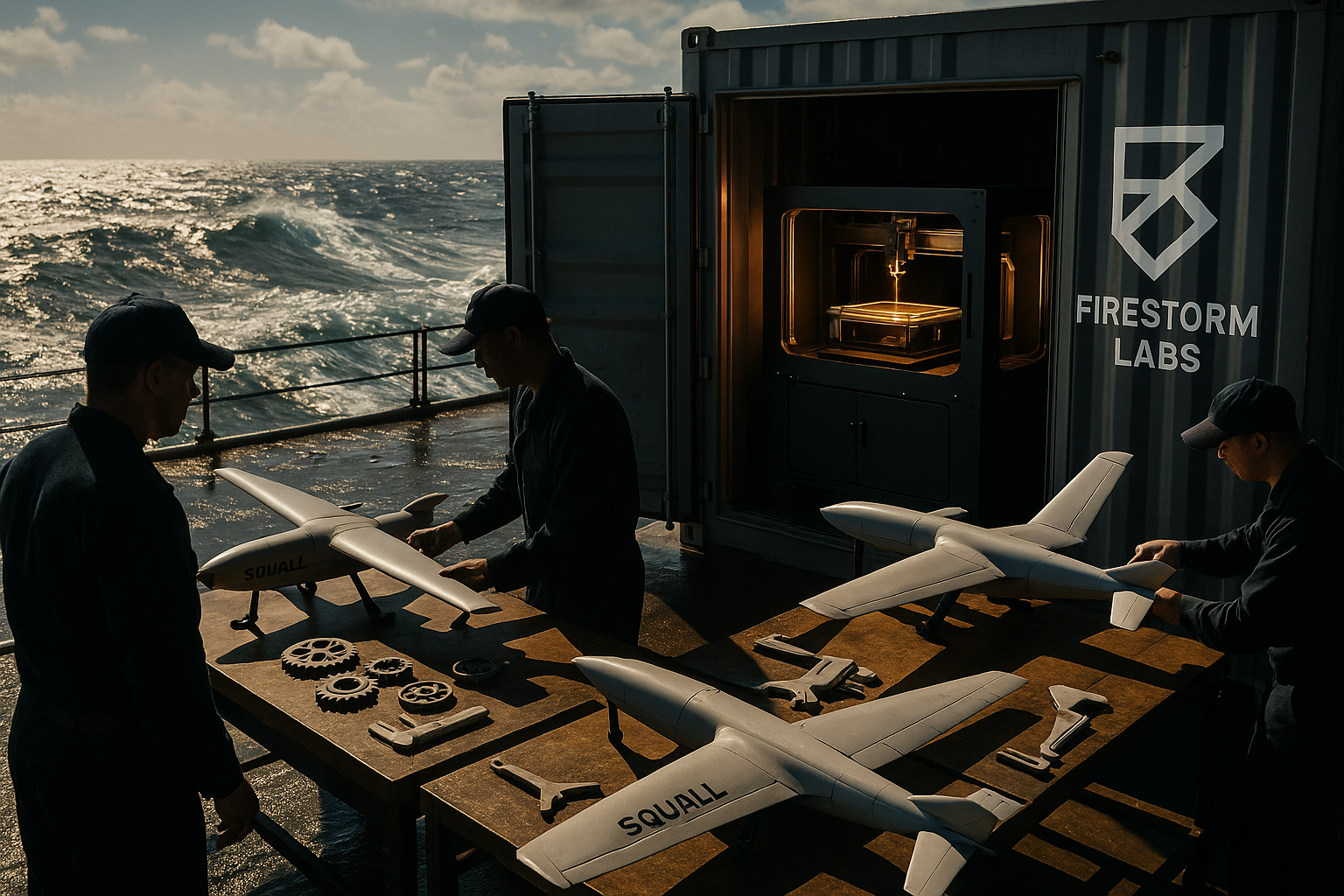
During RIMPAC 2026, Firestorm Labs showcased a groundbreaking leap in naval logistics by successfully 3D-printing and deploying 12 combat-ready Squall FPV drones aboard the USS Essex. These drones were not only flight-ready but actively participated as adversary aircraft in counter-UAS exercises, underscoring the practical tactical utility of at-sea manufacturing in real operational scenarios. This achievement highlights how containerized manufacturing platforms like Firestorm's xCell can seamlessly integrate into naval operations to enhance combat readiness.
The xCell expeditionary manufacturing platform demonstrated remarkable resilience and reliability by maintaining continuous production despite enduring rough maritime conditions, including waves up to 12 feet during a two-week transit. Beyond drones, over 1,000 critical parts, including vital spares for Apache helicopters, were printed on demand, illustrating the platform’s capacity to support diverse operational needs under challenging environments. This milestone marks a significant advancement in expeditionary manufacturing, proving that at-sea 3D printing can sustain complex naval operations without interruption.
At-sea 3D printing is revolutionizing naval combat readiness by drastically reducing dependence on traditional resupply chains. As Firestorm Labs emphasized, every part produced aboard the USS Essex eliminates the need for risky and resource-intensive shipments across contested waters, cutting fuel consumption, aircraft hours, and personnel deployment. This shift to on-demand manufacturing not only accelerates repairs and part replacements from weeks to mere hours but also enhances operational sustainability and agility in dynamic maritime theaters.
Microfactories Redefine Ship Supply
A portable, containerized factory aboard the USS Essex proved that complex drone and helicopter parts can be printed and assembled at sea, slashing reliance on vulnerable supply chains.
Firestorm Labs' xCell microfactory showcases a groundbreaking containerized expeditionary manufacturing platform, ingeniously housed within just two expandable 20-foot ISO containers—or a single 40-foot equivalent—aboard the USS Essex during RIMPAC 2026. This compact setup integrates industrial HP Multi Jet Fusion polymer printers alongside semi-automated assembly stations, enabling a fully mobile, on-demand production line capable of fabricating complex components such as the Squall FPV drones directly at sea. The design's modularity and portability underscore a strategic shift toward distributed manufacturing that can be rapidly deployed wherever naval operations demand.
Despite enduring rough seas with waves reaching up to 12 feet, the xCell microfactory maintained uninterrupted production, printing over 1,000 critical parts—including 12 combat-ready Squall FPV drones and essential helicopter spares—demonstrating remarkable resilience and operational robustness in challenging maritime conditions. This uninterrupted manufacturing capability not only validates the platform's engineering but also highlights its tactical utility in reducing reliance on vulnerable, extended supply chains. As noted in the case study, every part produced on deck eliminates the need for risky logistics across contested waters, cutting fuel consumption, aircraft hours, and personnel demands to keep the ship mission-ready.
Autonomous Boats Transform Resupply
A software-driven drone boat autonomously delivered a critical 3D-printed part across 40 nautical miles, signaling a new era of jam-resistant, crewless naval logistics.
The successful autonomous delivery of a 3D-printed spare part by a 42-foot Kaikoa drone boat across nearly 40 nautical miles of Hawaiian waters to the Royal Canadian Navy’s fleet oiler MV Asterix during RIMPAC 2026 marks a significant milestone in maritime logistics. This operation, coordinated through the Naval Postgraduate School’s advanced manufacturing consortium, showcased how unmanned surface vessels can seamlessly integrate into multinational naval resupply chains, enabling rapid at-sea manufacturing support without the traditional constraints of crewed logistics. Such deployments underscore the growing strategic value of autonomous maritime delivery in enhancing fleet readiness and operational flexibility.
While the physical drone boats like Havoc’s Rampage vessels, which cost around $200,000 including software, provide the necessary platforms for autonomous maritime logistics, the true innovation lies in the sophisticated software that enables reliable, crewless navigation and operations. As co-founder and CEO Paul Lwin emphasized, 'The boat doesn’t matter,' highlighting that the software’s capability to maintain secure, uninterrupted voyages—unaffected by jamming, spoofing, or hostile interference—is the critical product driving this technological shift. This focus on software sophistication is pivotal for scaling autonomous delivery systems within complex naval environments.