AI agents move cloud coding into supervision
The gist
AI-powered agent orchestration platforms are transforming developers from hands-on coders into savvy conductors, supervising swarms of cloud-based AI agents that automate everything from code to workflow.
What to know
- Cursor, Claude Code, and Amazon’s Kiro are turning the classic IDE into a cockpit for managing AI agents—automating code, testing, and even project planning.
- Top engineers now distinguish themselves by orchestrating AI workflows, reviewing agent outputs, and knowing when to intervene—some haven’t written manual code in months.
- Agentic platforms like Pencil and Replit are slashing costs and letting non-developers build sophisticated apps and automation, expanding who can create software.
The IDE Becomes a Command Center
Cloud-based agent orchestration platforms are morphing the IDE into a dynamic hub where engineers supervise swarms of AI agents, automate entire workflows, and manage the economics of AI-driven development.
Cloud-based agent orchestration platforms are rapidly redefining the developer environment, transforming the traditional IDE from a solitary coding tool into a collaborative cockpit for supervising AI agents. Cursor, led by Erik Schluntz and Jonas, exemplifies this shift by automating not just coding tasks but entire team workflows, while Claude Code integrates project management features—such as persistent memory, git access, and connectors—bridging the gap between planning and prototyping for non-developers. This convergence of automation and collaboration signals a new era where the boundaries between development, project management, and AI-driven orchestration are increasingly blurred.
Amazon’s Kiro IDE, under the guidance of David Yanacek, and Claude Code’s suite of agent-driven features demonstrate how spec-driven AI and built-in task scheduling are enabling more adaptive and robust development workflows. Kiro’s focus on aligning code with developer intent through AI not only enhances testing but also fosters dynamic, responsive coding environments, while Claude Code’s '/loop' command and desktop scheduling capabilities empower developers to supervise recurring and autonomous tasks. Together, these innovations mark a decisive move away from static code editors toward intelligent, continuously evolving platforms.
The rise of agent-orchestrated platforms is also reshaping collaborative development, as seen in Anthropic’s 'Code Review by Claude,' which deploys a team of AI agents to review every pull request—at $15-25 per review—effectively turning code review into an AI-augmented service. This approach, coupled with the Claude Marketplace’s consolidation of AI spending, illustrates how developer environments are becoming centralized hubs for managing not just code, but also the orchestration and economics of AI-powered workflows. As Karpathy’s 'autoresearch' agents autonomously iterate on LLM training code with measurable speedups—such as an 11% improvement over two days on 8xH100 GPUs—the potential for agents to drive continuous, autonomous improvement is becoming a tangible reality.
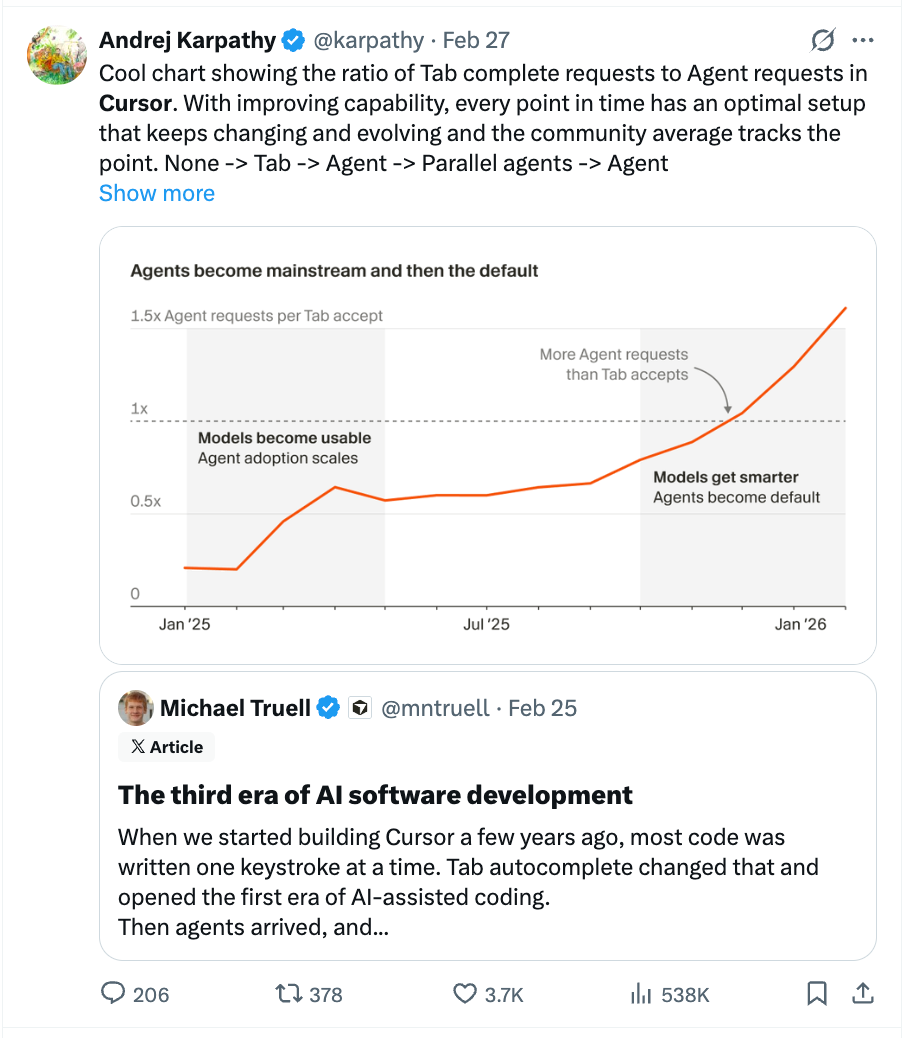
By early 2026, the traditional IDE’s hallmark features—like tab autocomplete—are being eclipsed by cloud-based AI agents that manage, automate, and even improve coding tasks. Cursor’s evolution into its 'third era' underscores this trend, as cloud agents take center stage in the developer workflow, shifting the developer’s role from direct code author to supervisor of a constellation of intelligent agents. This transformation not only augments productivity but also raises profound questions about the future skills and interfaces required for next-generation software development.




Engineering’s New Power Skills
Top engineers now stand out by mastering AI supervision, workflow orchestration, and trust management—shifting from hands-on coding to steering agent teams and navigating the psychological leap from coder to conductor.
Developer workflows are undergoing a profound transformation, shifting from hands-on coding to a model where supervising, orchestrating, and collaborating with AI agents is the new norm. At companies like Intercom and Notion, engineers now spend more time planning, reviewing, and verifying AI-generated outputs than writing code themselves, with some reporting they haven't typed a line in months. This evolution is redefining required skills—ambition, adaptability, and creative problem-solving are prized over rote coding, and the most valued engineers are those who deeply understand AI model limitations and know when to trust or intervene, as seen in the growing performance gap between tool-savvy '100x engineers' and those clinging to traditional workflows.
Team structures and collaboration models are also being reshaped by the rise of AI agents, with small, agile teams now managing a more chaotic, experimental workflow characterized by rapid prototyping and ambitious, agent-generated pull requests. The influx of AI-generated code has created new bottlenecks, such as PR review overload, and prompted a shift toward test-first development and layered verification, sometimes even questioning the necessity of mandatory human review. As AI agents fill knowledge gaps, engineers without specialized backgrounds can contribute across domains, enabling leaner infrastructure teams and greater cross-functional collaboration, while new organizational approaches—like clear swim lanes and mini-company ownership—are emerging to manage the explosion of feasible projects.
The very nature of engineering work is being redefined, with the IDE evolving into a cockpit or control plane for managing collaborative agent workflows, as predicted by leaders like James Everingham and Steve Yegge. Engineers are increasingly required to master skills in supervising, auditing, and scaling AI agents, as well as managing trust and accountability across federated environments—moving beyond mastery of specific languages or tools. This shift is not without its challenges: engineers must adapt to writing code and comments for AI readability, navigate the psychological adjustment of stepping away from manual coding, and develop nuanced approaches to risk management and long-horizon task oversight, all while leveraging the 'sentient fabric' of AI deeply woven into the software development lifecycle.




Quality Control in the Age of Agents
Architectural breakthroughs and rigorous verification protocols are redefining code quality, as multi-agent review systems and human-in-the-loop safeguards become essential for balancing automation with accountability.
The pursuit of quality and reliability in agentic coding is driving both architectural innovation and new verification standards. Techniques like the Aegean consensus protocol, which enables early termination when AI agents converge, are slashing latency by up to 20x without sacrificing answer quality—crucial for orchestrating multiple agents in real-time coding environments. Meanwhile, compact multimodal models such as Microsoft’s Phi-4-reasoning-vision-15B are pushing the boundaries of efficient, accurate reasoning by systematically filtering errors and augmenting data, ensuring that agentic systems can handle complex tasks with less compute and greater dependability.
As AI agents become more autonomous in software development, the industry is grappling with the balance between automation and human accountability. Amazon’s recent mandate for senior engineers to review all AI-assisted code changes—following outages linked to generative models—underscores that, despite advances in tools like Anthropic’s Claude Code, ultimate responsibility for deployment decisions remains firmly with human engineers. This cautious approach, echoed by Stripe’s Minions and StrongDM’s Software Factory, reflects a broader shift: engineers are moving from direct authorship to supervisory roles, with oversight protocols and human-in-the-loop safeguards evolving to maintain both code quality and system availability.
Automated multi-agent code review systems are redefining standards for reliability and verification by catching more bugs and providing deeper analysis than traditional reviews. For instance, Claude Code’s multi-agent review system increased substantive review comments from 16% to 54% of pull requests, with less than 1% of findings marked incorrect by engineers, while dynamically scaling oversight to match PR complexity. These systems filter false positives, rank issues by severity, and deliver high-signal feedback, but also introduce new challenges—such as the need for robust context management, careful evaluation design, and transparent analytics—to ensure that the signal-to-noise ratio remains high and that cost and scope are effectively managed.
Ensuring reliability in agentic coding also hinges on robust engineering fundamentals and continuous evaluation. Companies like Stripe and Shopify emphasize the importance of isolated environments, curated context, and comprehensive test suites—Shopify, for example, ran 974 unit tests across 120 AI-driven experiments to guarantee no regressions. Meanwhile, best practices are emerging around treating LLM outputs as structured data with enforced schemas, embedding domain-specific planning to avoid shallow reasoning, and integrating task-specific, binary metrics into development workflows to catch subtle regressions before they reach production. As Willison notes, 'Shipping worse code with agents is a choice. We can choose to ship code that is better instead,' highlighting that agentic coding, when grounded in strong fundamentals, can actually raise the bar for software quality.






Software Creation for Everyone
Agentic AI platforms are empowering non-developers to build and direct complex software through intuitive interfaces, shifting the competitive edge to those who can identify valuable problems and exercise creative judgment.
Agentic AI platforms like Pencil, Claude Code, and Replit are dramatically lowering the barriers to software creation, empowering non-developers and creators from diverse backgrounds to participate meaningfully in building digital products. By enabling users to collaborate with swarms of AI agents—each customizable and able to work in parallel across multiple screens—tools like Pencil humanize the development process, making it feel more like working with a team than wrangling code alone. This flexibility, combined with seamless integration into popular IDEs such as VS Code and Cursor, allows users to bring their own agents and workflows, fostering unprecedented cross-disciplinary collaboration and customization that expands the pool of who can contribute to software and design projects.
The rise of intuitive, intent-driven interfaces—exemplified by Replit’s whiteboard-style platform and Claude Code’s plain-English context files—has shifted the developer’s role from manual coding to editorial oversight and creative direction. Now, non-technical users such as product managers, marketers, and solopreneurs can orchestrate sophisticated software and automation simply by describing what they want or configuring context profiles, as seen in case studies where creators built health dashboards, blogs, and research agents without writing code. As the cost of implementation falls to near zero, the competitive edge moves to those who can identify valuable problems and exercise judgment, rather than those with deep technical credentials.
AI-driven platforms are not only democratizing access but also enabling new forms of creative, collaborative, and cross-disciplinary work by supporting seamless integration of multiple agents, adaptive workflows, and agent-to-agent communication. Companies like Meta, through acquisitions such as Moltbook and Manis, are betting on ecosystems where agents transact and collaborate independently, while tools like Replet and Claude Cowork let users orchestrate multiple agents simultaneously—even from a mobile phone. This evolution is fostering a world where the 'Sovereign Builder'—someone with the taste of a designer, the logic of a programmer, and the agency of a founder—can emerge without traditional credentials, and where the density of such builders becomes a company’s true competitive advantage.
The practical impact of this democratization is already visible in significant cost savings, efficiency gains, and the ability for individuals and small teams to independently execute complex projects that once required specialized contractors. For example, creators using Claude Code have reported saving thousands of dollars on tasks like EPUB formatting and print-on-demand publishing, while also launching multilingual websites and automated testimonial systems without deep technical know-how. These platforms not only broaden who can build software but also enable users to blend technical and non-technical skills, unlocking new forms of digital expression and business innovation.