AI and long-duration batteries redefine europe’s grid future
The gist
Europe’s grid is getting a radical upgrade as AI-powered platforms and breakthrough long-duration batteries unite to supercharge renewable power, resilience, and reliability.
What to know
- CATL’s 30MWh+ sodium-ion battery and Envision’s Gen8 BESS (up to 16-hour duration, 91% efficiency) are redefining large-scale, high-density energy storage across sectors.
- Game-changing grid-forming inverters and AI orchestration from leaders like Sungrow, SVOLT, and Envision are slashing costs by 10%, boosting yield by 5%, and enabling millisecond-level grid coordination.
- Landmark projects such as Germany’s 400MW/1,600MWh Stadorf BESS and the UK’s 310MWh Wolverhampton BESS signal a new era of scalable, resilient clean energy infrastructure in Europe.
Modular Batteries Break Barriers
Next-gen sodium-ion and LFP cell innovations, coupled with modular DC+AC designs, are transforming energy storage safety, density, and scalability across all sectors.
By mid-2026, breakthroughs in battery chemistries and modular designs have significantly advanced energy storage scalability and efficiency across sectors. CATL’s pioneering 30MWh+ sodium-ion battery block exemplifies the shift towards non-lithium alternatives, while Fluence’s 10MWh Smartstack and Trina Storage’s 13.8MVA/25MWh integrated DC+AC solutions highlight the growing emphasis on high-density, modular architectures that seamlessly integrate DC and AC components to enhance flexibility and deployment scalability.
SVOLT’s unveiling of its next-generation stacked short-blade cell technology combined with AI-driven hardware-software management marks a leap forward in energy storage safety and scalability for residential, commercial, and utility-scale applications. Their introduction of high-power LFP cells tailored for rapid transient switching addresses critical safety and performance needs in commercial and industrial sectors, while innovative Cell-to-Rack architectures optimize spatial energy density and thermal management, underscoring a holistic approach to system design.
For utility-scale deployments, SVOLT’s advanced energy storage containers incorporate triple-compartment architecture and liquid cooling systems that extend lifespan and elevate safety standards, facilitating smoother integration of large-scale renewables. Complementing this, their second-generation 122Ah cells with variants engineered for extreme low-temperature resilience and fast charging not only enhance residential market scalability but also align with global subsidy policies, reflecting a strategic push towards versatile, climate-resilient solutions validated by tier-1 providers.
Envision’s Gen8 4.X series utility battery energy storage system (BESS), showcased in July 2026, pushes the envelope with long-duration storage capabilities of 8 to 16 hours and a round-trip efficiency reaching 91%. Its distributed AC-block configuration, leveraging silicon carbide (SiC)-based power devices, delivers up to 250% overload capacity while reducing installation footprint by 30%, thereby enhancing safety and cost-effectiveness. By integrating proprietary cells, power electronics, and real-time controls, Envision achieves millisecond-level coordination from module to plant scale, setting new benchmarks in system reliability and economic performance.
Hybrid Systems Slash Costs
Integrated PV-storage solutions like Sungrow’s PowerMatrix and advanced grid-forming inverters are driving down balance-of-system costs while boosting energy yield and grid resilience.
By mid-2026, Sungrow’s PowerMatrix™ emerged as a pioneering native PV-storage integration solution, leveraging a multi-port topology and distributed control to optimize system-level performance. This architecture not only slashed balance-of-system costs by over 10% and lowered LCOE through significant CAPEX savings but also boosted end-to-end energy yield by approximately 5% via advanced MPPT, direct PV-to-storage charging, and dynamic energy routing. Beyond economic and efficiency gains, PowerMatrix’s inherent grid-forming capabilities enhanced system stability, supporting high PV and ESS capacity ratios with rapid voltage stabilization and fault isolation, making it adaptable across diverse applications from utility-scale to AI data centers.
The 2026 Intersolar Europe event spotlighted a wave of next-generation grid-forming power conversion systems (PCS) and hybrid solar-storage solutions from industry leaders including Sungrow, SMA, Nidec Conversion, and Power Electronics. These innovations collectively advanced critical grid functionalities such as black-start capability and virtual power plant (VPP) integration, while improving power conversion efficiencies to support higher renewable penetration and grid resilience. Inovance Technology’s upgraded 2.5 MW centralized PCS exemplified this trend by combining enhanced heat dissipation and power density with grid-forming control and black start features, complemented by a highly efficient 432 kW string PCS supporting flexible battery formats and advanced safety measures.
AXITEC’s AXIhycon ONE hybrid energy storage system, announced in July 2026 and slated for European commercial release in 2027, exemplifies the push toward maximizing PV self-consumption through integrated hybrid ESS designs. Featuring a 15 kW three-phase inverter with three MPPTs and a 34 kWh lithium-iron-phosphate battery, the system supports DC oversizing up to 160%, enabling efficient capture and storage of excess solar energy. Its rapid transition to off-grid mode in under 10 milliseconds and backup power duration of up to 2.26 hours ensure reliable uninterrupted supply, while delivering up to 98% conversion efficiency and backed by a robust 10-year warranty, underscoring durability and performance.
AI Orchestrates the Smart Grid
AI-driven platforms from SVOLT and Envision unify solar, storage, and grid assets for real-time, millisecond-level coordination and dispatchable renewables.
By mid-2026, SVOLT and Envision Energy emerged as pioneers in leveraging AI-driven system orchestration to unify solar generation, storage, and grid-forming functions into cohesive, high-performance energy solutions. SVOLT’s integration of AI-powered hardware-software management within its proprietary stacked short-blade cell technology exemplifies this trend, optimizing asset performance across diverse applications. Meanwhile, Envision’s approach—highlighted by Michael Koller—focuses on designing solar inverters, battery inverters, and plant controllers as a unified system rather than disparate components, unlocking tangible benefits in system sizing, optimal dispatch, and long-term asset reliability.
Envision’s AI-driven orchestration platform stands at the core of its roadmap to render intermittent renewables dispatchable at scale, seamlessly coordinating solar, storage, and grid-forming capabilities in real time. This orchestration layer dynamically optimizes system performance against weather variability, market signals, and grid constraints, enabling millisecond-level coordination from module to plant level. Such precision facilitates enhanced system stability and reliability, as evidenced by their 385 kW utility-scale string inverter with grid-forming capability, which supports coordinated frequency response and smooth power ramping to meet evolving grid-code requirements.
Envision’s Gen8 4.X long-duration battery energy storage system (BESS) exemplifies advanced control sophistication by improving real-time state-of-charge accuracy by 3 percentage points and delivering up to 250% overload capacity to maintain stable grid-forming performance during transient conditions. Offering 8 to 16 hours of storage with up to 91% round-trip efficiency, this system enhances grid resilience and flexibility. Furthermore, integrated communication between Envision’s power control centers and grid operators ensures precise compliance with ramp-rate requirements, enabling smooth, coordinated operation across solar, storage, and grid-forming assets in alignment with grid operator mandates.
Landmark Projects Set New Standards
Germany’s Stadorf and the UK’s Wolverhampton BESS projects showcase how early adoption of long-duration batteries and advanced integration are redefining grid flexibility and reliability.
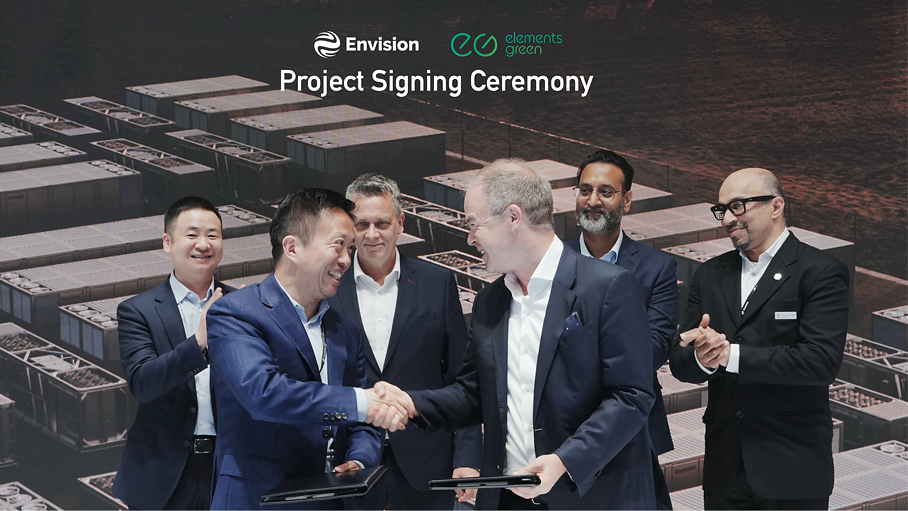
The launch of Germany’s largest battery storage project, the 400MW/1,600MWh Stadorf BESS by Envision Energy and Elements Green, underscores the pivotal role of large-scale, long-duration battery platforms in enhancing grid flexibility and renewable dispatchability. By prioritizing early selection of high-performance, long-life battery technologies, the project meets Germany’s rigorous standards for reliability and technical performance, setting a benchmark for sustainable energy transition infrastructure.
Envision Energy’s strategic partnerships across Europe, including the 310 MWh Wolverhampton BESS with Pulse Clean Energy in the UK and the 140.6 MWh Gen 8 BESS projects with ju:niz in Germany, illustrate a collaborative model that blends advanced Gen 7 and Gen 8 BESS platforms with local expertise to navigate complex regulatory landscapes. These deployments not only bolster grid stability and renewable integration through AI-powered grid-forming capabilities but also promote regional energy resilience and decarbonization aligned with broader sustainable development goals.
Envision’s Gen8 4.X series utility-scale BESS represents a leap forward in long-duration energy storage, delivering 8 to 16 hours of storage with up to 91% round-trip efficiency and an impressive 250% overload capacity for stable transient grid performance. Coupled with integrated 385 kW PV string inverters featuring distributed MPPT and millisecond-level real-time coordination, this integrated solar-storage solution enhances system reliability, reduces installation footprint by up to 30%, and optimizes balance-of-plant costs, all while supporting smooth power output ramping and coordinated frequency response.
Further advancing grid integration, Envision’s solid-state transformer (SST) technology consolidates voltage transformation and power conversion into a single digitally controlled platform, enabling higher switching speeds and improved efficiency for MW-scale rack power densities. This innovation exemplifies the next-generation power electronics essential for scalable, efficient utility-scale energy storage systems that can meet the evolving demands of modern grids.
C&I Storage Gets Smarter
High-density, modular storage and turnkey hybrid systems are making commercial and industrial facilities more resilient, efficient, and ready for rapid energy transitions.
By mid-2026, the commercial and industrial energy storage landscape saw significant innovation with modular, high-density systems like Fluence's 10MWh Smartstack and Trina Storage's 13.8MVA/25MWh integrated DC+AC solution, which enhanced scalability and efficiency for demanding C&I and data center environments. SVOLT further advanced this trend with its Cell-to-Rack architecture and utility-scale containers featuring triple-compartment design and liquid cooling, boosting spatial energy density, thermal management, and safety—critical factors for reliable, long-lasting commercial deployments.
Grid-forming power conversion systems (PCS) and hybrid solar-storage solutions introduced by industry leaders such as Sungrow, SMA, Nidec Conversion, and Power Electronics brought advanced functionalities including black-start capabilities, virtual power plant (VPP) integration, and improved power conversion efficiencies. Inovance Technology complemented this with its upgraded 2.5 MW centralized PCS and turnkey stations featuring transformer integration, enabling rapid deployment and flexible expansion tailored to commercial and industrial resilience needs.
AXITEC’s AXIhycon ONE hybrid energy storage system exemplifies the move toward turnkey, modular solutions that maximize PV self-consumption while enhancing resilience for commercial users. Equipped with a 15 kW three-phase inverter, 34 kWh lithium-iron-phosphate battery, and DC oversizing up to 160%, it delivers fast off-grid switching in under 10 milliseconds and backup power for over two hours, ensuring uninterrupted power supply and improved power quality in critical commercial applications.
Strategic Partnerships Accelerate Scale
Collaborations between Envision, Pulse Clean Energy, and ju:niz are rapidly deploying advanced BESS platforms in the UK and Germany, blending local expertise with cutting-edge technology for Europe’s clean energy future.
Envision Energy's strategic partnerships with Pulse Clean Energy and ju:niz mark a decisive expansion into key European markets, notably the UK and Germany, through deployment of large-scale, next-generation battery energy storage systems (BESS). In the UK, their collaboration on a 129 MW / 310 MWh BESS project in Wolverhampton leverages Envision's Gen 7 platform and grid-forming capabilities to enhance grid stability and renewable integration, setting a benchmark for future clean energy infrastructure. This project underscores a shared commitment to accelerating the UK's energy transition by delivering flexible, resilient low-carbon solutions that align with regional decarbonization goals.
Simultaneously, Envision and ju:niz have debuted in Germany’s grid storage market with a combined 140.6 MWh Gen 8 BESS deployment across two sites, showcasing scalable, AI-powered energy storage technology designed for four-hour duration and advanced grid support. This partnership exemplifies a complementary model where ju:niz manages complex regulatory and market requirements as project developer and operator, while Envision supplies cutting-edge technology, effectively navigating Europe's evolving energy landscape. Their collaboration highlights how blending technological innovation with local market expertise can accelerate the rollout of next-generation storage infrastructure crucial for Europe's clean energy ambitions.
