AI data center backlash spreads across party lines
The gist
A bipartisan wave of opposition is uniting Americans against local AI data centers, as economic, environmental, and trust issues spark a political backlash reshaping the AI infrastructure boom.
What to know
- A whopping 75% of Americans—across party lines—oppose new local AI data centers, with anxiety mounting over water, power use, and hefty tax breaks like Google’s $125 million Michigan deal.
- Political heavyweights from New York Governor Kathy Hochul to the National Republican Senatorial Committee are fueling moratoriums and calling for stricter AI controls, as left-right populist alliances emerge.
- Public trust in AI firms is plummeting, with 52% now more worried than excited about AI's growth—mirroring the nuclear industry’s historic social license collapse.
Bipartisan Anxiety Peaks
Americans across all demographics are uniting in distrust of AI data centers, with even swing state politicians fearing election fallout from ignoring widespread local backlash.
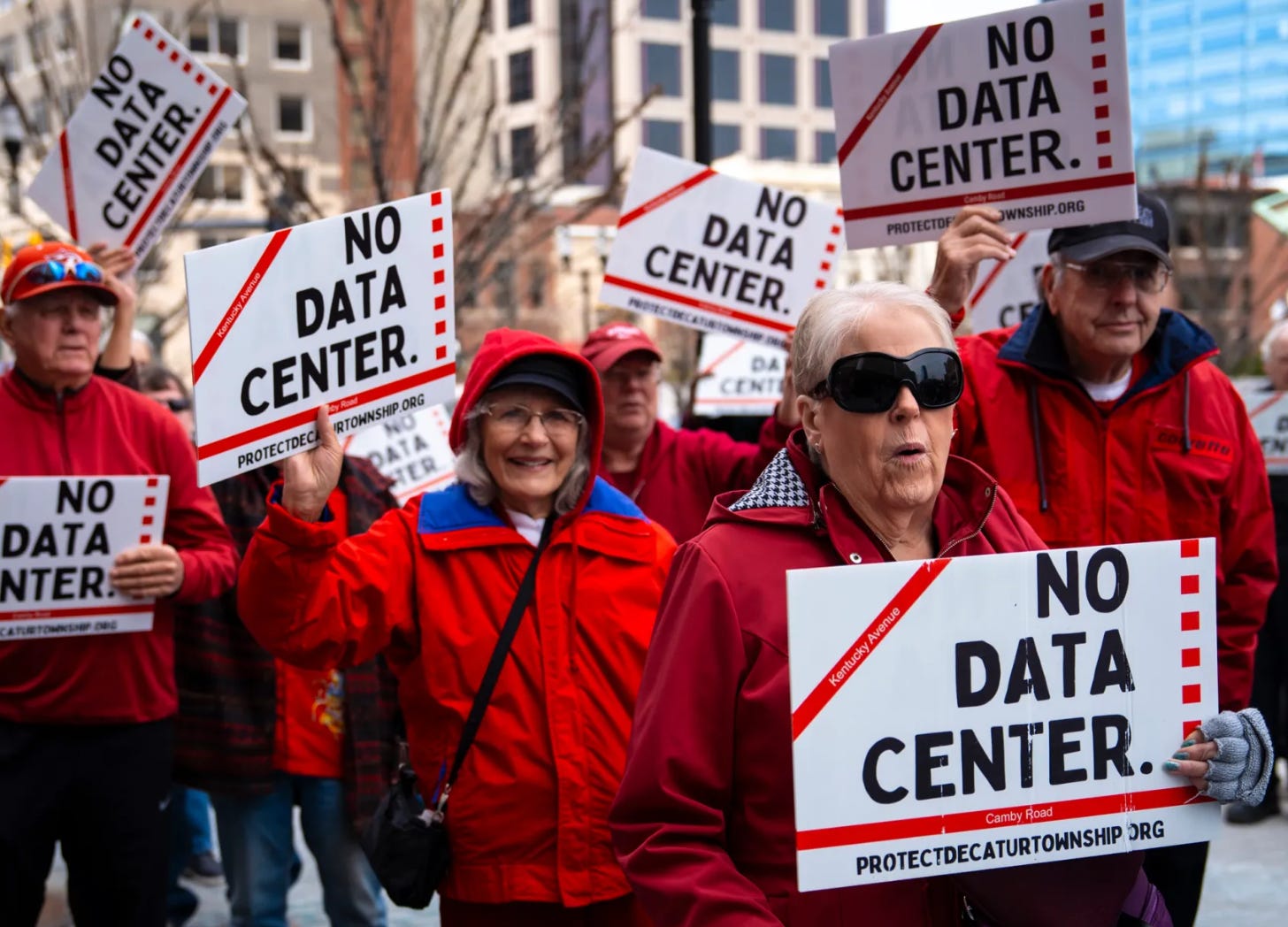
Public opposition to AI data centers has surged into a broad bipartisan concern, with surveys showing that up to 75% of Americans oppose local data center construction regardless of gender, age, socioeconomic status, or political affiliation. This widespread resistance is echoed by political actors such as the National Republican Senatorial Committee, which warned AI infrastructure projects could negatively impact election outcomes, notably in key battleground states like Ohio. The bipartisan nature of this opposition underscores a deep-rooted anxiety about AI’s societal footprint that transcends traditional party lines.
Americans’ unease about AI is intensifying, with a majority expressing more concern than excitement about AI’s growing role in daily life; Pew Research reports 52% are more concerned now compared to 37% in 2021, while over 70% believe AI is advancing too rapidly. This anxiety is particularly pronounced among younger adults aged 18 to 34, who predominantly distrust AI industry leaders to act responsibly, as revealed by a CNBC poll. Despite fears of job displacement, most American workers remain confident their own jobs are safe, highlighting a nuanced generational divide in perceptions of AI risk.
Economic perceptions heavily influence attitudes toward AI data centers, with Democrats largely viewing them negatively—60% say data centers are bad for the country—while Republicans are more divided and MAGA Republicans are comparatively supportive. Those optimistic about the economy tend to view data centers more favorably, with 55% seeing them as beneficial, contrasted with 59% of those pessimistic about economic conditions who view them negatively. However, trust in the purported economic benefits is low overall; only 21% of Americans agree with claims that data centers bring significant jobs and tax revenue, and concerns about local impacts like increased electricity costs are widespread, with 62% fearing higher bills.
Facing mounting public resistance, AI companies are compelled to offer substantial local incentives—such as job guarantees, clean water investments, and even $50,000 bonuses for teachers—to gain community acceptance for data center expansions. This reactive strategy reflects a broader erosion of trust in the AI sector’s social license, paralleling historical patterns seen in the nuclear energy industry’s public backlash post-1957. The rapid loss of public trust in Silicon Valley’s AI infrastructure ambitions signals significant political and cultural hurdles ahead for the industry’s growth.

Resource Strain Sparks Outrage
Surging electricity bills and controversial tax breaks are turning data centers into symbols of corporate extraction, fueling resentment in communities that see little benefit and bear the brunt of environmental costs.
Public opposition to AI data centers is increasingly fueled by tangible economic and environmental concerns, particularly around resource extraction and the visible imposition of massive corporate infrastructure in local communities. Residents see these data centers as physical symbols of extraction, where vast amounts of water and electricity are consumed—such as the 700,000 liters of freshwater used to train GPT-3—while local electricity bills have surged by 7.4% nationally and up to 267% in some heavily developed areas. This resource strain, coupled with land acquisition practices that evoke eminent domain, contrasts sharply with other industries like agriculture or golf courses, which do not provoke similar backlash despite comparable or greater resource use.
Economic resentment deepens as communities question the fairness of tax incentives and the true local benefits of data centers, with deals like Google's $125 million tax reduction in Michigan sparking outrage over lost public revenue. While some companies invest modestly in community amenities—such as OpenAI's contributions to local schools or Michigan’s upgraded recreation center—these efforts are widely viewed as insufficient relative to the scale and disruption of the projects. This perceived imbalance feeds a broader narrative that the environmental and social burdens disproportionately impact less affluent or politically marginalized communities, intensifying resistance and skepticism about who truly profits from AI infrastructure.
Community backlash is not solely about environmental metrics but also reflects deeper cultural and socioeconomic anxieties, including fears over job losses due to AI and the symbolic weight of sprawling, warehouse-like data centers disrupting local identities. As Jordan Schneider observes, the failure to invest in making data centers more community-friendly—whether through noise reduction, aesthetic improvements, or social amenities—represents a series of strategic missteps that alienate residents. This 'immune response' to external corporate investment underscores that financial incentives alone cannot overcome distrust, especially when communities feel excluded from decision-making and economic gains, leading to political consequences such as the ousting of city council members in Festus, Missouri.
The immense scale of AI infrastructure investment—estimated at $600 billion in 2026 and backed by nearly $3 trillion in purchase and lease commitments from Big Tech—heightens the stakes of local opposition, as political dynamics shift with Democrats pushing for stricter regulations while Republicans retreat amid voter backlash. This evolving landscape complicates the siting of data centers, given the limited availability of suitable locations with necessary grid connectivity, and raises questions about the sustainability of AI’s rapid expansion. The tension between framing data centers as vital national infrastructure supporting digital economies and addressing grassroots economic and environmental concerns encapsulates the complex challenges facing AI’s physical footprint.






Unlikely Alliances, Rising Tensions
Centrist and populist leaders from both parties are forging new coalitions to halt AI data centers, fracturing traditional alliances and making tech infrastructure a flashpoint in upcoming elections.
AI data center opposition is redrawing political alliances in unexpected ways, with centrist Democrats like New York Governor Kathy Hochul partnering with progressives such as State Senator Kristen Gonzalez to impose moratoriums, even as internal party rifts deepen over the issue. Meanwhile, populist and decelerationist movements are gaining traction on both sides: Bernie Sanders leads a leftist push framing AI infrastructure as a threat to jobs, mental health, and wealth equality, while conservative Tea Party-affiliated groups like Humans First, chaired by Amy Kremer, demand an 'America First AI policy' and urge Republicans to confront the issue rather than ignore it.
The political backlash against AI data centers is intensifying local governance conflicts and complicating legislative agendas, as economic competitiveness clashes with community concerns. Hochul’s moratorium drew criticism from White House officials worried about losing ground to China, while governors’ races increasingly feature data center opposition as a key issue, reflecting how cultural anxieties and environmental worries fuel populist resistance. This tension is especially pronounced in the Midwest, where the traditional 'pioneer spirit' is giving way to skepticism about rapid technological expansion, creating a fraught political environment for AI infrastructure projects.
Political calculations tied to upcoming elections are driving both Democrats and Republicans to recalibrate their stances on AI data centers, with some Republicans retreating from an industry they once championed after seeing candidates punished in swing states like Ohio. Labor unions supporting construction jobs clash with party officials concerned about environmental and social impacts, fracturing Democratic unity. Meanwhile, foreign interference—particularly Chinese-funded misinformation campaigns—exacerbates local opposition, and the AI industry’s leading figures, including Nvidia and Alphabet executives, have yet to mount an effective public counter-narrative to reassure voters and policymakers.



History Repeats: Trust Erodes Fast
Public trust in AI is collapsing at nuclear-speed as broken tech promises and economic grievances drive a wave of bipartisan resistance reminiscent of past infrastructure battles.
Public opposition to AI data centers echoes historical resistance to transformative infrastructure projects like 19th-century railroads, where issues such as environmental degradation, land conflicts, and corporate-government corruption fueled deep-rooted political and cultural tensions. Gene Marks draws a parallel by noting that while railroads physically moved people and goods, data centers now move information, making them essential yet contentious pillars of national competitiveness. This enduring tension between innovation-driven expansion and community disruption underscores the long-term challenge of securing a social license for AI infrastructure amid vocal local resistance.
The AI sector is experiencing a rapid and unprecedented erosion of public trust reminiscent of the nuclear energy industry's decades-long social license loss, but compressed into just a few years. By 2026, surveys reveal that 52% of Americans feel more concerned than excited about AI's growing role, a sharp increase from 38% in 2022, fueling widespread political backlash that has led to 146 AI-related legislative acts across all 50 states. This swift decline reflects not only fears about AI's societal impacts but also a broader cultural skepticism toward powerful technologies, mirroring the nuclear industry's struggles with environmental fears, whistleblower revelations, and media-driven opposition.
The trust crisis facing AI and Silicon Valley stems from a fundamental disconnect between grand promises and public experience, much like the nuclear industry's historical credibility collapse. Tech leaders such as Dario Amodei acknowledge that the public’s negative perception arises from unmet expectations and visible harms, including job displacement fears, opaque AI systems, and stark wealth inequality. This skepticism is compounded by a political landscape where bipartisan leaders like Governors Abbott and Shapiro have reversed support for data centers under constituent pressure, highlighting that opposition is driven more by economic grievances and distrust of tech wealth accumulation than abstract AI safety concerns.
Efforts by AI companies to regain public trust through assurances of safety and responsibility have largely failed, as the public associates such rhetoric with historical industry tactics used by tobacco, oil, and chemical companies to delay accountability. The tech industry's repeated calls to 'trust us' echo past failures that culminated in social license losses, revealing a deep cultural challenge that goes beyond technical risk management. This dynamic underscores the difficulty AI executives face in managing public perception amid complex fears, as ideological opposition and media amplification intensify scrutiny and resistance to AI infrastructure expansion.