AI data centers get off-grid power framework
The gist
AI data centers are rewriting the rulebook on energy, sparking a grid revolution with a new framework that tackles soaring power demands, grid bottlenecks, and the need for smarter, more resilient power architectures.
What to know
- The AI Data Center Energy Performance Framework, launched by NEMA, ASHRAE, and PNNL, delivers real-time, expert-driven guidance for optimizing power, cooling, and reliability in ultra-hungry AI data centers.
- Individual AI server racks now gulp up to 250 kW—with 900 kW expected by 2027—pushing hyperscale operators like Microsoft and Amazon to invest in carbon-free power and utility-scale generation.
- Grid delays and transmission bottlenecks are fueling a shift to high-voltage DC power, on-site battery solutions, and microgrids—helping AI data centers cut through red tape and keep pace with explosive AI growth.
Blueprint for AI Grid Harmony
A living framework unites industry giants to turn AI data centers into active grid partners, blending real-time standards with on-site generation and microgrids for resilience and efficiency.
The AI Data Center Energy Performance Framework is a landmark collaborative initiative by NEMA, ASHRAE, and PNNL that integrates expertise in electrical infrastructure, cooling systems, and energy research to holistically address the escalating energy efficiency, reliability, and operational challenges of AI data centers. By aligning power distribution, safety, and thermal management, the framework offers practical, expert-driven guidance that helps operators and designers navigate the complexities of higher rack densities and power consumption, as emphasized by NEMA President Debra Phillips and ASHRAE President Bill McQuade. This unified approach ensures that AI data centers not only optimize performance but also mitigate operational risks through seamless system integration.
Designed as a dynamic, continuously updated online resource, the framework adapts in real time to the rapid evolution of AI technologies, energy demands, and grid dynamics, ensuring that data center developers, engineers, and policymakers have access to the latest technical guidance and standards. PNNL Director Bing Liu highlights its living nature, which contrasts with traditional static standards, while Patrick Hughes of NEMA underscores its role in helping stakeholders manage the fast-changing AI landscape. This adaptability supports both new constructions and retrofits, enabling modernization that keeps pace with emerging operational practices and technological innovations.
A key innovation of the framework lies in its promotion of grid-interactive design strategies that transform AI data centers from passive electricity consumers into active grid participants. By integrating on-site generation, energy storage, and microgrids, as detailed by PNNL’s Srinivas Katipamula, data centers gain the ability to island from the grid during outages and reduce load during peak demand, potentially unlocking new revenue streams while enhancing grid stability. This approach addresses the dual challenges of soaring electricity demand and aging grid infrastructure, a concern emphasized by NEMA leadership, and positions AI data centers as 'good grid citizens' committed to efficiency, reliability, and affordability.
The framework also tackles critical operational challenges such as thermal management, recognizing that cooling can consume 20–40% of a data center’s energy. It provides actionable strategies like adaptive temperature controls and pre-cooling to alleviate grid stress during peak periods, reflecting a nuanced understanding of AI data center energy profiles. Furthermore, it incorporates safety considerations for deploying advanced technologies like 800V DC systems and liquid cooling, ensuring that innovations meet rigorous safety standards for workers and builders, as highlighted by NEMA’s commitment to safe, high-performance infrastructure.


Gridlock Spurs Radical Rethink
With grid delays stalling AI growth, hyperscalers are bypassing bottlenecks by co-locating data centers at renewable sites and investing directly in utility-scale clean power.
AI data centers are imposing unprecedented and continuous high-power demands on electrical grids, with individual AI racks consuming between 130 to 250 kilowatts today and projections reaching 900 kilowatts by 2027. Hyperscale campuses are now targeting power draws of up to one gigawatt, comparable to mid-sized cities, prompting major tech players like Microsoft, Amazon, and Google to invest directly in carbon-free power generation such as nuclear and geothermal to secure reliable energy, effectively transforming themselves into utility-scale operators.
The rapid scaling of AI data centers is severely constrained by grid infrastructure limitations, with U.S. interconnection timelines stretching from three to five years and transmission line permitting often taking a decade. In regions like PJM, utility commitments for large loads exceed accredited generation capacity by a factor of three, while in Northern Virginia, gaining grid access can take up to 14 years, creating critical bottlenecks that threaten to stall AI expansion and increase risks of single points of failure.
Innovative approaches are emerging to circumvent traditional grid bottlenecks by co-locating modular AI data centers directly at renewable energy sites, leveraging existing distribution-level interconnections to accelerate deployment. Companies like Nodiac are pioneering this model, which transforms renewable assets into active economic hubs by tightly coupling power generation and consumption, reducing exposure to wholesale market volatility and fostering resilient, symbiotic relationships between renewable developers and AI operators.
Beyond generation capacity, AI data centers offer unique opportunities to enhance grid flexibility through their inherently predictable, controllable, and delayable workloads. This flexibility can help balance the timing mismatch between variable renewable supply and demand peaks, mitigating the need for costly and slow grid expansions or large-scale storage solutions. Efficiency improvements within data centers, such as those achieved by Delta’s power conversion and thermal management technologies which saved 45.5 billion kWh between 2010 and 2023, further alleviate grid stress and highlight the importance of integrated demand-side strategies alongside new generation.




Powering the AI Surge
Hyperscalers are overhauling legacy infrastructure with high-voltage DC, advanced batteries, and nuclear deals, fueling a multi-billion-dollar race for scalable, always-on electricity.
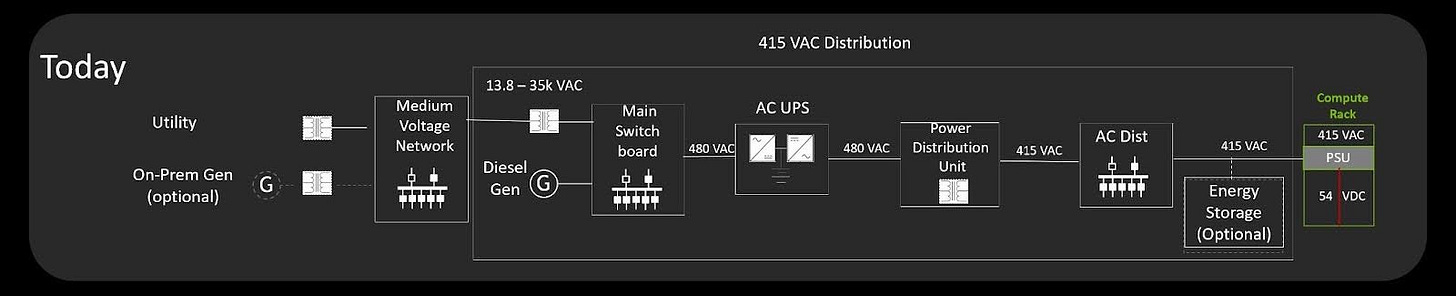
The surging power densities in AI data centers, now routinely exceeding 120 kW per rack with projections nearing 1 MW, have exposed the limitations of traditional 480VAC electrical infrastructures that rely on multiple AC/DC conversions. This legacy approach, designed for stable, low-voltage loads, is increasingly inefficient and spatially prohibitive due to the heavy copper wiring and hardware it demands. Industry consensus, as highlighted at Datacloud 2026, is coalescing around transitioning to higher-voltage DC architectures—such as 800VDC and even 1500VDC—to optimize power delivery by increasing voltage rather than current, thereby enhancing scalability and reducing complexity in powering volatile, high-density AI compute racks.
Behind-the-meter power solutions and advanced battery systems, particularly lithium-based technologies, are emerging as critical components in stabilizing the erratic and high-frequency power demands of AI workloads. Companies like Ampace emphasize that these battery systems do more than provide backup; they actively smooth power curves and coordinate with the grid to manage dynamic energy loads safely and reliably. Enerflex’s modular power solutions exemplify this trend by delivering hundreds of megawatts of scalable, rapid-deployment capacity, addressing the urgent need for speed and reliability in AI data center power infrastructure.
Hyperscalers are investing tens of billions into integrated power infrastructures that combine nuclear, renewable, and emerging technologies like fuel cells to meet the unprecedented energy demands of agentic AI workloads, which could require up to 1,000 times more power capacity than earlier generative models. Amazon’s $20 billion nuclear-powered campus and Microsoft’s 10.5 GW Brookfield nuclear and solar deal illustrate a strategic shift toward securing guaranteed, always-on electricity, a competitive moat underscored by Goldman Sachs’ projection of $736 billion capex in 2025 focused heavily on power infrastructure. This massive investment reflects a coordinated industry effort to build resilient, large-scale power architectures that can sustain the vertical growth in AI compute intensity.
The collaborative framework released by NEMA, ASHRAE, and PNNL exemplifies the industry's push toward integrated design standards that unify expertise in power generation, delivery, storage, and advanced cooling technologies. ASHRAE’s leadership on cooling innovations—including liquid-to-chip systems that efficiently manage the intense heat of dense GPU deployments—combined with NEMA’s power delivery insights and PNNL’s building system engineering, creates a nimble standard-setting process designed to evolve rapidly alongside AI data center technologies. This approach addresses not only the technical challenges of high-voltage DC distribution but also operational realities such as the extreme noise levels (105–110 decibels) generated by cooling and power infrastructure, underscoring the complexity of safely and efficiently operating next-gen AI data halls.