AI data centers ignite off-grid gas boom—and backlash
The gist
AI giants are bypassing clogged power grids by building private, gas-fired plants for data centers—igniting a high-stakes clash over health, secrecy, and local control.
What to know
- Developers have quietly built at least four off-grid gas power plants (totaling 2 GW) for AI data centers in just 18 months, using everything from trucked-in turbines to repurposed jet engines.
- Analysts predict hyperscalers could add a staggering 62 GW of off-grid gas-fired power by 2030—enough to rival new utility markets, with up to 40% of new data center capacity skipping the main grid.
- The backlash is fierce: health experts warn of hundreds of premature deaths from pollution, and local protests have already stopped Utah’s 40,000-acre Stratos AI campus dead in its tracks.
Paper Trail Reveals Gas Shift
Leaked permits and satellite images show tech giants rapidly deploying mobile turbines and jet engines, turning off-grid gas power from theory into reality at AI campuses.
What changed in October 2026 was not just the volume of concern but the quality of proof: the reporting was built on document trails showing developers choosing private gas generation over waiting for utility hookups. Distilled said it “reviewed hundreds of permits, regulatory filings, and other documents,” finding plans ranging from “gas turbines on the back of semi-trucks” to repurposed jet engines, and concluded this was already material infrastructure, with “four behind-the-meter data centers” built in the prior 18 months totaling 2 GW, evidence that the workaround had moved from proposal to deployment.
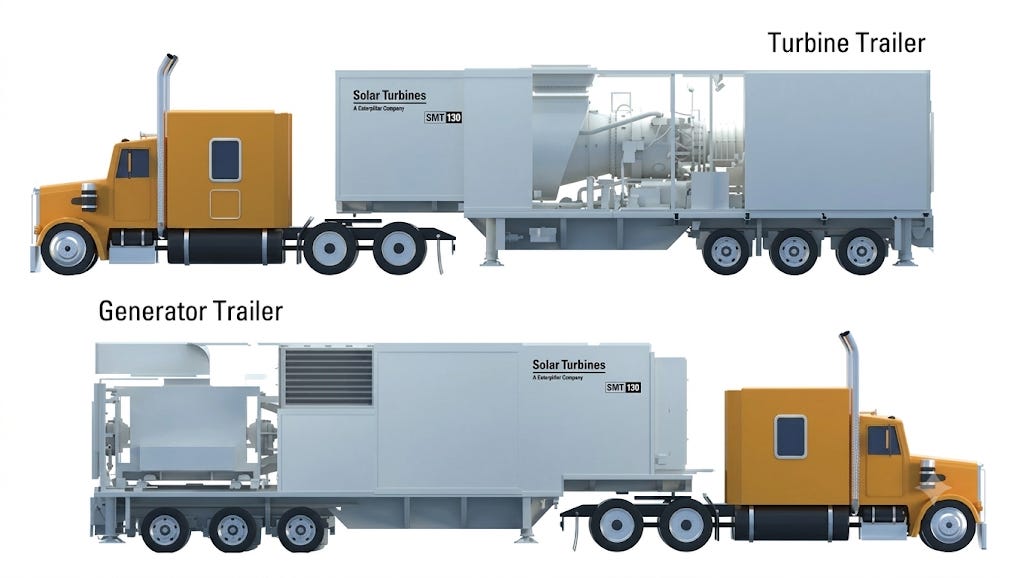
By October, that pattern was visible in named projects and in the broader energy mix around AI facilities, making the workaround harder to dismiss as anecdotal. Distilled reported that “since 2024, Elon Musk’s company has bought or leased dozens of mobile turbines,” now totaling 1.5 GW, while “satellite images commissioned by Cleanview show nearly 60 turbines onsite”; it also cited Vantage Data Centers in Virginia, which, rather than wait for utility service, trucked in 8 Solar SMT-130 natural gas turbines and “has operated its own onsite power plant since September 2025” after being unable to connect for years, and an October 6 interview said “almost 100% of power generation for these data centers is coming from natural gas power generation.”


Utilities Outpaced by Private Power
Frustrated by grid delays, major data center developers are bypassing utilities entirely, trucking in industrial gas generators to fuel explosive AI growth.
The shift is happening now because waiting for grid power has become commercially intolerable, pushing developers to route around utilities with on-site fossil generation. Cleanview reported that “rather than wait for a grid connection, some developers were planning to stick gas turbines on the back of semi-trucks and park them outside their data centers,” while others planned to use repurposed jet engines; in Virginia, Vantage Data Centers “has operated its own onsite power plant since September 2025,” and “Rather than wait, Vantage trucked in 8 Solar SMT-130 natural gas turb...” after being told grid access would take years.
This is no longer a speculative workaround but a visible buildout that is drawing scrutiny because it exploits gaps between data-center development and traditional utility oversight. Cleanview found that “In the last 18 months, developers have built four behind-the-meter data centers with a combined capacity of 2 GW—equivalent to two nuclear power plants,” including “xAI’s Colossus 1 and 2,” and published “Satellite images of Colossus 1 and 2 outside of Memphis, TN. Captured May 13, 2026”; Canary Media added that “59 planned facilities” are “looking to skip slow-moving utility processes altogether and build their own power sources on-site,” a strategy “Pretty much every big tech firm is pursuing.”

AI’s Power Demand Rivals Cities
Massive new AI complexes are driving off-grid gas generation to utility scale, with projects like SoftBank’s Ohio campus planning power plants bigger than most cities’.
This is no longer a niche workaround but a power-market-scale buildout. Spiceworks describes AI development shifting from hundreds of megawatts to multi-gigawatt, city-sized campuses with on-site generation, and the pipeline already includes projects such as “SoftBank 10GW Ohio AI Campus (Piketon, Ohio)… the site plans to feature a dedicated $33 billion, 9.2GW natural gas power plant,” a single development large enough to signal that behind-the-meter capacity is being planned in blocks usually associated with utility systems, not individual commercial facilities.
The forecasts are larger still: Enverus Intelligence Research projects hyperscalers will add 62 gigawatts of off-grid, natural gas-fired power serving data centers through 2030, with about $5 trillion in spending, and says strained grids and long interconnection waits will push about 40% of all new data center capacity additions entirely off the main grid. The scale of that pressure is visible in ERCOT, which is tracking more than 438 GW of large-load interconnection requests, with nearly 90% coming from data centers, versus an all-time historical peak demand record of 85.5 GW. That growth is concentrated enough to reshape regional markets—more than 80% is expected in Texas, PJM, and the West—and fuel demand alone reaches utility scale, with domestic off-grid gas use estimated at 1.3 billion cubic feet per day in 2030.
Unchecked Gas Plants Threaten Health
Dozens of sprawling behind-the-meter power stations are being greenlit piecemeal, exposing communities to pollution levels that public health models link to hundreds of premature deaths annually.
The public-health case is serious because these are not marginal peaker units but power systems on the scale of utilities, often attached to a single AI campus and reviewed in pieces. TechCrunch reported that Amazon’s Pecos County project would be “powered by new on-site generation that won’t raise electricity costs for Texas families,” and reporting on Amazon’s investment in an on-site power plant in Pecos County, Texas, described by The New York Times as tied to “the largest source of climate pollution in the United States.” Cleanview described 35 natural-gas turbines capable of generating 7.65 gigawatts for one customer—roughly seven nuclear reactors—and data-center fleets also typically include “a giant fleet of diesel generators” with “extra generators behind that,” compounding local pollution exposure.
What makes the risk larger is that regulators often never assess the full fleet as a fleet: The Regulatory Review said an EPA health-screening model applied to 67 proposed plants totaling 134 gigawatts projected 450 to 812 premature deaths and $7.5 billion to $13.2 billion in annual health damages once operating. Yet it also identified at least 74 proposed behind-the-meter gas plants totaling 143 gigawatts, none operating today, and showed how Project Jupiter in New Mexico was initially split into east and west microgrids, with developers having “initially split the air quality permit application in two” for “east” and “west” microgrids, each “just under the 250 ton threshold” that would have triggered stricter review.

Grassroots Revolt Halts Mega Campus
Fierce local opposition, fueled by secrecy and environmental fears, forced the abrupt shutdown of Utah’s Stratos project—signaling that community backlash can stop even the biggest AI ambitions.
These projects are becoming political liabilities because residents are reacting not just to abstract climate concerns but to immediate local burdens and to the sense that decisions were made without them. The August analysis of backup generation described communities “up in arms” over diesel units that “might only run 100 hours for per year for maintenance and emergency operations,” yet “when they do run” bring noise, vibration that can shake nearby areas, and “incredibly polluting” NOx emissions—exactly the kind of lived disruption that turns a permitting fight into a local political problem.
The clearest example is Stratos in Utah, where Decoder and The Verge portrayed the Wonder Valley battle as a political firestorm created by secrecy, bypassed local input, and the sheer audacity of the proposal. Residents learned late about what was described as “a 40,000 AC AI campus with more than 9 gigawatts of power, more than double the average power usage of the entire state of Utah,” and the backlash became so intense it stopped the project, underscoring the outlets’ conclusion that the industry has run into an obstacle it cannot buy its way around: local democracy.