AI divides the SaaS world: valuations crash for old guard as AI-native firms soar
The gist
**AI is splitting the SaaS universe in two—legacy firms face valuation freefall while AI-native upstarts soar to record highs.**
What to know
- By early 2026, median SaaS valuations crashed to 4-5x revenue for traditional players, while AI-native firms command 8x+ ARR multiples.
- Over 60% of SaaS companies now dedicate at least 5% of budgets to AI, but organizational inertia is stalling real bottom-line impact.
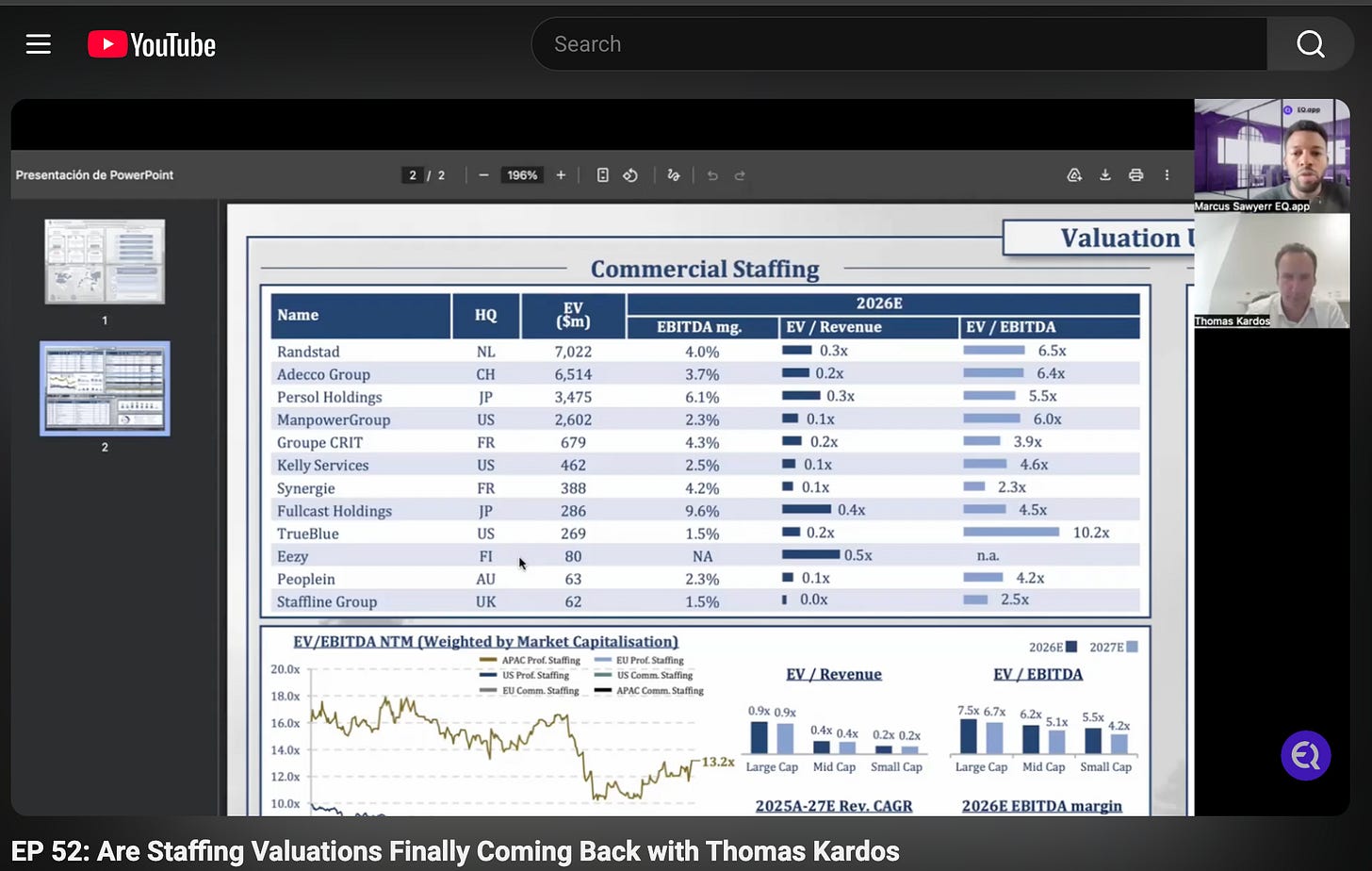
- Staffing giants like Randstad and Adecco lag as tech-enabled firms and AI-powered acquisitions fetch up to 48x EBITDA, reshaping the human capital landscape.
SaaS Valuations Reset
AI’s rapid budget reallocation and demand for capital efficiency have upended how SaaS firms are valued, rewarding sustainable profitability over hypergrowth for the first time in a decade.
By late 2025 and early 2026, the SaaS market underwent a dramatic valuation reset, with median public software companies trading near 4-5x revenue, a steep decline from the 50x-100x multiples of the zero-interest-rate era. While AI did not initiate this reset, it accelerated the transition by reallocating incremental budgets and compressing expansion economics within enterprise software stacks, signaling a fundamental shift in how SaaS businesses are priced.
The valuation paradigm shifted decisively from prioritizing top-line growth velocity to emphasizing capital efficiency, durable retention, and risk-adjusted cash flow quality. This new focus means that milestones like the $10 million ARR mark remain critical, but the criteria for elite valuation status now demand stronger capital discipline and retention metrics, reflecting a more unforgiving market math that rewards sustainable profitability over pure growth.
Early 2026 also saw a bifurcation in valuation multiples: traditional profitable software companies traded at 20-30x free cash flow, while services-based businesses commanded 8-12x multiples. AI-enabled services began to bridge this gap, attracting investor interest with multiples closer to software firms, as AI-driven efficiencies promised gross margins exceeding 50%, thus reshaping investor expectations around profitability and margin profiles.
Investor appetite became sharply differentiated, with AI-native SaaS companies commanding premium multiples often above 8x ARR, while traditional SaaS firms faced compressed valuations around 3.4x to 5x ARR. Strategic buyers were willing to pay 7-12x ARR for AI-enabled products capable of rapid ROI, underscoring a market preference for AI integration as a moat; Salesforce CEO Marc Benioff framed this 'SaaSpocalypse' as a natural market rerating driven by AI-fueled efficiency and innovation, while voices like Chamath Palihapitiya highlighted the vulnerability of low-end SaaS versus the resilience of large enterprise platforms amid consolidation.


AI Spend, Real Impact Lags
Despite surging AI budgets and wage premiums for talent, most SaaS and staffing organizations see little bottom-line impact as entrenched structures and accountability gaps stifle transformation.
By early 2026, AI adoption within SaaS companies has surged dramatically, with over 60% of firms allocating at least 5% of their budgets to AI initiatives, a fivefold increase from the previous year. This influx is reshaping product strategies and pricing models, as evidenced by Hubspot’s standout growth among major enterprise buyers and significant spending increases at Figma, Box, and others. However, this budget reallocation is not without friction; CIOs predict that systems integrators will face the brunt of budget constraints, underscoring structural tensions in integrating AI into existing operational and recruitment workflows.
In staffing, AI is evolving from a mere recruiter’s assistant to enabling autonomous workflows, with over half of talent leaders planning to implement such systems by 2026. Despite nearly 88% of organizations deploying AI, a striking 81% report minimal bottom-line impact, highlighting that the barriers are more organizational than technical. Traditional structures designed for human execution remain largely unchanged, with AI layered onto existing roles without shifting ownership or accountability, which stifles compounded gains and innovation.
The staffing sector also faces a pronounced wage premium for AI talent, with PwC reporting a 56% increase, reflecting fierce competition for skilled professionals who can navigate these new autonomous workflows. Concurrently, roles focused on repeatable execution are increasingly left unfilled, signaling a fundamental shift where AI assumes ownership of routine tasks, thereby transforming operational models and workforce composition.
Amid soaring AI adoption, enterprises like Anthropic have achieved remarkable valuations and ARR milestones, yet companies such as Meta, Uber, and AWS grapple with escalating token costs and ambiguous ROI. This paradox drives executives to ration AI usage and optimize spending, accelerating a transition toward AI-native workforces that prioritize high-impact applications to enhance long-term cost efficiency despite near-term financial challenges.



Staffing’s Winners and Losers
AI-enabled upstarts and vertical specialists are outpacing legacy staffing giants, as selective recovery and agile tech integration drive premium multiples and investor interest.
The professional staffing and HR solutions sector demonstrated notable resilience in Q1 2026, collectively beating revenue estimates by 1.8% and seeing average stock price gains of around 4.9% post-earnings. However, this aggregate strength masked a bifurcated performance among key players: while firms like Kforce and First Advantage surged—Kforce’s stock jumping nearly 30% on an EPS beat and First Advantage posting 8.6% revenue growth driven by AI-enabled vertical strategies—legacy leaders such as Robert Half and Insperity faced revenue declines and stock price drops amid missed earnings guidance and investor caution.
Investor sentiment around Robert Half encapsulates the sector’s cautious optimism: despite a 3.8% revenue decline and an 8.1% stock drop post-Q1, the company’s shares trade approximately 12% below analyst targets and are estimated to be 55.6% undervalued, reflecting a potential valuation opportunity fueled by AI-driven hiring shifts. Yet, concerns linger over dividend sustainability given a high 9.01% yield poorly covered by earnings, underscoring the delicate balance between growth prospects and financial risks in this evolving market.
The staffing sector’s valuation landscape is undergoing a selective recovery after hitting decade lows, with firms embracing AI enablement and strategic vertical focus commanding premium multiples. Private equity interest is concentrated in growth areas like light industrial, life sciences, and European commercial staffing, while innovative models such as the convergence of Statement of Work (SOW) with traditional temp staffing are tripling EBITDA for some companies despite flat revenues. Smaller and mid-sized firms are capitalizing on agile AI integration, outpacing incumbents like Adecco and Randstad, whose valuations languish around 6.4x revenue, compared to tech-enabled acquisitions fetching multiples as high as 48x EBITDA.
This evolution reflects a broader transformation of staffing from transactional labor provision to tech-enabled human capital architecture, where AI accelerates operational efficiencies and enables rapid back-office resigning—cutting processes from 48 weeks to 48 hours. Strategic consolidation of SOW and staffing budgets at the enterprise level is facilitating moves into higher-value MSP, RPO, and consulting roles, supported by significant investments like OpenAI’s $4 billion earmarked for consulting acquisitions. These shifts underscore the critical role of technology and market positioning in driving valuation recovery and investor confidence amid ongoing workforce digitization and regulatory changes.

Culture, Not Code, Drives AI
Microsoft and SAP prove that leadership-led cultural reinvention and new pricing models—not just new AI tools—are the real differentiators in achieving transformational gains.
By early 2026, leading tech giants like Microsoft and SAP illustrate that successful AI-driven transformation hinges on leadership's ability to reshape organizational culture and operational models rather than merely deploying new tools. Microsoft's 2026 Work Trends Index reveals that leadership and cultural redesign have twice the impact on AI success compared to individual efforts, with 80% of employees in restructured organizations producing work previously unattainable. Concurrently, SAP's strategic pivot to an AI consumption-based pricing model, moving away from traditional subscription fees, underscores how companies are innovating pricing structures to align with AI's evolving value proposition, despite challenges in cost predictability.
Addressing the 'Transformation Paradox,' where employees are eager to adopt AI but hampered by outdated metrics, Microsoft emphasizes leadership-driven cultural shifts and new incentive frameworks to foster experimentation and unlock AI’s full potential. As Matt Firestone and other Microsoft executives highlight, this requires re-architecting work structures to reward innovation. Mirroring this cultural evolution, SAP is embedding engineering teams directly with customers to co-develop AI applications, signaling a hands-on, collaborative approach that bridges operational and cultural divides for deeper AI integration.

AI Reshapes Staffing’s Value Chain
Agentic AI and global expansion are turning staffing firms into high-value, tech-driven partners commanding record multiples, while legacy players fall further behind.
Bain & Company’s 2026 research spotlights a transformative $100 billion US market opportunity for agentic AI within SaaS, particularly through automating up to 60% of complex workflows in customer support and R&D. This AI-driven automation is not only catalyzing premium valuations but also enabling smaller and mid-sized staffing firms to leverage agile AI adoption, outpacing industry giants like Adecco and Randstad by turning fragmented 'shadow AI' tools into competitive advantages.
The staffing industry is undergoing a profound evolution from transactional labor providers to tech-enabled, risk-mitigating architects of human capital, as exemplified by Thoma Bravo’s acquisition of Dayforce at an unprecedented 48.1x EBITDA multiple—far surpassing traditional firms like Randstad and Adecco at roughly 6.5x. This shift reflects investor enthusiasm for operational leverage and client 'stickiness,' with recent M&A deals consistently rewarding firms that own workflows and integrate AI, such as Sterling Check and Forum Engineering, trading between 14.3x and 21.7x EBITDA multiples.
Geographic expansion into Europe, the US, and the Middle East, alongside growth in verticals like life sciences and defense, is reshaping staffing market dynamics, with European commercial staffing quietly outperforming the US market. This geographic and vertical diversification, combined with the consolidation of SOW and staffing budgets under single enterprise purchasing leads, is enabling staffing firms to ascend the value chain into MSP, RPO, and consulting roles—further fueled by OpenAI’s $4 billion commitment to consulting acquisitions aimed at embedding AI solutions into talent management.
Looking ahead, CEOs must embrace AI enablement, geographic expansion, and clear growth strategies to attract premium buyers and ensure long-term resilience, as operational leverage and AI-driven growth become the defining factors of SaaS and staffing valuations. Firms ignoring these imperatives risk falling behind in a market increasingly dominated by tech-enabled models that prioritize de-risking client operations over mere talent placement, echoing Sector Expert Thomas Kardos’s assertion that 'The mission is no longer finding talent; it’s de-risking the client’s operations.'
