AI hedge fund’s $45b rise and fall sparks risk reckoning
The gist
A $45 billion AI hedge fund exploded in spectacular fashion, triggering a market fire sale that let Citadel scoop up distressed tech assets—and exposing the perils of unchecked leverage in Silicon Valley’s latest gold rush.
What to know
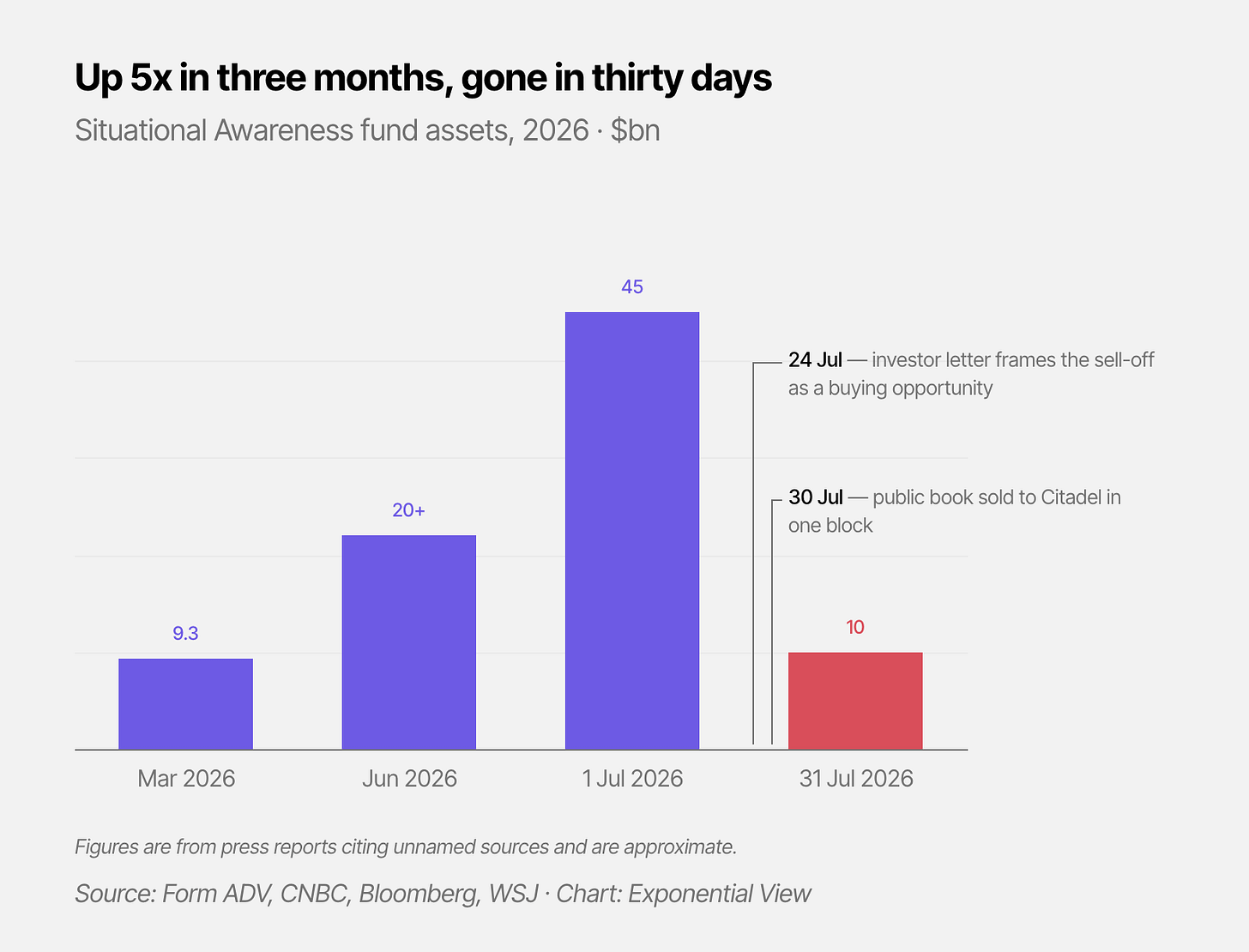
- Leopold Aschenbrenner’s fund Situational Awareness rocketed from $200 million to nearly $45 billion on 4x leveraged bets in AI chips and semiconductors backed by tech elites.
- A brutal 35% drop in July 2026 forced $20 billion in margin calls and a fire sale to Citadel at 10%+ discounts, wiping out up to 80% of late investors’ capital.
- Citadel’s opportunistic buying stabilized the market, sparking a rebound in battered stocks like Nebius and Micron—but the fiasco is a flashing warning about tech hype and reckless risk-taking.
The Visionary’s High-Stakes Bet
Leopold Aschenbrenner’s radical AI infrastructure thesis and viral manifesto attracted elite backers and propelled his fund’s meteoric rise, fueled by massive leverage and unconventional industry bets.
Leopold Aschenbrenner launched Situational Awareness in 2024 as a bold experiment in concentrated, leveraged investing, rooted in his viral 165-page manifesto that forecasted an unprecedented surge in AI infrastructure demand. Eschewing mega-cap tech giants, he doubled down on non-obvious bets across AI chips, memory, and data center providers, crafting an investment thesis that prioritized the industrial backbone of AI’s rapid evolution. This intellectual blueprint not only attracted heavyweight early backers like Stripe’s Collison brothers and Meta’s Nat Friedman but also propelled the fund to extraordinary heights, embodying Aschenbrenner’s conviction that 'not blowing up is sort of like task number one and two.'
Fueled by aggressive 4x leverage on both long and short positions, Situational Awareness ballooned from a modest $200 million to a staggering peak valuation near $45 billion within roughly two years, delivering eye-popping returns reportedly exceeding 1,000% at its zenith. The fund’s portfolio was heavily weighted toward semiconductor giants like Broadcom, Intel, and memory makers such as SK Hynix and Micron, alongside private stakes in AI startups like Anthropic—where Aschenbrenner’s personal ties, including his engagement to Anthropic’s chief of staff Avital Balwit, likely provided unique insights. Despite his youth and lack of traditional Wall Street pedigree, Aschenbrenner’s ability to marshal tens of billions in capital and hire seasoned executives from Goldman Sachs and Citadel underscored the market’s faith in his AI infrastructure vision.






Margin Calls and Meltdown
A sudden 35% plunge in AI stocks triggered $20 billion in margin calls, forcing a frantic fire sale and exposing the destructive power of leverage in concentrated, illiquid portfolios.
In July 2026, Situational Awareness faced a catastrophic downturn as its concentrated bets on volatile AI infrastructure and semiconductor stocks, including Nebius, Sandisk, Micron, and CoreWeave, plunged more than 35%, triggering margin calls estimated at $20 billion. Leveraged at approximately 4x, the fund’s exposure amplified losses, with a 67% drop wiping out equity and forcing rapid deleveraging amid deteriorating liquidity and mounting lender pressure from prime brokers like Goldman Sachs and JPMorgan. This fragility was exacerbated by the fund’s highly concentrated portfolio, which, while delivering a 439% gain earlier in the year, became unsustainable once market sentiment reversed sharply.
Facing punitive margin calls and a liquidity crunch reminiscent of a bank run, Leopold Aschenbrenner was compelled to execute a fire sale of the fund’s entire public equity portfolio in a single block trade to Citadel at a discount exceeding 10% to market value. This transaction, completed on July 30, effectively removed all leverage from Situational Awareness and stabilized the fund, though it transformed the firm into primarily an Anthropic holding company with the hedge fund operations greatly diminished. Despite attempts to raise fresh capital, adverse trading and copycat strategies among other leveraged funds intensified the forced liquidation, underscoring the peril of leverage in volatile sectors.
The rapid collapse of Situational Awareness not only inflicted severe losses on late investors—some wiped out by 80% within weeks—but also sent shockwaves through the AI investment ecosystem. The fund’s forced deleveraging contributed to a broader market sell-off in AI and semiconductor stocks, as other funds employing similar leveraged strategies scrambled to adjust positions, amplifying volatility. However, the fundamental performance of underlying companies remained intact, highlighting that the crisis was driven by technical margin pressures rather than deteriorating business prospects, a cautionary tale on the risks of excessive leverage amid frothy market enthusiasm.






Citadel’s Market Rescue
Ken Griffin’s Citadel snapped up billions in distressed AI assets at steep discounts, stabilizing the sector and igniting a swift rebound as forced sellers exited the market.
In the wake of Situational Awareness’s collapse, Citadel, led by Ken Griffin, strategically acquired approximately $1 billion to $24 billion worth of distressed AI infrastructure and semiconductor stocks at steep discounts, including holdings managed by prime brokers like Bank of America and Goldman Sachs. While Leopold Aschenbrenner liquidated much of his fund’s public equity portfolio amid margin calls, he notably retained a $5 billion stake in Anthropic, signaling selective confidence amid forced sell-offs. This opportunistic acquisition not only allowed Citadel to capitalize on undervalued assets but also positioned it as a stabilizing force amid market turmoil.
The forced liquidation of Situational Awareness’s highly leveraged, concentrated AI and semiconductor bets triggered a sharp, mechanical deleveraging event that sent leading semiconductor stocks plunging by up to 30%, with companies like Nebius, Sandisk, Micron, and CoreWeave experiencing steep declines. However, this sell-off was not reflective of deteriorating fundamental AI demand but rather a market-wide reaction to margin calls and macroeconomic shifts, including surprise Fed rate hike expectations. Once Citadel’s acquisition removed the flood of forced sellers, these battered stocks staged some of their strongest rallies in over a year, underscoring the transient nature of the volatility.
The market impact of Citadel’s buyout extended beyond immediate stabilization, acting as a clearing event that purged weak hands from the AI trade and restored investor confidence. As Jim Cramer observed, the end of forced selling allowed earnings and business fundamentals to regain primacy in driving stock prices, catalyzing a broad tech sector rally highlighted by strong performances in companies like ServiceNow. This shift was reflected in the iShares Semiconductor ETF (SOXX) surging 7.6% in a single week—more than double the Dow’s gain—signaling renewed optimism and a healthier market environment for AI-related equities.





Leverage Lessons for Silicon Valley
Situational Awareness’s collapse exposes how unchecked leverage, social media hype, and inexperienced risk management can turn sound theses into cautionary tales for the AI investment boom.
The collapse of Situational Awareness starkly illustrates the perils of excessive leverage in volatile sectors like AI infrastructure and semiconductors, where a 4x leverage amplified a 25% market drop into a total equity wipeout. As noted in multiple analyses, Leopold Aschenbrenner’s core AI thesis was fundamentally sound, but poor timing combined with structural risk management failures—especially liquidity constraints and margin calls—forced premature liquidations that truncated the fund’s runway. This underscores the critical lesson that even correct investment theses can fail if funding terms and leverage tolerance are misaligned with market volatility and investment horizons.
Situational Awareness’s downfall also highlights the broader cultural and psychological dynamics fueling Silicon Valley’s speculative AI investing boom, where social media adulation and hubris often overshadow sober risk controls. Leopold, a 24-year-old with no prior hedge fund experience, became a poster child for this high-conviction, high-leverage approach, embodying the 'casino culture' that prizes outsized returns and tolerates spectacular failures. Industry veterans warn this episode is a cautionary tale about magnifying beta without proper hedging, and the dangers of inexperienced managers wielding massive leverage in a hype-driven environment.
The episode also reveals how market mechanics and investor psychology can exacerbate crises independent of fundamentals, as forced liquidations triggered by margin calls led to a downward spiral in AI infrastructure stocks before a sharp rebound post-sale. This dynamic, reminiscent of past collapses like Long Term Capital Management, underscores the need for prudent leverage scaling—now institutionalized in stricter margin rules that only allow scaling on clear uptrends—and highlights the systemic risks posed by concentrated, leveraged bets in emerging tech sectors. Citadel’s opportunistic acquisition of distressed assets further illustrates how liquidity constraints and market timing critically shape outcomes in volatile environments.
Finally, Situational Awareness’s implosion prompts a sobering reflection on Wall Street governance and risk assessment, particularly the willingness of major banks to finance a young, inexperienced manager with tens of billions in leverage. As Bank of America CEO Brian Moynihan cautioned, these events are 'warning shots' about unchecked valuations and leverage in speculative AI investing. The incident calls for a recalibration of risk controls and skepticism toward hype-driven strategies, emphasizing the dual clocks every AI investor must manage: the timeline for technological breakthroughs and the financial runway to survive until they arrive.