AI in the classroom: from homework helper to critical thinking hazard, experts warn of 'cognitive stunting' crisis
The gist
AI is reshaping the classroom from homework helper to critical thinking hazard, with experts warning that overreliance is stunting students’ minds and undermining authentic learning.
What to know
- By early 2026, MIT and Carnegie Mellon researchers found that students who lean too hard on AI report lower confidence and a loss of ownership over their ideas.
- Widespread use of AI-detection tools like GPTZero and TwainGPT has 73% of students changing how they use AI, but false positives unfairly impact non-native and neurodivergent students.
- Neuroscientific studies reveal that routine, unguided AI use leads to cognitive stunting for over two-thirds of students, prompting experts to call for a shift from detection to teaching AI literacy and critical verification skills.
Memorization’s Collapse, Authorship’s Rise
As AI renders memorization obsolete, education faces a crisis of trust and authenticity, shifting the focus from proving knowledge to proving original authorship—often at the expense of non-native and neurodivergent students.
AI's advent has fundamentally disrupted traditional education models that prioritized memorization and fact recall, rendering these skills obsolete as AI can instantly generate answers. As noted on November 20, 2025, the 200-year-old system built around proving knowledge through memorization now faces a crisis where the real skill schools must teach is discerning and verifying authentic information. However, widespread reliance on AI detection tools has backfired, producing false positives that undermine trust and disproportionately affect non-native speakers and neurodivergent students, shifting the burden of proof from demonstrating knowledge to proving authorship and complicating the educator-student relationship.
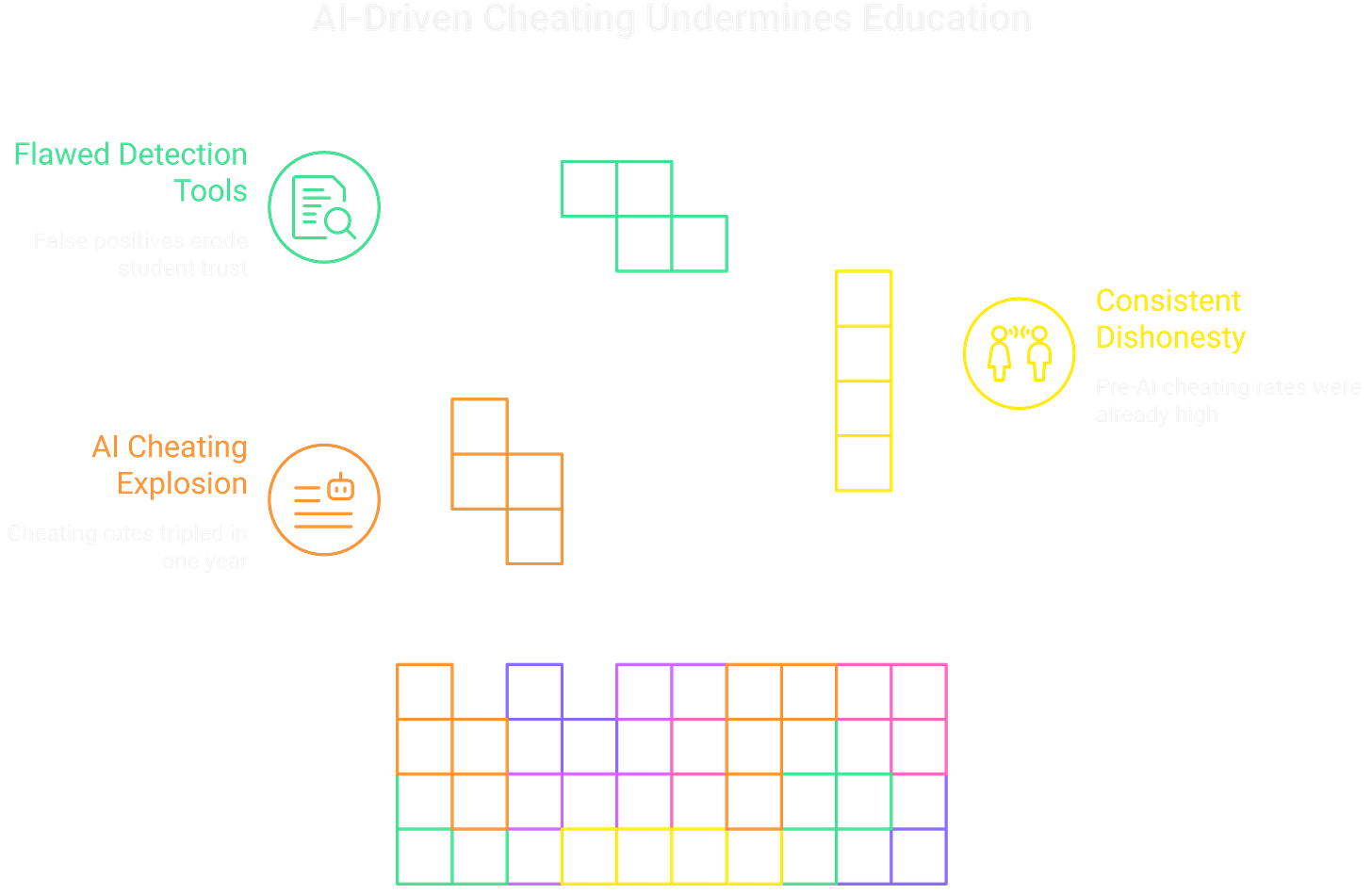
Despite fears of rampant AI-enabled cheating, the overall rate of academic dishonesty among high school students has remained steady at 60-70%, though the methods have shifted from peer copying to AI usage. This behavioral change highlights a deeper crisis: education increasingly teaches students to prioritize the appearance of authenticity over genuine understanding, a trend exacerbated by unclear boundaries between AI assistance and cheating. Consequently, standardized tests and traditional assessments that measure memorization skills are now misaligned with the realities of AI, urgently necessitating a redesign to emphasize critical thinking, judgment, and authentic comprehension.
By late 2025, experts like Andrej Karpathy argued that at-home assignments have become unreliable indicators of student understanding due to the undetectability of AI use, prompting calls to shift assessments into classrooms where teachers can directly observe learning. Karpathy advocates for teaching students to critically interrogate AI outputs by asking questions about sense-making, explanation, counterexamples, and sourcing, thereby cultivating verification skills as a new literacy essential for authentic understanding. Yet, a fundamental challenge remains: AI-generated content can be fluent yet devoid of true insight or 'slop,' a quality that remains unmeasurable at scale and complicates efforts to ensure meaningful learning.
By early 2026, Ursula Franklin’s research illuminated how AI in education risks enabling students to outsource learning, improving short-term exam performance without fostering lasting understanding. She distinguishes between work-related technologies that scaffold authentic engagement and control-related technologies that enforce compliance, warning that many educational tools—including AI—may inadvertently prioritize control over genuine learning. Effective AI integration, therefore, should support sequential, scaffolded learning processes rather than shortcutting them, underscoring the urgent need to redesign assessments to focus on authentic understanding rather than rote completion or superficial compliance.


Cognitive Risks of Passive AI
Unchecked, routine AI use in classrooms is stunting students’ critical thinking and brain development, as passive reliance replaces intellectual struggle and foundational cognitive growth.
By early 2026, extensive research and global surveys reveal that AI integration in education poses significant cognitive and developmental risks, primarily through fostering overreliance that undermines critical thinking and intellectual autonomy. Over two-thirds of students using AI for homework perceive a decline in their critical thinking skills, as AI encourages passive consumption rather than active problem-solving, leading to cognitive stunting and poorer performance when AI support is withdrawn. Experts like Rebecca Winthrop emphasize that AI use often bypasses essential skill development, with 65% of students citing cognitive development threats, while studies from institutions like Oregon State University warn that routine AI reliance during formative years may stunt the cultivation of intellectual habits necessary for professional life.
The manner in which AI is employed critically influences its cognitive impact: when AI acts as a scaffold or tutor—guiding students through problem sequences without replacing effort—it can enhance learning outcomes, as demonstrated by programs like Nigeria’s World Bank AI tutoring trial and Stanford’s Tutor CoPilot. Conversely, unguided or crutch-like AI use risks intellectual atrophy by outsourcing thinking, eroding users’ confidence and sense of ownership over ideas. Studies led by Sarah Baldeo and research from MIT and Carnegie Mellon highlight that active engagement with AI outputs—modifying or challenging suggestions—preserves cognitive agency, whereas passive acceptance leads to 'intellectual leveling' and diminished motivation to independently complete tasks.
Beyond cognitive skills, AI and screen exposure in educational settings raise concerns about brain development and executive function in children. Neuroscientists like Tzipi Horowitz-Kraus and longitudinal reviews from Auckland University document that early and excessive screen use, including AI interfaces, correlates with reduced neural activity in language and executive function regions, weaker brain connectivity, and attention deficits. This cognitive atrophy is compounded by screens displacing vital activities such as sleep, physical movement, reading, and imaginative play, creating a feedback loop where children with self-regulation challenges gravitate toward screens, further hampering their cognitive growth.
The ethical and developmental risks of AI in education have prompted calls from doctors and education experts for a moratorium on AI use in schools, particularly due to its potential to impair independent thinking and exacerbate educational inequities in under-resourced settings. Furthermore, mental health concerns arise from AI products lacking ethical oversight, with companies like Google and Character.AI facing lawsuits over harms to minors. Drawing on Ursula Franklin’s framework distinguishing 'work-related' from 'control-related' technologies, experts warn that AI tools risk becoming instruments of compliance rather than genuine learning, underscoring the urgent need for AI designs that preserve human agency and embed safety guardrails within human relationships.

![[ Center for Humane Technology ]](https://substackcdn.com/image/fetch/$s_!uhgK!,w_256,c_limit,f_auto,q_auto:good,fl_progressive:steep/https%3A%2F%2Fsubstack-post-media.s3.amazonaws.com%2Fpublic%2Fimages%2F5f9f5ef8-865a-4eb3-b23e-c8dfdc8401d2_518x518.png)



Verification Over Detection
Teaching students to interrogate AI’s confident but often shallow outputs is emerging as the new essential literacy, as traditional detection methods fail to capture real understanding or insight.
By late 2025, experts like Andrej Karpathy emphasized that detecting AI use in student work is futile, advocating instead for cultivating verification skills that empower students to critically interrogate AI outputs through questions like 'Does it make sense?' and 'What would a second source say?'. This approach addresses the challenge posed by AI’s confident yet often inaccurate responses—what Karpathy terms 'slop'—which superficially appear coherent but lack true insight, underscoring the need to teach students discernment beyond surface-level correctness.
By early 2026, the conversation around AI literacy assessment shifted toward developing multi-dimensional, high-altitude evaluation methods that capture critical thinking, ethical reasoning, and long-term decision-making, moving beyond traditional metrics. However, this approach demands a cultural shift in education, requiring trust, professional development, and acceptance of less quantifiable outcomes, as well as vigilance against equity gaps where only resource-rich students gain deep AI literacy while others remain limited to compliant tool use.
Throughout early 2026, calls intensified for actionable, scalable pedagogical interventions that move past documenting AI’s pitfalls toward teaching students how to critically engage with AI tools already in their hands. While experimental studies showed promise—such as doubling override rates on faulty AI advice—educators still lack ready-to-implement curricula, highlighting a pressing need to build instructional infrastructure that fosters responsible AI use without sacrificing human critical thinking.
By spring 2026, AI literacy was increasingly framed as encompassing epistemic literacy: understanding AI’s probabilistic nature and knowing when independent verification is essential. Experts stressed that verification is no longer procedural but interpretive, requiring human judgment to navigate AI’s semantic strengths and its limitations in tasks like citation accuracy. This epistemic awareness is critical to counteract the epistemic risk posed by AI’s fluent but fallible outputs, as illustrated by real-world examples like AI hallucinations misleading students.
Practical classroom and home strategies emerged by mid-2026 to foster AI literacy through experimentation, critical engagement, and ethical use. Boston Principal Traci Walker Griffith’s work exemplifies how integrating AI as a tool for mastery—not mere production—can accelerate learning when intentionally designed. At home, experts like Alexis recommend nurturing curiosity, modeling thoughtful AI use by verbalizing reasoning and acknowledging errors, and engaging children in collaborative AI interactions that position AI as a creative partner rather than a passive tool, thereby deepening critical thinking and ethical awareness.

Detection Tools Reshape Behavior
The rise of AI-detection platforms is not only curbing misuse but also prompting students to self-regulate and demand transparency—forcing schools to balance enforcement with trust and innovation.
By early 2026, awareness of AI detection tools among students significantly shaped their AI usage behaviors, with 73% reporting changes due to detection concerns and 36% reducing AI use to avoid misconduct. These tools, including popular platforms like GPTZero and TwainGPT, not only act as deterrents but also foster ethical reflection and self-regulation, as 62% of students acknowledged AI's role in enhancing their critical thinking. Importantly, student trust hinges on transparent and fair policies, with over half perceiving detection tools as fair when schools disclose their use upfront, underscoring the need for clear communication to balance enforcement with innovation.
Monitoring AI use in educational settings remains inherently complex due to the subtlety of AI-generated content and the blurred boundaries between assistance and full task completion. Experts advocate shifting focus from mere detection to verifying genuine learning by engaging students in explaining and applying knowledge, thereby promoting a culture where students can openly disclose AI use without fear of punishment. This approach aligns with emerging institutional practices, where some schools deploy proprietary platforms guiding responsible AI use, echoing corporate AI management strategies and emphasizing skill development over mere task completion.
The challenge of defining acceptable AI use in schools is compounded by the nuanced, context-dependent nature of AI integration, with educators and families struggling to establish clear boundaries. Institutional responses vary widely—from outright bans risking technological lag to unregulated use risking cognitive gaps—highlighting the necessity of policies that promote AI as a cognitive partner enhancing reasoning rather than a shortcut. This perspective recognizes that the impact of AI depends on how and when it is used, with effective monitoring focusing on fostering 'good use' that amplifies student thinking rather than replacing it.
Technological advances in AI writing detection, exemplified by Pangram Labs’ system achieving approximately 99% accuracy with minimal false positives, rely on analyzing stylistic and word choice patterns rather than superficial grammar checks. According to Max Spiro, this sophistication is critical as AI-generated content can flood information channels with seemingly credible but automated text, challenging traditional heuristics of author credibility. Meanwhile, institutional policy responses are gaining momentum, with landmark measures like LAUSD’s ban on screens for first graders and districtwide screen time limits reflecting growing concerns about AI’s developmental impact and the need for community-informed regulation. Complementing these efforts, a coalition of over 250 experts calls for a five-year moratorium on generative AI in Pre-K–12 education, citing risks to cognitive skill-building and advocating for transparency, independent audits, and regulatory frameworks to address equity and privacy concerns.





Safeguarding Confidence and Agency
Overreliance on AI is eroding students’ confidence in their own reasoning, making deliberate, critical engagement and thoughtful integration essential to preserve independent thinking.
By early 2026, research from MIT and Carnegie Mellon, highlighted by Sarah Baldeo, revealed that overreliance on AI can erode users' confidence in their independent reasoning and diminish their sense of ownership over ideas, with 58% of participants feeling AI 'did most of the thinking.' Baldeo emphasizes that maintaining active oversight and critically engaging with AI outputs preserves cognitive engagement and confidence, recommending strategies such as attempting problems independently before consulting AI, refining AI prompts multiple times, and taking regular breaks from AI use to prevent intellectual complacency and disengagement from deeper cognitive work.
In educational settings, Principal Traci Walker Griffith’s experience at a Boston public school illustrates how AI can serve as a transformative 'secret weapon' when integrated thoughtfully, supporting rather than supplanting essential cognitive challenges. This requires ongoing experimentation by educators to strike a balance that maintains student engagement and confidence, ensuring AI acts as a scaffold to help students get 'unstuck' rather than providing complete answers, thereby fostering persistence and problem-solving skills.
Studies from Oregon State University and market research education experts underscore the critical need to preserve foundational learning and human agency amid AI’s rise. Routine reliance on generative AI during formative years risks stunting intellectual habit development, while thoughtful AI design should promote a meaningful division of cognitive labor that supports rather than replaces critical thinking. As one market research educator notes, foundational logic and reasoning skills—once rigorously taught through manual processes—remain indispensable and cannot be accelerated or bypassed by AI without compromising sound decision-making.


Parents Face the AI Dilemma
Without clear rules, families and schools struggle to set boundaries, as unsupervised AI use threatens to undermine teens’ autonomy, creativity, and emotional regulation.
By early 2026, parents and educators grappled with the challenge of monitoring AI use among teens, as AI-generated content often blurs the line between assistance and substitution. Instead of policing every prompt, experts recommend focusing on verifying genuine learning outcomes—whether adolescents can explain and apply knowledge—while fostering a culture of transparency where teens feel safe to disclose their AI use without fear of punishment. Schools have begun adopting AI-guided platforms and detection tools like GPTZero and TwainGPT to support responsible use, complemented by parental monitoring of work evolution through version control features in editors, which together help ensure authentic intellectual growth.
The absence of clear guidelines and regulatory frameworks leaves parents and communities navigating a complex landscape of AI use in education, often resulting in inconsistent responses ranging from outright bans to permissive attitudes. Thought leaders emphasize the importance of establishing nuanced, reasoned boundaries that encourage adolescents to treat AI as a cognitive interlocutor rather than a crutch, thereby fostering autonomy and critical thinking. As one analysis put it, 'the intelligence artificial llegó a las escuelas antes de que aprendiéramos cómo usarla,' underscoring the urgent need for ongoing dialogue and shared language among parents, teachers, and students.
Given the current regulatory void, proactive parental engagement is crucial to prevent cognitive dependency and preserve creativity. Studies reveal that unsupervised AI use can impair children's ability to initiate independent thinking and even affect emotional regulation, as AI increasingly shapes their developmental environment. Programs like Gnius Club’s 'IA para Papás' offer structured support to help parents regain 'autoridad tranquila'—a calm authority grounded in clear, sensible rules—enabling families to distinguish between AI as a learning tool and as a cognitive crutch, and to detect early signs of emotional dependence.
Practical strategies for fostering healthy AI engagement at home include modeling thoughtful AI use aloud, encouraging low-stakes curiosity-driven conversations, and collaboratively exploring AI’s creative potential through joint projects. Alexis, an AI educator, advocates for parents to verbalize their reasoning processes and openly handle mistakes to teach critical thinking and ethical AI interaction. Meanwhile, cautious parents like Justine Moore exemplify hands-on supervision, setting firm personal rules such as restricting device access to protect creativity and mitigate concerns about environmental impact, reflecting a broader trend of families crafting bespoke boundaries amid widespread integration of AI and screens in schools.