AI megadeals dominate VC, squeezing out startup diversity
The gist
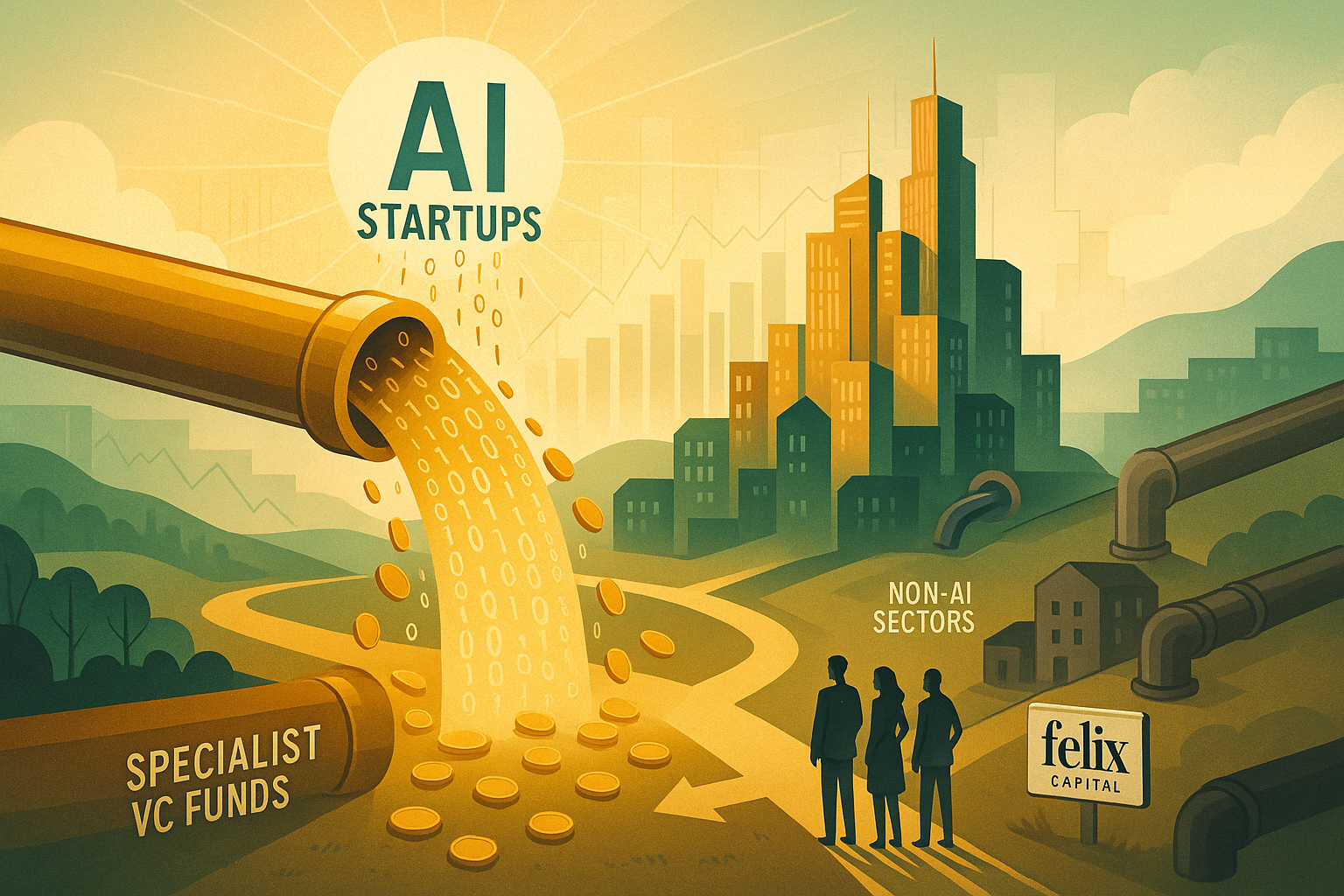
Venture capital is pouring record billions into a handful of AI megadeals, leaving most startups—and entire non-AI sectors—scrambling for scraps.
What to know
- In H1 2026, 87.5% of US VC funding—over $412 billion—went to $100M+ AI rounds, while overall deal count slumped to a decade low.
- Median late-stage AI startup valuations hit $3.95B (6.6x higher than non-AI peers), and companies last funded in 2026 are trading at zero discount on the secondary market.
- Mega-funds like Andreessen Horowitz, buoyed by AI IPO returns, raised over $15B in 2025—further concentrating capital and influence in venture.
AI Megadeals Reshape VC Market
A handful of late-stage AI startups are soaking up nearly all venture capital, creating a two-tiered ecosystem where record funding masks a historic collapse in deal diversity and opportunity.
US venture capital funding in 2026 is overwhelmingly concentrated in a handful of megadeals, with rounds of $100 million or more capturing approximately 87.5% of total capital invested—over $412 billion in the first half alone. AI companies, especially those developing large language models and AI agents, dominate this landscape, accounting for roughly 86% of all venture investment and driving unprecedented late-stage valuation premiums; for instance, median pre-money valuations at Series D and later for AI firms now reach $3.95 billion, nearly 6.6 times higher than their non-AI counterparts. This intense focus on a small cadre of AI startups has created a bifurcated market where record funding totals coexist with a decade-low deal count, reflecting investors’ strategic bets on fewer companies poised to become category leaders.
Despite the surge in capital flowing into AI megadeals, the overall number of venture deals has declined sharply—dropping 11% quarter-over-quarter to just over 7,000 deals, the lowest in more than a decade. This paradox highlights a market where capital remains abundant but is disproportionately funneled to a select group of AI-focused giants, leaving the broader startup ecosystem facing tougher fundraising conditions. As noted, 'record funding totals should not be mistaken for an easier fundraising environment' for most, underscoring a growing divide between heavily funded AI decacorns and the rest of the market.
The rise of tender offers and secondary transactions has enabled late-stage AI startups to delay IPOs while continuing to raise capital at soaring valuations, reinforcing the dominance of mega-funds and fueling a valuation bifurcation in the secondary market. Companies that last raised capital in 2026 trade at no discount, whereas those from earlier rounds in 2021 and 2022 face median discounts exceeding 54%, illustrating investors’ laser focus on recent AI-driven rounds. This dynamic, coupled with capital returned from AI IPOs and acquisitions, is consolidating power among a small number of AI megadeals, with nontraditional investors and corporate venture arms participating in over 80% of deal value, further entrenching the market’s bifurcation.

Valuation Gap Widens for Startups
AI startups command soaring valuations and easy access to capital, while non-AI companies face steep discounts and shrinking investor interest, deepening the divide across the venture landscape.
AI companies have secured substantial valuation premiums compared to their non-AI SaaS counterparts, driven by unprecedented rapid value creation and market dominance. For example, Anthropic’s valuation surged 5.3x in just eight months, contributing to a median valuation step-up of 2.2x for AI firms this year versus 1.6x for others. This contrasts sharply with traditional SaaS firms, where investors have grown skeptical of moats against AI-native competitors, resulting in substantial valuation downgrades even for companies growing at 35% annually without a credible AI narrative.
By early 2026, a stark bifurcation had emerged in the venture capital landscape, with large AI-focused funds dominating megadeals and commanding premium valuations, while smaller or non-AI startups struggled to attract funding and faced steep valuation discounts. In Q1 2026, 72% of all VC dollars flowed to AI companies, coinciding with sub-$100 million deal volumes hitting a 14-year low. Secondary market data from Forge underscores this divide: companies last funded in 2026 trade at no discount, whereas those from 2021 and 2022 endure median discounts exceeding 54%, illustrating how fresh AI rounds reinforce fund dominance and deepen market segmentation.
LP Liquidity Fuels Mega-Funds
Capital from blockbuster AI exits is cycling back to the largest venture funds, accelerating their dominance and locking smaller players out of the fundraising flywheel.
Capital returned from AI IPOs is playing a pivotal role in alleviating a $169 billion liquidity crunch for limited partners, who have experienced negative net cash flows since 2022 and distributions falling to just 6% of assets under management by early 2025. This influx of liquidity enables LPs to recommit funds, effectively reshaping venture fundraising dynamics by fueling a concentration flywheel where successful AI exits generate distributions that help the largest venture firms raise even bigger successor funds, reinforcing their competitive advantages and market dominance over time.
The disproportionate flow of capital back to established mega-funds is starkly illustrated by the 10 largest U.S. venture funds capturing nearly one-third of all capital raised in 2025, with Andreessen Horowitz alone raising over $15 billion across five funds—accounting for more than 18% of the total U.S. venture capital raised that year. This concentration not only cements the dominance of these large funds but also shapes venture capital allocation, influencing which startups receive funding, at what valuations, and under what terms, as Andrew Gershfeld observes, "A concentration of LP capital in a handful of mega-funds shapes which startups get funded, at what valuations, and on what terms."
The structural shift toward larger fund sizes is justified by the rapid growth and high valuations of AI companies like Anthropic, whose revenue run rate soared from $10 million in 2022 to approximately $45 billion, underscoring the early-stage opportunity and the need for substantial capital deployment, especially in compute-intensive growth stages. Despite concerns about multiple compression, LPs remain confident in the discipline and focus of large growth funds to deliver tier-one returns, as one interviewee noted, "Our managers have continued because they do see pick and win the best deals their returns continue to be tier tier one," reinforcing the rationale behind the dominance and oversubscription of mega-funds.
This capital concentration fueled by AI IPOs is deepening a bifurcated market landscape, where a limited cadre of AI-driven companies attract massive funding rounds while startups outside these dominant sectors face increasingly constrained financing environments. This barbell market effect not only amplifies the power of mega-funds but also risks sidelining innovation in less capital-intensive or non-AI sectors, potentially narrowing the breadth of venture-backed innovation in the years ahead.