AI memory bottleneck spurs hardware, software rethink
The gist
AI’s future isn’t about faster chips—it’s about breaking the memory bottleneck that’s throttling large language models, forcing a radical rethink of everything from hardware to algorithms.
What to know
- By early 2026, memory bandwidth—not raw compute FLOPS—was exposed as the main choke point for large language model inference, with top-tier GPUs like Nvidia’s H100 running at just ~1% of their peak compute during decode.
- Game-changing innovations—from multi-GPU parallelism with Ring Attention and NVLink/NVSwitch, to aggressive quantization (INT4, NVFP4) and KV cache compression frameworks like TurboQuant and OScaR—have delivered massive leaps in memory efficiency and throughput.
- AI infrastructure leaders (NVIDIA, Amazon, Cloudflare) are pivoting to memory-centric architectures, deploying tiered KV cache systems and hybrid memory (HBM + high-bandwidth flash) to unlock ultra-long context windows, cut costs, and scale up for agentic AI workloads.
Decode Bottleneck Exposed
Despite GPU compute surpluses, memory bandwidth throttles large language model decoding, leaving most processing power idle as data movement becomes the true limiter.
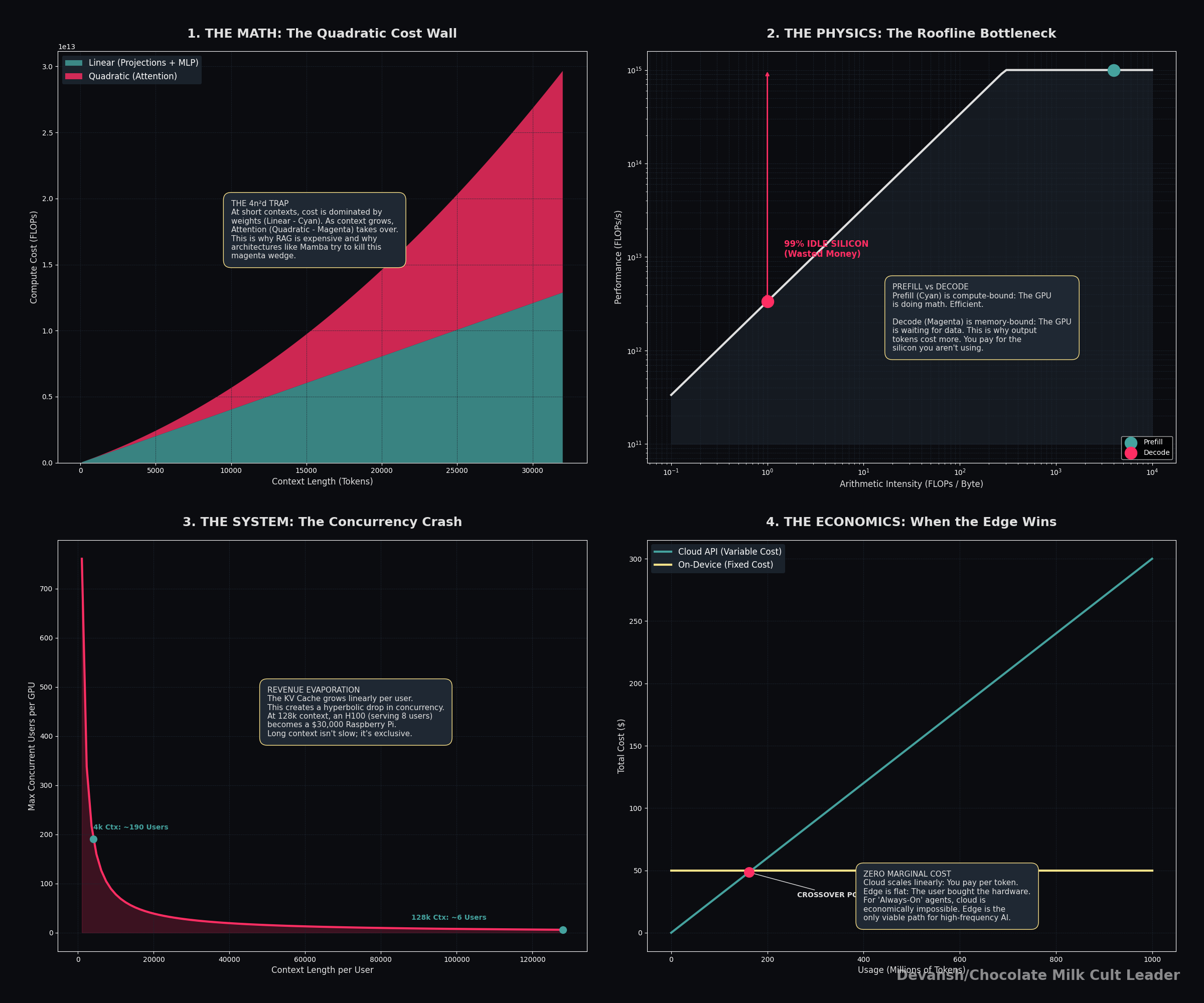
By early 2026, comprehensive roofline model analyses revealed that memory bandwidth, rather than compute power, is the fundamental bottleneck during the decode phase of large language model inference. Despite GPUs like Nvidia's H100 boasting peak FP16 compute capabilities near 1,000 TFLOPS, their memory bandwidth—around 3,350 GB/s—creates a severe imbalance, causing the chip to operate at roughly 1% of its theoretical peak during decode. This is because decode’s arithmetic intensity hovers around 1 FLOP per byte, far below the H100’s compute-to-bandwidth ratio of 295 FLOPs per byte, leaving 99% of compute units idle while waiting on data movement.
In contrast, the prefill phase of inference is compute-bound due to its high arithmetic intensity—often exceeding 4,000 FLOPs per byte—making GPUs highly efficient during this stage. This dichotomy means that while prefill benefits directly from advances in compute capacity, decode performance is strictly limited by memory bandwidth and capacity. As a result, hardware optimizations and architectural designs must address these fundamentally different demands within a single AI request, underscoring the critical importance of memory-focused innovations alongside compute improvements.
The growing KV cache, which scales linearly with context length and stores attention states to avoid recomputation, exacerbates memory capacity and bandwidth constraints, especially during decode. This 'quadratic tax'—the combination of prefill’s O(n²) compute cost and decode’s linear but heavy memory bandwidth tax—creates a fixed bytes-per-new-token overhead that hardware and software co-design must tackle. Industry moves, such as NVIDIA licensing Groq’s SRAM-based architecture to build decode-focused machines, highlight the critical need to prioritize memory bandwidth and capacity to sustain scaling and throughput in autoregressive models with long contexts and multiple concurrent users.
The persistent and widening gap between compute performance and memory bandwidth—where compute scales roughly 20,000× faster than bandwidth over recent decades—has made memory the dominant bottleneck in AI inference infrastructure. Hyperscalers now allocate up to half their capital expenditure on memory to address these constraints, investing heavily in data movement technologies like HBM4, NVLink 5, and photonic interconnects. This economic and physical asymmetry in scaling memory versus compute underscores why further gains in inference speed and efficiency hinge on overcoming the 'memory wall' rather than simply adding more FLOPS.






Multi-GPU Memory Revolution
Breakthroughs in GPU interconnects and parallelism—like Ring Attention and hybrid memory stacks—are redefining hardware performance by prioritizing bandwidth and capacity over raw FLOPS.
By early 2026, it became clear that memory bandwidth, rather than raw compute power measured in FLOPS, is the primary bottleneck limiting usable AI inference performance. For instance, despite the DGX H200 pod's high theoretical FLOPS, its memory bandwidth of 345.6TB/s constrains throughput compared to systems like the GB200 NVL72 and CloudMatrix384, which offer 576TB/s and 1,229TB/s respectively, enabling them to outperform the DGX H200 in real workloads. This underscores the critical role of arithmetic intensity and memory bandwidth in unlocking hardware potential, as achieving peak compute requires unrealistically high FLOPS per byte ratios that typical AI workloads cannot sustain.
Innovations in multi-GPU parallelism and interconnect technologies have become essential to overcoming memory capacity and bandwidth constraints inherent in single GPUs. Techniques like Ring Attention distribute the KV cache across multiple GPUs arranged in a communication ring, enabling near-infinite context lengths without sacrificing model accuracy. High-bandwidth interconnects such as NVIDIA’s NVLink and NVSwitch, providing up to 900 GB/s per H100 GPU, facilitate efficient tensor and expert parallelism by minimizing latency and maximizing data exchange frequency. These advances allow large models with hundreds of billions of parameters, which exceed single-GPU memory limits, to be hosted and run efficiently across GPU clusters.
Emerging memory technologies like High Bandwidth Flash (HBF) are poised to complement traditional High Bandwidth Memory (HBM) by offering vastly larger capacities—up to 4TB per stack compared to HBM’s hundreds of gigabytes—at a fraction of the cost. While NVIDIA currently hesitates to adopt HBF due to NAND flash’s limited write endurance and early manufacturing challenges, Google’s TPU architecture leverages HBF to store static weights and precomputed KV caches, significantly enhancing large-scale inference tasks. Industry leaders like SK Hynix and Micron are developing hybrid 'H³' architectures combining HBM and HBF, using advanced packaging techniques such as TSMC’s CoWoS and Intel’s EMIB to integrate these memory tiers seamlessly, signaling a future where hybrid memory hierarchies mitigate capacity bottlenecks while balancing latency and endurance trade-offs.
Hardware-software co-design and advanced inference engineering toolkits are critical in maximizing memory bandwidth utilization and mitigating bottlenecks. NVIDIA’s TensorRT 11.0, integrated with NCCL, optimizes multi-GPU inference by automatically selecting the best interconnect transport and supporting parallelism strategies like context parallelism and pipeline parallelism. Quantization techniques, such as NVIDIA’s NVFB4 4-bit floating-point format, drastically reduce memory footprint and increase throughput, while KV cache management strategies like Dynamo offload infrequently accessed data to lower-bandwidth tiers, reducing latency and avoiding costly recomputations. These layered innovations, combined with resource pooling exemplified by NVIDIA’s Grace Blackwell NVLink72 rack-scale system, collectively push AI inference performance forward by addressing memory bandwidth and capacity constraints holistically.



Quantization Transforms Efficiency
Aggressive memory-saving formats and advanced KV cache compression are slashing resource demands, allowing massive models to run faster and support more users without sacrificing accuracy.
By early 2026, quantization formats such as INT4, NVFP4, FP8, and BF16 had become foundational techniques for reducing memory footprint in large language models like Qwen3.5 and Nemotron 3 Super, enabling these models to maintain accuracy close to their original full-precision counterparts. Lower-bit formats like INT4 and NVFP4 stood out by significantly decreasing memory consumption, which in turn allowed for larger KV caches and supported more concurrent requests on single GPUs—a critical advantage given the memory-bound nature of AI inference workloads. This strategic reduction in memory usage also facilitated architectural innovations where full attention was applied only in a subset of layers, further shrinking KV cache sizes and boosting concurrency at maximum context lengths compared to older full-attention models.
Innovations in KV cache quantization and compression, exemplified by frameworks like TurboQuant and OScaR, have pushed the envelope by enabling near-lossless compression down to as low as 2.5 bits per vector without retraining. TurboQuant’s training-free approach leverages fixed random orthogonal rotations and scalar codebooks to regularize KV vectors statistically, simplifying integration across diverse LLM architectures and hardware. Meanwhile, OScaR addresses Token Norm Imbalance through Canalized Rotation and Omni-Token Scaling, achieving up to 5.3× memory footprint reduction and 4.1× throughput increase compared to BF16 baselines. These advances not only reduce the memory footprint but also accelerate decoding, highlighting how algorithmic and architectural innovations at the model level are essential complements to quantization.
Kernel fusion techniques such as FlashAttention have become pivotal in overcoming memory bandwidth bottlenecks by increasing arithmetic intensity and reducing redundant memory accesses during attention computation. By computing attention outputs in tiled blocks within ultra-fast on-chip memory and employing online softmax, FlashAttention cuts memory transfers from quadratic to linear complexity, enabling 2–4× speedups and achieving up to 85% of peak GPU throughput on NVIDIA H100. These software-level optimizations, combined with speculative decoding methods that parallelize multi-token verification using a small draft model and a large target model, have doubled to quadrupled throughput without hardware changes, effectively mitigating memory bandwidth constraints that dominate decode-phase latency.
The synergy of quantization, kernel optimizations, and model-level strategies has transformed AI inference efficiency, with software and model improvements accounting for the majority of gains over hardware advancements. For instance, NVIDIA’s H100 GPU saw a 1.5× throughput increase on Llama 2 70B purely through software updates, while multi-token speculative decoding doubled throughput on Qwen 3.6 27B using the same 3090 Ti hardware. Furthermore, selective quantization—retaining FP8 precision in sensitive layers while aggressively compressing others to FP4 or INT4—balances quality and memory savings, enabling up to 4× throughput improvements. These advances emphasize that optimizing memory bandwidth and reducing bytes moved per token through integrated software and model-level innovations remain the critical frontier for scaling AI inference.



Scaling Contexts, Shifting Architectures
Ultra-long context windows and sequence partitioning are driving a pivot from traditional tensor parallelism to new streaming and tiered cache strategies that overcome GPU memory limits.
As AI models scale to handle million-token contexts, traditional tensor parallelism falters due to severe inter-node bandwidth bottlenecks, prompting a paradigm shift toward sequence partitioning and streaming approaches like Ring Attention. By distributing the KV cache across GPUs and overlapping communication with computation, these methods enable exact attention over ultra-long contexts without prohibitive synchronization costs, addressing the staggering memory demands that can exceed hundreds of gigabytes per request and outstrip even multi-GPU setups.
Innovations in KV cache quantization, exemplified by Google's TurboQuant and the OScaR framework, have revolutionized memory efficiency by compressing key/value vectors down to as low as 2.5 bits per vector without sacrificing long-context attention fidelity. These training-free, online quantization methods leverage fixed random orthogonal rotations and outlier-aware mixed-precision schemes to maintain accuracy while drastically reducing both memory footprint and bandwidth requirements, thus enabling scalable, latency-sensitive AI workloads.
To overcome the inherent limitations of GPU high-bandwidth memory, leading AI infrastructure solutions like NVIDIA Dynamo and Lightbits Inferra employ tiered KV cache architectures that extend caching beyond GPU HBM into CPU RAM, local SSDs, and shared distributed storage. This multi-level memory hierarchy, combined with intelligent cache routing and offloading, achieves near-100% cache hit rates and up to 16x session density improvements, dramatically reducing time-to-first-token and enabling support for context windows exceeding 10 million tokens, which is critical for agentic and long-context AI workloads.
Runtime memory management strategies such as paged attention, continuous batching, and modular KV cache routing frameworks have emerged as essential tools to optimize latency and throughput in AI inference. Techniques like vLLM’s virtual memory-inspired paged attention break the KV cache into manageable pages, improving dynamic allocation, while continuous batching schedules active sequences to maximize GPU utilization. Additionally, Dynamo’s developer toolkit facilitates flexible KV cache data movement across clusters, and innovations in routing and ownership models have reduced memory overhead and latency by over 40%, collectively enabling scalable, cost-effective inference for complex, agentic AI workloads.

Memory Economics Redefine AI
AI infrastructure costs and scalability are now dictated by bytes-per-token and memory hierarchy, not compute cycles, forcing a fundamental rethink in system design and deployment.
By early 2026, it became clear that AI inference costs and latency are predominantly constrained by memory bandwidth rather than raw computational FLOPs, with the bytes loaded per token from model weights and the KV cache driving decode speed and cost. The KV cache, especially as context windows lengthen, can grow to rival or exceed model weight sizes, making memory management a critical bottleneck that directly limits concurrency and inflates infrastructure expenses. This fundamental shift from compute-bound to memory-bound inference has forced a reevaluation of AI compute economics, where traditional metrics like FLOPs give way to memory-centric considerations such as bandwidth, capacity, and bytes-per-token.
Quantization and architectural innovations have emerged as vital economic levers to mitigate memory bottlenecks, enabling significant reductions in model weight sizes and KV cache footprints without proportionate losses in accuracy. Techniques ranging from INT4 to FP4 quantization, as adopted by models like Qwen3.5 and supported by software such as vLLM’s FlashInfer, allow for higher concurrency and longer context windows by easing memory bandwidth demands. Companies like Cloudflare and Amazon have demonstrated how these memory optimizations translate into improved throughput, reduced latency, and more flexible deployment options across cloud and edge environments, fundamentally altering cost structures and hardware selection criteria.
Resource pooling and hierarchical memory architectures have become essential system-level strategies to overcome the concurrency and cost limitations imposed by memory bottlenecks. Innovations such as NVIDIA’s Grace Blackwell NVLink72, Dynamo KV cache offloading, and Amazon SageMaker’s tiered KV cache with shared NVMe pools exemplify how extending and sharing KV cache beyond GPU memory can drastically improve time-to-first-token and reduce infrastructure costs. These approaches enable multi-session clusters with strict SLA guarantees and better utilization of expensive high-bandwidth memory, reflecting a broader industry trend toward blending memory tiers and optimizing data locality to meet diverse deployment needs from cloud to edge and agentic AI.
Economic and system-level implications of memory bottlenecks extend beyond hardware to influence organizational and deployment strategies, including budget fragmentation and infrastructure fungibility. As NVIDIA’s CEO Jensen Huang highlighted, optimizing for memory bandwidth and resource pooling rather than traditional compute metrics like MFU is key to scaling AI inference efficiently. Fragmented budgets and siloed resources limit concurrency and inflate costs, whereas aggregating resources and adopting mixed-generation GPU fleets tailored to specific inference workloads can unlock significant economic efficiencies. Furthermore, the rise of agentic AI with ultra-low latency demands is reshaping CPU and memory architectures, signaling a diversification of infrastructure designs that balance cost, concurrency, and latency across cloud, edge, and specialized deployments.


Flexible Memory, Flexible Future
Adaptable architectures, hybrid memory stacks, and open-source tools are displacing fixed-function accelerators as AI workloads demand ever-greater memory agility and ecosystem innovation.
By mid-2026, the AI memory infrastructure landscape is pivoting from fixed-function accelerators toward adaptable architectures that can evolve alongside rapidly changing algorithms, as exemplified by NextSilicon’s revolutionary chip that replaces traditional GPUs to tackle memory bottlenecks head-on. This shift acknowledges that future AI workloads will demand drastically less computation and memory bandwidth, rendering specialized accelerators for static models like transformers obsolete and emphasizing flexible, energy-efficient designs that bridge the enormous efficiency gap between current GPUs and biological brains.
Hybrid memory systems combining high-bandwidth flash (HBF) with high-bandwidth memory (HBM) have emerged as a promising solution to AI inference’s capacity and bandwidth challenges, with companies like SK hynix and SanDisk pioneering standards that deliver terabyte-scale capacities at speeds rivaling HBM. This approach leverages HBM’s endurance and low latency for write-heavy operations while offloading read-intensive phases to HBF’s non-volatile, SSD-like memory, enabling persistent storage of model weights directly on accelerators and dramatically reducing inference startup times—a strategy validated by research collaborations such as Huawei, ETH Zurich, and HUST through workload-driven co-design frameworks like FLINT.
The evolution of AI memory infrastructure is increasingly shaped by open-source innovations and ecosystem diversification, with tools like NVIDIA’s Dynamo library facilitating flexible key-value cache management across heterogeneous hardware and inference frameworks. Meanwhile, advances in parallelism and speculative decoding techniques, including recursive methods akin to training GANs, underscore the complexity and dynamism of inference engineering, highlighting a trend toward developer-driven customization rather than monolithic, out-of-the-box solutions.
Looking ahead, the AI memory ecosystem is poised for diversification beyond the dominance of high-bandwidth memory and power-hungry data centers, as emerging workloads—such as long-horizon agents optimizing for cost per completed task—demand more nuanced resource orchestration. This paradigm shift opens opportunities for integrating CPUs, flash memory, and smaller compute pools in economically efficient configurations, signaling that while gigawatt-scale campuses will remain relevant for fast inference, they may no longer represent the majority of AI workload deployments.