AI model routing slashes enterprise costs by up to 90%
The gist
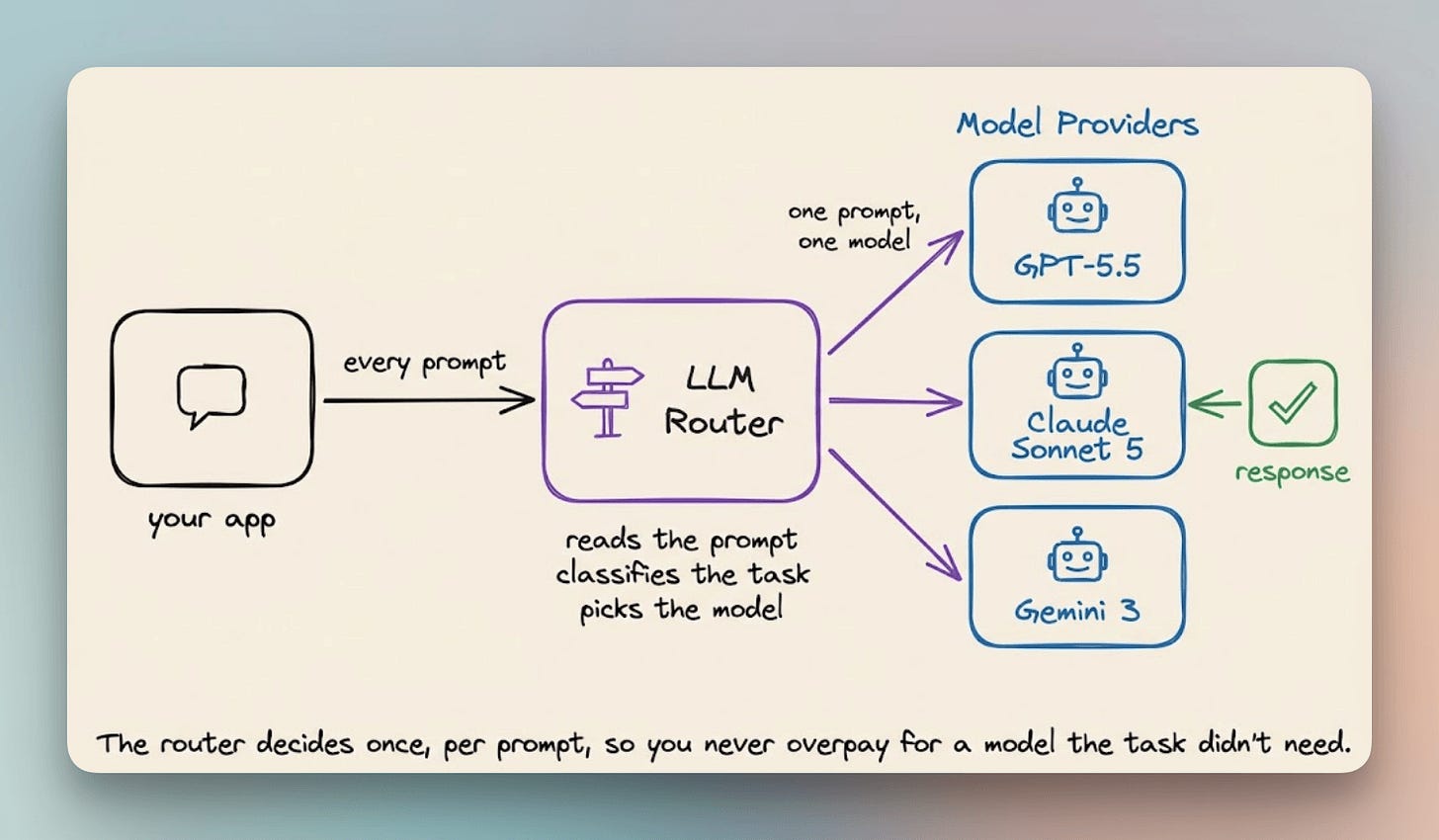
Enterprises are slashing AI costs by up to 90% with smart model routing that matches each task to its cheapest capable model—without sacrificing quality.
What to know
- Kilo, Microsoft, and Nvidia lead the charge with multi-layer routing systems that dynamically select from hundreds of models, achieving up to 85% cost savings and 50% faster responses.
- Anthropic’s advisor model pattern escalates tough queries from budget models to elite ones only when needed, driving costs down by 85% and boosting task success rates.
- Big names like Palantir and Coinbase report 90%+ savings, while startups tap frameworks like AICC and OpenRouter for seamless, provider-agnostic cost optimization across 300+ models.
Task Complexity Meets Model Match
Dynamic tiered routing matches each AI request to the right model based on task complexity, slashing costs by up to tenfold while maintaining output quality.
AI model routing fundamentally hinges on matching task complexity to the appropriate AI model to optimize cost without sacrificing quality. Kilo's Gateway exemplifies this by routing requests based on task mode—such as planning, coding, or debugging—assigning each to models calibrated for that complexity, which reduces guesswork and cuts average costs per request by roughly one-third. This mode-to-model mapping is dynamically updated outside client software, allowing seamless model swaps as prices and capabilities evolve, thereby maintaining consistent user experience and cost efficiency.
Tiered routing systems are central to cost-effective AI deployment, enabling users to balance performance and expense by directing routine or background tasks to cheaper or even free models, while reserving frontier models for demanding work. Kilo’s multi-tier approach, for example, achieves over tenfold cost reductions per request by offloading simpler tasks to economical models, a strategy echoed by Google’s release of multiple models tailored for varying task complexities. This tiered design transforms AI from a costly utility into a scalable, economically sustainable service by ensuring that the most expensive models are used only when genuinely necessary.
The economics of AI model routing are starkly influenced by the vast price disparities between frontier and open-source or specialized models. For instance, Claude’s Opus 4.8 can cost over five times more than cheaper alternatives like Sonnet or Haiku, while open-source models such as DeepSeek V4 offer up to 30x lower token costs with comparable output quality for many tasks. Platforms like OpenRouter facilitate this multi-model ecosystem by providing unified API access to hundreds of models, enabling automated routing that respects cost limits and task requirements, thereby turning AI spending into a finely tuned routing problem rather than a blunt expense.
Effective AI model routing demands sophisticated, software-driven decision-making that dynamically assigns tasks based on measurable quality thresholds rather than solely on cost. Coinbase’s experience, as highlighted by Brian Armstrong, demonstrates that AI-driven routing layers can halve costs while growing usage by automatically selecting cheaper models for routine coding tasks and reserving frontier models for complex planning. This approach incorporates validation steps and session-level model affinity to maintain context and cache efficiency, ensuring that cost savings do not come at the expense of output quality or user experience.






Multi-Layer Routing Revolution
Provider-agnostic, real-time routing frameworks now orchestrate hundreds of models per task, blending speed, accuracy, and cost control with intelligent, session-aware escalation.
By mid-2026, the AI industry had embraced multi-layer and provider-agnostic routing architectures that strategically allocate tasks among models of varying capabilities and costs to optimize performance and reduce expenses. Microsoft’s three-layer LLM routing on AKS exemplifies this with semantic routing via RouteLLM, GPU-aware load balancing, and governance managed by agentgateway, achieving up to 85% cost savings by predicting when cheaper models can match stronger ones without sacrificing quality. Similarly, OpenRouter’s platform processes 25 trillion tokens weekly, enabling seamless access to over 300 models through a single API and automating cost-based routing, while Nvidia’s NeMo Switchyard advances this further with dynamic mid-task model reshuffling and intelligent orchestration layers that adapt routing based on agent state, verbosity, and infrastructure signals, cutting task costs by up to two-thirds and boosting speed by 50%. These innovations collectively demonstrate a shift towards modular, scalable, and intelligent routing frameworks that balance cost, latency, and accuracy across heterogeneous AI ecosystems.
The rapid closing of the performance gap between open-source and frontier models has transformed routing strategies from purely cost-driven to intelligence-driven, enabling open-source models like DeepSeek, Qwen, and GLM to handle agentic workflows previously reserved for expensive frontier models. This evolution supports multi-tiered model selection frameworks where high-stakes reasoning tasks are routed to premium models such as GPT-5.5 or Claude Opus, mid-tier models handle standard content, and open-source variants efficiently process bulk or routine tasks. Such nuanced routing not only slashes costs—Claude Sonnet, for instance, can generate a 1,500-word blog post for as little as $0.02—but also enhances workflow depth and flexibility, as highlighted by Cognition’s approach of using frontier models for planning and delegating execution to cheaper sub-agents, reducing costs by 40% while deepening intelligence.
Dynamic routing algorithms have become essential to address the fragility of static, task-based model selection in evolving AI sessions. As Walden Yan points out, sessions often morph from simple queries into complex debugging or feature requests, requiring routing architectures that can adapt in real time. Nvidia’s Switchyard and OpenRouter’s auto router exemplify this adaptability by leveraging heartbeat signals and agent state routing to detect when smaller models operate outside their training distribution, escalating tasks to stronger models before cost overruns occur. This fine-grained control, including routing at per-step granularity within multi-turn tasks, not only prevents inefficient loops but also maintains high accuracy and responsiveness, reflecting a new generation of routing technologies that dynamically balance cost, performance, and session context.
Provider-agnostic frameworks and intelligent orchestration layers are driving scalability and ease of adoption in routing architectures, as demonstrated by OpenRouter and the newly launched AICC API framework. OpenRouter’s ability to remain dormant until triggered by specific application needs, such as continuous token generation from agents, highlights its flexible and adaptive design. Meanwhile, AICC promises startups up to 80% savings by dynamically routing tasks across over 300 models from providers including OpenAI, Anthropic, Google, and Meta, with minimal integration effort—often just a base URL update—and region-specific routing to meet regulatory compliance like the EU AI Act. These innovations underscore a trend toward routing systems that not only optimize cost and performance but also embed governance and legal considerations seamlessly into AI workflows.


Advisor Models: Escalate to Win
Anthropic’s advisor pattern lets cheap models escalate tough queries mid-task, boosting success rates and cutting advisor output by sevenfold without sacrificing quality.
By mid-2026, the advisor model pattern emerged as a pivotal evolution in AI cost-efficiency, where a cheaper executor model dynamically escalates complex queries to a more capable advisor model. Anthropic's implementation notably improved task pass rates by about 7 percentage points and reduced advisor output tokens sevenfold without quality loss, illustrating how this approach balances cost and performance. Unlike OpenAI's upfront routing system, Anthropic's executor model autonomously decides mid-task when to consult the advisor, leveraging full shared context to optimize escalation, a strategy gaining traction among firms like OpenRouter and Cognition despite limited widespread production use.
The advisor model pattern reflects a broader paradigm shift in AI development from merely scaling model size towards economically orchestrating multiple models to mimic efficient human team workflows. OpenRouter's cross-provider advisor tool exemplifies this by enabling any model to serve as executor or advisor across providers, capitalizing on stark price disparities—up to 67x per token between budget and frontier models. This orchestration, often requiring minimal API changes as Anthropic recommends, transforms previously bespoke escalation logic into a low-cost, high-impact engineering experiment with significant payoffs in cost-quality tradeoffs.
Empirical data underscores the advisor pattern's ability to simultaneously enhance quality and reduce costs, especially when pairing weaker executor models with strong advisors. For instance, Anthropic's Haiku executor doubled its BrowseComp score from 20% to 41% with an Opus advisor while cutting costs by 85% compared to a stronger solo executor. Similarly, combining capable executors with advisors captures most of the advisor's standalone performance at substantially lower costs, demonstrating that dynamic escalation prevents wasted computation and failed attempts, thereby optimizing AI agent efficiency.
Advisor models act as intelligent orchestrators, delegating subtasks to cheaper executor models based on complexity, akin to managerial delegation in human teams to avoid wasting expensive resources on low-level tasks. This granular task breakdown allows cheaper models to handle simpler steps like research or outlining, while reserving critical thinking and quality control for more capable models, as seen in workflows using models like Fable, Sonet, and Opus. Additionally, open-source models such as Deepseek Flash play a crucial role in cost-effective multi-model orchestration, offering up to 100x cost savings and emphasizing pragmatic decisions based on capability and price rather than open versus closed source distinctions.



Enterprise Routing Goes Mainstream
AI model routing has become core infrastructure for giants like Palantir and Coinbase, enabling up to 97% cost savings, regulatory compliance, and robust global performance.
By mid-2026, enterprises across sectors have embraced intelligent AI model routing as a critical lever to slash computing costs while maintaining or even enhancing performance. For instance, Palantir's Evolve tool demonstrated staggering cost reductions of up to 97% by switching tasks from OpenAI's GPT-5.1 to the leaner GPT-5.4 Nano model, while Coinbase reported halving their AI spend even as token usage surged, thanks to a routing layer that matches tasks to the most cost-effective models like GLM 5.2 for coding and frontier models for complex planning. This widespread adoption is underscored by robust funding rounds such as OpenRouter's $120 million raise and the growing popularity of Databricks’ Unity AI Gateway, signaling that model routing has transitioned from experimental to mainstream enterprise infrastructure.
Leading tech giants like Microsoft and Nvidia have pioneered sophisticated multi-layer routing architectures that dynamically allocate AI workloads based on semantic analysis, GPU load, and task complexity, achieving up to 85% cost savings without sacrificing output quality. Microsoft's three-layer LLM routing on AKS integrates open-source components such as RouteLLM and agentgateway to balance calls between strong and weak models, while Nvidia’s NeMo Switchyard reshuffles AI models mid-task, cutting costs to roughly a third by evaluating model verbosity and routing accordingly. These solutions not only optimize cost but also enhance performance and adaptability, with Nvidia’s open-source approach uniquely combining model ownership and routing logic to offer enterprises a comprehensive, flexible framework.
Beyond cost reduction, intelligent routing infrastructures are becoming the strategic backbone of enterprise AI deployments, enabling compliance with regulatory demands, latency optimization, and resilience against provider outages. Telnyx CEO David Casem highlights that the future competitive edge lies not in the smartest AI models but in the intelligence to route requests optimally across providers and geographies, a capability bolstered by Telnyx’s private global IP backbone that manages routing decisions within the network itself. This approach addresses real-world constraints such as GDPR compliance for European financial institutions and latency-sensitive healthcare applications, making multi-model routing an indispensable component of scalable, compliant, and reliable AI services.
Startups and SMBs are also tapping into the power of model routing to transform AI from a costly liability into a scalable business driver. The AICC’s new API framework promises up to 80% savings by segmenting tasks across more than 300 models with minimal integration effort, while OpenRouter’s cost-effective models like Deep SEQ Flash enable high-volume, low-complexity tasks to be offloaded from expensive subscriptions such as Claude or OpenAI. This democratization of routing technology not only slashes expenses but also enhances reliability and regulatory compliance, signaling a broad shift where intelligent routing layers become foundational for economic sustainability across enterprises of all sizes.

Inference at Scale: New Bottlenecks
Continuous AI workloads demand cloud-native, intelligent routing to balance GPU utilization, cost, and reliability—making orchestration and observability the new frontier for enterprise AI.
As AI infrastructure pivots from training to inference workloads, a primary challenge lies in balancing GPU utilization, cost-efficiency, and reliability within continuously operating production environments. Companies like QumulusAI and Hyperbolic emphasize that idle GPU capacity is the most expensive problem, necessitating tailored infrastructure configurations that optimize storage, networking, and tenancy models for diverse workload demands. This evolution moves the industry away from separate stacks for training and inference toward unified infrastructure tuned differently for each use case, reflecting the distinct orchestration, CPU-to-GPU ratios, and deployment strategies required for dynamic AI tasks.
The unpredictable, 24/7 nature of inference workloads demands adaptive, cloud-native routing systems that dynamically scale heterogeneous resources and intelligently direct requests to the most cost-effective models. Fixed hardware sizing leads to inefficiencies and failures during demand spikes, as highlighted by the need for service level objectives beyond uptime, including latency and throughput guarantees. This shift underscores the operational burden of managing physical infrastructure, pushing enterprises toward cloud-based orchestration that can rightsized fleets and route requests based on model warmup behavior, ultimately freeing teams to focus on improving model quality rather than infrastructure minutiae.
Intelligent model routing has emerged as a critical strategy to optimize AI costs and performance by leveraging hybrid ecosystems of open and closed models, each selected based on task complexity, latency, and cost considerations. Despite open models achieving roughly 90% of closed model quality at 87% lower cost, closed models still dominate revenue, illustrating the nuanced tradeoffs enterprises face. The complexity of agentic AI workflows, which amplify token usage by 5–30x per task, further complicates cost management, making orchestration, observability, and retry mechanisms key areas for innovation. Mature LLM routing tools now enable real-time, multi-model production deployments, signaling progress toward sophisticated model fusion and orchestration solutions.
Looking ahead, adaptive routing faces unresolved research challenges, particularly in dynamically recognizing when smaller specialized models are out of their depth and escalating tasks to more capable frontier models. Efficient context sharing between models is essential to prevent cost inflation, requiring selective transmission of high-level information rather than full data traces. Companies like OpenRouter and Cognition are pioneering orchestration primitives—such as continuous context sidekicks and advisor tools—that reduce token costs by up to tenfold and enable deeper intelligence through model fusion. Moreover, ecosystem-driven collaboration and infrastructure ownership, exemplified by Telnyx’s private global IP backbone, are becoming vital for optimizing latency, compliance, and resiliency, positioning routing intelligence as the next frontier in enterprise AI competitiveness.