AI-native dev tools go mainstream with unified agent workflows
The gist
AI-native dev tools are breaking out of their silos, with unified agent workflows turning scattered code, collaboration, and deployment tasks into seamless, model-agnostic superplatforms.
What to know
- By mid-2026, platforms like Zide and Google’s Antigravity 2.0 are fusing code, version control, issue tracking, CI/CD, and AI agents into end-to-end, workflow-aware environments.
- Morph’s modular multi-agent architecture uses lightweight GPT5 mini and nano subagents to parallelize coding workflows, slashing compute costs and development time.
- Open protocols MCP and A2A, now stewarded by the Linux Foundation and adopted by 150+ organizations, have made secure, multi-agent collaboration and tool interoperability the new enterprise baseline.
Agents Rewrite Dev Workflows
AI agents now drive real-time, multi-path coding, syncing updates across tools like Jira and Confluence while enabling bytecode-level experimentation before code reaches GitHub.
The advent of AI agents as active collaborators has driven a fundamental reimagining of developer tooling and workflows, moving beyond traditional Git repositories to systems that support real-time, high-frequency commits and distributed coordination. Companies like Relays have pioneered innovations such as the 'repost' feature, enabling agents to explore multiple code paths in a bytecode-friendly environment before committing finalized changes to platforms like GitHub. This evolution extends to integrating specification and story-tracking tools like Jira and Confluence, which can automatically update based on code changes, thereby enhancing collaboration and productivity in AI-native workflows.
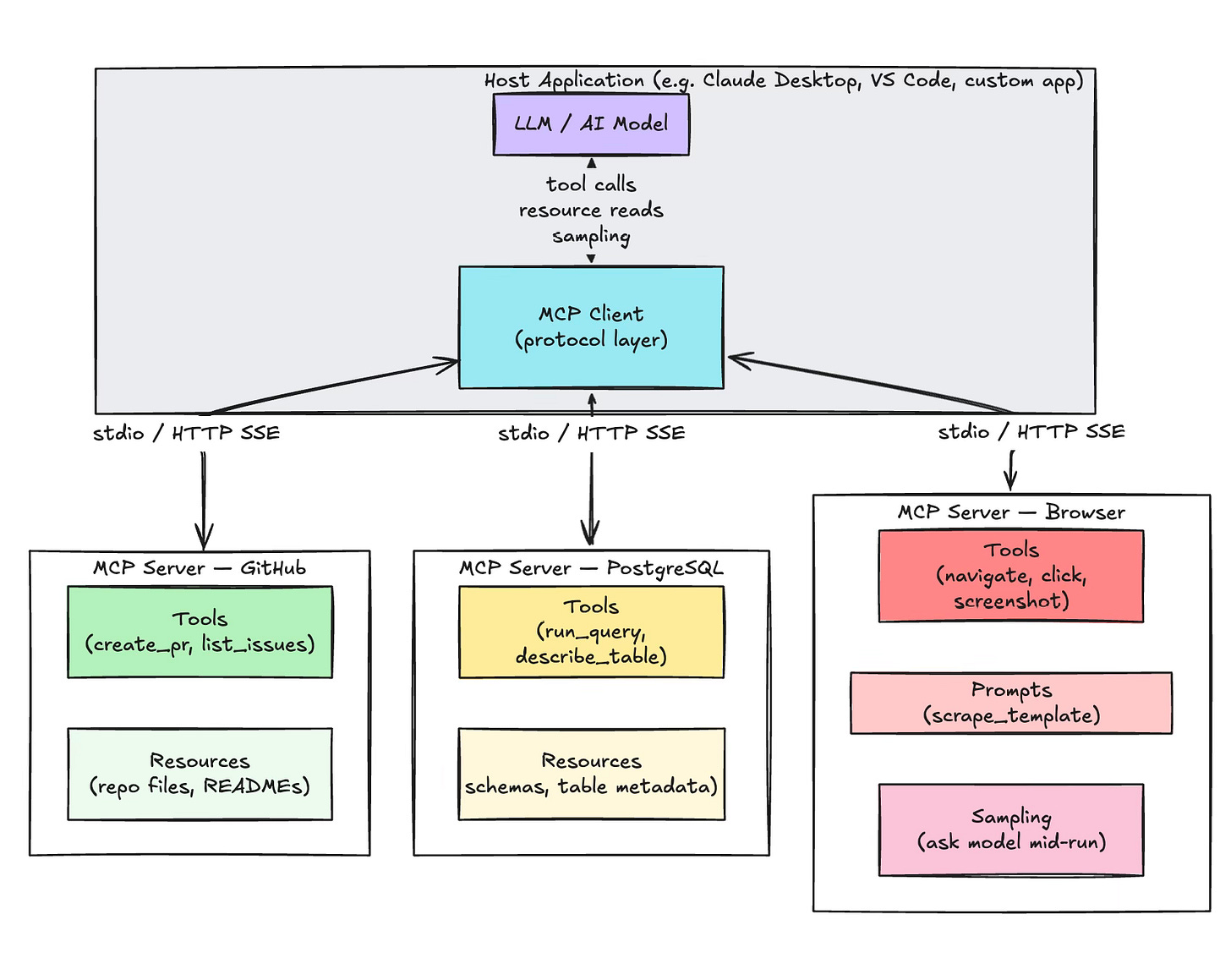
The transformation of developer environments is comprehensive, encompassing documentation, testing, and CI/CD pipelines. AI-driven platforms like Mintlify are redefining documentation and automated PR reviews, while Bitbucket’s introduction of 'Agentic CI/CD' leverages natural language-defined workflows and AI-powered steps to automate complex pipeline tasks, including autonomously fixing flaky tests via the Robbo CLI code agent. This shift reflects a broader trend toward integrated AI development environments that blend human and agent interactions seamlessly, supported by innovations such as Multi-Channel Protocol (MCP) servers that expose tools designed specifically for AI agents rather than human users.
Emerging infrastructure and modular architectures are accelerating AI-native development workflows by enabling coding agents to apply changes at unprecedented speeds and with greater autonomy. Morph’s subagent architecture decomposes coding tasks into specialized smaller models, optimizing for speed, cost, and quality, while delivering up to 10,000 tokens per second through speculative decoding and the 'fast apply' method. This modular SDK approach allows developers to integrate pre-built sub-agents easily, facilitating scalable, reliable autonomous software updates and reflecting a broader industry trend of reserving large frontier models for complex interpretation while delegating simpler subtasks to lightweight agents.
By mid-2026, AI-native developer tooling has matured into unified, workflow-aware environments that integrate code, version control, issue tracking, CI/CD, and AI agents within single applications. Platforms like Zide and Google’s Antigravity 2.0 exemplify this evolution by offering native desktop experiences with tabbed interfaces, embedded terminals, and Git controls that support seamless transitions between development stages while maintaining trust and reviewability in AI-assisted workflows. These tools are model-agnostic and support multiple repository hosts, empowering developers to orchestrate agentic workflows with flexibility and transparency, signaling a decisive shift from fragmented toolchains to cohesive AI-native development ecosystems.


Multi-Agent Systems at Scale
Enterprises are orchestrating thousands of specialized subagents in isolated, GPU-bundled containers, slashing costs and accelerating workflows through parallel execution and context isolation.
By early 2026, Morph pioneered scalable multi-agent coding architectures through a modular subagent design that delegates specialized tasks like writing, editing, and code search to smaller, optimized LLMs such as GPT5 mini and nano. This hierarchical orchestration not only accelerates workflows by enabling parallel execution but also reduces compute costs by reserving heavyweight frontier models for complex reasoning. Morph’s SDK further democratizes this approach, allowing enterprises to integrate pre-built subagents seamlessly, fostering a shared infrastructure that supports rapid deployment and reliable AI coding at scale.
Effective context management emerges as a cornerstone for scalable multi-agent systems, with strategies like context forks and isolated runtimes preventing pollution of the main agent’s conversation window. Techniques such as running subagents in fresh, bounded contexts—illustrated by use cases like transcribing segmented Instagram reels—enable agents to handle complex, token-heavy tasks without overwhelming the parent context. Moreover, specifying models per skill or subagent, often opting for smaller, cost-efficient models for simpler subtasks, optimizes resource allocation and maintains workflow efficiency.
The adoption of isolated runtimes and containerized virtual machines for each agent marks a significant evolution in multi-agent infrastructure, providing secure, sandboxed environments that mimic personal workspaces. Companies like Composio and others have demonstrated that such isolation not only safeguards sensitive data but also empowers agents with capabilities like internet access, document parsing, and process tracking. This architectural shift supports massive scale, with deployments running thousands of agents concurrently, each in customizable, tightly controlled containers, reflecting a broader cloud computing trend toward GPU-bundled, agent-optimized platforms.
Recent advances in multi-agent orchestration emphasize deterministic, modular workflows that balance parallelism with reliable context management. Tools like Pi Extensible Workflows introduce deterministic DSLs that isolate subagents in clean sessions, returning only compressed results to the orchestrator and enabling pause-resume functionality without re-executing completed steps. Complementing this, the open skills standard—adopted by over 25 tools—facilitates progressive disclosure and sharability of lightweight, single-task skills, which together with dynamic skill loading and metadata-driven invocation, form the backbone of scalable, efficient, and maintainable multi-agent architectures.


Protocols Power Agent Ecosystems
Universal standards like MCP and A2A, stewarded by industry alliances, have turned agent interoperability from a technical hurdle into the backbone of scalable, multi-vendor AI collaboration.
The emergence of two complementary open protocols, Model Context Protocol (MCP) and Agent-to-Agent Protocol (A2A), has fundamentally reshaped AI agent interoperability by standardizing how agents access tools and communicate with each other. MCP, introduced by Anthropic in late 2024 and likened to a 'USB-C for AI tools,' simplifies vertical integration by enabling any large language model to connect seamlessly with diverse tools and data sources, drastically reducing the integration complexity from M × N to M + N. Meanwhile, Google's A2A, launched in April 2025 and described as the 'HTTP for agent collaboration,' standardizes horizontal communication, allowing agents to discover skills, delegate tasks, and collaborate securely across frameworks and vendors, fostering a robust multi-agent ecosystem.
By mid-2026, MCP and A2A had transitioned from nascent protocols to foundational infrastructure underpinning composable AI ecosystems, with MCP powering orchestration of specialized agents handling research, analysis, and execution, and A2A reaching version 1.0 supported by over 150 organizations including Google, Microsoft, and AWS. Managed under the Linux Foundation and integrated into major cloud platforms and mobile OS environments, these protocols have enabled enterprises like Salesforce to break down silos by coordinating multi-instance agent environments, although broad adoption remains in early stages focused on incremental automation rather than full multi-agent orchestration.
The governance and collaborative stewardship of MCP and A2A under neutral bodies like the Linux Foundation and the Agentic AI Foundation, with contributions from industry giants such as Google, Anthropic, Salesforce, and IBM, have accelerated convergence toward unified standards. Notably, IBM’s Agent Communication Protocol merged into A2A in 2025, signaling industry alignment away from competing protocols. This open, multi-stakeholder approach ensures no single entity controls the protocols, fostering trust and enabling enterprises to build sophisticated multi-agent systems that operate seamlessly across organizational and technological boundaries without sacrificing choice or control.
Despite their promise, challenges remain in orchestrating complex workflows across departments and vendors, particularly regarding governance, accountability, and control in multi-agent collaborations. While MCP and A2A have dramatically lowered integration barriers and enabled interoperable ecosystems, current enterprise deployments largely focus on specialized, single-task agents rather than transformative multi-agent orchestration. Industry experts emphasize that the protocols’ design principles—such as A2A’s opaque execution ensuring agents collaborate without exposing internal processes—are critical to building trust and scalability as use cases evolve toward more comprehensive automation.



Enterprise AI: Build, Buy, Govern
Hybrid strategies and robust governance frameworks are transforming Slack and other platforms into secure, multi-agent hubs, balancing automation with human oversight and compliance.
By 2026, enterprises have embraced a nuanced 'build and buy' strategy for agentic AI integration, blending custom-built agents with third-party platforms to optimize capabilities and scalability. This hybrid approach is exemplified by Outshift’s healthcare multi-agent system that seamlessly coordinates across disparate platforms like WebEx and insurance databases, demonstrating that interconnected agents can collectively deliver far greater value than isolated solutions. The adoption of open standards such as Model Context Protocol (MCP) and Agent2Agent (A2A), stewarded by the Linux Foundation and supported by industry leaders including Google, Salesforce, and SAP, has been pivotal in enabling interoperable agent orchestration and data access across diverse enterprise environments.
Collaboration platforms like Slack have evolved into central hubs for agentic AI deployment, transforming into what Slack terms the 'enterprise brain' that integrates humans, AI agents, data, and workflows within a unified conversational interface. Slack’s innovations, including Slack Code and the ability to appmention AI agents as easily as human colleagues, facilitate seamless multi-agent collaboration and real-time project coordination, as seen in Mercor’s management of up to 23,000 experts across thousands of workspaces. This integration reduces context switching and enhances productivity by embedding AI agents directly into familiar workflows, while maintaining flexibility through support for multiple AI models and vendors.
Robust governance frameworks have emerged as critical enablers for scaling agentic AI in enterprises, addressing security, accountability, and operational challenges through centralized management and fine-grained controls. Platforms like AccuKnox’s AgentZ and Aziro’s Aziron embed governance directly within workflows, employing sandboxed execution, zero-trust permissions, audit trails, and dynamic access policies to ensure transparent, secure, and compliant AI operations. These models emphasize the necessity of human oversight, with controls allowing agents to be paused mid-task and requiring expert sign-off on critical outputs, thereby balancing automation with accountability and mitigating risks such as shadow AI and unauthorized data exposure.
Open-source, self-hosted platforms like AgentConnect, SandboxAQ’s Switch, and Alook have gained traction by enabling enterprises to integrate multiple AI agents within existing collaboration tools such as Slack, Microsoft Teams, and Discord while maintaining full control over agent execution environments. These platforms prioritize fine-grained access management, preserving context and history across agent handoffs, and support deployment flexibility through Docker Compose or Kubernetes, addressing privacy, compliance, and operational scalability. Their vendor-agnostic architectures prevent lock-in and foster seamless multi-agent collaboration, effectively bridging the gap from isolated pilots to production-ready, governed agentic AI ecosystems.

Orchestrating Agents, Shaping Power
The shift to agentic AI demands a new operational playbook—blending custom and third-party agents under tight governance, while redefining accountability and the human-AI relationship across the enterprise.
By early 2026, enterprises have moved beyond the simplistic build-versus-buy dichotomy for agentic AI systems, adopting a nuanced build-and-buy ratio that blends homegrown agents with third-party solutions to meet diverse operational needs. This hybrid approach is exemplified by Outshift’s healthcare multi-agent system, which integrates agents across platforms via common standard interfaces, creating complex, secure workflows greater than the sum of their parts. However, managing such heterogeneous ecosystems demands enterprise-grade tooling that ensures security, observability, and confidence, enabling leaders to experiment judiciously and tailor their agentic AI strategies without succumbing to marketing pressures for more tools.
Scaling agentic AI from isolated tools to enterprise-wide orchestration presents profound strategic and operational challenges, including balancing immediate internal demand with the need to build robust, invisible infrastructure that guarantees safety, relevance, and reliability over time. This transition shifts AI’s role from personal productivity enhancers to coordination technologies that can automate dozens of simultaneous workflows, as Meghna Shah highlights, enabling enterprises to orchestrate up to 70 processes concurrently and freeing humans from repetitive tasks. Yet, this transformation also raises critical governance questions about power dynamics, accountability, and the evolving interplay between AI-driven bureaucracies and traditional organizational structures.
Effective deployment of agentic AI hinges on embedding autonomy within narrowly scoped agents that operate under governed workflows emphasizing coordination, accountability, and human-in-the-loop control. Thought leaders like Artur Huk and Dan Shipper stress that agents must not function as isolated experiments but as reliable production components with transparent interfaces showing both human and agent actions, supported by new operational roles such as forward deployed engineers and AI operators. This collaborative human-agent synergy is crucial to address evaluation gaps, maintain model sovereignty, and control costs—strategies exemplified by SaaS companies enabling users to bring their own AI tokens and by platforms like Dust enforcing strict data access permissions.
Despite rapid advances, most enterprises remain in early stages of agentic AI adoption, cautiously automating discrete tasks rather than deploying fully autonomous multi-agent systems, partly due to immature governance frameworks and the complexity of orchestrating agents across departments and vendor platforms. The release of foundational open standards like Model Context Protocol and Agent2Agent in late 2024 and early 2025 has been pivotal in enabling governed data access and multi-agent collaboration, yet challenges persist in sequencing workflows, ensuring transparency, and balancing control with accountability. As Gary Lerhaupt and Julie Linn Teigland observe, scaling agentic AI demands new governance models that can integrate multi-vendor agents while preventing siloed operations and shadow AI risks, underscoring the critical need for robust infrastructure, evaluation, and policy alignment before widespread production deployment.