AI-powered labs race ahead, but biology hits the brakes
The gist
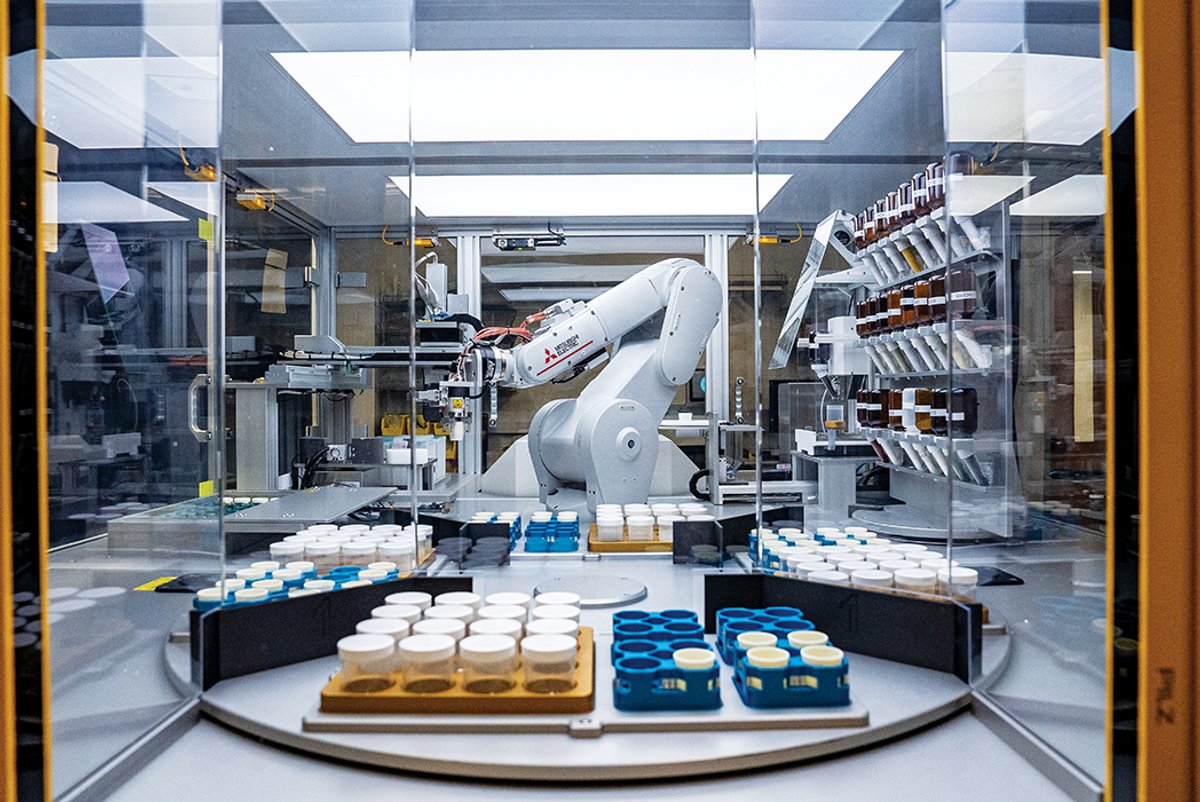
AI-powered labs are racing ahead at breakneck speed, but biology is throwing down the brakes on just how fast new discoveries reach the real world.
What to know
- By fall 2026, OpenAI, DeepMind, and Danaher all deployed autonomous labs with GPT-5 running closed-loop experiments—no human in the loop.
- AI can generate and refine hypotheses in minutes, but actual biological testing and validation still drag on human and regulatory timelines, making integrated model-plus-robotics stacks like Eli Lilly's LillyPod the new gold standard.
- Ginkgo ran 30,000 AI-designed experiments every week for six weeks and Deep Origin claimed a 31% hit rate—nearly 100x better than typical machine learning approaches—but 44% of scientists now say physical experimentation is their main bottleneck.
AI Labs Go Hands-Free
GPT-5-powered labs now run entire experiment loops autonomously, with major players like OpenAI and DeepMind rapidly building robotic systems to physically validate AI-driven discoveries—no humans required.
By late summer 2026, closed-loop autonomous labs had moved from concept to visible deployment. SemiAnalysis reported that OpenAI “showcased GPT-5 operating in a closed loop: proposing protocol modifications, receiving experimental results, and iterating autonomously with no human in the loop,” and noted it “had to set up basic robotic systems” to run those experiments; the same analysis added, “DeepMind is also starting an automated materials science research lab in 2026,” showing major AI players were building physical validation capacity, not just better hypothesis engines.
That momentum became unmistakable across August to October as startups and incumbents announced lab-native collaborations and platforms. Gasgoo said AI² Robotics and Pharmaron would build a smart lab ecosystem around a “real-world scenario — data — model — re-verification” loop, extending robotics into discovery workflows, while noting, “Previously, in 2025, AI² Robotics partnered with Bloomage Biotech to deploy its Aibao robots”; by October, Danaher unveiled an AI-powered autonomous lab, and practitioners on Latent Space summed up the maturation bluntly: “if you sent me back two years ago, I'd be like, that is a tough path to walk through.”


Automation Hits a Wall
AI models can generate ideas in minutes, but even fully integrated lab automation stacks are now limited by how quickly wet labs can deliver reliable experimental results, making physical throughput the new choke point.
AI has moved the bottleneck by proposing what to test faster than biology can test it. BiotechTV said foundation models can reduce the iteration cycle between literature, data, hypothesis generation, and discovery, while automated wet labs can turn in-silico ideas into a cheap experiment quickly. Berkeley RDI said some iterations can shrink from days or weeks to minutes or hours, but only when design, experiment, and feedback are automated together. The constraint is no longer generating hypotheses; it is producing reliable experimental feedback fast enough to validate them.
That is why the winning architecture is shifting from standalone models to integrated operating systems. TechBio 1.0 was prediction, while TechBio 3.0 adds robotic lab automation and automated experiments feeding structured data back into models, after TechBio 2.0 showed acceleration with Insilico’s IPF program reaching a preclinical candidate in about 18 months versus the usual 3–5 years. Eli Lilly built one AI operating system for LillyPod connecting data, models, and tools into a single system, because as of mid-2026 no AI-designed small molecule has FDA marketing approval, and even 2.2 million predicted crystals narrowed to only a few thousand after synthesis attempts. Lilly’s TuneLab also released a nanobody developability model trained on 2,500+ VHHs that BigHat generated.



Human Biology Sets the Pace
Despite AI’s acceleration at the discovery stage, clinical trials and physical experiments remain stubbornly slow, with regulatory and biological realities stretching timelines far beyond software’s reach.
AI may flood the top of the drug-discovery funnel with better candidates, but the decisive bottleneck sits lower down, where safety and efficacy must be proven in people. On Gradient Dissent, one researcher put the limit bluntly: “It takes forever… I need to go and prove that this drug is safe and then go and dose some humans and then wait for six months and it’s going to be like the loop is going to be three years long,” explicitly rejecting “closed loop RL to teach it how to find new drugs” because that loop still runs on human biology, not software speed.
The same slowdown appears in the physical and regulated layers before and after trials: wet-lab execution takes days, some viral work takes more than a week, and one analysis argued that “Simply procuring the machines needed to build this hypothetical lab would take the better part of a year and hundred million US.” Scientific American, citing a Google/DeepMind/MIT FutureTech report, said about 44 percent of scientists now see their main bottleneck downstream in physical experimentation and data collection, while Avak Kahvejian told Legal Tech Monitor, “Yes, we may have sequence, but the sentences around that individual element don’t exist all the time, so we have to go create it.” AI can trim some quality overhead around that process—“AI-assisted analytics have been shown to cut deviation-investigation time by 50–70%, and digital quality workflows can compress batch-record review by 70–90%”—but that does not remove the core throughput constraint. And while “RTRT is not new in principle — it is embedded in ICH Q8–Q10 thinking — but AI makes the underlying prediction sharper and, in doing so, raises the validation stakes.”


Robot Labs Break Speed Records
Around-the-clock, robot-assisted labs are delivering tens of thousands of experiments weekly, crushing old benchmarks and achieving hit rates up to 100 times higher than traditional machine learning.
The strongest evidence that the AI-lab stack is not hypothetical is its sheer operating speed. In Cognitive Revolution’s June discussion, robot-assisted chemistry was described as running “24 hours a day,” with throughput that would “accelerate our work… by easily a multiple” simply by letting robots set up experiments continuously; the same speaker said a chemical-space search that once took a year could shrink to a month, and that “even at 95% we would have accepted some errors too” because the iteration gain was so large.
Those gains are now showing up in benchmarked output and hit quality. On Inside the ICE House, Ginkgo said, “We let GPT5 design 30,000 experiments a week for six weeks,” and against a Stanford lab benchmark “after the fourth round, it had beat it… after the sixth round, we beat it by 40%,” while contrasting normal cycles of “weeks, months and not years” with “minutes and days”; separately, Deep Origin said it delivered “nearly a 31% hit rate” on a cancer immunotherapy enzyme, “nearly 100x higher” than common ML approaches, while maintaining “50% to 89% pose accuracy where the pure AI and ML approaches failed.”