AI speeds drug discovery, but clinical trials still lag
The gist
AI Speeds Drug Discovery, But Clinical Trials Still Lag
What to know
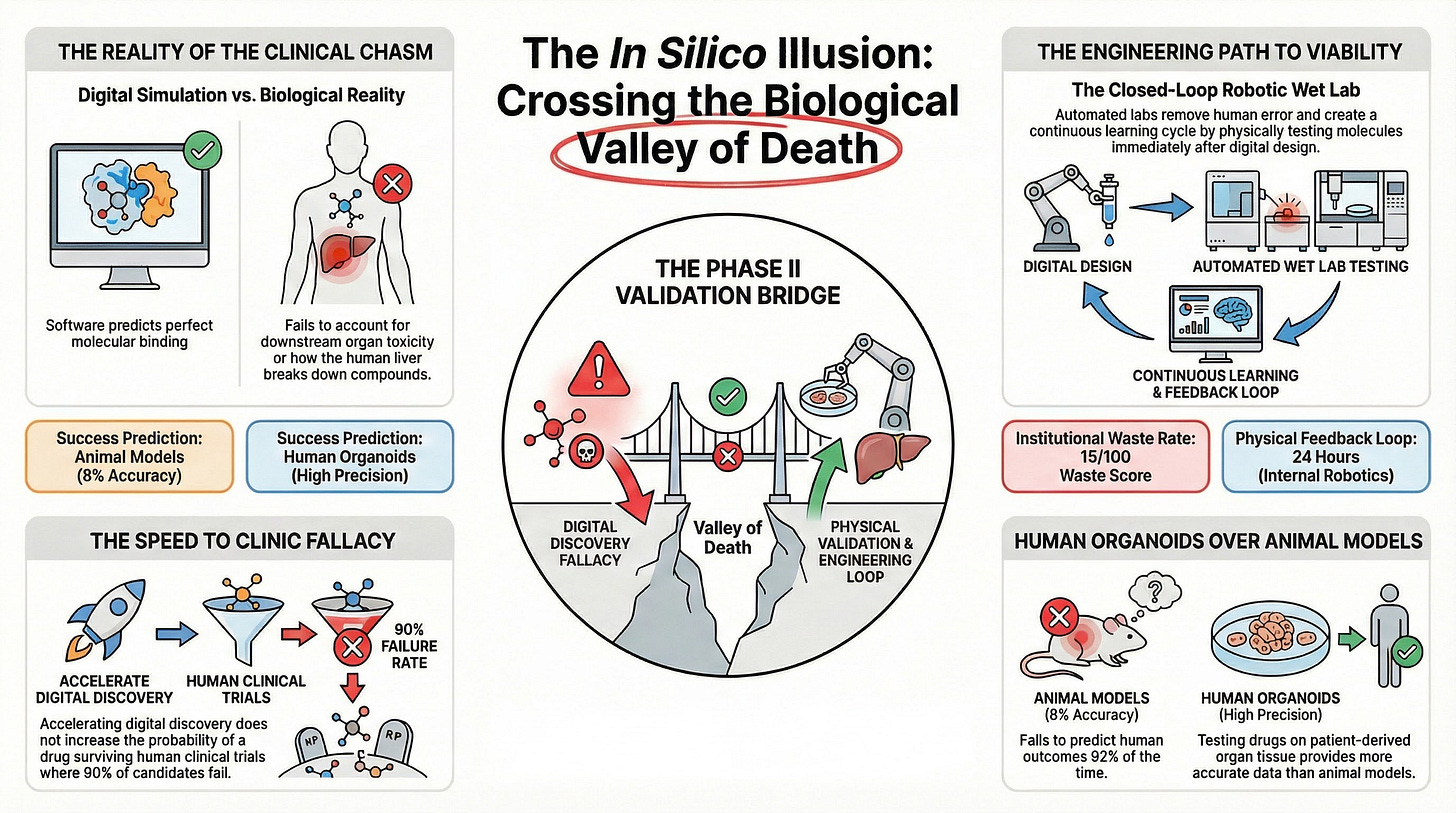
- By late 2025, AI had become integral in biotech drug discovery, excelling in preclinical tasks and enabling rapid antibody design with hit rates near 39%, though challenges in predicting clinical trial efficacy, especially in Phase II, persist with ~90% failure rates.
- Multi-agent AI systems combining large language models, foundation models like AlphaFold, and autonomous robotics are compressing drug development timelines to under 18 months, exemplified by Insilico Medicine's AI-designed oral therapy entering Phase I with 90% safety success.
- Despite AI-driven acceleration in molecule generation, clinical validation remains a bottleneck due to complex human biology and regulatory hurdles, with companies like Recursion and Insilico facing setbacks from overlooked off-target effects and metabolic issues.
AI Agents Reshape R&D
Multi-agent AI systems and virtual cell models are redefining biotech by generating high-quality hypotheses and simulating human responses, setting the stage for a new era of scientific discovery.
By late 2025, AI was widely anticipated to become a standard tool in biotech drug development within five years, particularly excelling in preclinical tasks like toxicity studies but still struggling with the critical challenge of predicting clinical trial efficacy, especially in phase two where failure rates remain high due to incomplete biological understanding. Experts noted that while AI platforms could integrate novel datasets and molecular machine learning to design medicines previously thought impossible, foundational breakthroughs such as virtual cell models—leveraging existing biological data to simulate human responses—were seen as promising near-term advancements that could transform efficacy prediction and drug discovery.
The initial wave of AI applications in drug discovery focused narrowly on identifying optimal chemical entities to engage targets, but by late 2025, the field recognized the transformative potential of integrating multi-omics data with AI to impact the entire drug development pipeline—from target identification through clinical translation and patient stratification. With foundational AI computational systems largely established and robust multi-omics datasets becoming available, industry leaders predicted an acceleration in AI-driven therapeutics within two to three years, shifting the paradigm from modality selection to pinpointing the best targets and patient populations across an expanding druggable space that now includes biologics, gene therapies, and novel modalities like molecular glues.
The year(https://podcasts.apple.com/podcast/id1528594034) marked a pivotal moment with the rise of AI agents and generative design revolutionizing scientific discovery, exemplified by breakthroughs in de novo antibody design from companies like CHAI and NABLA that enabled rapid generation of therapeutic candidates ready for human trials. Early multi-agent AI systems, such as the SAGA framework introduced in early 2026, demonstrated dynamic objective reformulation and multi-domain applicability—achieving superior results in antibiotic, materials, and DNA design—while architectures like MACI addressed the need for coordinated goal-directed reasoning beyond pattern matching. These foundational advances set the stage for a 2026-2027 inflection point where AI agents are expected to generate the majority of high-quality scientific hypotheses, fundamentally reshaping biotech R&D workflows.
Pioneering companies like Insilico Medicine, founded around 2014 at the dawn of deep learning, spearheaded early integration of generative adversarial networks to create novel synthetic biological and chemical data, applying AI to model complex biological processes such as aging via multi-omics data simulation. Concurrently, open-source efforts like OpenFold3 and large genomic foundation models like Arc Institute’s Evo 2 laid critical groundwork for reproducible biomolecular AI systems, while agentic AI platforms demonstrated superior rare disease diagnosis and autonomous experimental design, exemplified by JURA’s platform testing over 209 million antibody candidates in days. Despite these advances, industry surveys in mid-2026 revealed that while nearly 60% of pharma companies adopted AI for early drug discovery, challenges remain in shortening R&D timelines and fully realizing AI’s potential beyond incremental improvements.




Antibody Design Breakthroughs
AI-powered platforms now compress antibody discovery from years to weeks and enable collaborative, cross-functional drug development, but clinical translation and manufacturing hurdles remain.
By late 2025, drug discovery had begun to harness a sophisticated ecosystem of AI agents working in concert—from large language models (LLMs) that strategize discovery goals, to scientific foundation models like AlphaFold that predict protein folding, and embodied AI robotics conducting physical experiments in wet labs. This multi-agent approach, exemplified by platforms enabling seamless collaboration across vendors and clouds, integrates scientific, business, and regulatory considerations simultaneously, ensuring that AI-driven drug development is not only innovative but also commercially viable and compliant.
The rapid acceleration of antibody and protein design stands out as a hallmark breakthrough, with companies like Nabla Bio and Chai Discovery compressing antibody discovery timelines from years to mere weeks and achieving hit rates near 39%. Notably, AI-designed antibodies have demonstrated unprecedented functional capabilities, such as the first GPCR-activating antibody, signaling a leap beyond traditional small molecule targeting. Yet, challenges remain in clinical translation, with in vivo validation, immunogenicity testing, and manufacturing scale-up still pending, underscoring the frontier nature of these advances.
Early 2026 witnessed tangible real-world deployments of AI-driven drug development, from Insilico Medicine’s AI-designed oral therapy entering Phase I trials with a 90% safety success rate, to Medra’s autonomous AI robotic labs partnering with Genentech and launching one of the largest fully autonomous labs in the U.S. These developments illustrate how AI is compressing discovery-to-clinic timelines to under 18 months and enabling scalable, reproducible experimentation that rivals traditional biotech efforts costing hundreds of millions and years of work, as Lila Sciences demonstrated by matching a $2.1 billion biotech asset in six months with just a handful of staff.
The integration of AI platforms into drug discovery is also fostering novel collaborations and expanding therapeutic modalities, such as BostonGene and Daiichi Sankyo’s partnership to apply AI-driven translational intelligence in antibody drug conjugate development, and startups like Gamgee using ChatGPT and AlphaFold to design personalized mRNA cancer vaccines for dogs with plans for human applications. These examples highlight AI’s growing role in enabling precision medicine, accelerating early-stage molecule design, and attracting significant investor confidence, while experts emphasize the ongoing need for rigorous clinical validation to ensure safety and efficacy.


Trials: The Stubborn Bottleneck
Despite AI's rapid candidate generation, human clinical trials remain a costly and slow barrier, with biology’s complexity and regulatory rigor causing high failure rates that computational models alone cannot overcome.
Despite AI's remarkable ability to accelerate early-stage drug discovery and increase the number of promising candidates entering development funnels, the fundamental bottleneck remains the lengthy, costly, and complex human clinical trials required for safety and efficacy validation. As highlighted in late 2025 analyses, AI can double Phase I safety success rates to around 90%, yet Phase II efficacy testing still suffers from a stubborn ~90% failure rate, underscoring that computational advances do not circumvent the need for rigorous clinical proof. Regulatory frameworks, particularly the FDA’s stringent three-phase testing protocols, maintain high safety standards that cannot be bypassed by AI, although some regions like China experiment with faster approval processes to boost productivity.
The translation of AI-generated molecules into effective human therapies is hampered by the intrinsic complexity and heterogeneity of human biology, which current AI models and simulations fail to fully capture. Companies like Recursion Pharmaceuticals and Insilico Medicine have faced high-profile clinical setbacks because their algorithms optimized for binding affinity but overlooked critical factors such as off-target toxicity and metabolic breakdown. This gap means that speeding up molecule generation—from months to weeks as CellType attempts—only accelerates the arrival of flawed candidates at expensive clinical trial tollbooths, inflating downstream failure costs to hundreds of millions per Phase II or III trial.
Operational innovation and improved clinical validation strategies are emerging as the true competitive moats in AI-driven drug discovery, shifting focus from discovery itself—which is becoming commoditized—to the design of biomarker strategies and trial execution that reflect human biology. Experts emphasize that AI models are only as good as the experimental data they train on, and that the long, expensive feedback loops of human trials—often spanning years—limit rapid learning. The need for comprehensive, multimodal, and longitudinal datasets akin to a 'UK Biobank on steroids' is critical to reliably predict clinical efficacy, which remains the 'holy grail' and the last frontier for AI maturation in pharma.
Early examples like Gamgee, the startup developing fully computationally designed mRNA cancer vaccines for dogs, illustrate both the promise and the challenges of translating AI discoveries into validated therapies. While anecdotal tumor shrinkage in a single case accelerated by ChatGPT and AlphaFold tools has garnered attention, experts caution that reproducibility and rigorous clinical trials remain essential to overcome skepticism and regulatory hurdles. Gamgee’s ongoing clinical trials in Australia and global case acceptance highlight nascent operational innovations aimed at addressing validation bottlenecks, yet underscore that AI-driven therapies must still navigate the traditional, high-stakes gauntlet of clinical and regulatory scrutiny.


AI-Native Biotech Emerges
Next-generation biotech firms are embedding AI across every stage of drug development, combining specialized models and high-dimensional data to create auditable, biologically plausible decision-making frameworks.
The future of biotech R&D is rapidly evolving toward AI-native organizations that integrate AI comprehensively across drug discovery and development stages. Companies like Xaira and Formation Bio exemplify this shift by embedding AI-driven approaches in target selection, molecular design, and clinical trial optimization, supported by substantial funding exceeding $1 billion. This systemic AI integration aims to overcome traditional bottlenecks by leveraging high-dimensional causal datasets and multi-model AI architectures, as Formation Bio highlights the necessity of combining specialized models—such as large language models, knowledge graphs, and toxicology predictors—to create auditable and biologically plausible decision frameworks.
Despite AI's transformative promise, significant challenges remain in translating early-stage computational successes into clinical efficacy, especially in costly Phase II and III trials where failure rates hover around 90%. Accelerating molecule generation alone does not guarantee improved clinical outcomes, as AI-optimized candidates often falter due to unpredictable toxicity and complex human biology that defies deterministic modeling. Experts urge a paradigm shift toward treating biology as a chaotic physical system rather than software, to reduce false positives and better predict human responses, underscoring the need for AI to evolve beyond current agentic workflows.
Looking ahead, AI-driven foundation models are poised to revolutionize drug discovery across diverse therapeutic classes, including small molecules, biologics, and RNA therapeutics, with RNA drugs projected to increase tenfold within a decade. This AI integration also enables novel business models, such as owning multiple drugs for combination therapies in oncology, overcoming traditional industry barriers to collaboration. Furthermore, AI is expected to halve drug development timelines from over a decade to around five years by simulating molecular and clinical trial outcomes in silico, while also driving enterprise-wide reinvention through cross-departmental collaboration and upskilling to embed AI-augmented processes.
The financial and operational impact of AI in biotech is already evident in companies like Insilico Medicine and GGA Corp, which leverage generative adversarial networks and integrated AI platforms to accelerate biomolecule design, enhance regulatory compliance, and expand global competitiveness. Insilico’s ability to simulate biological aging and generate synthetic future biological data exemplifies AI’s potential to deepen understanding of disease progression and longevity. Meanwhile, GGA’s AI-driven DeepExoMir platform has doubled smart R&D revenue and boosted overseas business by 65%, illustrating how AI is becoming a core growth engine that can dramatically lower drug development costs by reducing failure rates and enabling more targeted, affordable medicines.