AI stacks supercharge creator workflows and level the field
The gist
AI content stacks are turning creators and small businesses into production powerhouses—slashing content creation from days to minutes and putting agency-grade muscle within everyone’s reach.
What to know
- By mid-2026, creators like Ryan Law and Dan Koe used chained AI skill files to generate publish-ready articles and multi-format social posts in under an hour.
- Affordable AI tools—like Descript, OpenAI’s Whisper, Buffer, and Vidyo.ai—now automate everything from transcription to video clipping and multi-platform publishing.
- Emerging all-in-one AI platforms such as Lobo Digital and Mond Inc.’s AMONDLAB let SMEs automate brand profiling, content creation, and distribution, cutting production time by over 90%.
AI Stacks: From Tools to Ecosystems
Modular AI workflows now chain specialized skill files and parallel agents, reducing full content production from days to minutes while preserving brand voice and editorial quality.
The foundational evolution of creator AI stacks marks a paradigm shift from treating AI as a mere writing assistant to envisioning it as an interconnected infrastructure that automates entire content production workflows. This transition is epitomized by the author’s realization that instead of refining prompts for individual articles, what was needed was a cohesive stack where each AI tool’s output seamlessly feeds into the next, enabling a single session to accomplish what once took an entire week. Creators like Ryan Law and Dan Koe exemplify this organic growth, starting with automating repetitive editorial tasks and progressively layering modular AI skills and multi-format repurposing to scale content production without compromising human insight or quality.
Verified examples from leading creators demonstrate that scalable AI content systems rely on chaining specialized AI skill files and prompts to automate sequential editorial steps and content repurposing. Ryan Law’s Ahrefs system, for instance, employs 23 custom skill files within Claude Code to produce publish-ready article drafts in as little as 6 to 12 minutes, while Dan Koe’s workflow deconstructs posts into diverse social media formats using custom Claude and Gemini prompts. These modular, pipeline-driven approaches form the backbone of efficient, scalable AI-driven content automation ecosystems.
The author’s own automated AI content creation stack exemplifies the power of centralized orchestration through Anthropic’s Claude Code CLI tool, which acts as a single command center integrating writing, image generation, data analysis, and browser automation. By maintaining a master instruction file (CLAUDE.md) that defines all content production processes, updates propagate seamlessly across future workflows, enabling rapid iteration and scalability. This stack also incorporates brand-specific voice profiles to ensure AI-generated content sounds authentic and personalized, while parallel AI agents simultaneously handle writing, SEO metadata, image creation, and teaser generation—reducing full article production from a morning’s work to about 15 minutes.
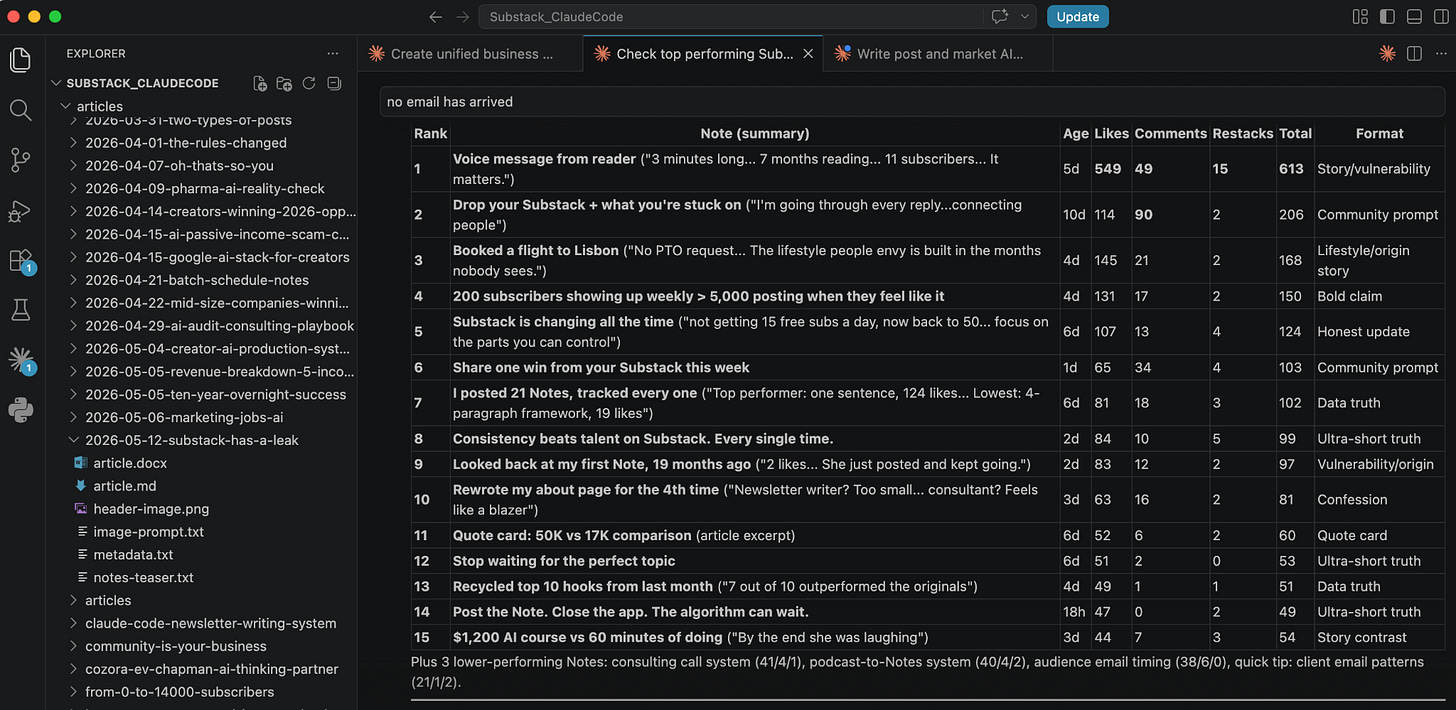
Beyond writing, automation extends deeply into data collection and analysis, with tools like Puppeteer MCP enabling Claude Code to scrape performance metrics directly from platforms such as Substack. This real-time data integration reveals nuanced insights that manual review would miss, fundamentally transforming content strategy by highlighting what resonates with audiences. Coupled with automated brand-consistent image generation via Google’s Imagen API, these workflows illustrate how creator AI stacks have matured into comprehensive ecosystems that streamline and elevate every facet of content production.

AI Powers the Creator Business
AI has unified content, revenue, and systems into seamless creator ecosystems, freeing up time for strategy and plugging revenue leaks with automated sales and messaging optimization.
By mid-2026, AI had become the backbone of creator businesses, enabling them to seamlessly integrate three core layers—content creation, revenue generation, and systems optimization—into a unified, efficient ecosystem. This shift drastically reduces the manual workload and context switching that once consumed creators' most valuable hours, allowing them to focus on high-level strategy rather than repetitive tasks. As highlighted in a 2026 analysis, many creators traditionally struggled with juggling these layers manually, often burning out or leaving revenue on the table due to fragmented workflows and inconsistent messaging.
Within the content creation layer, AI tools revolutionize the ideation and publishing process by automating tasks such as newsletter writing, crafting engaging X/Twitter threads with scroll-stopping hooks, and repurposing a single newsletter into multiple platform-native pieces. These capabilities not only streamline content production but also enhance performance through AI-driven audits that diagnose why certain pieces fail to convert, ensuring creators maintain a consistent and compelling voice across channels.
The revenue generation layer addresses a critical pain point where many creators lose potential income—not due to poor offers but because of ineffective messaging and sales systems. AI assists in packaging offers, validating market demand, and constructing persuasive sales pages and email sequences with optimized calls-to-action, thereby reducing friction in the buyer journey. This focus on refining the sales narrative and system architecture helps creators capture revenue that was previously slipping through the cracks.
Finally, the systems optimization layer embodies lean operational principles by leveraging AI for tool stack audits, designing autonomous AI agents, automating workflows, and continuously monitoring ROI. This layer's purpose is to eliminate the need for manual oversight across content and revenue functions, empowering creators to build skills once and delegate execution to AI-driven systems. The result is a creator business that operates with precision and scalability, freeing up cognitive bandwidth for innovation and growth.

Repurposing at Lightning Speed
AI-driven tools now transform a single transcript into multi-format, platform-ready content in under 30 minutes, democratizing high-quality production for creators at any scale.
By mid-2026, AI-driven content repurposing had revolutionized resource creation by automating transcript processing and generating diverse content formats from a single source, drastically reducing turnaround times. For instance, teams that once waited until the next day to post content could now complete the entire process in about 30 minutes. Tools like Claude's 'skills' and Gemini's 'gems' further enhanced this workflow by enabling creators to produce accurate session descriptions, takeaway tips, and reader-friendly transcripts with timestamps, significantly improving user experience and content accessibility.
The rapid maturation of free and low-cost AI tools democratized content creation by allowing creators to transform one piece of content into multiple formats without expensive equipment or software. Platforms such as Descript’s free tier enable users to record podcasts or videos and automatically generate transcripts that can be repurposed into blog posts, newsletters, emails, and social media content. Meanwhile, open-source solutions like OpenAI’s Whisper provide unlimited, professional-grade transcription at zero cost, albeit requiring some technical setup, thus lowering barriers for creators willing to invest initial effort.
Integration of AI features within existing content platforms streamlined workflows by reducing context switching and enhancing efficiency. Buffer’s free AI assistant, for example, generates multiple social media variations from a single core idea directly within its scheduling tool, simplifying content distribution. Additionally, AI-driven video repurposing tools like Vidyo.ai automate the extraction of shareable clips from long-form videos, effortlessly producing short-form content tailored for platforms such as TikTok, Instagram Reels, and YouTube Shorts, thereby expanding creators’ reach without manual editing labor.


Autonomous Marketing Workflows Arrive
AI systems autonomously analyze competitors, orchestrate multi-channel campaigns, and verify each step, but human input remains critical to avoid generic, low-value output.
By mid-2026, AI-driven workflows had evolved to autonomously identify growth trends through deep competitor content analysis, as exemplified by marketers who instructed tools like Codex to research niche newsletters and extract emerging patterns. These sophisticated systems leverage persistent, multi-step browser-based scraping and data aggregation—even from platforms lacking public APIs—enabling continuous, scalable marketing operations without manual intervention, such as running cron jobs on always-on Mac Minis for uninterrupted workflow execution.
Dynamic AI workflows revolutionized content marketing by transforming a single asset into a suite of branded outputs across channels, automating transcription, idea extraction, drafting, clipping, and distribution while preserving brand voice consistency. This orchestration's reliability is critical; the system verifies each step autonomously, reducing the need for marketers to babysit handoffs and allowing them to efficiently scale content production without sacrificing quality.
The quality of AI-generated marketing content hinges on thoughtful input design and human oversight—embedding brand voice, constraints, and final approval elevates output beyond generic 'AI slop.' Marketers who actively review and refine AI drafts distinguish themselves, whereas those relying solely on automation risk flooding audiences with low-value, easily recognizable content. This nuanced approach underscores that AI is a powerful amplifier of human creativity, not a replacement.
Creators like Will Weinbach demonstrate the cutting edge of AI-driven marketing efficiency by deploying fully autonomous social media workflows that handle content creation, editing, scheduling, posting, and analytics with self-optimizing A/B testing. Weinbach highlights that his lack of coding knowledge paradoxically empowers fearless experimentation, underscoring how accessible AI workflows democratize innovation and enable marketers to iterate rapidly toward viral success.



SMEs Get Agency-Grade AI
Affordable all-in-one AI platforms empower small businesses to automate brand profiling, content creation, and distribution—delivering professional marketing results without a dedicated team.
By mid-2026, AI-driven marketing platforms tailored specifically for SMEs and startups began to fill a critical gap in the market, as exemplified by London-based Lobo Digital’s launch of an AI marketing assistant app priced affordably at £19 per month. This app leverages over 15 data points to build detailed brand profiles and delivers expert, channel-specific marketing outputs across ten disciplines, democratizing access to agency-grade strategies that were previously out of reach for smaller businesses.
The rise of all-in-one AI marketing platforms is transforming how small businesses manage their marketing operations by automating content creation, design, and multi-channel distribution, thereby saving time and reducing costs. With 38% of SMEs already integrating AI across marketing, customer service, and data analysis functions by early 2026, these platforms not only streamline workflows but also ensure brand consistency through integrated brand kits, which is crucial for businesses lacking dedicated marketing teams.
AI marketing assistants have become indispensable tools for small business owners by simplifying complex tasks such as content ideation, design, and repurposing across channels. Instead of spending hours brainstorming or creating multiple assets, businesses can generate unified campaigns with AI-generated copy and graphics that adapt seamlessly for different platforms. Additionally, AI’s drag-and-drop email builders and performance tracking capabilities enable faster campaign launches and more effective audience engagement.
AI Agents Run Brand Campaigns
Emerging AI ecosystems like Profound Aim and AMONDLAB autonomously manage research, content, and publishing—cutting costs by 99% and scaling from startups to governments.
By mid-2026, commercial AI marketing ecosystems are evolving from passive data aggregation to proactive, autonomous execution platforms that integrate external AI signals with internal brand context. Profound Aim, launched in July 2026, exemplifies this shift by transforming chaotic AI data into structured marketing projects managed by autonomous AI agents that research, generate, and publish optimized content directly to brand channels, all while maintaining human oversight. This approach positions Profound as a pioneer in Answer Engine Optimization (AEO), addressing the critical need for brands to actively manage their presence within emerging AI-driven discovery ecosystems.
Simultaneously, AMONDLAB by Mond Inc. is redefining marketing automation through an all-in-one AI platform that streamlines the entire social media content lifecycle from brand analysis to publishing with a single URL input. Launched in July 2026, AMONDLAB leverages proprietary style-learning technology to create brand-exclusive 2D and 3D AI avatars, enhancing personalization and enabling repeated use in promotional assets. This innovation not only slashes content production time by over 90% but also reduces personnel costs to roughly one three-hundredth of traditional methods, making it especially attractive to small businesses and solopreneurs.
Beyond technology, AMONDLAB’s strategic expansion into B2B and B2G markets signals a broad ecosystem growth trajectory. Mond Inc. is extending services to marketing agencies and local governments, supporting digital transformation and startup incubation, while preparing for seed funding rounds following successful pilot projects with around 20 early-stage enterprises. This multi-pronged approach underscores a future where AI-driven marketing automation platforms not only optimize content creation but also foster international scalability and cross-sector collaboration.
Complementing these platform innovations, hands-on AI automation labs like Rick Kranz’s AMONDLAB emphasize bespoke, project-based implementations tailored for seasoned marketing and sales leaders rather than novices. This model prioritizes direct involvement—from automation design to training—empowering clients with both immediate operational efficiencies and educational resources to customize and manage their automations independently. Such a hybrid service-education approach reflects a maturing market that values outcome-driven partnerships over generic, high-volume automation solutions.