AI weed control revolutionizes fields, slashes herbicide use
The gist
AI-powered tractors and sprayers are driving a farming revolution, slashing herbicide use by up to 90% and making hands-free, precision weed control the new norm.
What to know
- John Deere’s AI-enabled 9Rx830 tractors and sprayers use up to 36 cameras and Nvidia Orin GPUs to target weeds at 15 mph, cutting chemical use and tackling labor shortages.
- Tech like Agtecnic’s SenseSpray and Carbon Robotics’ LaserWeeder combine AI vision and innovative delivery—think lasers and selective spraying—to dramatically reduce herbicide dependence.
- Farmers like Caileam Loughman and Graham Christensen are seeing major cost savings and healthier fields, while industry giants and startups are teaming up to supercharge AI’s impact across agriculture.
AI Tractors Go Autonomous
John Deere’s sensor-packed, AI-driven machinery is transforming fieldwork with real-time perception, hands-free operation, and even plant-level stress detection for ultra-precise, sustainable farming.
By early 2026, John Deere had pioneered the integration of advanced AI, sensor arrays, and embedded computing into autonomous farm machinery, exemplified by the 9Rx830 tractor and self-propelled sprayers. These vehicles leverage sophisticated multi-camera arrays—16 cameras on tractors and 36 on sprayers—paired with embedded Nvidia Orin GPUs hardened for extreme field conditions, enabling real-time perception, depth sensing, and precise, hands-free operation even in challenging agricultural environments. This sensor fusion and AI-driven machine vision empower capabilities like targeted 'see and spray' herbicide application at 15 mph, significantly reducing chemical use by treating only weed-infested areas, thereby enhancing sustainability and operational efficiency.
Addressing critical labor shortages in agriculture, where only 1.5% of the population is engaged and planting windows last a mere two to three weeks, John Deere’s autonomous machinery offers farmers the ability to replace themselves in the cab during peak periods. With over 30 years of development culminating in limited customer deployments over the past four years, these fully autonomous tractors and sprayers allow hands-free operation, enabling farmers to maximize productivity during labor-intensive seasons without sacrificing precision or control.
Precision in planting and crop management is further enhanced through the integration of GPS and GNSS technologies, which allow John Deere’s autonomous equipment to place seeds with exacting accuracy—down to 30-inch rows—ensuring no overlap or missed areas in large fields. Beyond machinery, John Deere is exploring innovative plant-level sensing by partnering with companies like Interplant to genetically modify crops that fluoresce under stress, effectively creating a 'wearable' for plants. This visionary approach aims to provide real-time insights into plant health, enabling farmers to 'listen' to their crops and tailor treatments with unprecedented precision.



Sprayers Get Smart—and Selective
AI-powered sprayers and retrofit kits slash herbicide use by up to 90% by targeting only weed-infested spots, with new tech now integrating seamlessly across global farm fleets.
By mid-2026, John Deere had set a high bar in precision spraying technology through its AI-driven self-propelled sprayers equipped with an extensive camera array—36 cameras spanning a 120-foot boom—and nine embedded Nvidia Orin GPUs hardened for rugged field conditions. This sophisticated setup enables real-time identification and targeted herbicide application at speeds up to 15 mph, drastically reducing chemical use by spraying only weed-infested pixels, thereby benefiting both farmers and the environment while supporting autonomous farming operations.
Agtecnic’s SenseSpray platform pushes the envelope further with its innovative 'green-on-green' AI technology, allowing selective weed control within growing crops and achieving up to 90% herbicide reduction. Its expanding compatibility with third-party PWM systems like CapstanAG’s PinPoint 3 and Ag Leader’s RightSpot, alongside native hardware development, reflects a strategic effort to integrate seamlessly across diverse sprayer models, meeting strong user demand and facilitating adoption beyond Australia into North America and South Africa.
Retrofit solutions like Greeneye’s dual-tank, dual-line AI spraying system demonstrate how precision weed control can be effectively scaled to existing equipment, cutting herbicide use by up to 90% without compromising efficacy. Partnerships with local dealers such as Intellifarms Northern enhance timely service and installation, critical for narrow spraying windows, while farmer demonstrations build confidence by showcasing tangible input savings and operational benefits, signaling a maturation in market readiness and adoption.
Emerging autonomous robots like Croplands Equipment’s Kilter and Carbon Robotics’ LaserWeeder exemplify a new frontier in precision spraying by combining advanced AI classifiers, high-resolution imaging, and innovative delivery methods such as Single Droplet Technology. These platforms offer supervised autonomy that reduces labor demands while precisely targeting weeds with minimal chemical use, supported by massive AI training datasets and integration capabilities that allow rapid in-field customization and retrofit options, positioning them as cost-effective, scalable alternatives to traditional and mechanical weed control methods.
Weather Data Powers Precision
Minute-by-minute weather and high-res weed mapping are turning spray decisions into a science, helping farmers meet strict regulations and cut costs with pinpoint chemical applications.
By 2026, real-time environmental sensing has become indispensable for precision agriculture, with SwarmFarm Robotics deploying over 300 WeatherStation® sensors since 2019 to empower their autonomous SwarmBots. These Airmar instruments deliver on-machine, minute-by-minute data on critical meteorological variables—wind speed, direction, temperature, humidity, and Delta T—that directly influence spray drift and chemical efficacy. This granular weather intelligence not only optimizes spray applications but also ensures strict adherence to global pesticide regulations from bodies like the US EPA, EU Pesticide Regulation, and Australia's APVMA, which mandate detailed environmental documentation during agrochemical use.
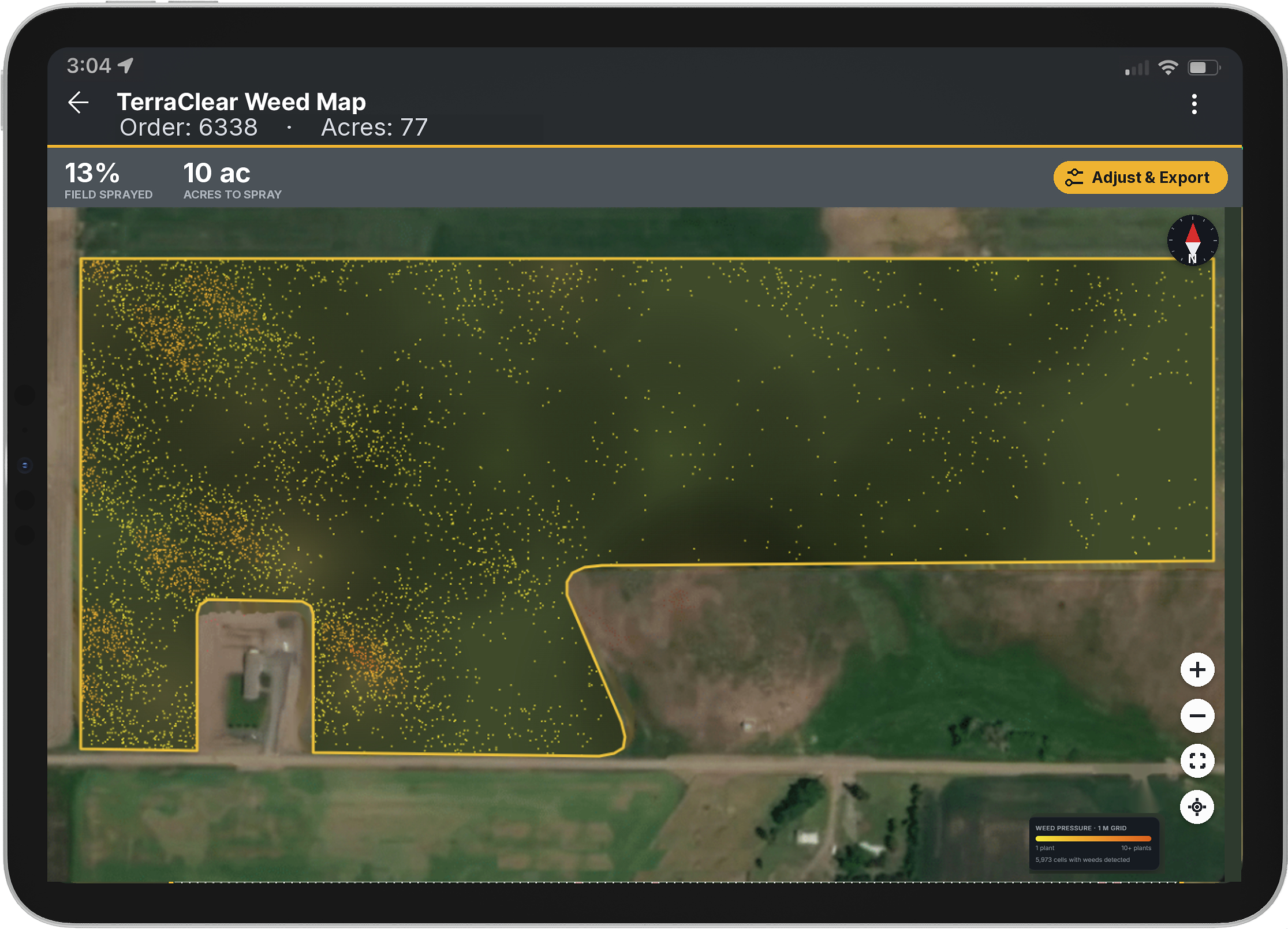
TerraClear’s 2026 launch of quarter-inch weed mapping technology marks a leap forward in data-driven crop management by converting traditional sprayers into precision-targeting instruments. Utilizing high-resolution imagery at 1.5-millimeter resolution combined with RTK-grade GPS positioning, TerraClear can map over 1,000 acres daily and deliver sprayer-ready prescription maps within 24 hours. CEO Devin Lammers highlights that this innovation builds on their rock detection platform to optimize chemical application, reduce costs, and bolster regulatory compliance by enabling section and nozzle-level control that targets only weed-infested zones, offered flexibly through Mapping-as-a-Service or hardware-plus-subscription models.

Farmers Profit From Precision
AI spot spraying and robotic weeders are unlocking new revenue streams and major input savings for farmers, while protecting soil health and supporting sustainable practices.
AI-driven precision spot spraying has emerged as a lucrative new income stream for farmers like Caileam Loughman, who leverages the SKAi Spot Sprayer to offer specialized, labor-efficient services that complement traditional dairy farming. This technology requires minimal manpower—just one operator and a tractor—allowing seasonal flexibility and additional earnings while significantly reducing herbicide use to as low as 5-6% of conventional blanket spraying, translating into substantial cost savings of over €3,400 on a 100-acre job. Beyond economics, spot spraying enhances sustainability by protecting valuable pasture components such as clover and preventing grass stunting, which are common drawbacks of traditional chemical applications.
Similarly, Nebraska farmer Graham Christensen’s adoption of Greenfield robotic weed-cutters exemplifies how AI-driven automation can reduce pesticide dependence and associated costs while advancing regenerative agriculture goals. By mechanically removing weeds and eliminating the need for a second pesticide spray on soybeans, Christensen aligns his operation with growing consumer demand for chemical reduction. Despite initial learning curves, he anticipates that savings on chemical inputs will offset the three-year loan for the robots, underscoring the economic viability of integrating innovative automation tools into established farming practices.
The successful deployment of AI precision tools also hinges on strong industry partnerships and knowledge transfer, as demonstrated by Grasstec Group’s role in facilitating the adoption of the SKAi Spot Sprayer in Ireland. By bringing farmers like Caileam and Laurence to Scotland for hands-on training and subsequently distributing six machines across Ireland, Grasstec underscores the importance of collaborative networks in scaling sustainable technologies. This support ecosystem not only accelerates adoption but also ensures that farmers can maximize both economic returns and environmental benefits from precision automation.
Ecosystem Fuels AgTech Breakthroughs
Strategic partnerships, innovation hubs, and real-world deployments are accelerating rugged AI adoption, ensuring that farm automation delivers practical value—not just hype.
Reservoir's $10 million, three-year partnership with John Deere exemplifies a strategic collaboration that merges R&D, grower insights, and venture capital to accelerate rugged AI adoption in specialty crop management. By establishing innovation hubs like Reservoir Farms in Salinas and Sonoma, which host over 20 ag startups and connect engineers directly with growers, Reservoir fosters a hands-on ecosystem that drives the real-world scaling of precision agriculture solutions across key U.S. regions.
The collaboration between Carbon Robotics and iMerit highlights how multi-year partnerships and custom data annotation workflows are pivotal in advancing rugged AI for agriculture. Their foundation AI model, trained on 150 million labeled plant images, enables instant in-field customization of autonomous LaserWeeder machinery via an iPad app, while integration with John Deere tractors through retrofit kits underscores the ecosystem’s role in scaling autonomous solutions through established equipment manufacturers.
Industry leaders like Burro’s Charlie Andersen emphasize that successful farm automation innovation hinges on practical deployment and incremental automation of simple, repetitive tasks such as movement and towing before advancing to complex operations like autonomous harvesting. This pragmatic approach, coupled with building trust among farm laborers by improving their productivity and work conditions, distinguishes rugged, scalable robotics companies from those that only excel in flashy demos, underscoring the ecosystem’s focus on real-world impact and adoption.