Aletta robot redefines blood draws, wins over patients
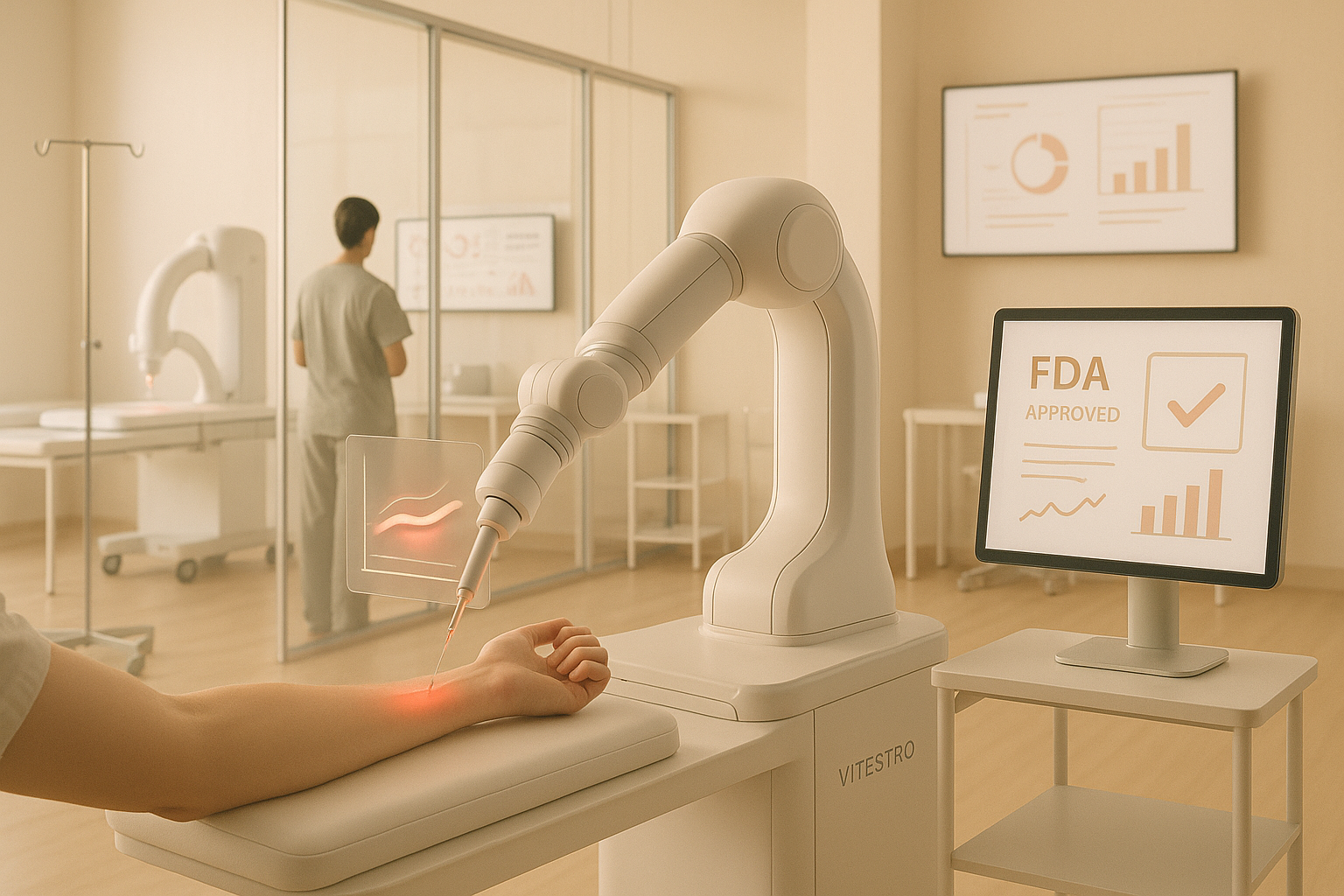
The gist
Vitestro’s Aletta just became the first FDA-cleared robot to autonomously draw blood—outperforming many humans and winning over patients in the process.
What to know
- Aletta uses near-infrared and Doppler ultrasound to find veins and perform blood draws fully autonomously, with FDA De Novo clearance setting a regulatory precedent.
- One phlebotomist can now supervise up to three Aletta robots at once, helping clinics tackle staffing shortages while keeping safety and quality checks in human hands.
- Patients are on board: 30-32% are indifferent to the robot, only 5% have strong opinions, and blood draws now average just 2.5 minutes each.
FDA Sets New Robotic Standard
Aletta’s De Novo clearance not only legitimizes fully autonomous blood draws but also creates a regulatory blueprint for future medical robots, with built-in safety protocols that halt procedures if veins aren’t found.
Aletta’s FDA authorization marks a groundbreaking regulatory milestone as the first robotic device cleared to perform fully autonomous venipuncture on adults without any human hand involvement. This approval, granted through the De Novo pathway, not only recognizes Aletta as a novel low- to moderate-risk medical device but also establishes a new regulatory category with special controls for labeling, performance, and clinical testing, setting a precedent for future autonomous medical technologies. A critical safety feature embedded in Aletta’s design is its autonomous decision to abort the procedure if it cannot locate a suitable vein, underscoring the device’s commitment to patient safety and procedural reliability.
Technologically, Aletta leverages advanced near-infrared light and Doppler ultrasound imaging to identify veins with greater precision than the human eye, particularly benefiting patients with darker skin tones or difficult venous access. This innovation addresses longstanding disparities in venipuncture success rates by enabling the robot to distinguish veins from arteries and perform the entire blood draw process autonomously—from tourniquet application and skin preparation to needle insertion and tube handling. The FDA’s regulatory framework now requires manufacturers to demonstrate that Aletta’s performance matches or exceeds that of trained phlebotomists across diverse patient populations, ensuring equitable and effective clinical outcomes.
Automation Meets Human Oversight
Aletta’s design lets one phlebotomist supervise multiple robots, boosting clinic capacity while keeping critical safety and quality decisions in human hands.
Aletta’s operational design allows a single trained phlebotomist to oversee up to three robotic blood draw machines simultaneously, a breakthrough that directly addresses the widespread staffing shortages in clinical settings. This capability not only increases patient throughput by automating routine venipuncture tasks but also alleviates work pressure on healthcare staff, as highlighted by a hospital board member in Nieuwegein who emphasized the device’s role in reducing workload rather than merely improving precision.
While Aletta automates the venipuncture process, it maintains essential clinical oversight by requiring a trained phlebotomist to initiate each session and remain nearby to manage any issues and verify proper tube filling. This hybrid approach ensures patient safety and procedural accuracy, balancing automation with human expertise to optimize workflow efficiency without compromising quality control.
Patients Embrace Robotic Routine
Most patients feel neutral or comfortable with Aletta, allowing human staff to focus on those who want personal care and signaling smooth adoption of automated blood draws.
Patient acceptance of Vitestro's Aletta robotic blood draw device is notably high, with roughly 30 to 32% of patients reporting indifference toward the machine, indicating that the technology integrates seamlessly into the blood draw process without causing disruption or discomfort. This broad neutrality suggests that the robotic system operates almost invisibly from the patient’s perspective, easing the transition toward automation in clinical settings. Furthermore, the device’s deployment allows phlebotomists to dedicate more time to patients who prefer human interaction, enhancing overall care quality by balancing technological efficiency with personalized attention. As one expert noted, "The phlebotomist now has time to take care of those people because the machine is taking care of all the people that are okay with that machine," highlighting how automation complements rather than replaces human touch.
While the majority of patients exhibit neutral or comfortable attitudes toward the Aletta robot, only a small minority—about 5%—expressed strong positive or negative reactions, underscoring minimal resistance to this autonomous venipuncture technology. This limited polarization suggests that concerns over patient apprehension may be overstated, paving the way for broader acceptance and smoother integration of robotic blood draws in diverse healthcare environments. The data imply that initial skepticism or enthusiasm is confined to a small subset, allowing providers to focus on optimizing the experience for the majority who adapt readily to the innovation.

Speed, Precision—and Caution
Aletta cuts draw times nearly in half with advanced tech, but experts stress that human judgment and expanded trials are essential to ensure safety and equity across all patient groups.
Aletta’s robotic blood draw device, developed by Vitestro, demonstrates a marked improvement in clinical efficiency by reducing average draw times to 2.5 minutes compared to the typical 4-5 minutes taken by human phlebotomists. This speed advantage is complemented by advanced machine learning and computer vision technologies that enhance precision and stability down to the micrometer level, allowing the robot to perform delicate tasks with high accuracy. However, the system is designed to integrate human oversight, with one phlebotomist supervising up to three devices to confirm tube order, volume, labeling, and patient monitoring, ensuring safety and quality control throughout the procedure.
Experts like Dr. Gary Tolbert emphasize that despite Aletta’s technological sophistication, the nuanced skill and experience of human phlebotomists remain indispensable, particularly for patient comfort and managing complex cases. The robot’s safety mechanisms are intentionally conservative, enabling it to recognize when a vein is unsuitable or when it cannot safely proceed, prompting it to defer to human intervention rather than risk errors. This collaborative dynamic underscores a hybrid workflow where robotic precision augments but does not replace human expertise, fostering a safer and more patient-centered clinical environment.
While initial clinical evaluations are promising, experts caution that Aletta’s current performance data is primarily derived from relatively homogenous populations, such as those in Norway, and that broader, more diverse clinical trials are necessary to validate its effectiveness across varied skin tones, body types, and clinical scenarios. This call for expanded studies highlights the device’s current limitations and the importance of inclusivity in medical technology validation to ensure equitable performance and safety for all patient demographics.