AMD’s AI gains hit a Wall: GPU shortages stall ROCm.AI
The gist
AMD’s AI-powered ROCm.AI platform is rewriting the GPU playbook—but critical internal GPU shortages are stalling its assault on Nvidia’s CUDA empire.
What to know
- ROCm.AI’s AI-native automation and Hyperloom system boost GPU kernel speeds up to 3.3x, promising a real threat to Nvidia’s 20-year CUDA dominance.
- Despite open-source momentum and rapid CUDA-to-ROCm porting, a shortage of stable internal GPU clusters has caused delays, regressions, and hit software quality hard.
- AMD’s 72-GPU Helios rack system packs 2.9 EFLOPS and 260TB/s bandwidth, but without more internal compute, ROCm.AI’s development is running on fumes.
AI Agents Rewrite GPU Playbook
ROCm.AI’s autonomous AI agents compress years of manual GPU optimization into hours, enabling rapid breakthroughs that directly challenge Nvidia’s CUDA dominance.
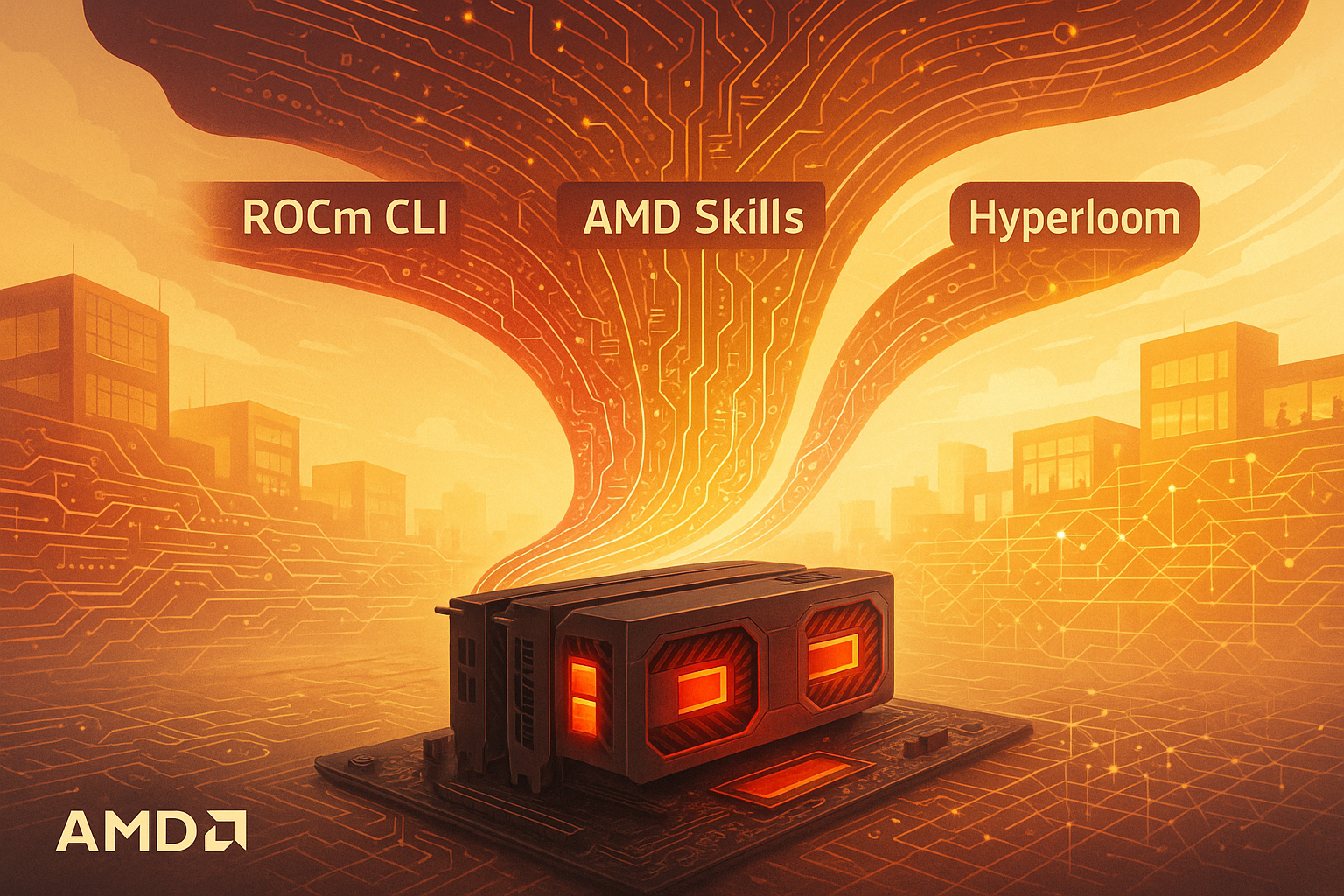
AMD's ROCm.AI platform represents a paradigm shift in GPU software optimization by harnessing AI-native capabilities to autonomously generate and tune GPU kernels, effectively breaking Nvidia's two-decade CUDA lock-in. Demonstrated by Anthropic's Claude running natively on AMD MI355X GPUs after just a single engineer's weekend of AI-driven iterative tuning, ROCm.AI compresses years of manual optimization expertise into scalable, parallelizable AI agents that accelerate development timelines from years to mere compute-time challenges.
Central to ROCm.AI's innovation is the Hyperloom system, an AI-powered workload optimization engine that autonomously analyzes inference tasks, identifies bottlenecks, and applies targeted kernel and host code optimizations. This fully automated process has yielded impressive performance gains, such as a 38% increase in tokens-per-second on GPU kernel optimization and a 3.3x speedup on the DeekSeek AI model, underscoring AMD's competitive edge against Nvidia's CUDA ecosystem.
ROCm.AI leverages a suite of AI coding agents—including Claude, Codex, Cursor, and Gemini—to transform GPU programming into a high-level, goal-driven process where developers specify workloads and performance targets, and AI agents autonomously navigate optimization pathways. As AMD Senior VP Vamsi Boppana notes, these AI-generated kernels often surpass manually tuned versions, signaling a disruptive challenge to Nvidia's entrenched CUDA dominance by democratizing and accelerating GPU software development.


Open Source, Bottlenecks, and Breakthroughs
AMD’s open-source ROCm.AI is rapidly closing the gap with CUDA, but internal GPU shortages and CI instability threaten to stall its developer-first momentum.
AMD’s ROCm.AI platform is ambitiously reshaping the AI software ecosystem by leveraging AI-driven automation to translate CUDA-based GPU programs into ROCm format, directly challenging NVIDIA’s entrenched 18-year software dominance. While CUDA’s extensive libraries and APIs remain a formidable advantage, AMD’s open-source, hardware-agnostic approach broadens developer engagement beyond AMD hardware, enabling rapid porting of AI workloads as demonstrated by Anthropic’s swift migration over a single weekend. This strategic openness, combined with aggressive R&D and ecosystem orchestration under CEO Lisa Su, has compressed nearly two decades of competitive lead into just five years, signaling a developer-first evolution in AI software infrastructure.
Despite significant strides in software stability and integration, AMD’s ROCm ecosystem still grapples with critical infrastructure bottlenecks that threaten its momentum. Persistent shortages of stable internal GPU clusters for development and automated continuous integration (CI) testing have severely hampered gating and blocking tests essential for maintaining software quality, as highlighted by recent regressions in vLLM test progress due to cluster instability. This scarcity constrains AMD’s ability to fully harness AI coding agents, which require GPU resources for iterative testing, thereby limiting the pace at which ROCm can mature to match CUDA’s CI sophistication and performance gating.
AMD’s shift towards a developer-first, agentic engineering culture is evident in its open-source compilers and kernels, positioning ROCm well for the AI-driven future of software development. The transition of disaggregated inference from experimental demos to continuously tested upstream features—such as the June integration of a two-node MI355X 1P1D disaggregation nightly—marks a critical maturation in developer infrastructure. Internal engineering teams have demonstrated rapid performance gains, exemplified by an 18× improvement in Kimi K2.5 interactivity within 30 days, underscoring the vital role that stable and scalable developer infrastructure plays in sustaining ROCm’s competitive progress.


Helios: Rack-Scale AI Powerhouse
AMD’s Helios system unifies 72 GPUs and cutting-edge CPUs into a single, ultra-dense rack, delivering record-breaking compute and bandwidth for large-scale AI inference.
AMD's Helios rack-scale AI platform marks a strategic evolution from isolated chips and servers to a unified, integrated system designed specifically for large-scale AI inference workloads. By combining 72 Instinct MI455X GPUs with EPYC 9006 “Venice” CPUs and Pensando NICs/DPUs, Helios delivers a cohesive hardware stack that leverages the UALoE Scale-up Fabric to enable single-hop interconnectivity, drastically reducing latency and data locality issues common in traditional multi-server clusters. As AMD CEO Lisa Su emphasized, 'the entire rack must be designed as one unified system,' reflecting the industry's shift toward tightly coupled hardware and software ecosystems optimized for AI at scale.
Helios achieves remarkable computational density and bandwidth by balancing a 1 CPU to 4 GPU ratio per compute tray, ensuring that the Venice CPUs provide sufficient cores, memory, and I/O to orchestrate complex AI inference workloads without bottlenecks. This design supports a peak of 2.9 EFLOPS of MXFP4 compute performance across the 72 GPUs, complemented by an immense 31TB of HBM4 memory and an unprecedented 1.7PB/second total memory bandwidth. Such specifications underscore AMD's focus on maximizing GPU density while maintaining efficient CPU scheduling and data flow within the rack.
The networking fabric within Helios is engineered for both resilience and scalability, employing a multi-plane architecture with redundant paths that allow traffic rerouting in case of link or switch node failures, thereby enhancing fault tolerance and maintaining high availability. This fabric supports a staggering 260TB/second of intra-rack bandwidth for seamless GPU communication and a 43TB/second inter-rack bandwidth to enable efficient scaling across multiple Helios racks. This dual-domain network design positions Helios as a flexible platform capable of handling expanding AI workloads without sacrificing reliability or performance.
GPU Shortages Cripple Progress
AMD’s lack of stable internal GPU clusters is stalling ROCm.AI’s automated testing and quality control, undermining its ability to compete with Nvidia’s mature software ecosystem.
AMD's internal software development for ROCm.AI is severely constrained by a persistent shortage of stable GPU clusters, which are critical for efficient testing, continuous integration (CI), and the operation of AI coding agents. This shortage has led to significant regressions in gating automated test progress, particularly affecting the vLLM team, as AMD leadership has redirected clusters away from internal software teams during capacity crunches, undermining the pace of development and quality control.
The agentic development model that ROCm.AI relies on—where multiple AI agents run GPU-intensive tests in parallel—ironically exacerbates AMD's internal GPU cluster scarcity rather than mitigating it. Each AI agent demands dedicated GPU resources for testing loops, making the lack of stable cluster infrastructure a critical bottleneck that hampers the very AI-driven automation ROCm.AI aims to leverage for competitive advantage against NVIDIA's CUDA.
AMD's underinvestment in internal CI capacity planning and the resulting unstable GPU cluster availability have caused zero parity with NVIDIA’s ConnectX-7 NIC on Kubernetes inference nightly testing, delaying key ROCm.AI roadmap milestones. Despite the importance of gating/blocking tests—which prevent code merges unless tests pass—AMD leadership’s deprioritization of stable cluster access for internal teams has compromised software quality standards and slowed progress toward matching CUDA’s performance.
There is a clear internal call for AMD leadership, including figures like Anush, Vamsi, and Mark Papermaster, to re-prioritize providing stable GPU clusters to the vLLM engineering teams. Achieving 90%+ parity with NVIDIA’s CUDA on gating tests and accelerating ROCm.AI’s development velocity hinges less on the sophistication of AI optimization tools and more on solving this fundamental infrastructure challenge, underscoring that AMD’s biggest risk lies in its hardware resource allocation rather than software innovation alone.