AppLovin’s AI ad surge shakes up e-commerce giants
The gist
AppLovin has exploded out of its gaming niche to take on digital ad giants with an AI-powered platform that’s rewriting the rules of e-commerce advertising—and it’s already raking in record profits.
What to know
- By mid-2026, AppLovin opened its AI-driven platform to all advertisers, jumping into the $165B e-commerce and retail media ring against Meta, Google, and Amazon.
- Its AXON engine processes over 2 million auctions per second, offering outcome-based pricing and delivering superior ROAS that’s lured more than 10,000 advertisers.
- Despite initial Wall Street skepticism, AppLovin’s consumer ads division now generates $1.3B in quarterly profit—crushing rivals like Trade Desk and proving its AI-first model works far beyond gaming.
From Gaming Niche to Ad Powerhouse
AppLovin’s founder-led reinvention—removing barriers, integrating key acquisitions, and democratizing access—transformed it from a mobile gaming ad network into a global AI-driven platform challenging the ad industry’s biggest players.
By mid-2026, AppLovin decisively transformed from a niche mobile gaming ad network into a full-stack, AI-powered advertising platform with ambitions far beyond its original domain. This evolution was marked by the rebranding of its AI engine Axon to AppLovin Ads and the removal of referral code barriers, thereby opening the platform to all advertisers globally. This strategic pivot not only broadened AppLovin's addressable market to include e-commerce and retail media—sectors with a combined global market opportunity exceeding $165 billion—but also positioned the company to compete head-to-head with digital advertising giants like Meta, Alphabet, and Amazon.
AppLovin’s shift to a fully open, self-serve model aims to democratize access for a long tail of small and mid-sized advertisers, leveraging its AI-driven bidding and targeting capabilities to optimize performance across diverse verticals. While this expansion promises to diversify revenue streams and increase advertiser counts—benchmarks such as reaching 10,000 advertisers in its consumer ads program are closely watched—it also intensifies demands on onboarding, customer support, and infrastructure robustness. Moreover, by offering potentially greater transparency and performance insights than established walled gardens, AppLovin challenges prevailing assumptions about digital ad efficacy, positioning itself as a more accountable alternative in the crowded ad tech landscape.
AppLovin’s ability to execute this strategic transformation has been underpinned by its founder-led governance and disciplined capital management, which preserved independence even amid a $1.42 billion acquisition attempt blocked by CFIUS. This autonomy enabled AppLovin to integrate key technologies such as MAX for in-app header bidding and launch Lion Studios to harness first-party user data, collectively fueling the development of its AI engine Axon. These foundational moves have allowed AppLovin to evolve from a fragmented ad network into a comprehensive, AI-powered platform capable of real-time bidding and performance optimization across billions of auctions, setting the stage for sustained growth in broader digital advertising verticals.


AXON’s AI: The Secret Weapon
AppLovin’s AXON engine leverages real-time reinforcement learning and a closed-loop data ecosystem to deliver continuously improving ROAS, setting a new bar for AI-driven advertising performance outside gaming.
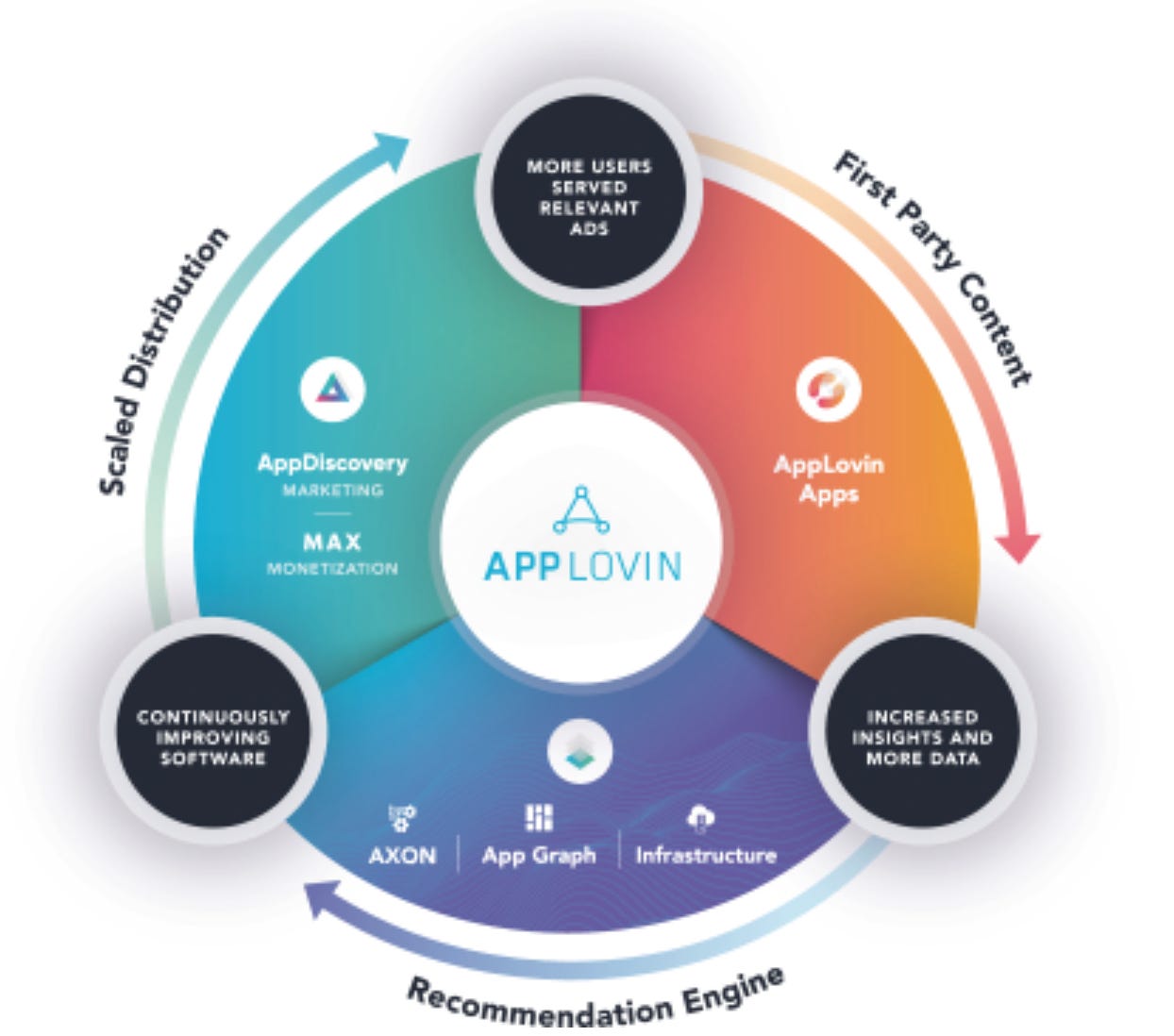
AppLovin’s proprietary AI engine AXON, originally developed within the mobile gaming sector, leverages real-time reinforcement learning to predict user conversion probabilities and optimize bid amounts across billions of auctions, processing over 2 million auctions per second and drawing behavioral signals from more than 1 billion devices. This AI-driven approach, which continuously learns from every user interaction including non-clicks, creates a self-reinforcing loop where increased ad spend generates richer data, enhancing prediction accuracy and driving superior return on ad spend (ROAS).
AXON’s proven success in the fiercely competitive mobile gaming market—characterized by continuous measurable user actions and stringent ROAS optimization—has provided AppLovin with a robust foundation to expand its AI-driven advertising capabilities into larger, non-gaming verticals such as e-commerce and connected TV. Management estimates these new markets represent a five to ten times larger opportunity, and early e-commerce ROAS metrics have already matched those of Meta’s Audience Network, underscoring AXON’s adaptability and effectiveness beyond gaming.
By integrating AXON with its full-stack ecosystem—including demand generation via AppDiscovery, supply mediation through MAX, and measurement with Adjust—AppLovin achieves end-to-end optimization and superior signal visibility that competitors reliant on third-party tools cannot match. This comprehensive control over the advertising pipeline enables more precise decisioning and performance improvements, which, coupled with the launch of a self-serve AXON Ads Manager and dedicated e-commerce platform in mid-2026, signals a strategic pivot towards diversified ad tech leadership beyond gaming.
A key competitive advantage of AXON’s AI-driven performance advertising model lies in its pricing structure, which charges advertisers based on verified outcomes rather than estimated reach. This outcome-based pricing ensures that advertisers pay only when the model delivers tangible results, reinforcing advertiser trust and fueling further budget allocation to AXON-powered campaigns, thereby compounding the engine’s data advantage and ROAS over time.
Cracking the Meta-Google Duopoly
By opening its platform and harnessing first-party data, AppLovin is mounting a credible challenge to entrenched giants, offering advertisers transparent, outcome-based alternatives in the $165B e-commerce ad market.
By mid-2026, AppLovin boldly repositioned itself to challenge advertising behemoths Meta, Google, and Amazon by rebranding Axon to AppLovin Ads and removing referral code barriers, thereby opening its platform to all advertisers beyond its traditional mobile gaming niche. This strategic pivot to a fully open, self-serve model aims to attract a diverse spectrum of small and mid-sized advertisers, leveraging its AI-powered bidding and targeting tools to diversify revenue streams while intensifying demands on onboarding and infrastructure. However, this expansion into e-commerce and retail media exposes AppLovin to fierce competitive pressures on pricing and product quality, as it confronts entrenched giants dominating these larger markets.
AppLovin’s competitive edge stems from its vertically integrated, data-driven AI platform AXON, originally honed in the high-stakes mobile gaming sector where real-time bidding and conversion prediction across billions of auctions became second nature. Unlike Meta and Google, which dominate by controlling both inventory and user data, AppLovin differentiates itself through transparent, outcome-focused performance advertising powered by first-party data from its Lion Studios game publishing arm and advanced header bidding technology acquired via MAX. This closed-loop system enables precise ROAS optimization, allowing advertisers to feed budgets confidently into channels that reliably return more than a dollar for every dollar spent.
Expanding beyond gaming into the vast $165 billion e-commerce and retail media advertising market, AppLovin is making a credible third-way bid to disrupt the longstanding Meta-Google duopoly. Management estimates this adjacent opportunity is five to ten times larger than its current gaming market, and early traction is evident with $1.3 billion in quarterly profit vastly outperforming rivals like Trade Desk. AppLovin’s approach uniquely aligns with natural human behavior patterns, reaching users during mobile gaming breaks or commutes, a differentiated ad placement strategy that contrasts with Meta’s dominance in traditional social media spend and helps overcome initial skepticism about its effectiveness outside gaming.
Despite its innovative AI-driven model and expanding footprint, AppLovin faces a daunting competitive landscape dominated not only by advertising giants Google, Meta, and Amazon but also by platform gatekeepers Apple and Google, who control the mobile ecosystems critical to AppLovin’s SDK operations. This complex rivalry underscores the challenge of scaling beyond gaming into broader digital advertising, requiring AppLovin to continuously enhance transparency, service, and product quality to carve out sustainable market share against these entrenched tech titans.

Winning Trust with Radical Transparency
AppLovin’s embrace of custom measurement, high-touch support, and granular reporting is earning the confidence of sophisticated advertisers wary of the opaque practices of traditional ad giants.
AppLovin distinguishes itself in the ad tech landscape by offering advertisers flexible and advanced measurement options that accommodate specific brand demands, a stark contrast to the rigid frameworks imposed by giants like Google, Meta, and Amazon. Advertisers have praised AppLovin’s willingness to support rigorous holdout testing and incrementality analyses, as exemplified by AS Beauty’s exhaustive tests that confirmed the legitimacy and effectiveness of AppLovin’s traffic. This openness to bespoke measurement approaches builds a foundation of trust among sophisticated advertisers who often rely on third-party tools such as North Beam, Triple Whale, and House Incremental to validate campaign performance.
Transparency and personalized service form the cornerstone of AppLovin’s strategy to win advertiser confidence amid the typical opacity of walled gardens. Unlike Google and Meta, which have largely replaced human support with chatbots, AppLovin provides high-touch account management and discloses performance data along critical dimensions like operating system, time of day, and creative unit type. This approach not only addresses advertiser skepticism but also enables the creation of customized data packages and incrementality testing frameworks that larger platforms often neglect, reinforcing AppLovin’s reputation for superior customer service and collaborative partnership.
AppLovin’s commitment to transparency extends to delivering greater visibility in campaign reporting compared to competitors such as Google’s Performance Max, challenging the assumption that all major platforms inherently generate genuine performance. However, advertiser trust also hinges on AppLovin’s ability to sustain bottom-of-funnel, last-click conversion performance over time—a critical test of its long-term value proposition. Milestones like reaching 10,000 advertisers in its consumer ads program will serve as tangible benchmarks signaling growing adoption and confidence in AppLovin’s differentiated service model.
Skepticism Gives Way to Profit
Despite initial doubts and a slow start, AppLovin’s consumer ads business has rapidly outpaced legacy rivals, turning Wall Street skepticism into $1.3B quarterly profits and reshaping the competitive landscape.
AppLovin's ambitious expansion into e-commerce advertising has encountered a rocky start, as evidenced by Bank of America Securities analysts' observations in July 2026 of a 'muted start' that contributed to notable stock declines. However, the company's ad delivery strategy, which aligns with authentic human behavior patterns—targeting users during casual moments such as breaks or commutes—offers a compelling rationale for advertisers seeking precise audience engagement, effectively tapping into everyday consumer rhythms.
Despite skepticism from advertisers accustomed to AppLovin's gaming-centric roots, with doubts about the effectiveness and attribution of ads in casual mobile games voiced as recently as August 2026, the company has demonstrated remarkable growth. Its consumer ads business has graduated from beta to a robust profit center, generating $1.3 billion in profit in the latest quarter—vastly outperforming competitors like Trade Desk, which reported profits in the mere tens of millions—signaling AppLovin's rising stature as a formidable player beyond gaming.